



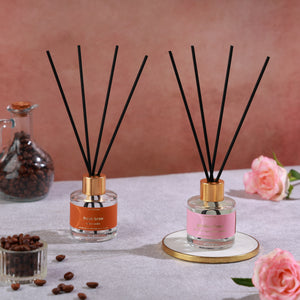
Cost: 130ml at ₹1,249 runs 14–18 weeks on six reeds — under ₹90 a week, and further on four. The 50ml at ₹749 runs 6–8 weeks and works out dearer per week.
What moves it: heat and draught speed evaporation and shorten the bottle; air-conditioning slows it and stretches it. Ceiling height matters, because this is a volume question, not a floor-area one.
2. Buy the 130ml, not the 50ml, if this is permanent. A 50ml at ₹749 runs 6–8 weeks on six reeds, which is roughly ₹94 to ₹125 a week. A 130ml at ₹1,249 runs 14–18 weeks, which is roughly ₹69 to ₹89 a week — and on four reeds rather than six it stretches further again. The 50ml is the right size for trying a scent before you commit; the 130ml is the right size for a room you sleep in every night.
3. Three or four reeds, on the far side of the room from the bed. Reed count is the volume control on a passive diffuser and the only one it has. Six is a living-room setting. Put the bottle on a dresser or shelf away from the pillow, out of direct sun, away from a lamp and not under an air-conditioning vent — heat and moving air speed evaporation, which gives you a stronger throw and a much shorter bottle.
4. Remember this is a volume question, not a floor-area one. A hundred and twenty square feet under a nine-foot ceiling is a different room from the same footprint under a twelve-foot ceiling in an older building, which holds about a third more air. Coverage figures assume ordinary modern ceiling heights. In a high-ceilinged room, expect to use the full six reeds and to notice it less.
5. And no size of bottle fixes a source. Fragrance adds and never subtracts. If the room has a live problem — an unaired bed, a dry P-trap, damp in a wall — a bigger bottle gives you both smells at once. Deal with that first and the smallest sensible dose will then be plenty.
Made in India, composed by an ISIPCA Versailles-trained perfumer — and a portion of every order supports girl-child education through Nanhi Kali.
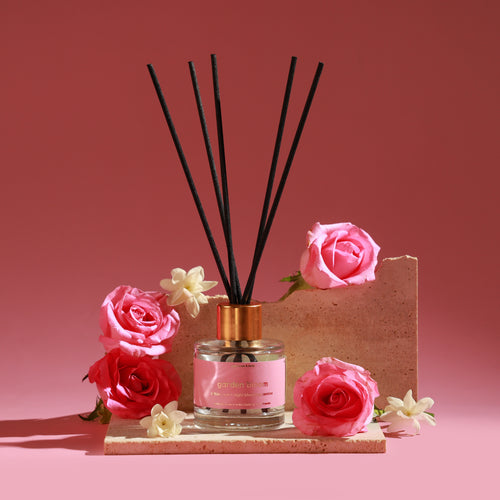
Why 120 sq ft sits inside the margin
The coverage figure on a reed diffuser is not a cliff edge, it is a rating for full strength: all six reeds in the bottle, in an ordinary room, at ordinary temperature. Up to roughly 150 sq ft is where that setting is aimed. A 120 sq ft bedroom is therefore not a marginal case that needs the maximum — it is a room where the standard product is already over-specified, which is the pleasant version of this problem to have. The correct response to spare capacity in a bedroom is to spend less of it, not more. Fewer reeds gives a lower, more even background, and it slows consumption, so the same bottle covers more weeks. It is the rare case where the restrained option is also the cheaper one.
Two things move those numbers, and both are physical rather than a matter of quality. The first is temperature and airflow: a reed diffuser works by capillary wicking and evaporation, and evaporation rises with heat and moving air. The same 130ml will throw harder and empty sooner on a sunny windowsill in a Chennai May than it will on a shaded dresser in a Delhi December, and an air-conditioned bedroom is the gentlest environment of all — quieter throw, longer life. The second is ceiling height. Coverage is quoted in square feet because that is how people describe rooms, but the diffuser is filling a volume. A 120 sq ft room under a twelve-foot ceiling in an older building holds roughly a third more air than the same footprint under nine feet, and it will need the full six reeds to read the same way.
The numbers that matter in a room this size
 Step fourFrom ₹749Both bottle sizes come with six fibre reeds, and six reeds is the setting the coverage figure refers to. At 120 sq ft you are thirty square feet inside it, so the sensible starting point is three reeds, moving to four if a visitor says the room smells of nothing. Two would suit an en-suite bathroom off the same bedroom. Add reeds one at a time with a week between changes — a diffuser is at its strongest in the first few days while the fibre saturates, so judging it on day two tells you almost nothing. And if throw drops off after two or three months while there is still liquid in the bottle, that is clogged fibre rather than a weak fragrance: replace the reeds, not the liquid.
Symptom to cause: when the numbers do not behave
If a diffuser in a room this size is not performing, the cause is almost always one of five things, and only one of them is the bottle. Work down until a row matches.
| What you notice | Most likely cause | How to confirm it | What actually fixes it |
|---|---|---|---|
| Lovely for a week, then you stop noticing it entirely ★ | Adaptation, not a bottle that is too small for the room | Leave the flat for thirty minutes and judge the first breath back in | Change nothing if a visitor can smell it. Adding reeds here is how rooms get over-scented |
| The 50ml emptied in four weeks instead of eight | Six reeds plus heat, sunlight, a lamp or an AC vent speeding evaporation | Check where the bottle stands and what the room temperature is through the day | Three or four reeds, on a shaded dresser away from moving air; consider the 130ml |
| Liquid barely moves and you can never smell it | Too few reeds for the conditions, or a cold, still, air-conditioned room | Add one reed and wait a full week before judging | Four reeds; move the bottle to an open shelf rather than behind a lamp or in an alcove |
| Same footprint but an old building with very high ceilings | Volume, not floor area — a tall room holds far more air than the square feet suggest | Measure the ceiling; compare with a modern room of the same footprint | Use all six reeds, and expect it to read quieter than in a standard-height room |
| Balcony door open all day and the fragrance vanishes | Cross-ventilation at 3–8 air changes an hour exporting it as fast as it evaporates | Close up for two hours and see whether the room reads normally | Accept it — this is ventilation working. Scent the room for the hours it is closed |
| No dose ever makes the room read clean | A live source — an unaired bed, a dry P-trap, or damp in a wall | Remove the reeds for two days, cross-ventilate, and judge what is left | Fix the source. Damp and drains are building and plumbing jobs, not fragrance ones. |
| If none of these fit: take the reeds out for forty-eight hours and open the window. Whatever the room smells like then is what you have actually been adding to. | |||
Reeds · always-on roomsFrom ₹749Shop →  Sukoon · when you want a switch₹1,899Shop →
  Hotel Collection · the scentFrom ₹299Shop →
Setting it up in a room this size
Buy the 130ml and start at three reeds. At ₹1,249 for 14–18 weeks it is the better value of the two sizes for a room you sleep in every night, and starting at three of the six reeds costs you nothing and stretches it further. Stand it on a dresser, shelf or chest on the far side of the room from the bed — not on the nightstand, which is the commonest placement and the worst one. Keep it out of direct sunlight, away from a lamp, and away from an air-conditioning vent or a draughty doorway, because heat and moving air raise the evaporation rate and you will spend the bottle rather than spread it. Leave it a full week before adjusting anything.
Then calibrate from outside the room. You adapt to a steady smell in about twenty minutes and you sleep in there, so your own reading is the least reliable one available. Leave the flat for thirty minutes and judge the first breath on returning, or ask someone arriving and believe them. If they say the room smells of nothing, add a fourth reed and wait another week. If you can smell it from the corridor before you open the door, take one out. Four reeds in a 120 sq ft bedroom is a generous setting rather than a cautious one, and six is a living-room number that this room does not need unless the ceiling is unusually high.
And know what would justify spending more, since it is not coverage. The Sukoon at ₹1,899 covers roughly 270–320 sq ft, so in this room it is over-specified on area by a factor of more than two. The reason to buy it is the switch: scent for half an hour while you read and nothing at all overnight, which some people strongly prefer and which a passive reed cannot offer. It runs 3–6 drops of the water-based Hotel Collection from ₹299 per tank — use three in a room this size. Do not buy the Megh for a bedroom on coverage grounds; at roughly 215 sq ft it covers less than the Sukoon and exists for runtime and tank capacity instead. And when the reed diffuser eventually needs topping up, a 300ml refill at ₹2,399 fills a 130ml roughly twice, with fresh reeds fitted at the same time.
What to do, in order
The free steps still come first, because no bottle size compensates for an unaired room. Then buy once, at the right size, and run it below its rating.
| Step | What to do | When | Cost |
|---|---|---|---|
| 1. Remove the source | Damp towels out, worn clothes in a basket, en-suite door shut at night, water down rarely-used drains weekly | Before anything else | ₹0 |
| 2. Move the air | Duvet thrown fully back and ten minutes of window-and-door cross-ventilation every morning | Daily, five to ten minutes | ₹0 |
| 3. Deal with what holds it | Weekly sheets and pillowcases, a washable pillow protector, mattress vacuumed and aired each season | Weekly to monthly | ₹0 |
| 4. Then the always-on layer ★ | A SOSA reed diffuser — a 130ml at ₹1,249 on three or four of its six reeds — rated to roughly 150 sq ft, so comfortably inside this room | 50ml 6-8 weeks · 130ml 14-18 | from ₹749 |
| 5. Or the on-demand layer | Sukoon with a Hotel Collection scent — the switch rather than the coverage: three drops, half an hour before bed, silence overnight | Run it when you want it | ₹1,899 |
Versailles
I like this question because the honest answer is the cheap one. A hundred and twenty square feet is a small room, our six-reed rating goes to about a hundred and fifty, and so the correct advice is buy one bottle and use it below its capacity. Nobody in my position enjoys writing "use less of the product", but a bedroom run at full strength is the most common way people end up disliking a fragrance they chose carefully.
The size choice is worth being practical about. A 50ml at ₹749 is a way to find out whether you like a blend. A 130ml at ₹1,249 is what you buy once you know, because it works out at under ₹90 a week and considerably less than that on four reeds. After the first bottle, refill rather than rebuy — and fit the fresh reeds at the same time, since clogged fibre is far and away the commonest reason a diffuser seems to fade.
If you are choosing between a reed and a machine for a room this size, do not choose on coverage — a Sukoon covers more than double this bedroom, so that comparison tells you nothing. Choose on whether you want a switch. If you want the room to smell the same at all times with nothing to operate, the reed is the better object. A portion of every order funds a girl's classroom through Nanhi Kali.
Frequently asked questions
- Fresh without being perfumed — restraint as the technique.
- Clean and expensive rather than sweet — which profiles hold up in a bedroom.
- The hotel-room gap — why consistency beats strength.
- Fine at night, weird by morning — the work that comes before the bottle.
- Brand: the SOSA founder story.
SOSA products & prices (verified August 2026): Hotel Collection water-based ultrasonic diffuser fragrance 15ml ₹299 · 100ml ₹999 · 300ml ₹1,799 · Pack of 7 (15ml, all fragrances) ₹1,799; refills 100ml from ₹999. Seven scents: The Ritz-Carlton-inspired (white tea · bergamot · cedar), Westin-inspired (white tea · aloe · cedar), 1 Hotels-inspired (cedarwood · vetiver · green leaves), The St. Regis-inspired (amber · violet · woods), Shangri-La-inspired (jasmine · green tea · white tea), Four Seasons-inspired (citrus · floral · sandalwood), W Hotels-inspired (citrus · pepper · amber). Diffusers: Boond 300ml ₹899 · Sukoon 500ml ₹1,899 · Megh 6L ₹3,499. Water-based, phthalate-free, composed to IFRA standards for home diffusion; 3–6 drops per tank. Made in India, Pune. The Hotel Collection scents are SOSA's own interpretations inspired by the world's finest hotels; all hotel names are trademarks of their respective owners and are used only to describe the scent style — SOSA is an independent Indian fragrance house, not affiliated with or endorsed by any hotel brand. Prices and availability subject to change — see the live product pages.