



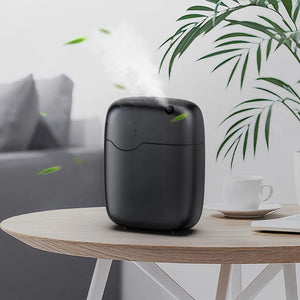
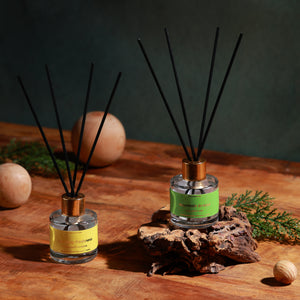
Never diffuse over live cooking. Fragrance layered onto cooking makes a third smell that nobody designed and everybody notices.
Fragrance does not remove a cooking smell. It adds a scent to air that is already the way it is. Ventilation and cleaning remove; fragrance decorates. Keep those two jobs separate.
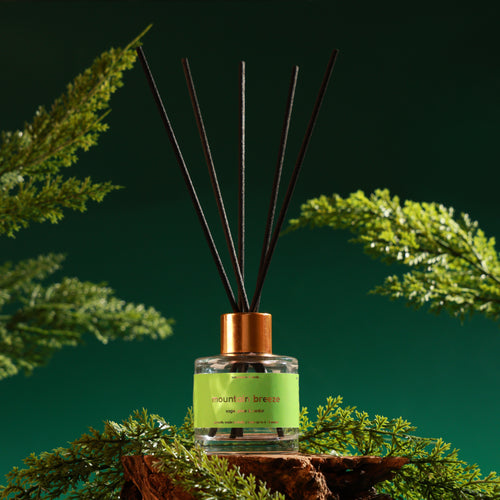
Choose dry over sweet in a cooking zone. Green, woody and citrus registers sit alongside food smells more cleanly than a heavy gourmand does — Mountain Breeze or Morning Freshness.
2. Open a window or balcony door for about ten minutes when you finish. Cross-ventilation moves far more air than an extractor alone. Ten minutes of genuinely open air does more than any product on this page.
3. Then close the room up. An open room cannot hold fragrance — you would be scenting the street. Shut the window, let the extractor stop.
4. Wait about half an hour before you scent. The air needs to settle first. Fragrance released into cooking still hanging in the room does not cover it; the two combine into a third smell that nobody designed.
5. Never run a diffuser over live cooking. This is the one rule in this guide I would ask you to take literally. It is also the commonest mistake in open-plan homes, because the diffuser is right there and the instinct is to fight fire with fire.
6. Choose one scent for the whole connected volume, and make it dry. Green, woody and citrus registers hold up alongside food smells better than heavy sweetness does. And two different scents in one open plan will meet somewhere near the dining table and make a seam — if you must run two sources, choose compositions that share a note.
7. Be clear about what fragrance is for. It adds a scent to the air. It does not clean the air, remove a cooking smell or neutralise anything. Ventilate and clean to remove; scent afterwards to decorate. Our reeds are composed and handmade in small batches in Pune, the machines are made in India, and a portion of every order supports girl-child education through Nanhi Kali.
Part one — the kitchen as a competing source
In a closed kitchen the cooking stays in the kitchen and the living room is a separate scenting problem with a door between them. Open the wall and you have joined two volumes that have entirely different jobs — one of which involves aerosolising oil at high temperature several times a day. Everything that makes open-plan living pleasant is the same thing that makes it hard to scent: nothing is contained. Three consequences follow, and understanding them is what turns this from a fragrance question into a routine.
 Morning Freshness₹749 · 9.0/10Frying releases a fine warm aerosol as well as a smell, and in a connected space that aerosol travels until something stops it. What stops it is soft furnishing — curtains, upholstery, rugs, cushions — which takes it up and releases it slowly afterwards, in exactly the way it takes up and releases fragrance. That is why the living end of an open plan can smell faintly of last night's dinner in the morning even though the kitchen surfaces are spotless. The response is mechanical, not olfactory: run the extractor properly, ventilate afterwards, and wash or air soft furnishing on a schedule. No diffuser addresses this and I would be misleading you to suggest otherwise — fragrance in fabric does not clean fabric. What a well-chosen scent does do is give the room a consistent character of its own rather than leaving it to whatever last happened in it, and that is worth having. But it is decoration on a clean surface, and the cleaning is a separate job.
Part two — the cooking-day sequence, step by step
The whole guide compressed into a timeline. Nothing here is a measurement; it is the order of operations that stops the two smells in your home from colliding, and the timings are practical guidance rather than a specification.
| When | What is happening in the air | Extractor and windows | The diffuser |
|---|---|---|---|
| During cooking ★ | Warm oily aerosol rising and spreading into the shared volume | Extractor on, on high, from before the pan heats | Off. Never diffuse over live cooking |
| The first ten minutes after | The room is at its most loaded and the air is still warm | Extractor still running; window or balcony open for cross-flow | Still off — anything released now goes straight outside |
| Closing up | Exchange has done its work; the room can start to hold again | Window shut, extractor off | Still off. Give it a moment |
| About half an hour later | Air settled, nothing hanging, nothing competing | Closed | Now. A timed machine, or reeds already in place doing their steady work |
| Through the evening | Ordinary occupancy; people moving are the main mixers | Closed, or a fan on low to distribute | Steady low background — a reed bottle, or a machine on a 4h timer |
| The honest caveat: fragrance does not remove a cooking smell, neutralise it or clean the air — it adds a scent to whatever is already there. If a room still smells of cooking after ventilating, ventilate for longer and check the bin, the sink trap and the extractor filter before reaching for anything scented. Layering fragrance over an unresolved smell reliably produces a worse result than either on its own. | |||
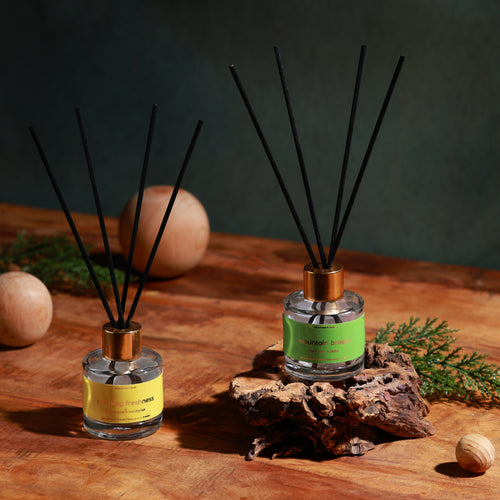 Fresh & Grounded duo · shares a green note₹1,548Shop →
  Sukoon · runs after cooking₹1,899Shop →
 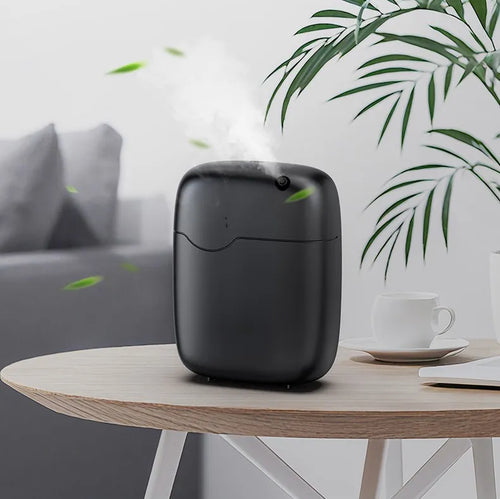 Vaayu · one scent, whole floor₹11,999Shop →
Part three — when a machine is not the answer
In an open kitchen, more often than anywhere else in this cluster, the answer is a habit rather than a purchase. If the complaint is "the living room smells of dinner", no diffuser at any price resolves it and buying one is a way of postponing the actual fix. The actual fix is the extractor running longer, ten honest minutes of cross-ventilation, a clean filter, an empty bin and a checked sink trap. I say this knowing it costs me sales, but a customer who buys a ₹11,999 machine to solve a ventilation problem will be disappointed by it and will blame the fragrance, and they will be right to. Ventilate first. Scent second. Never the other way round, and never both at once.
Where a purchase does help, size it to the connected volume rather than to the drama of the room. Measure the whole open footprint — kitchen, dining, living, and any hall the air moves through with no door — and check your ceiling. Under 300 sq ft, two reed bottles from ₹749 each, one at the living end and one near the dining, both well away from the hob and out of the extractor's pull. Between 300 and 800 sq ft, a Sukoon at ₹1,899 — and here the timer is the feature you are actually buying, because a machine that runs for two hours after dinner is precisely what this sequence needs. A word on the Megh at ₹3,499, which people reach for in big open plans: at about 215 sq ft it covers less than the Sukoon. It is a runtime and humidity machine, bought for a hundred hours of unattended running, and it is not the answer to a large floor.
Above roughly 800 to 1,000 sq ft of connected open plan, the case for a Vaayu at ₹11,999 becomes real, and in a cooking zone it has one specific advantage worth naming: because it can be scheduled to the hour and locked, you can run it in the window after dinner rather than trusting anybody to remember. It is also waterless, which matters in a room that already gets steam from a hob and a monsoon outside — an ultrasonic adds humidity, and a cold-air nebuliser does not. Two honest cautions before you spend. Mounting hardware, installation and warranty terms are not published, so ask SOSA. And the machine ships with 400ml of cold-air oil — four Hotel Collection fragrances at 100ml each, 90 or more days at a mid setting — and SOSA does not currently sell a separate Vaayu refill. The water-based Hotel Collection sold for ultrasonic machines is a different product on a different carrier and must not be poured into a Vaayu, despite the shared scent names. If continuous supply is part of your decision, get an answer from SOSA before you buy.
Part four — what goes where, zone by zone
One connected volume wants one scent, but it does not want one source in the middle of it. Here is how I would distribute it across a typical Indian open plan.
| Zone | What belongs here | Why | Price |
|---|---|---|---|
| The hob and counter ★ | Nothing at all. Extractor, clean filter, empty bin | Fragrance next to live cooking makes a third smell — and oil near a hob is a hazard | Free |
| The dining end | A reed bottle on a sideboard, away from the extractor's pull | Passing traffic distributes it; steady and low is right for a table | From ₹749 |
| The living end | A Sukoon at table height on the 2H timer, or a second reed bottle | Where people sit longest, and where you want the scent to land | ₹1,899 or ₹749 |
| The whole connected floor, if large | One Vaayu, placed centrally, scheduled after dinner | One scent everywhere beats three that meet in the middle | ₹11,999 |
| Behind any door you close | Its own small source — a 50ml reed bottle per room | A closed door ends the shared volume, in both directions | From ₹749 |
| If you run two scents | Compositions that share a note — Morning Freshness + Mountain Breeze | They meet on green eucalyptus rather than colliding | Duo ₹1,548 |
Versailles
The most consistent piece of bad advice in home fragrance is that you should scent while you cook, so the room "stays fresh". It does the opposite. Cooking aromas are complex, warm and enormously present, and a fragrance released into them does not sit on top of them politely — it combines. What you get is a third smell that nobody chose and that everyone in the room can tell is wrong, even if they cannot say why.
The correct order is dull and it works: extractor on, ten minutes of open window when you finish, close the room, wait about half an hour, then scent. It is dull because it is a ventilation routine rather than a purchase, and I would rather give you the routine than sell you a stronger bottle to fight with.
The other thing I would say to anyone with an open kitchen is to pick one scent and stay with it across the whole floor. An open plan is a single room, whatever the floor plan calls it, and the pleasure of walking from the sofa to the table without the smell changing is worth more than having a clever different fragrance in each zone. Everything in our reed range is composed and handmade in small batches in Pune, the machines are made in India, and part of every order funds a girl's classroom through Nanhi Kali.
Frequently asked questions
- Best diffuser for a large open living and dining area — the four size bands, and which one you are in.
- Why are large open rooms difficult to fragrance? — volume, air exchange and absorption, and why they compound.
- How airflow affects fragrance in large open spaces — the extractor, the balcony door and the stairwell, in one place.
- The complete large open-space guide — this page and the eight around it, in one place.
- Brand: the SOSA founder story.
SOSA Vaayu specifications (verified from the live product page, August 2026): ₹11,999 (the product page displays a rounded ₹12,000). Waterless cold-air nebulisation — pressurised air atomises undiluted fragrance oil into a dry nano-mist; no water, no heat, residue-free. Coverage up to 1000m³, about 2,000–3,000 sq ft. 400ml refillable tank, 90+ days per fill at a mid intensity setting. Bluetooth app plus onboard buttons, 1h / 4h / 8h / 24h timers, adjustable mist intensity, auto-stop and key-lock. Under 38 dB. DC 12V / 1A, 5W. 165 × 80.5 × 215 mm, 0.9 kg, black or white. Freestanding or wall / HVAC mount. CE, RoHS and SGS certified. Ships with four SOSA Hotel Collection fragrances at 100ml each (400ml in total) in one of three combos chosen at checkout. SOSA does not currently sell a separate Vaayu refill oil; the 400ml supplied in the box is the fragrance available at the time of writing, and buyers who need long-term supply should confirm current refill availability with SOSA before purchasing. The cold-air oil supplied with the Vaayu is a different product from the water-based Hotel Collection sold for ultrasonic machines (15ml ₹299 · 100ml ₹999 · 300ml ₹1,799), which must not be used in a Vaayu despite sharing scent names. Other SOSA machines: Boond 300ml ₹899 (~150 sq ft) · Sukoon 500ml ₹1,899 (270–320 sq ft) · Megh 6L ₹3,499 (~215 sq ft — a runtime and humidity machine, not a coverage upgrade) · Aangan ₹25,999 (~8,000–10,000 sq ft) · Meenar ₹38,500 (12,000–18,000 sq ft) · Safar car diffuser ₹3,999. Reed diffusers 50ml ₹749–₹849 (6–8 weeks) · 130ml ₹1,249–₹1,349 (14–18 weeks) · duo sets ₹1,498–₹1,598 · oil-only refills 300ml ₹2,399 / 500ml ₹3,499. Runtime, consumption and coverage figures are manufacturer specifications and vary with intensity setting, run hours, ceiling height, ventilation and season; any per-month or per-day figure in this guide is arithmetic on those specifications, not a measurement. Electricity costs vary by state tariff. No claim is made that scenting affects ratings, reviews, bookings, occupancy, revenue, health, mood or air quality. Free shipping above ₹499. A portion of every order supports girl-child education through Nanhi Kali. Prices subject to change — see the live product pages.