
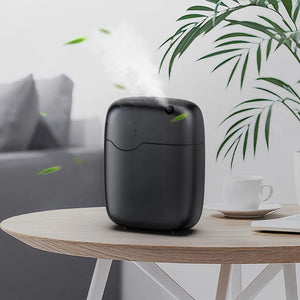


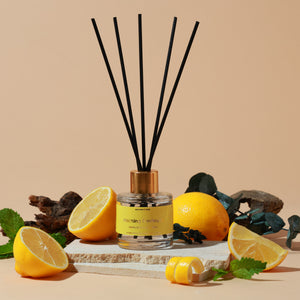

Order of operations: ventilate, clean, close the property up, then let fragrance establish for at least an hour before check-in. Fragrance layered onto a stale room makes a third smell nobody designed.
Format by size: reeds from ₹749 for an entryway or a studio; Sukoon ₹1,899 for one room on a timer; Vaayu ₹11,999 for an open-plan property up to about 2,000–3,000 sq ft.
The honest limit: nobody can promise a scent moves a rating, a review score or a booking. There is no data for that. What is real and describable is the guest's experience of walking in.
2. Remove the sources rather than covering them. Bin, drain traps, the cloth left in the sink, the fridge, damp towels in the machine, and shoes by the door. Every host who has chased an arrival smell with more fragrance has eventually found it was one of those six.
3. Close the property up and let the scent establish. Fragrance needs air to fill. An hour is a reasonable minimum for a room, two for an open-plan floor. This is the single most common mistake — scenting at the end of the clean, four hours before check-in, and losing most of it to an open window.
4. Scent the space the guest actually enters first. Not the bedroom. The door, the hall, the first three metres. Everything else is a second impression, and second impressions are much easier to fix.
5. Choose the format by how big the connected volume is and by who will be standing in the property. Reeds need nobody. A Sukoon at ₹1,899 needs filling between stays. A Vaayu at ₹11,999 runs 90+ days on one 400ml fill and can be scheduled from a phone, which matters when you are not there.
6. Keep your expectations honest. Scent changes the experience of walking in. Nobody can promise you it moves a rating, a review, a booking or a nightly rate, and any brand that tells you otherwise is inventing data that does not exist. I would rather you bought this for the reason that is true.
Our reed compositions are made in small batches in Pune, the Vaayu is made in India, and a portion of every order supports girl-child education through Nanhi Kali.
Part one — what a guest's nose actually does in the first ninety seconds
Almost every article about Airbnb scenting is written as though the guest were a camera: point something pleasant at them and the impression registers. Noses do not work that way. They are change detectors, and they are ruthlessly efficient at discarding anything constant. The whole of your arrival impression is delivered in a handful of breaths at the threshold, and then the instrument that measured it switches itself off. Understanding that turns arrival scenting from a question of what smells nicest into a question of sequence and timing, which is a much easier problem for a host to solve.
 Garden Bloom₹799 · entrywayOlfactory adaptation is fast and it is not a defect. Within a minute or two of standing in a constant smell, conscious awareness of it drops away sharply; the receptors keep working but the brain stops forwarding the report. By the time a guest has put their bags down, taken their shoes off and found the light switches, the smell of your property has become invisible to them — and the impression it made is already filed. The practical consequence is uncomfortable but useful: a scent that arrives late arrives to nobody. Spraying the hall as you leave, lighting a candle at handover, or asking the housekeeper to mist the sofa at the end of the clean are all attempts to fill a window that closes before the fragrance has had time to spread through the air.
Part two — the arrival, second by second, and what a host controls
Here is the same argument as a timeline. The left column is real time from the door opening; the right columns are the only things you can actually influence. Note how quickly control passes out of the host's hands, and note that every lever worth pulling is pulled before the guest is anywhere near the property.
| Time from the door | What the guest is doing | What their nose registers | What the host still controls | Cost of controlling it |
|---|---|---|---|---|
| 0–10 seconds ★ | Door open, one step in, bags still in hand | A full contrast reading — the sharpest of the whole stay | Nothing at all. This is decided hours earlier | Free, if the ventilation was done |
| 10–30 seconds | Bags down, lights on, first look around | Confirmation or contradiction of the first reading | Congruence — does the scent agree with the room | The choice of fragrance, ₹749 upwards |
| 30–90 seconds | Walking through — kitchen, balcony, first bedroom | Consistency between zones; a seam is noticed here | Whether the whole floor is scented or just the hall | One machine, or two to four reed bottles |
| 90 seconds – 5 minutes | Unpacking, kettle, air conditioning on | Adaptation well under way; awareness fading | Very little — the impression is filed | Not recoverable by spending |
| After the first hour | Settled, moving in and out of rooms | Brief re-readings on re-entry to the property | Whether the scent is still running at all | Runtime — reeds constant, machine on a timer |
| The honest caveat: everything in this table is about the guest's experience of arriving. It is not a performance claim. No one — SOSA included — can promise you that scenting a property changes a review score, a rating, an occupancy figure or a nightly rate, because no such data exists. Buy this because you would like the first breath to be a good one, and treat any other promise with suspicion. | ||||
Vaayu · 2,000–3,000 sq ft₹11,999Shop →  Sukoon · one room on a timer₹1,899Shop →
  Garden Bloom · the entrywayfrom ₹799Shop →
Part three — when scenting is the wrong answer, and you should not do it
There are properties and situations where adding fragrance is a mistake, and I would rather say so here than have you spend money discovering it. The first and largest is when the property has a smell that is being produced, not merely lingering. Damp behind a wardrobe, a dry drain trap in a bathroom nobody has used, a fridge seal, a chimney, a leaking gas connection, a soft furnishing that has absorbed cigarette smoke — these are all sources, and a source does not stop producing because you have added a nice smell nearby. What the guest meets in that case is not your fragrance. It is a compound of the two, and it reads worse than the original problem because it now carries the signature of an attempted cover-up. Fix the source. Ventilate. Only then scent, and only if you still want to.
The second case is a guest population you cannot make assumptions about. If your listing is marketed to families with infants, if you accept pets, if you have hosted guests who have written to you about asthma or migraine, or if your property is small enough that there is nowhere for someone to go to escape a fragrance, the risk-to-reward on scenting shifts. A studio of 300 square feet with a bathroom off it is not a lobby; there is no far end of the room. In those properties I would run either nothing at all or a single reed diffuser in the entry, where it is a low, constant, removable background rather than a machine pushing atomised oil into every cubic metre. And I would put a line in the listing saying the property is lightly scented, because a guest who has been told is a guest who can decide before they book.
The third case is a property that is not clean enough to justify the expense. This one is uncomfortable and it is true. If the linen is tired, the grouting is grey and the kitchen bin has no liner, a ₹11,999 machine is the wrong ₹11,999. Scent is the last five per cent of an arrival, applied to a property that already deserves it. It is not a substitute for the first ninety-five, and a guest who walks into a beautifully scented flat with a hair in the shower has simply been given a more confusing message. And the fourth: if the connected space you are trying to scent is under about 800 to 1,000 square feet, a Vaayu is more machine than the property needs. A Sukoon at ₹1,899 or two reed diffusers at opposite ends will do it, and I would rather you spent the difference on the mattress.
Part four — the arrival kit, in the order I would buy it
Everything above, arranged as spending. The first two lines cost nothing and solve more arrival complaints than every product beneath them combined. Work down the list only as far as your property actually requires.
| Step | What it fixes at the door | Suits | Turnover effort | Price |
|---|---|---|---|---|
| 1. Twenty minutes of open windows ★ | The closed-property smell that most arrival complaints actually are | Every listing without exception | None — it runs during the clean | Free |
| 2. Deal with the six sources | Bin, drains, fridge, damp cloths, washing machine, shoe rack | Every listing | Ten minutes, added to the checklist | Free |
| 3. A reed diffuser in the entry — Garden Bloom or Morning Freshness | Gives the threshold breath something designed to meet | Studios, 1BHK, any entrance hall | Flip weekly with gloves; nothing at handover | ₹749–₹799 · 6–8 weeks |
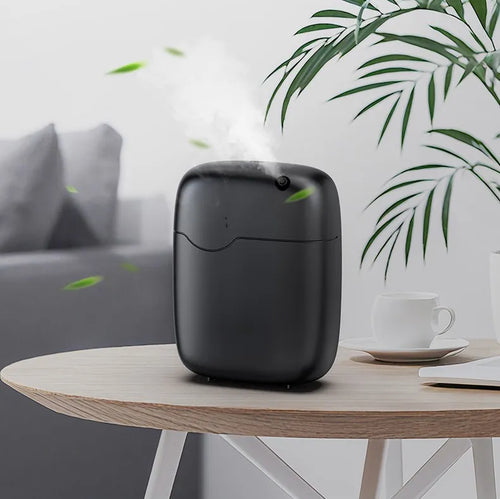
| 4. Sukoon in the living area | Lets you put scent in the air on a schedule rather than constantly | One room up to 270–320 sq ft | Refill the water tank each turnover | ₹1,899 · three 15ml scents in the box |
| 5. Vaayu on the common floor | One even scent across an open-plan property, scheduled from a phone | Up to 1000m³ — about 2,000–3,000 sq ft | Almost none — 90+ days per 400ml fill | ₹11,999 |
| Not an arrival tool: Megh 6L | ~100 hours of runtime, but only about 215 sq ft of coverage | Long unattended runtime and humidity, not reach | A 6L tank to fill and keep clean | ₹3,499 — never a coverage upgrade |
Versailles
The first property I ever helped scent was a friend's two-bedroom in Goa, and I got it wrong in the most instructive way. I chose something I loved — warm, deep, a little gourmand — and she ran it beautifully. Guests kept mentioning it, and not always kindly. The flat was white, bright, breezy and forty minutes from a beach. The fragrance was arguing with the building.
We swapped it for something clean and cool and nobody mentioned it again, which was the point. A good arrival scent is not a scent people compliment; it is a scent that makes the room feel more like itself. That is a smaller ambition than most of this industry sells, and it is the one I can actually deliver on.
The other thing I would say to hosts, having now had this conversation several hundred times: be sceptical of anyone who tells you fragrance will improve your numbers. It might improve your guests' first two minutes, which is genuinely worth having and is what you are buying. Anything beyond that is a story. Everything we make is composed in Pune, the machines are made in India, and a portion of every order funds a girl's classroom through Nanhi Kali.
Frequently asked questions
- What should guests smell when they enter? — the hierarchy, from neutral to masked.
- The best entrance fragrance — why the door should smell different from the living room.
- Keeping it fresh between check-ins and the luxury first impression — the turnover side of the same problem.
- The complete arrival scenting guide — this page and the eight around it, in one place.
- Brand: the SOSA founder story.
SOSA Vaayu specifications (verified from the live product page, August 2026): ₹11,999 (the product page displays a rounded ₹12,000). Waterless cold-air nebulisation — pressurised air atomises undiluted fragrance oil into a dry nano-mist; no water, no heat, residue-free. Coverage up to 1000m³, about 2,000–3,000 sq ft. 400ml refillable tank, 90+ days per fill at a mid intensity setting. Bluetooth app plus onboard buttons, 1h / 4h / 8h / 24h timers, adjustable mist intensity, auto-stop and key-lock. Under 38 dB. DC 12V / 1A, 5W. 165 × 80.5 × 215 mm, 0.9 kg, black or white. Freestanding or wall / HVAC mount. CE, RoHS and SGS certified. Ships with four SOSA Hotel Collection fragrances at 100ml each (400ml in total) in one of three combos chosen at checkout. SOSA does not currently sell a separate Vaayu refill oil; the 400ml supplied in the box is the fragrance available at the time of writing, and buyers who need long-term supply should confirm current refill availability with SOSA before purchasing. The cold-air oil supplied with the Vaayu is a different product from the water-based Hotel Collection sold for ultrasonic machines (15ml ₹299 · 100ml ₹999 · 300ml ₹1,799), which must not be used in a Vaayu despite sharing scent names. Other SOSA machines: Boond 300ml ₹899 (~150 sq ft) · Sukoon 500ml ₹1,899 (270–320 sq ft) · Megh 6L ₹3,499 (~215 sq ft — a runtime and humidity machine, not a coverage upgrade) · Aangan ₹25,999 (~8,000–10,000 sq ft) · Meenar ₹38,500 (12,000–18,000 sq ft) · Safar car diffuser ₹3,999. Reed diffusers 50ml ₹749–₹849 (6–8 weeks) · 130ml ₹1,249–₹1,349 (14–18 weeks) · duo sets ₹1,498–₹1,598 · oil-only refills 300ml ₹2,399 / 500ml ₹3,499. Runtime, consumption and coverage figures are manufacturer specifications and vary with intensity setting, run hours, ceiling height, ventilation and season; any per-month or per-day figure in this guide is arithmetic on those specifications, not a measurement. Electricity costs vary by state tariff. No claim is made that scenting affects ratings, reviews, bookings, occupancy, revenue, health, mood or air quality. Free shipping above ₹499. A portion of every order supports girl-child education through Nanhi Kali. Prices subject to change — see the live product pages.