


- The direct answer
- Why ventilation, not the fragrance, decides where scent goes
- The three mechanics worth understanding
- Placement scenarios, and what usually happens
- What this means for how a zone is dosed
- What to buy, once placement is right
- A note from Sonal
- Questions about AC, exhaust and fragrance placement
2. A diffuser near a return grille is largely wasted, not just less effective. Its output is drawn into the ductwork before it has time to spread through the room, which means the room the diffuser was meant to serve gets a fraction of what was actually released.
3. Kitchen exhaust creates negative pressure, and negative pressure pulls air from somewhere. A powerful extraction hood removes a large volume of air from the kitchen continuously; that air has to be replaced from somewhere in the building, and it's often pulled from the nearest available source rather than from outside.
4. That "somewhere" can be a scented non-food zone. If a washroom or entrance sits on the kitchen's makeup-air path, its scented air can be drawn toward the kitchen and exhausted out of the building entirely — the fragrance is being extracted, not just diluted.
5. This is a mechanical question, and it belongs to a ventilation contractor. Fragrance choice, intensity and scheduling can't compensate for a placement that's fighting the building's own air currents — the fix is in the ductwork and grille layout, not the diffuser.
Central AC decides where air enters and leaves a room; kitchen exhaust decides how urgently that air gets replaced. Together they decide where a fragrance actually ends up, and a café's placement plan should be built around both, with a ventilation contractor's input, not around the fragrance alone.
Why ventilation, not the fragrance, decides where scent goes
A café's zoning plan answers where fragrance should be, in principle — which rooms have a genuine air boundary, which sell food, which are reliably enclosed. None of that plan says anything about where the air in those rooms is actually moving at any given moment, and that's a separate question the building's mechanical systems answer on their own, continuously, whether anyone is thinking about fragrance or not.
Central air conditioning is always doing two things at once: pushing conditioned air into rooms through supply grilles, and pulling air back out through return grilles to be reconditioned and recirculated. A diffuser placed near a supply grille has its output carried into the room on the incoming air, which usually helps distribution. The same diffuser placed near a return grille has its output pulled toward the return before it can spread — the fragrance is captured by the system almost as soon as it's released, and the room it was meant to serve barely notices it arrived.
Kitchen exhaust adds a second, often stronger current to this picture. A functioning kitchen extraction system removes a large volume of hot, greasy air continuously, and every cubic metre it removes has to be replaced by air pulled in from somewhere else in the building. In a well-designed system that replacement air comes largely from outside, through dedicated makeup-air inlets. In many existing cafés, particularly older or retrofitted ones, some of that replacement air is instead drawn from the nearest available interior space — which can include a washroom or entrance corridor that was carefully scented on the assumption its air would simply sit there.
The three mechanics worth understanding
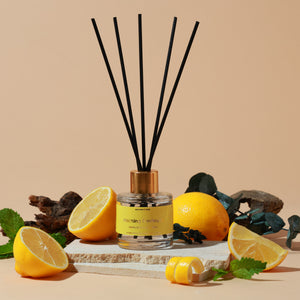
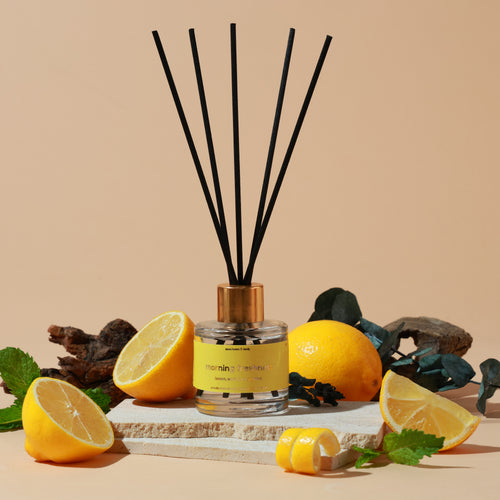
 Morning Freshness₹749A diffuser near a supply grille rides the incoming air into the room; the same diffuser near a return grille is captured before it ever really arrives.
Placement scenarios, and what usually happens
None of these outcomes are fragrance problems — every one of them is a placement or ventilation problem that shows up as a fragrance that doesn't seem to work.
| Scenario | What's happening mechanically | Usual outcome | What actually fixes it |
| Diffuser mounted beside a return air grille | Output is drawn into the return duct almost immediately | The room barely registers the fragrance | Relocate to a supply grille or a neutral wall, confirmed with the ventilation layout |
| Washroom on the kitchen's makeup-air path | Negative pressure from the exhaust hood pulls the washroom's air toward the kitchen | Fragrance is drawn out of the zone faster than expected, refill cycles feel unusually short | A ventilation contractor reviews the makeup-air path and, ideally, isolates the washroom's extraction |
| Entrance sharing one AC loop with the dining floor | Any grille exchange between the two mixes their air | Entrance fragrance drifts onto the dining floor, or dining air drifts into the entrance | Confirm whether the two zones are on separate air handling before treating the entrance as separated |
| Machine mounted on a supply grille or a wall with steady incoming airflow | Output is carried into the room on the incoming air | Even, predictable distribution across the zone | This is usually the correct placement, once confirmed |
| A retail floor or washroom with its own independent extract, no shared return with the kitchen or the dining floor, keeps its air largely to itself — this is the layout every placement decision above is trying to recreate, one grille and one duct run at a time. | |||
Morning Freshness · independent extract zone₹749Shop →  Sukoon · washroom suite away from returns₹1,899Shop →
  Vaayu · placed clear of returns and exhaust paths₹11,999Shop →
What this means for how a zone is dosed
Never assume a stronger intensity setting compensates for a poor placement — a diffuser fighting a return grille or a kitchen exhaust path loses fragrance faster at higher output, not less.
Sometimes a zone that seems correctly bounded on a floor plan turns out to share air handling with another zone entirely, which only becomes obvious once the ventilation layout is actually checked rather than assumed.
Usually, correcting placement — moving a unit away from a return grille, or confirming a washroom's extraction is independent of the kitchen's makeup-air path — does more for a fragrance plan's success than any change to the fragrance itself.
What to buy, once placement is right
The hardware choice itself doesn't change because of ventilation — what changes is where it's mounted, and that should be confirmed before, not after, installation.
| Route | Premises | Why | What it costs |
| Confirm supply, return and exhaust paths first | Every zone under consideration | Placement decides whether any hardware choice below actually works | No cost — a conversation with a ventilation contractor |
| Reed diffuser | A washroom with independent extraction, under 150 sq ft | Simple, and largely unaffected by AC ducting since it has no airflow dependency of its own | ₹749–₹849 |
| Sukoon ultrasonic | A washroom suite confirmed clear of return grilles, 270–320 sq ft | Steady coverage for a larger confirmed zone | ₹1,899 |
| Vaayu, mounted away from returns | Entrance or retail, confirmed clear of the kitchen's makeup-air path | Wall or HVAC mount placed to work with supply airflow rather than against a return | ₹11,999 |
| Any machine mounted on or beside a return grille | Nowhere in this cluster's zoning plan | Output is drawn into the ductwork before it reaches the room | Not recommended at any price |
I'm a perfumer, not a mechanical engineer, and I want to be clear about where my expertise ends on this one. I can tell an owner which zones deserve fragrance and at what register and intensity. I can't tell them, from a fragrance conversation alone, whether their washroom shares a return grille with the kitchen's makeup-air system — that's a ventilation question, and it needs a ventilation answer.
What I can do, and what I push every large-café client toward, is asking the right question of the right person before installing anything. A five-minute conversation with whoever designed or services the building's HVAC and kitchen extraction, about where a proposed diffuser or machine would sit relative to supply, return and exhaust, saves months of an owner wondering why a well-chosen fragrance "isn't working."
The two or three times I've seen a fragrance plan genuinely fail in a large café, the problem was never the fragrance. It was a diffuser mounted a metre from a return grille, or a washroom sitting on a kitchen's makeup-air path nobody had mapped. Fixing the ventilation fixed the fragrance every time.
Questions about AC, exhaust and fragrance placement
- Should a Large Café Scent Its Entrance, Retail Section and Washrooms but Leave Dining Neutral? — the plan this page's mechanics are protecting.
- Can Poor Exhaust Make a Café Smell Bad Even if the Space Is Clean? — the exhaust side of this same mechanical picture.
- Why Does Kitchen Smell Travel Into My Café Seating Area? — the same negative-pressure mechanism, working in the opposite direction.
- Exhaust, Grease, Drains, Upholstery, HVAC, Humidity or Fragrance: What Should I Fix First if My Café Smells Bad? — the wider source-first framework this page's mechanics sit inside.
- Brand: the SOSA founder story.
SOSA products & prices (verified September 2026): Reed diffusers 50ml ₹749–₹849 (to 150 sq ft, 6–8 weeks at six reeds) · 130ml ₹1,249–₹1,349 (above 150 sq ft, 14–18 weeks) · reed refill 300ml ₹2,399. Ultrasonic: Boond ₹899 (~150 sq ft) · Sukoon ₹1,899 (270–320 sq ft, ships with three 15ml Hotel Collection fragrances) · Megh ₹3,499 (6L tank, ~100 hrs runtime, ~215 sq ft — a runtime machine, not a coverage upgrade). Waterless cold-air: Safar ₹3,999 (no published coverage figure) · Vaayu ₹11,999 (up to 1000 m³, roughly 2,000–3,000 sq ft; 400ml tank lasting about 90+ days; app and onboard control, 1h/4h/8h/24h run windows, adjustable intensity, key-lock, under 38 dB, freestanding or wall/HVAC mount, 5W, CE/RoHS/SGS) · Aangan ₹25,999 (8,000–10,000 sq ft). Hotel Collection water-based fragrance 15ml ₹299 · 100ml ₹999 · 300ml ₹1,799 is for ultrasonic machines; reed oil and Hotel Collection are not interchangeable. Reed diffusers are alcohol-free, phthalate-free, paraben-free, IFRA-compliant and low VOC, handmade in small batches in Pune. Every purchase funds a girl's education through Nanhi Kali. Prices and availability subject to change — see the live product pages.