


The two failure directions: a lobby at negative pressure pulls hot, humid outdoor air inward all day, which dilutes the fragrance and imports the street; a lobby at positive pressure pushes conditioned air outward, which spends the fragrance on the pavement. Both feel like a weak machine. Neither is one.
The fix, in order: sensor dwell time and door scheduling, then the building’s pressure balance with the ventilation engineer, then an air-lock or vestibule that is allowed to do its job, then the machine — positioned in the volume that stays put and, where a central air system exists, mounted into an HVAC return so the fragrance is replenished with the supply air rather than sitting in a puddle near the door.
The honest gap: SOSA publishes no air-change rate, no infiltration figure, and nothing that tells you what one door cycle costs you in fragrance. I will not estimate any of them, because a number of that kind ends up in a tender document and is then wrong for every building but the one it was guessed for.
2. The direction of the airflow is set by the building, not by the door. If the lobby sits at slightly lower pressure than outside, air flows in for as long as the opening exists — warm, humid, carrying whatever the porch carries. If the lobby sits at slightly higher pressure, conditioned air flows out and takes the fragrance with it. Both conditions are common, both are invisible, and both are usually diagnosed as a weak diffuser.
3. Raising the intensity is the wrong instrument. A dilution problem has a rate, and the rate is set by how much air crosses the opening. Meeting it with more fragrance means running permanently at a level that will be far too strong in the eleven quiet hours of the day, and the first person to notice will be a member arriving at half past ten in the morning to an empty hall. Dose down, not up — and solve the airflow separately.
4. Use the vestibule as an air-lock rather than as a display case. The entire function of a draught lobby is to ensure that the inner and outer doors are never open at the same time. Where that discipline exists, the automatic door becomes a much smaller problem. Where the inner doors have been hooked open for the evening because a function is arriving, the club has spent its air-lock and should not be surprised. The vestibule itself should not be scented. It is the one part of the entrance whose air belongs to the street.
5. Put the machine in the volume that stays put, and prefer the air system to the room. The fragrance belongs inside the second line of doors, three or more metres clear of the threshold, in the supply airflow path and above head height — or, where the club has central air conditioning, mounted into an HVAC return so that it is continuously reintroduced with the conditioned air rather than being deposited once near a door that keeps opening. Everything SOSA makes is alcohol-free, phthalate-free, paraben-free, IFRA-compliant and 0 ppm formaldehyde, composed in Pune, and a portion of every order supports girl-child education through Nanhi Kali.

Three things an automatic door actually does to the air in a club entrance
Clubs usually describe this to me as a fragrance complaint — the lobby smells lovely at eleven in the morning and of nothing at seven in the evening. It is almost never a fragrance fault, and it is rarely even a dose fault. It is three distinct physical effects arriving together at exactly the hour when the most people are present to notice.
 Vaayu₹11,999Every automatic door has a hold-open time, and most of them were commissioned generously so that no member is ever caught by a closing leaf. That is the correct instinct and it has a consequence. The moment arrivals become continuous — a function, a Friday evening, a tournament finishing — each new person retriggers the sensor before the previous dwell has run out, and the door remains open for minutes at a time. The entrance stops being a series of exchanges and becomes one long one. Two further details make it worse than people expect. A motion sensor set wide will hold the door open for somebody walking past the entrance rather than into it, which is why a club with a busy porch can have doors cycling with no arrivals at all. And a valet stand, a smoking area or a waiting chauffeur immediately outside guarantees that traffic.
Aangan₹25,999An open door does not simply leak in both directions in a friendly way. It carries a net flow, and the direction of that flow is decided by whether the lobby is at higher or lower pressure than the outside. A club is full of things that quietly remove air — toilet extract, kitchen extract, a smoking-room extract, stair pressurisation systems taking their make-up from the wrong side — and if the fresh-air supply was never increased to match, the lobby ends up slightly negative. A negative lobby with an automatic door is a building-scale intake, drawing in outdoor air all through the peak, which is the hottest and most humid air of the day in most Indian cities. The opposite case is less common in clubs and equally expensive: a positively pressurised lobby exports its conditioned air, and the fragrance goes with it. Air that leaves takes the fragrance with it, which is the same reason a room with its windows open all day is not a fragrance environment during those hours.
Vaayu₹11,999Every automatic door has a hold-open time, and most of them were commissioned generously so that no member is ever caught by a closing leaf. That is the correct instinct and it has a consequence. The moment arrivals become continuous — a function, a Friday evening, a tournament finishing — each new person retriggers the sensor before the previous dwell has run out, and the door remains open for minutes at a time. The entrance stops being a series of exchanges and becomes one long one. Two further details make it worse than people expect. A motion sensor set wide will hold the door open for somebody walking past the entrance rather than into it, which is why a club with a busy porch can have doors cycling with no arrivals at all. And a valet stand, a smoking area or a waiting chauffeur immediately outside guarantees that traffic.
Aangan₹25,999An open door does not simply leak in both directions in a friendly way. It carries a net flow, and the direction of that flow is decided by whether the lobby is at higher or lower pressure than the outside. A club is full of things that quietly remove air — toilet extract, kitchen extract, a smoking-room extract, stair pressurisation systems taking their make-up from the wrong side — and if the fresh-air supply was never increased to match, the lobby ends up slightly negative. A negative lobby with an automatic door is a building-scale intake, drawing in outdoor air all through the peak, which is the hottest and most humid air of the day in most Indian cities. The opposite case is less common in clubs and equally expensive: a positively pressurised lobby exports its conditioned air, and the fragrance goes with it. Air that leaves takes the fragrance with it, which is the same reason a room with its windows open all day is not a fragrance environment during those hours.
 Mountain Breeze₹849Even when the net flow is modest, the air in the first few metres of an automatic entrance is being stirred rather than moved: door leaves sweeping, people passing, a temperature difference of fifteen degrees or more between two adjacent bodies of air, and in many clubs an air curtain adding a deliberate jet of its own. Nothing holds a steady concentration in that zone, which is why putting the diffuser by the door — the instinct almost every club has — produces an entrance that smells strong for one second and absent for the next. Two machines in that zone do not rescue it either. Two sources in turbulent air produce two shifting pockets rather than one even field, and a member walking the diagonal may cross neither. The answer to an unstable zone is not more input into the unstable zone; it is to accept the first three metres as a transition and build the impression just past it.
The pressure difference, in plain language a committee can follow
Buildings are not sealed, and they are not meant to be. Air enters, is conditioned, does its work and leaves, and the ventilation design decides how much comes in and how much goes out. When those two quantities do not match, the difference is made up through whatever opening is available, and in a club that opening is overwhelmingly the main entrance. This is why a lobby can be perfectly scented on a Tuesday morning and hopeless on a Saturday evening with no change to the machine at all: on Saturday the kitchen extract is running hard, the toilets are busy, the banqueting extract is on, and the main doors are open. The building is making up the shortfall through your entrance.
There is a second mechanism worth naming because clubs over three or four floors feel it strongly and rarely attribute it correctly. Warm air rises, and a building with an open stair, a galleried entrance or a lift shaft behaves like a chimney. In a tall lobby the upper part is at slightly higher pressure than the lower, so air tends to be drawn in at the entrance and to leave higher up. That is not a defect; it is how the building works. But it means fragrance released at ground level in a double-height entrance is partly a gift to the first-floor landing, and it means a machine placed at the foot of an open stair will scent the gallery more effectively than the hall. That may be a useful result. It is only a good result if somebody intended it.
Neither of these is a reason to buy anything. They are reasons to spend twenty minutes with whoever maintains the air handling before deciding that a scent machine has failed. The tests are crude and reliable: hold a strip of tissue at the open door and see which way it leans; walk the lobby at the quiet hour and again at the peak and notice whether the difference is in the fragrance or in the temperature and the noise as well. If the lobby is measurably warmer and louder at peak, you are not describing a fragrance problem. You are describing the street, arriving.
Every entrance configuration, judged for what it does to fragrance
The entrance types I am most often shown, and the honest consequence of each. The last row is the one that makes a club’s life easiest and is almost always decided by an architect years before anyone thinks about scent.
| Configuration | What the air does | Consequence for fragrance | What to do |
|---|---|---|---|
| Single automatic sliding door, no vestibule ★ | Continuous exchange at peak; direction set by building pressure | Worst case. Dilution you cannot out-dose | Sensor dwell, then balance, then site the machine well inside |
| Automatic doors with a proper vestibule, interlocked | Inner and outer doors rarely open together | The lobby keeps its own air; the problem largely disappears | Leave the vestibule unscented and protect the interlock |
| Vestibule whose inner doors are hooked open for functions | The air-lock has been spent; behaves as a single door | Evenings collapse; mornings are fine. Diagnosed as the machine | An operational rule, not a purchase |
| Revolving door with automatic side leaves | The revolving drum exchanges very little; the side leaves do the damage | Good in principle, undone by the leaf everybody actually uses | Route ordinary traffic through the drum |
| Automatic door plus an air curtain | A deliberate jet across the opening, plus stirring for a metre or two | Helps the thermal boundary, extends the turbulent zone inward | Push the machine further inside, not closer |
| Double-height entrance with an open stair or gallery | Stack effect; air drawn in low and leaving high | Ground-floor fragrance partly serves the floor above | Reason in volume, not floor area, and site accordingly |
| Any of the above, on a central air system | Conditioned air is continuously supplied to the whole zone | Fragrance is replenished rather than deposited once | Best. Mount into an HVAC return and stop fighting the door |
The lobby zone · Vaayu₹11,999See it → Into the AHU · Aangan₹25,999See it → 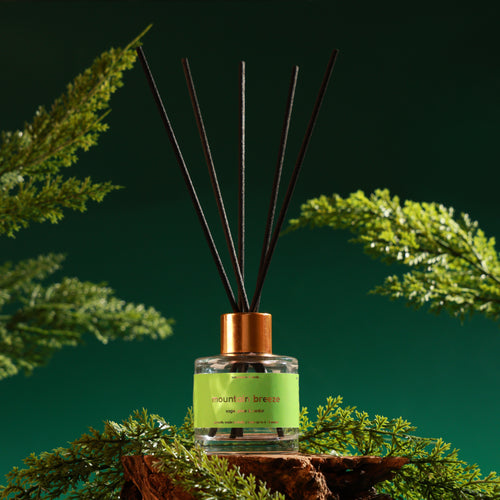 A cloakroom · reeds₹849See it →
Where the machine goes once the doors are understood
Everything above is free or nearly free, and I would do all of it before spending on hardware. Once it is done, the specification is straightforward. The fragrance belongs to the first stable volume inside the entrance — past the vestibule, past the door swing, past the air-curtain jet, three or more metres in, above head height, and in the path of the supply air rather than beside a return grille. A Vaayu at ₹11,999 covers up to 1000 m³ ≈ 2,000–3,000 sq ft, which in a double-height entrance is less floor than the square-foot figure suggests, because coverage is a volume and a six-metre ceiling eats it. Reason in volume. A closed door is a boundary and an open plan is one volume, and the entrance hall of most clubs is connected to considerably more than the plan implies.
Where the club has central air conditioning, I would stop discussing the lobby wall altogether and look at the return. Aangan at ₹25,999 is built for this: it connects mechanically to HVAC or an AHU, and that connection is the published condition for coverage of up to 3,000 m³ ≈ 8,000–10,000 sq ft. The reason it answers a door problem so well is not that it is bigger. It is that fragrance introduced into the supply air is delivered continuously to every part of that zone, so what an open door removes is replaced on the next pass rather than waited for. It also removes the object from the room, which is why members can never find the diffuser in a well-run hotel: there is no local plume and no gradient to walk up. Practically, it wants a serviceable position, an 800ml reservoir that the published claim describes as weeks between refills on business-hours schedules, DC 12V at 14W, and room for a metal unit of 3.9 kg measuring 284 × 125 × 246 mm, in black or white, one-year warranty, imported, at under 42 dB.
One distinction to write on the drawing before a project team invents it. The HVAC connection is mechanical and nothing more. The unit is joined into ductwork so that the building’s own air movement distributes the fragrance. It is not a controls integration: no SOSA machine offers Wi-Fi, Alexa, Google Assistant, Zigbee, KNX, Crestron, Control4, RS-232, Modbus, BACnet, a dry contact, an API or any building-management interface. Vaayu is set with a Bluetooth app and onboard buttons. Aangan is set at an intelligent PCB with programmable work and pause cycles and daily schedules, with no app and no Bluetooth. Meenar ₹38,500 is the larger-property option and is specified on enquiry. And for the waterless machines there is no refill oil listed on the store at all — the fragrance is specified and quoted per property through the contact page, which is the ordinary way commercial scenting is bought.
The entrance edit — and the honest gap
In the order I would work through it with a general manager and a services engineer. Note how far down the list the purchase sits. The last row is what is not published, said plainly rather than estimated.
| Step | What it is | Why it matters | Cost |
|---|---|---|---|
| 1. Review the sensor and hold-open time ★ | Re-aim for approach rather than passage; shorten the dwell to the safe minimum | Turns a permanently open aperture back into a series of exchanges | A service visit |
| 2. Ask about the building’s pressure balance | Extract volumes against fresh-air make-up, with the ventilation engineer | Decides whether you are importing the street or exporting your air | No purchase |
| 3. Restore the air-lock discipline | Inner and outer doors never open together, functions included | The single largest evening variable in most clubs | An operational rule |
| 4. Leave the vestibule unscented | No machine, no reeds, nothing in the draught lobby | Its air belongs to the street; anything there is spent outdoors | Saves money |
| 5. Site the unit in the first stable volume | Three or more metres inside, above head height, in the supply stream, with a DC 12V / 1A 5W point at that position for Vaayu | Position changes effective coverage more than intensity does | ₹11,999 |
| 6. Or put the fragrance in the air system | Aangan connected mechanically to HVAC or an AHU, DC 12V at 14W, under 42 dB | Continuously replenished instead of deposited once near a door | ₹25,999 |
| 7. Set it once and lock it | A written intensity, run windows and days, with the Vaayu key-lock engaged | Stops an adapted evening steward answering a door problem with a dial | No purchase |
| What is not published: the honest gap | No air-change rate, no infiltration figure, no cost-per-door-cycle, no minimum clearance from a threshold, and no machine count as a formula. No refill oil is listed for the waterless commercial machines either; that fragrance is specified and quoted per property | Named rather than invented, because a guessed figure ends up in a tender | Quoted |
Versailles
The first time a club described this to me I made the mistake of treating it as a perfumery question. The general manager said the entrance smelled beautiful in the morning and of nothing by the evening, and I began thinking about volatility and heat and whether the composition was front-loaded. It was none of those. I stood inside the doors at six o’clock and they were simply open, held by a stream of arrivals, with a valet stand outside and a sensor generous enough to respond to people walking past on the drive. The lobby had been quietly connected to the porch for an hour and a half.
What I find genuinely difficult about this problem is that every instinct it produces is wrong. It presents at the busiest hour, in front of the most people, so it feels urgent. It looks like weakness, so it invites intensity. And the person who raises the dial is invariably somebody who has been in the building since morning and has stopped smelling the fragrance altogether, which means the correction is made by the one person in the club least equipped to judge it. The entrance then runs three steps too high for the eleven quiet hours of the day, and the complaint changes from “we cannot smell it” to “it is overpowering” without anything having been fixed.
So I have become rather boring about it. Look at the door first. Ask the services engineer which way the air is going. Protect the air-lock even during a function, particularly during a function. And then place the machine where the air is staying, or put it in the air system and stop competing with the entrance altogether. None of that is a fragrance decision, and almost all of it is free, which I recognise is an odd thing for a perfumer to keep saying. Everything we make is composed in Pune, and a part of every order funds a girl’s classroom through Nanhi Kali.
Frequently asked questions
- The pillar: the first fifteen seconds — what the arrival window is for.
- Entrance and lobby and whether the entrance should be stronger.
- Arrival as choreography and where the machine is installed.
- Consistency under traffic — the scheduling answer to the same peak.
- Reception versus the lobby, reeds versus machines, and the hotel method.
- Brand: the SOSA founder story.
SOSA commercial scenting — facts verified August 2026: Vaayu ₹11,999, waterless cold-air nebulising, up to 1000 m³ ≈ 2,000–3,000 sq ft, 400ml refillable sealed tank lasting up to about 90+ days depending on intensity and hours, Bluetooth app plus onboard buttons, run windows of 1h / 4h / 8h / 24h, day selection, adjustable intensity, auto-stop and key-lock, under 38 dB, freestanding, wall-mounted or HVAC-return, DC 12V / 1A at 5W, CE, RoHS and SGS, black and white. Aangan ₹25,999, HVAC or AHU connection or standalone wall-mount or lay-flat, up to 3,000 m³ ≈ 8,000–10,000 sq ft, 800ml reservoir giving weeks between refills on business-hours schedules, under 42 dB, DC 12V at 14W, intelligent PCB with programmable work and pause cycles and daily schedules, metal body 3.9 kg at 284 × 125 × 246 mm, black or white, one-year warranty, imported; it is not app-controlled, has no Bluetooth, and no certifications are published for it. Meenar ₹38,500 is the larger-property option, specified on enquiry; no coverage figure is published for it here, and it should not be assumed to reach further than Aangan. Ultrasonic machines: Sukoon ₹1,899 at 270–320 sq ft with a 500ml tank and 16–18 hours on low, Boond ₹899 with a 300ml tank at up to about 150 sq ft, Megh ₹3,499 with a six-litre tank and around 100 hours of runtime but only about 215 sq ft of coverage. Hotel Collection fragrance oils are water-based and ultrasonic-only at 15ml ₹299, 100ml ₹999 and 300ml ₹1,799; they are not for reed diffusers and not for the waterless commercial machines. No purchasable refill oil is listed for the waterless commercial machines; that fragrance is specified and quoted per property. SOSA publishes no leather fragrance in any format and no tobacco or smoky fragrance for any diffuser. SOSA sells no air purifier and no dehumidifier, and every SOSA spray is a car perfume rather than an interior product. No SOSA machine offers Wi-Fi, Alexa, Google Assistant, KNX, Crestron, Control4, Modbus, BACnet or any building-management integration; the Aangan HVAC connection is mechanical. Reed diffusers 50ml ₹749–₹849 lasting 6–8 weeks and 130ml ₹1,249–₹1,349 lasting 14–18 weeks, six fibre reeds, alcohol-free, phthalate-free, paraben-free, IFRA-compliant, 0 ppm formaldehyde, heat-stable CCT carrier, refillable glass bottle, tested at 45°C and 85% RH, composed in Pune. No dealer programme, reseller margin, trade price, territory or service contract is published. Free shipping above ₹499. A portion of every order supports girl-child education through Nanhi Kali. SOSA is an independent Indian fragrance house; the Hotel Collection scents are SOSA’s own interpretations inspired by the world’s finest hotels, and SOSA is not affiliated with or endorsed by any hotel brand. Prices subject to change — see the live product pages.