

Why both are true: moving air lifts the saturated layer off the reed surface, which raises the evaporation rate. Whether that reads as presence or as waste depends entirely on whether the fragrance stays in the room and whether the reeds get any recovery time.
The two failure modes: dead air — an alcove, a cabinet, behind a curtain — gives you a bottle you can only smell up close. Continuous draught gives you a bottle you cannot smell at all and that finishes well short of the 6–8 weeks a 50ml is rated for — by how much is our own working guidance, not a measurement.
The target: a console or shelf near a doorway or walkway, waist to chest height, clear space around the neck, several feet from any vent or fan, out of direct sun.
2. Intermittent air is what you want. A doorway, a walkway, a passage between rooms — somewhere people cross a few times an hour. Each passage stirs the room enough to distribute what has accumulated, and then the air settles and the reed surface recovers. Over a week this costs the bottle almost nothing and gives you a room that actually smells of the thing you bought.
3. Continuous mechanical air is the failure mode. A split AC stream, a table fan aimed at the shelf, a ceiling fan on high, a permanent cross-breeze from two open windows. The reed surface never re-saturates, so the bottle runs at a raised rate for hours a day — and because that same stream is carrying fragrance out of the room, you rarely get to enjoy any of it. Weak room and short bottle, together.
4. Dead air is the opposite failure and just as common. An alcove, the back of a bookshelf, a closed cabinet, behind a heavy curtain. Here the bottle is running at its designed rate and nothing is carrying it, so fragrance pools within a foot of the glass. This is the "I can only smell it standing next to it" complaint, and it is a distribution problem, never a strength problem.
5. If you want a louder room, buy it with reeds, not with a fan. Nine reeds in a 50ml gives you a noticeably fuller room and roughly five weeks instead of eight — a controlled, reversible trade. Pointing a fan at six reeds gives you a similarly short bottle and, usually, a quieter room, because the fan is also the delivery vehicle taking it away.
6. The target placement, in one sentence: a console or open shelf near a doorway, waist to chest height, real clearance around the neck of the bottle, several feet from any vent or fan, out of direct sunlight, standing on a tray.
Composed and handmade in small batches in Pune, and a portion of every order supports girl-child education through Nanhi Kali.
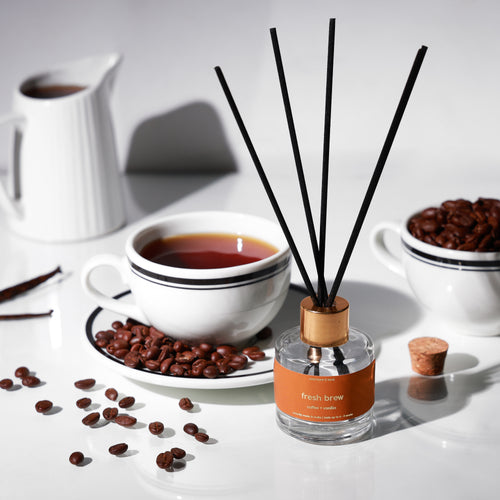
Part one — one mechanism, two outcomes
Start at the fibre, because everything else follows from what happens there. Oil climbs six reeds by capillary action and evaporates from the exposed surface into the air immediately touching it. That thin skin of air becomes saturated with fragrance almost at once, and once saturated it acts as a brake: molecules can only leave as fast as that layer is carried away and replaced with fresher air. This is why a reed diffuser in perfectly still air is slow, and why the same bottle in moving air is fast. The rate is not set by the oil alone. It is set by the oil and the air together, and the air is the half you control by choosing a shelf. The three cards below split what "moving air" actually does into the three things it can be.
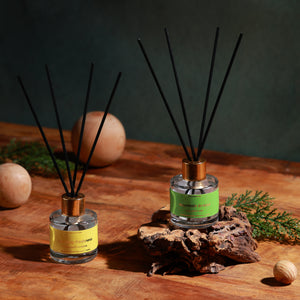
 Fresh & Grounded duo₹1,548 · two sourcesA reed diffuser has no fan, no heat and no propulsion. It releases, and then it waits for the room to carry. In genuinely still air, molecules move by diffusion alone, which over the distance of a living room is glacially slow — so the fragrance concentrates in a small volume around the bottle and never arrives anywhere else. Gentle room-scale movement is therefore not a nuisance to be avoided; it is the delivery system. The trap is that people conclude they need more air, and reach for a fan. What they actually need is occasional air, plus more sources if the room is long. Output per bottle is fixed at a given reed count, so the only honest way to raise the total fragrance in a space is another bottle — two 50ml at opposite ends of an open living-dining beat one 130ml in the middle, every time. If two compositions will share connected air, choose ones that meet on a note or you will smell the seam: Mountain Breeze and Morning Freshness meet on green eucalyptus, which is what the Fresh & Grounded duo at ₹1,548 is.
Part two — the airflow ledger, source by source
Here is every kind of air a reed diffuser meets in an Indian home, sorted by whether it is worth having. Read the two middle columns together — a source is only good when it helps the room more than it hurts the bottle. Week figures are SOSA working guidance drawn from in-house testing and customer correspondence rather than laboratory measurement; the published 50ml life of 6–8 weeks assumes six reeds, weekly flipping, no draught and no direct sun.
| Air source | How often it moves | Effect on the room | Effect on the bottle | Verdict |
|---|---|---|---|---|
| Doorway or passage traffic ★ | Seconds at a time, a few times an hour | Distributes well; the level rebuilds between passes | Cost close to invisible over a week | The target. Everything else is measured against this |
| Ceiling fan on the lowest speed | Continuous while on, but very gentle | The best whole-room distribution available to a passive format | A real but modest acceleration | Good, if you accept a shorter bottle for an even room |
| Ceiling fan on high | Continuous and forceful | Turbulent; disperses rather than distributes | Strips the reeds all day | Move the bottle out from under it |
| Split AC stream, bottle in the path | Hours without pause, and dried air | Carries fragrance along the wall and away | Among the fastest finishes we hear about | The single worst deliberate placement |
| Split AC running, bottle diagonally out of the path | Room-scale circulation only | Reasonable — the room still mixes | Mild; the sealed room helps hold what is released | The correct way to live with an AC |
| Table or pedestal fan aimed at the shelf | Continuous and directional | Blows fragrance into one wall, not into the room | Severe — this empties bottles | Never. Aim fans at people, not at glass |
| Open window or balcony door | Continuous and outbound | The room becomes part of the outside | Severe, with nothing received in return | Air the room, then close it, then diffuse |
| Alcove, cabinet, behind a curtain | Effectively never | Fragrance pools within a foot of the glass | Bottle lasts well — because it is not working | The opposite failure, and just as wasteful |
| The honest caveat: this ledger ranks sources reliably; it does not measure them. Air speed at a shelf depends on your room's shape, your AC's louvres, your fan's blade pitch and where the furniture sits, and none of that generalises. Treat the ordering as sound and any implied week figure as SOSA working guidance. The one line that holds everywhere: a source that moves air occasionally is worth having, and a source that moves air constantly is worth moving away from — regardless of how gentle it feels on your skin. | ||||
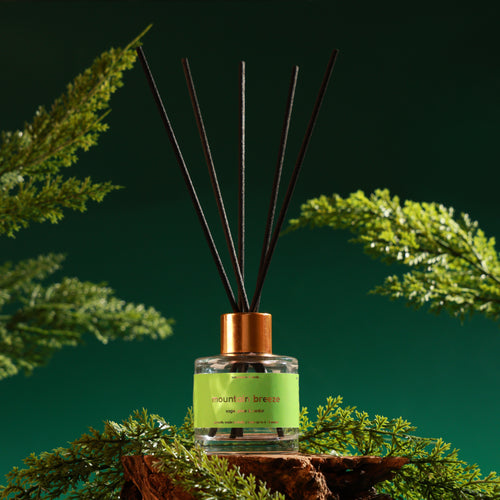 Mountain Breeze · 9.4/10from ₹849Shop →
 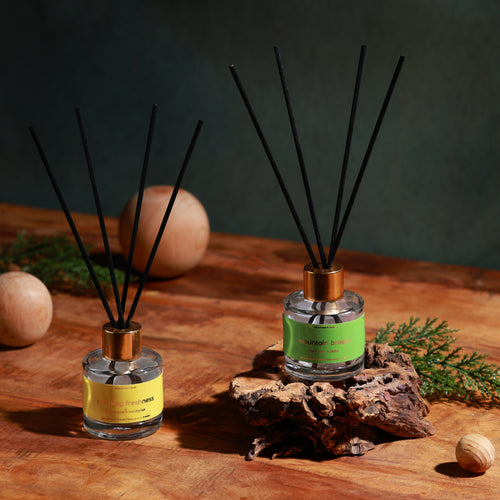 Fresh & Grounded duo₹1,548Shop →
 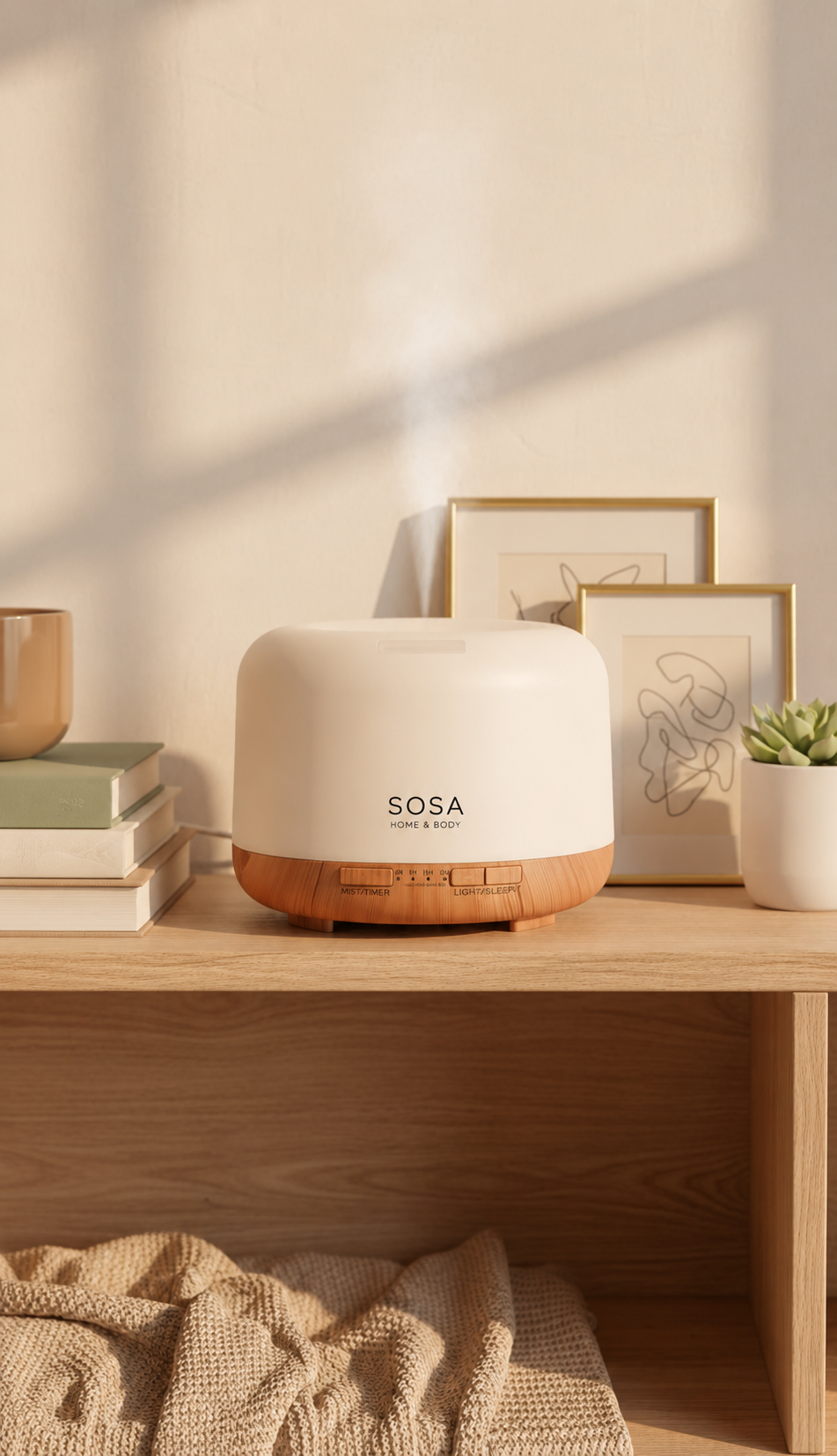 Sukoon · scent on demand₹1,899Shop →
Part three — recovery time, and the one trade you are allowed to choose
The concept that makes all of this usable is recovery. When air passes a reed, the surface is momentarily stripped and the local rate spikes; when the air stops, the fibre keeps wicking and the surface re-saturates over the following minutes. A diffuser standing in intermittent air spends most of its day in the recovered state and only briefly in the stripped one, which is precisely the pattern the compositions are dosed around. Six reeds, a weekly flip and a room with ordinary human movement is our reference condition, and the 6–8 weeks on a 50ml and 14–18 on a 130ml describe it. Continuous air removes the recovery entirely. The reed never returns to its resting state, so the bottle runs at the raised rate for as long as the machine is on, and the arithmetic of that is why an AC-stream bottle and a fan-blown bottle behave like bottles with ten reeds in them without giving you the room a ten-reed bottle gives.
This also resolves the question people ask most often about their own homes: my bottle is emptying quickly and I still cannot smell it — how can both be true? They are not two symptoms, they are one. High throughput plus outbound transport equals a fast, invisible bottle. High throughput plus a bounded room equals a fast, very present bottle. The distinction is entirely about where the air goes after it has passed the reeds. A doorway sends it into the rest of your flat, where you will meet it. An open window and an AC blowing along an exterior wall send it out of your life. If you take nothing else from this article, take the habit of asking where the air goes next, because that one question sorts every placement decision you will ever make.
Now the honest exception, because there is one and pretending otherwise would be dishonest. You are allowed to buy presence with bottle life deliberately — that is what reed count is for, and it is the cleanest lever in the format. Nine reeds in a 50ml raises projection noticeably and brings you to roughly five weeks instead of eight; ten reeds is the practical top of the format at about four to five weeks. What makes reed count the right lever and a fan the wrong one is control. Reeds are reversible in ten seconds, the cost is proportional and predictable, and every bit of the extra output happens in your room. A fan spends the same bottle life and posts a good share of the result down the corridor. So: six reeds on ordinary days, nine on a Friday before people arrive, back to six on Sunday. That is hosting strength for two days at almost no annual cost, and it is what I do at home. Keep the spare reeds standing in a small glass — reed oil marks wood and stone — and flip all of them, gloves on, when you make the change.
And the ceiling, which airflow thinking eventually runs you into. If you have placed the bottle in intermittent air, flipped it weekly, run nine reeds and chosen a 9.4 or 9.5 composition and the room still is not what you pictured, the limit is the format rather than the fragrance. Past roughly 250 to 300 sq ft of connected open volume, or when what you want is scent on demand rather than constantly, a reed diffuser is the wrong tool. A Sukoon at ₹1,899 covers 270–320 sq ft, runs 16–18 hours on low, has steady, two-hour and four-hour timers and comes with three 15ml Hotel Collection scents in the box — and it makes its own airflow, which is the entire point of the format difference. It is not an upgrade and reeds are not a failure; they do different jobs, and most homes end up running both. Keep the lines separate, though: reed oil never goes into a machine, the water-based Hotel Collection never goes into a reed bottle, and neither goes into a waterless Vaayu.
Part four — diagnosing which failure you have
Both airflow failures produce unhappy customers, and the two need opposite corrections — which is why guessing is expensive. This table takes you from what you have noticed to what is actually happening, with a test in between that costs nothing.
| What you have noticed | Which failure it is | The test that settles it | The correction |
|---|---|---|---|
| Strong at the bottle, nothing at the sofa ★ | Dead air — no distribution | Hold a tissue at the bottle: if it hangs dead still, that is your answer | Move to a console near a doorway, chest height, clear space |
| Level dropping fast and the room still quiet | Continuous draught — stripped and exported | Same tissue: if it lifts steadily for minutes, you are in a stream | Move diagonally out of the path, several feet clear |
| Fine on weekends, absent on weekdays | Duty cycle — the AC or fan runs when you are out | Check the level after a week of heavy AC use against a quiet week | Relocate to a room whose air is human, not mechanical |
| Level barely moving in months | Dead air plus possible stalled reeds | The wet-line test: lift a reed and find the oil boundary | High and dark, flip; barely above the oil, refresh the reeds |
| Guests comment, you cannot smell it at all | Neither — this is olfactory adaptation | Leave the house for two hours and walk back in | Nothing. The bottle is working; your nose has stopped reporting |
| Strong for three days, then much quieter | Neither — this is the normal curve | Compare week six with week three, never with day two | Nothing. The plateau is the product; the spike was the reeds filling |
| Everything right, room still too big for it | The format ceiling | Two bottles at opposite ends for a fortnight | Two 50ml, or a Sukoon at ₹1,899 for on-demand scenting |
Versailles
For a long time I answered airflow questions badly. Somebody would ask whether a fan helps and I would say "gentle air is good, strong air is bad," which is true enough to sound sensible and useless enough to change nothing. Speed was the wrong way to describe it. The honest answer is that a diffuser wants air that arrives and then leaves it alone. Twenty seconds of somebody walking past, then twenty minutes of nothing. That rhythm is what our compositions are dosed against, and it is why the reference condition for every week figure we publish is an ordinary room with an ordinary door.
The reason this matters commercially is that the wrong diagnosis sends people shopping. Somebody with a bottle in an AC stream concludes the fragrance is weak, buys a stronger one, puts it in the same stream, and gets the same result a second time for another ₹849. I would much rather they moved the bottle three feet and bought nothing at all. A brand that sells you the paid fix before the free one has told you something about itself.
What I will happily sell you is a second bottle for a long room, because that one is real: output per bottle is fixed, and more sources is the only honest way to raise the total. And if the room is genuinely beyond the format — big, open, or wanting fragrance on demand rather than always — I will tell you to buy a machine instead, and mean it. Everything we make is composed and handmade in small batches in Pune, and a part of every order funds a girl's classroom through Nanhi Kali.
Frequently asked questions
- Does a ceiling fan affect scent throw? — where the line between a distributor and a stripper sits.
- Does an open window affect a reed diffuser? — the outbound case, and the ventilate-then-close sequence.
- Where to place a SOSA diffuser for the best airflow — room by room, with the fibre-reed caveat.
- The complete airflow and placement guide — the whole sub-cluster in one page.
- Brand: the SOSA founder story.
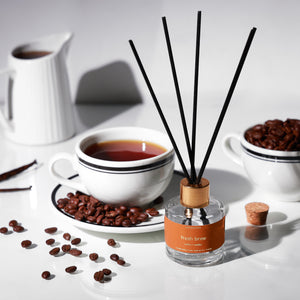
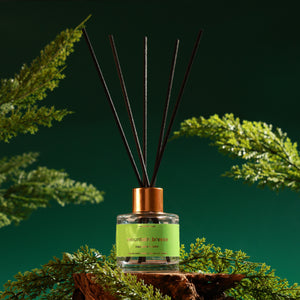
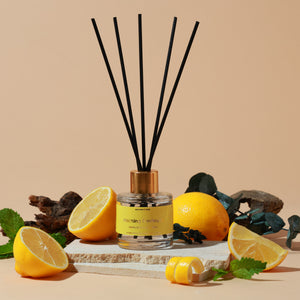
SOSA reed diffuser range & prices (verified August 2026): alcohol-free, phthalate-free, paraben-free and IFRA-compliant compositions on a heat-stable coconut-derived (CCT) carrier, low-VOC, supplied in a refillable glass bottle with six fibre reeds; 50ml lasts 6–8 weeks and 130ml lasts 14–18 weeks. Morning Freshness (Malabar lemon · peppermint · Nilgiri eucalyptus) 50ml ₹749 · 130ml ₹1,249 · 9.0/10; Garden Bloom (British rose · night-blooming jasmine) 50ml ₹799 · 130ml ₹1,299 · 8.9/10; Evening Calm (Kashmir lavender · chamomile) 50ml ₹799 · 130ml ₹1,299 · 8.9/10; Fresh Brew (Coorg coffee · Kerala vanilla) 50ml ₹849 · 130ml ₹1,349 · 9.5/10; Mountain Breeze (Himalayan pine · sage · Indian cedar) 50ml ₹849 · 130ml ₹1,349 · 9.4/10. Reed diffuser refills are oil only — you reuse your own vessel and reeds: 300ml ₹2,399 (roughly 8–11 months) · 500ml ₹3,499 (roughly 14–18 months), about ₹7–8 per ml against ₹15–17 per ml for a 50ml bottle. Duo sets ₹1,498–₹1,598 for 2 × 50ml and ₹2,498–₹2,598 for 2 × 130ml. Strength figures are positions on SOSA’s own internal strength scale, not an industry standard. Replacement reeds are not sold as a separate SKU; SOSA guidance is to refresh reeds every few months. The reed line is separate from the water-based Hotel Collection for ultrasonic machines (15ml ₹299 · 100ml ₹999 · 300ml ₹1,799) and the two are not interchangeable. Diffusers: Boond 300ml ₹899 · Sukoon 500ml ₹1,899 · Megh 6L ₹3,499 · waterless Vaayu ₹11,999. Composed and handmade in small batches in Pune, India; tested through 45°C summer heat and 85% monsoon humidity. Free shipping above ₹499. A portion of every order supports girl-child education through Nanhi Kali. Prices subject to change — see the live product pages.