Founder Diaries · Clinics & Medical Centres · Arrival and the First Sixty Seconds
By Sonal Sahani · ISIPCA Versailles 11 min read Updated September 2026
Yes — in exactly one way, and the honest description of that one way is shorter than the sales pitch you have probably already been sent. A scenting system can hold the public areas of your centre at smelling of nothing in particular, for twelve hours, instead of smelling of the floor cleaner. That is presentation and housekeeping, it is genuinely worth something, and it is the entire claim. It does not reduce anxiety, it does not aid recovery, it does not purify or disinfect air, a diffuser is not an air purifier, and it does nothing whatever to a patient. This page is written so that you can hand it to a medical director and have the conversation survive.
Quick answers — read this first
The one thing it does: holds the entrance, reception, waiting areas and inter-departmental corridors at smelling of nothing in particular rather than of disinfectant, consistently, for the whole of the opening hours. Presentation and housekeeping.
The things it does not do: it does not reduce anxiety or stress, does not lower blood pressure, does not aid recovery or improve sleep, does not purify, disinfect or clean air, does not kill anything, and has no clinical effect on any patient. A diffuser is not an air purifier.
What that costs: the
Vaayu at ₹11,999 — waterless, up to 1000 m³, 400ml lasting about seventy-five days, app and 1h/4h/8h/24h timers, under 38 dB, key-lock. Clinical rooms stay fragrance-free, and a smell with a source gets fixed rather than covered.
The short answer
Short answer: yes, but only in one narrow sense. Fragrance can stop your public areas smelling of disinfectant and hold them at smelling of nothing in particular for the whole working day, which reads to a patient as a facility that is looked after. It has no clinical, therapeutic or air-cleaning effect of any kind, and any supplier who tells you otherwise is selling you a liability.
The pick: the
Vaayu at ₹11,999 for the entrance and reception volume — waterless, so there is no standing water tank and no new daily job for housekeeping — with the Westin-inspired
White Tea Serenity, the lightest of the seven scents. An alcohol-free
reed diffuser from ₹749 for an administrative cabin. Nothing at all in consultation rooms, procedure rooms, sample collection, the laboratory, dispensing, imaging, oncology day-care or paediatric clinical areas.
Shop: the
Vaayu ₹11,999 (1000 m³, about 2,000–3,000 sq ft, four hotel-inspired scents included) and the
Aangan ₹25,999 (up to 3,000 m³, HVAC-connected or standalone, under 42 dB). Ultrasonic
Sukoon ₹1,899,
Boond ₹899,
Megh ₹3,499 are water-based and suit one administrative cabin. Alcohol-free reeds from ₹749. Free shipping above ₹499.
Straight answer
Can fragrance genuinely improve the arrival experience at a multi-speciality medical centre?
1. Yes, and here is the whole of it: the public areas stop smelling of the cleaning regime. Most Indian medical centres have one dominant smell signature and it is phenolic floor cleaner — strong at nine, fading by eleven, strong again after the afternoon mop. Replacing that with nothing in particular is a real improvement in how a centre presents itself, and it is the only improvement being claimed here.
2. It is consistency rather than intensity that does the work. A morning spray is a twenty-minute product in a twelve-hour building; it has gone before the ten o'clock queue arrives, and the difference a patient registers at four in the afternoon is between a building that holds one level and one that does not.
Holding a consistent level from opening to closing is the actual deliverable.
3. It does not do anything to a patient, and I will not pretend otherwise. No reduction in anxiety, no effect on blood pressure, no help with recovery or sleep, no air purification, no disinfection, no antibacterial anything. A diffuser is not an air purifier and it does not clean air. In a healthcare setting these are not merely exaggerations; they are the kind of statement your own medical director should refuse to let you print.
4. It cannot help at all if the smell has a source. A dry drain trap, a dressing bin past collection, a soiled-linen route through a public corridor, biofilm in an air-conditioning drain pan: a persistent smell is information, and covering it removes the signal that told housekeeping something was wrong. Find it and fix it first, every time.
5. And it belongs in about half the building. Entrance, reception, shared waiting areas, inter-departmental corridors, lift lobbies, administration and the café corner. Not consultation or examination rooms, treatment and procedure rooms, day-care surgery, dressing rooms, sample collection, the laboratory, dispensing, sterile stores, imaging, oncology day-care or paediatric clinical areas.
6. If all of that still sounds worth ₹11,999, the Vaayu is the machine. Waterless, so there is no reservoir standing in a twelve-hour building, up to 1000 m³, a 400ml tank lasting about seventy-five days, app scheduling and 1h/4h/8h/24h timers, under 38 dB and key-locked.
A portion of every order supports girl-child education through Nanhi Kali.
TL;DR: yes, in one narrow way: the public areas stop smelling of disinfectant and hold at smelling of nothing in particular for the whole working day, which is presentation and housekeeping. It does not reduce anxiety, purify air, disinfect anything or affect any patient clinically, and it cannot help with a smell that has a source. The
Vaayu at ₹11,999 does the honest version; clinical rooms stay fragrance-free.
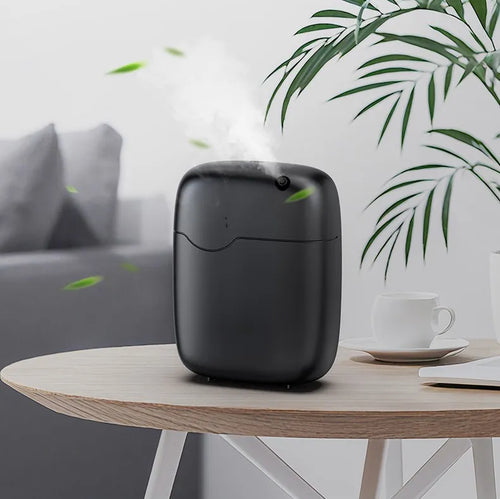
A housekeeping argument, deliberately not a clinical one
SOSA Vaayu · no standing water ₹11,999
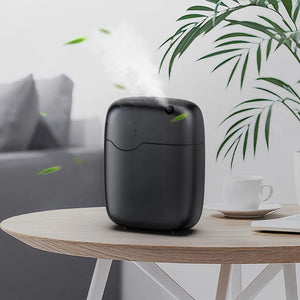
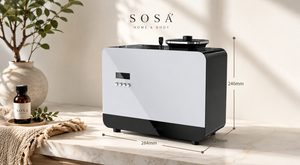
The Vaayu holds no water. It atomises undiluted oil directly, so there is no reservoir standing in a building that runs twelve hours a day. I want to be precise about why that matters, because the temptation to oversell it in a healthcare setting is obvious and I am not going to. It is not infection control and I will not describe it as infection control. It is a housekeeping fact: a water tank is a daily job for a named person — empty, rinse, dry — and in most clinics that person does not exist. Buy the machine that adds nothing to the housekeeping roster. 1000 m³, 400ml lasting about seventy-five days, app and onboard timers, under 38 dB, key-lock, auto-stop, CE, RoHS and SGS certified.
The one thing it does, described exactly
Every centre I have worked with has arrived at this question from the same direction: somebody visited a hotel or a private hospital, noticed that the lobby smelled of something quiet and expensive, and wondered whether it would suit a medical building. It does, but the reason it works in that hotel lobby has nothing to do with the fragrance being pleasant and everything to do with it being constant. The nose reports change and discards constants, so a steady background level stops being a smell within about a minute and becomes, instead, an absence of anything to notice. That is what you are buying. Not a smell that patients enjoy — a building with nothing for them to react to, held there reliably from the first appointment to the last.
1
WHAT IT DOES
It replaces the cleaning regime as your building's smell signature
Let me be specific about the thing being replaced, because most owners have stopped noticing it.
The default smell of an Indian multi-speciality centre is its disinfectant, and that is not a failure of housekeeping — it is housekeeping working correctly. Phenolic and pine-based floor cleaners are doing a job in the clinical areas and they should carry on doing it. The problem is only that the same signature reaches the entrance, the reception and the waiting hall, where it is not doing a job at all, and where it tells every arriving patient that they are in a place of illness before anybody has spoken to them. A steady, very light background in the public areas changes what the building's first impression is made of.
It is worth being honest about the size of this: it is a presentation improvement of the same order as clean glass, working lights and a reception desk without a sellotaped notice on it. Not transformative, not clinical, not measurable in any patient outcome, and genuinely noticeable. In a sector where a patient's judgement of standards is formed in a minute and where two similar centres a kilometre apart can feel completely different, a presentation improvement is not nothing. It is simply not more than it is. A second honest gain sits alongside the first: where a café or refreshment counter breathes into a waiting area, a dry woody background gives that air something else to be, and
the cafeteria smell reaching the waiting area is common enough to deserve its own page — though the door closer usually fixes more of it than any machine.
2
WHAT IT DOES NOT DO
The vendor list, item by item, with the honest answer
Now the list, because you will be shown a version of it. It does not reduce anxiety or stress in patients. It does not lower blood pressure. It does not aid recovery, improve sleep or help anybody heal. It does not purify, clean, sterilise or disinfect air — a diffuser is not an air purifier and does not pretend to be one. It does not kill bacteria or viruses. It is not antibacterial. It has no clinical effect on any patient or any condition, and it is not a treatment of any kind. I am listing them flatly because the softened versions are worse than the blunt ones. Phrases like "patients settle", "the waiting room feels better" or "a more healing environment" are the same claim wearing a coat, and a medical director will recognise them immediately. Nor will you find any suggestion on this site that your waiting hall should feel like anything other than a competent medical building, or that a clinic is in the business of atmosphere. There is a commercial reason for this and it is not modesty. If a supplier hands you marketing that makes a health claim, the claim ends up on your wall, in your patient leaflet or in your receptionist's mouth, and then it is your problem rather than theirs. A regulator will not be interested in who wrote it. Buy fragrance from somebody who has already written down what it cannot do.
The two sentences I would give your medical director: "It is a housekeeping and presentation measure for the public areas, on the same budget line as the floor cleaner. No clinical claim is made or implied, and every clinical room stays fragrance-free."
3
WHAT IT CANNOT RESCUE
A smell with a source, and the half of the building it never enters
Then the two hard limits, which are the reason this page cannot simply say yes.
The first is that fragrance is useless against a smell that has a cause, and worse than useless in a medical facility, because the smell was doing a job. A corridor that smells at half past ten is telling you the dressing-waste bin has not gone; a toilet that smells after cleaning is usually telling you about a dry trap or a stopped extract fan; ten musty minutes at start-up is usually the air-conditioning drain pan. Put fragrance over any of those and you have deleted the signal, and the next person to discover the problem will be a patient.
The list of things to fix before spending anything is short, free and should be worked through first.
The second limit is that this only ever applies to the public half of your floor plan. Consultation and examination rooms, treatment and procedure rooms, day-care surgery and recovery, dressing rooms, blood- and sample-collection rooms, diagnostic laboratories, pharmacy dispensing, sterile stores and CSSD, imaging and radiology rooms, oncology and chemotherapy day-care and paediatric clinical areas stay fragrance-free. The reasons are practical rather than decorative: a clinician is trained to notice what a room and a patient smell of and a patient may have to describe a symptom involving smell; people faint and feel sick in sample-collection rooms; aversion to smells during chemotherapy is real and any oncology nurse will tell you so; children cannot consent and their parents did not choose it; and airborne anything in a laboratory or a sterile store is a conversation you do not want with your own quality lead.
That list is the page I would read first.
The claims you will be offered, and what is actually true
I have collected these from material that clinic owners have forwarded to me over the past two years, and each row prints the claim on the left and the honest position on the right. The first row is the only one that survives. I would suggest keeping this table to hand when a scenting company visits, because every sentence below the first line is one your medical director will eventually be asked to defend.
Claim against fact
What a scenting supplier may tell a medical centre, and what is true
| What you may be told |
Is it true? |
What is actually the case |
| "The public areas will smell looked after rather than clinical" ★ |
True, and the only claim on this page |
Presentation and housekeeping. A steady low background in the entrance, reception and waiting areas instead of the floor cleaner |
| "It reduces patient anxiety" |
Not true, and not claimed here |
No fragrance reduces anxiety, lowers blood pressure or affects any patient clinically. Refuse this sentence in writing |
| "It purifies and cleans the air" |
Not true. A diffuser is not an air purifier |
It adds a very small quantity of fragrance to air. It removes nothing, filters nothing and cleans nothing |
| "It is antibacterial and helps with infection control" |
Not true, and dangerous to repeat |
It disinfects nothing. The waterless argument for the Vaayu is about not adding a standing water tank to housekeeping, which is a different point entirely |
| "It will fix the smell in the corridor" |
Not true, and the wrong thing to want |
A persistent smell is information about a source. Find it and fix it. Covering it deletes the warning |
| "You should scent the whole facility" |
Not true. Roughly half of it, at most |
Clinical rooms, laboratories, dispensing, sterile stores, imaging, oncology day-care and paediatric clinical areas stay fragrance-free |
Shop this guide
The honest setup, in three products
The SOSA principle
The useful question is not whether fragrance helps. It is which single sentence about it you would be willing to defend in front of your own medical director — and there is exactly one.
The public areas smell of nothing in particular rather than of disinfectant, all day, reliably. Housekeeping and presentation. Nothing beyond that, ever.
How to do the one thing properly
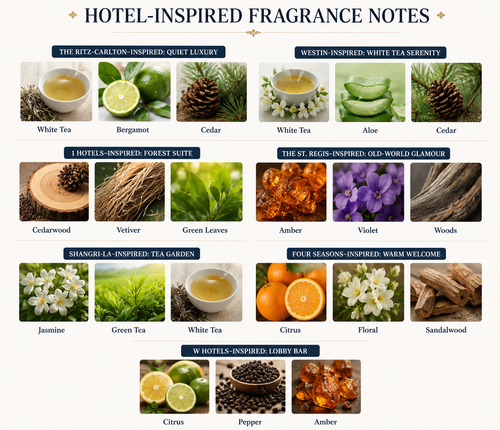
If the claim is narrow, the execution has to be exact, and the first part of it is the level. The rule I would write into your SOP is that a patient should not be able to tell you what the fragrance is — only that the place did not smell of anything unpleasant. The moment somebody at the desk is asked what scent you use, the setting is too high, and the correct response is to turn it down rather than to feel flattered. That points at the scent as much as the intensity: the brief for a medical building is narrower than for any other commercial space I work on, and it is clean, dry, quiet, unmemorable as a product and impossible for anybody to object to. The Westin-inspired White Tea Serenity — white tea, aloe and cedar — is the lightest of the seven and my default here, with the Ritz-Carlton-inspired Quiet Luxury a step more present and the 1 Hotels-inspired Forest Suite where a refreshment counter is in play. Nothing heavily floral, nothing sweet, nothing gourmand, nothing a patient could name as a perfume. The choice between fresh, woody, herbal and neutral goes into this properly, and a centre can certainly smell too strongly of fragrance.
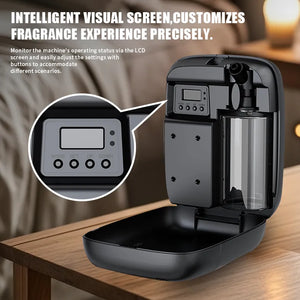
Then the machine, and the argument for the Vaayu at ₹11,999 in a healthcare building is narrower than the brochure suggests. It is waterless: undiluted oil atomised to a dry cold-air mist with no reservoir. I want to be careful here, because this is the point most easily oversold in a clinic and I have seen it oversold. It is not infection control and it is not a hygiene claim. It is a housekeeping fact — an ultrasonic machine holds standing water and consumes 30 to 50 millilitres of it an hour, and a tank of standing water in a building that runs twelve hours a day needs emptying, rinsing and drying every day by somebody whose job it is. If that person does not exist on your roster, do not buy a water tank. That is the whole argument and it is enough. Alongside it: up to 1000 m³ or roughly 2,000 to 3,000 sq ft, a 400ml tank lasting about seventy-five days so procurement is handling four refills a year per unit, Bluetooth app control plus 1h/4h/8h/24h onboard timers, adjustable intensity, auto-stop, under 38 dB, and a key-lock that is the reason it can stand in a public hall at all. The Aangan at ₹25,999 covers up to 3,000 m³ and ties into HVAC, which is right for an atrium or a whole floor and wrong for a 2,500 sq ft polyclinic.
Then the operating discipline, which is where most installations quietly fail. Set the intensity once, during the first week, by walking into the building cold each morning before it fills; then lock it and leave it alone. The key-lock exists for the public, but the person it most often protects you from is a well-meaning member of staff who has stopped smelling the building — which everybody does within a fortnight, because a nose discards constants. Nobody raises it at lunchtime because the hall got busy: busy is an air-change and occupancy problem, and adding fragrance to a crowded room makes it worse rather than better. The schedule runs the opening hours and stops, rather than running overnight into an empty building. And the boundary gets held physically rather than by policy: doors closed on the clinical side, the machine sited well away from the corridor that leads to the consultation cabins, and the fragrance kept out of clinical zones as a matter of layout rather than intention. On the rest of the range, briefly and honestly: the water-based Hotel Collection bottles at ₹299 for 15ml belong in the ultrasonic machines rather than in the Vaayu, which takes its own undiluted oil and ships with four hotel-inspired scents; an alcohol-free reed diffuser from ₹749 needs 24 to 72 hours to establish and is a cabin product; candles are not appropriate in a healthcare facility because an open flame is a fire-safety and insurance matter; and SOSA does not make a room spray, which is worth knowing before you go looking for one.
Any supplier willing to tell you that fragrance helps patients has just made you responsible for a sentence they will not be in the room to defend.
— Sonal Sahani, SOSA
The SOSA edit
What I would actually put into a multi-speciality centre, in order, with the honest scope of each. The last two rows are the ones I would read twice: one is a product we make and would not sell you for this building, and the other is a product we do not make at all.
The SOSA edit
An arrival experience, bought honestly
| Buy |
What it is |
Scope, honestly stated |
Price |
| 1. The free work first ★ |
Drain traps watered, bin collection times checked against reality, the AC drain pan inspected, the linen route looked at |
Before any purchase. A smell with a source is information, and covering it deletes the warning |
₹0 |
| 2. Vaayu for entrance and reception |
Waterless, no standing water tank, up to 1000 m³, 400ml ≈ 75 days, app plus 1h/4h/8h/24h timers, under 38 dB, key-lock, auto-stop |
Once the public areas are clean. Low, on the opening-hours schedule, locked after week one |
₹11,999 |
| 3. The scent, chosen to be unmemorable |
Westin-inspired White Tea Serenity by default; Ritz-Carlton-inspired Quiet Luxury a step up; 1 Hotels-inspired Forest Suite near a café corner |
With the machine. If a patient can name it at the desk, turn it down |
from ₹299 |
| 4. Aangan, only if the volume is real |
Up to 3,000 m³ or roughly 8,000–10,000 sq ft, 800ml reservoir, HVAC-connected or standalone, programmable, under 42 dB |
A double-height atrium or a whole-floor AHU tie-in. Not a 2,500 sq ft polyclinic |
₹25,999 |
| 5. reed diffuser for one admin cabin |
Alcohol-free, from ₹749, 24–72 hours to establish, output falls away past about a metre |
Behind a door, out of reach of children, never in a public waiting hall |
from ₹749 |
| Not sold here: any claim about patients |
No anxiety reduction, no air purification, no disinfection, no clinical effect of any kind |
Printed rather than implied, because the claim would end up on your wall rather than ours |
— |
Honest notes for buyers: fragrance in a medical facility is housekeeping and presentation, never treatment. Nothing on this page claims that a fragrance reduces anxiety, aids recovery, improves sleep, cleans or disinfects air, or has any clinical effect whatsoever, because it does not and a diffuser is not an air purifier. Scenting belongs to the entrance, reception, shared waiting areas, inter-departmental corridors and administrative rooms. Consultation and examination rooms, treatment and procedure rooms, day-care surgery, dressing rooms, blood- and sample-collection rooms, laboratories, pharmacy dispensing, sterile stores, imaging rooms, oncology day-care and paediatric clinical areas should be left fragrance-free. A persistent smell is information about a dry drain trap, a bin, a soiled-linen route or an air-conditioning drain pan: find it and fix it rather than covering it. On the machines: the
Vaayu at ₹11,999 is waterless cold-air nebulisation with no standing water tank, covering up to 1000m³ or roughly 2,000–3,000 sq ft, with a 400ml tank lasting about 75 days, Bluetooth app control, 1h/4h/8h/24h timers, under-38dB running, auto-stop and a key-lock for public areas. The
Aangan at ₹25,999 covers up to 3,000m³ and connects to HVAC for a whole floor or an atrium. The ultrasonic
Sukoon,
Boond and
Megh are water-based, hold standing water and add 30–50 ml of water an hour to the air, which makes them suitable for a single administrative cabin with a named person emptying and drying the tank daily, and unsuitable for public clinical property. An alcohol-free
reed diffuser needs 24–72 hours to establish and suits a small lobby rather than a large waiting hall. Candles are not appropriate in a healthcare facility because an open flame is a fire-safety matter. SOSA does not make a room spray. The Hotel Collection scents are SOSA's own interpretations inspired by the world's finest hotels; SOSA is an independent Indian fragrance house, not affiliated with or endorsed by any hotel brand. A portion of every order supports girl-child education through Nanhi Kali.
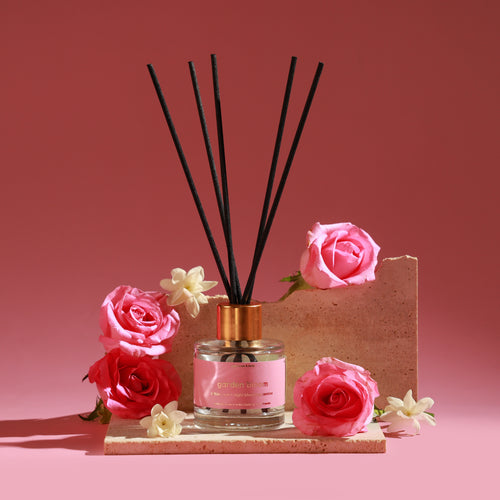
Right for a cabin, wrong for a forty-seat hall
SOSA alcohol-free reeds from ₹749
Alcohol-free, which is a genuine point in a clinic rather than a marketing one, and
Morning Freshness at ₹749 is Malabar lemon, peppermint and eucalyptus.
Two honest limits, both of which matter in this building. They take 24 to 72 hours to reach their working level, so they are no use to anyone thinking about tomorrow morning; and their output falls away past roughly a metre, which means a 40-seat waiting hall never receives them at all. A glass bottle of oil at reach height in a public area with children in it is also a spill and an ingestion risk. Put them in an administrative cabin or a small consultation-suite lobby, where they are exactly right.
A note from Sonal
I have turned down two healthcare enquiries in the past year, and in both cases the sticking point was the same. The buyer wanted a line they could put on a poster about patients feeling better, and I would not write it. One of them told me, pleasantly enough, that every other supplier had been happy to. I believe him. It is an easy sentence to write and a very difficult one to be standing next to two years later when somebody's quality audit asks where the evidence is.
What I will write instead is the narrow thing, and I think the narrow thing is more useful than it sounds. A medical centre whose public areas smell of nothing in particular for twelve hours a day looks after itself in a way people register without being able to say why, and it does so at about the cost of two decent waiting-room benches. That is the trade. It sits in the facilities budget beside the floor cleaner and the extract-fan service, it belongs in half the building at most, and it should never, in any leaflet or any conversation at your desk, be offered to a patient as something that will do anything to them. A clinic is a serious building. It deserves a supplier willing to be dull about what their product is.
Everything is made and supported from Pune, and a part of every order funds girl-child education through Nanhi Kali. You get a space that smells like somewhere looked after; a girl gets a classroom. That equation has always felt right to me.
Frequently asked questions
Can fragrance improve the arrival experience at a medical centre?
In one narrow way, yes: it can hold the entrance, reception and waiting areas at smelling of nothing in particular instead of smelling of disinfectant, consistently, for the whole working day. That is presentation and housekeeping. It has no clinical, therapeutic or air-cleaning effect, and a diffuser is not an air purifier.
A supplier told us scenting reduces patient anxiety. Is that true?
No. No fragrance reduces anxiety, lowers blood pressure, aids recovery, improves sleep or affects any patient clinically, and softened versions of the claim are the same claim. Ask any supplier to put their wording in writing and show it to your medical director before it appears anywhere patients can read it.
Using fragrance without making medical claims covers the internal language.
Does a scent machine clean or purify the air in a clinic?
It does not. A diffuser adds a very small quantity of fragrance to air and removes nothing from it. It does not filter, purify, sterilise or disinfect, and it is not antibacterial. If you need air cleaning, that is a ventilation and filtration project and it belongs with your HVAC contractor.
Why does the Vaayu being waterless matter in a clinic, if it is not an infection-control claim?
Because it is a housekeeping fact rather than a hygiene claim. An ultrasonic machine holds standing water and consumes 30–50 ml an hour, and a tank in a building that runs twelve hours a day must be emptied, rinsed and dried daily by a named person. If nobody on your roster owns that, do not buy a water tank.
Standing water in a diffuser tank goes into it properly.
Will fragrance help with the smell in our corridor?
No, and it should not be asked to. A persistent smell in a medical facility is information about a source — a dry drain trap, a dressing bin past collection, a soiled-linen route, an air-conditioning drain pan. Find it and fix it rather than covering it, because covering it removes the signal that told housekeeping something was wrong.
Why a clinic smells of disinfectant all day is the companion page.
One honest claim, written down
Nothing in particular, all day — and nothing claimed beyond that
The Vaayu is ₹11,999: waterless cold-air nebulisation with no standing water tank, coverage up to 1000 m³ or roughly 2,000–3,000 sq ft, a 400ml tank lasting about seventy-five days, Bluetooth app control with 1h/4h/8h/24h timers, under 38 dB, auto-stop and a key-lock, supplied with four hotel-inspired fragrances. The Aangan is ₹25,999 for up to 3,000 m³. No medical, therapeutic or air-cleaning claim is made anywhere on this site. Free shipping above ₹499.
See the Vaayu · ₹11,999 Reeds for an admin cabin · ₹749
Continue the read
More from SOSA
Editorial standards & sources
About this guide: Written by Sonal Sahani, ISIPCA Versailles-trained founder and perfumer at SOSA Home & Body, setting out the single narrow improvement fragrance can honestly make to arrival at a multi-speciality medical centre, the full list of claims it cannot support, why a smell with a source must be traced rather than covered, and the two sentences a clinic owner can give a medical director.
Facts verified August 2026: Product facts used in this guide. SOSA Vaayu ₹11,999: waterless cold-air nebulising diffuser, atomises undiluted fragrance oil to a dry residue-free nano-mist with no water reservoir, coverage up to 1000m³ (approximately 2,000–3,000 sq ft), 400ml refillable tank lasting up to about 75 days per fill, Bluetooth app plus onboard control, 1h/4h/8h/24h timer scheduling, adjustable intensity, under 38 dB, DC 12V/1A at 5W, 165 × 80.5 × 215 mm and 0.9 kg, freestanding or wall or HVAC mounted, auto-stop and key-lock, CE, RoHS and SGS certified, supplied with four hotel-inspired fragrances. SOSA Aangan ₹25,999: HVAC-connected or standalone commercial nebulising diffuser, coverage up to 3,000m³ (roughly 8,000–10,000 sq ft), 800ml reservoir, metal body, programmable schedules, under 42 dB. Ultrasonic machines are water-based, hold standing water and consume 30–50 ml of water an hour: Sukoon ₹1,899 (500ml, 270–320 sq ft, 16–18 hours on low, 3–6 drops per tank, steady/2H/4H timers, three 15ml Hotel Collection scents included), Boond ₹899 (300ml), Megh ₹3,499 (6 litres). Hotel Collection water-based fragrance 15ml ₹299, 100ml ₹999, 300ml ₹1,799, Pack of 7 at 15ml ₹1,799 against ₹2,093 bought singly; the Vaayu and Aangan take their own undiluted oil rather than these water-based bottles. Alcohol-free reed diffusers from ₹749, requiring 24–72 hours to reach their working level. Free shipping above ₹499. Coverage arithmetic: cubic metres equal floor area in square feet divided by 10.76 and multiplied by ceiling height in metres, counting only the volumes that are actually scented. This guide makes no medical, therapeutic or clinical claim of any kind for fragrance: a diffuser does not purify, disinfect or clean air, and does not treat, calm or affect any patient or condition. Fragrance is housekeeping and presentation. Clinical areas should be left fragrance-free, and a persistent odour should be traced to its source and corrected rather than covered. SOSA is not affiliated with or endorsed by any hotel brand. Prices subject to change — see the live product pages.