

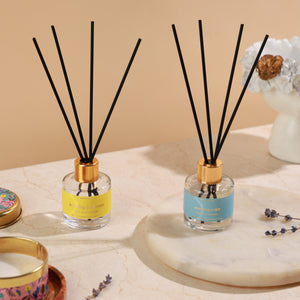

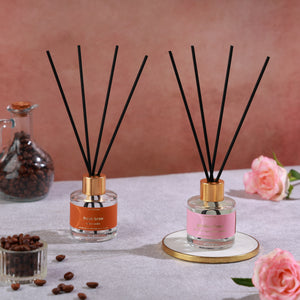

The demonstration: the same 900 sq ft 2BHK costs ₹2,148 if the doors stand open all day and ₹3,347 if they are all kept shut. Identical floor plan, ₹1,199 apart.
The corollary: a room behind a permanently closed door needs its own bottle or nothing. There is no partial credit from the corridor.
2. So the same floor area produces two different orders. Take a 900 sq ft 2BHK. Household A leaves every internal door open through the day and shuts only the bedrooms at night: functionally one large air space plus two that appear after ten in the evening. Household B runs an AC in each bedroom, keeps the kitchen door shut against cooking smells, and closes the study: five separate air spaces from morning to night. Same builder, same plan, same 900 sq ft. Household A needs two bottles and household B needs three.
3. The count itself takes two minutes. Walk through your flat at about eight in the evening — the hour when a home is in its most typical state — and note which doors are shut. Do not count doorways without doors, archways or open kitchens; those are not boundaries. Do not count doors you never close. What you are left with is the number of air spaces you actually live in, and it is almost always smaller than the number of rooms on the floor plan and much smaller than the floor-area sum suggests.
4. Rooms behind permanently closed doors are all or nothing. This is the part that saves the most money. If a door is shut around the clock — a bedroom with an AC running, a room let to a tenant, a study kept closed against noise — then that room gets its own bottle or it gets nothing, and there is no middle option. People try the middle option constantly: a stronger bottle in the corridor, six reeds instead of four in the hall, a second diffuser near the door. None of it crosses. Decide whether the room deserves a bottle on its own merits, and if it does not, leave it unscented without guilt.
5. Doors also diagnose a bottle that seems weak. When somebody tells me a diffuser is underperforming, the first question is not what size it is but what is shut between them and it. A living room bottle judged from the bedroom with the door closed will always seem weak, because it is being asked to do something no bottle does. Before you buy a larger size, check whether the problem is a boundary. The fix for a boundary is either a bottle on the other side of it or an open door — never more millilitres.
Made in India, composed by an ISIPCA Versailles-trained perfumer — and a portion of every order supports girl-child education through Nanhi Kali.

Why a passive source stops at a door
Every diffusion method has a range, and the range is set by whatever is moving the fragrance. A spray has pressure behind it and travels a few feet. An ultrasonic machine like the Sukoon has a fan and pushes a fine mist outward, which is why it covers about 270–320 sq ft against a reed diffuser's 150. A reed diffuser has nothing behind it at all. Capillary action lifts oil up the fibre core, the exposed length of reed presents a surface, and evaporation does the rest at whatever rate the room's temperature and air movement allow. From the moment a molecule leaves the reed it is at the mercy of the room. It goes where the air goes, and air in a closed room barely goes anywhere: a shut room exchanges roughly 0.2 to 0.5 of its volume an hour.
That is what makes a door absolute rather than partial. The gap under a door looks like an opening but does nothing useful, because moving air through it requires a pressure difference, and in a still flat there is not one worth the name. When there is one — an exhaust fan running, a window open on the far side — it usually pulls air out of the scented room and away, which is worse than nothing. So each closed door creates a bounded pocket, and each pocket is an independent decision with an independent bottle. Floor area cannot express this, because area is a property of the plan and doors are a property of the household. Two families in identical flats can have completely different counts, and both can be right. It also explains the most common disappointment in home fragrance: a bottle bought for a whole flat, placed in the hall, judged from a bedroom. It was never doing that job, and a larger bottle would not have either — a 130ml holds a room for longer than a 50ml, not further.
The three things a door count tells you
 One per spaceFrom ₹749Walk the flat when it is in its normal evening state and note every door that is shut. Ignore archways, open kitchens and doorways without doors — those are not boundaries and the spaces either side of them are one space. What you count is the number of independent air pockets your household actually operates. In most flats it is three or four, whether the home is 750 sq ft or 1,200, and it is always fewer than the number of rooms in the brochure.
Sizing by space — the same 900 sq ft, counted two ways
One floor plan, two households, and the rooms that are all-or-nothing. Two rows here come to ₹0, and one of them is a perfectly nice bedroom.
| Space | What it needs | How many | Cost |
|---|---|---|---|
| 900 sq ft 2BHK, internal doors open all day, bedrooms shut only at night ★ | One large daytime air space plus bedrooms at night — one 130ml for the living-dining, one 50ml for the master bedroom | Two | ₹2,148 |
| The same 900 sq ft 2BHK with every door kept shut | Five separate air spaces — buy the three that are occupied: living-dining, master bedroom, second bedroom | Three | ₹3,347 |
| A bedroom with the door shut around the clock and an AC running | Its own 50ml on three reeds, or nothing — no partial credit reaches it from the hall | One, or none | from ₹749 |
| A study or box room kept locked, opened twice a month | Nothing. It is sealed off from everything else and nobody is in it to notice | None | ₹0 |
| An open-plan living-dining-kitchen with no doors between them | One air space, not three. One 130ml near the seating, and a second source only if the run exceeds about 22 ft | One | from ₹1,249 |
| A room you keep open to the living room all day — a study nook or an alcove | Nothing of its own. It shares the living room's air; add a reed to that bottle instead, which is free | None | ₹0 |
| A note on all of the above: the two households above are ₹1,349 + ₹799 = ₹2,148 and ₹1,249 + ₹1,299 + ₹799 = ₹3,347 — a difference of ₹1,199 on an identical floor plan. Every coverage figure here assumes closed rooms with still air; a door that is open is not just a boundary removed, it is also ventilation added. | |||
One room · the unitFrom ₹749Shop → 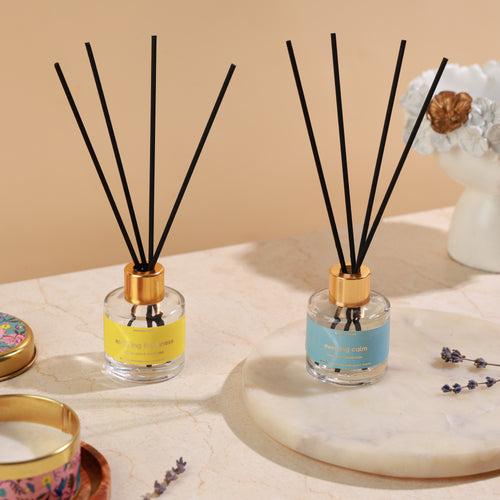 Two rooms · better value₹1,498Shop →
  Large room · a switch₹1,899Shop →
Doing the count, and what to do with it
Count at eight in the evening, then again on a Sunday afternoon. Those two moments cover how a home is usually operated, and the difference between them is informative. If a door is shut in both counts, that space is genuinely independent and needs its own decision. If it is shut in one and open in the other, the room borrows from its neighbour for part of the day and can usually wait — buy for it last, if at all. Doorways without doors, arches and open kitchens do not count at any hour. What you end up with in most Indian flats is three or four independent spaces, which is also, not coincidentally, the number of bottles most homes should own.
Then use reeds to match each space rather than buying a bottle to compensate for a boundary. Six reeds is a living-room or entrance setting; four suits a bedroom; two or three suits a small bathroom. If a space reads quiet, the free move is to add a reed and wait forty-eight hours for it to saturate before judging. What no number of reeds will do is push scent past a shut door, so if the room you are dissatisfied with is not the room the bottle is in, stop adjusting and either open the door or buy that room its own bottle. More reeds also means faster consumption, so it is a trade rather than a free upgrade — but it is free in rupees, which is why it goes first.
Then buy one space at a time, largest occupancy first. For household A above that is a 130ml for the shared living-dining at ₹1,349 and a 50ml for the master bedroom at ₹799 — ₹2,148, and the flat is done, because everything else is inside those two air spaces for most of the day. For household B it is three bottles at ₹3,347, with the second bedroom included because its door is shut and nothing else will reach it. When a 130ml empties, a 300ml refill at ₹2,399 fills it roughly twice and is the moment to fit fresh reeds. Use Morning Freshness across the open part of the home so that the connected spaces agree with each other, and let the closed rooms differ — a room behind a shut door can wear Evening Calm without arguing with anything, precisely because nothing crosses the boundary.
What to buy
One bottle per air space you actually operate, sized to the space. Here is what each option is for once you have your door count.
| Buy | What it covers | Lasts | Price |
|---|---|---|---|
| One 50ml | A single reed diffuser — a small closed space that has to be self-sufficient — a bedroom behind a permanently shut door, a bathroom | 6–8 weeks | from ₹749 |
| One 130ml ★ | The value size — the largest air space in the count, which is usually the living-dining and usually the first purchase | 14–18 weeks | from ₹1,249 |
| The duo | Day & Night duo — two closed rooms solved at once, with blends composed to sit beside each other on either side of a wall | 6–8 weeks each | ₹1,498 |
| Sukoon | 500ml ultrasonic — one air space over about 150 sq ft, where a passive source cannot hold the whole pocket | Runs when you switch it on | ₹1,899 |
| 300ml refill | The running cost — a three-bottle home, where doors have already told you exactly how many refills you will need | Roughly 2 × 130ml fills | ₹2,399 |
Versailles
I have been asked "how many for 900 square feet" hundreds of times and I have never been able to answer it from the number alone. Square feet is what you bought. Doors are what you live in. Two families in the same building, same plan, same area, and one of them needs two bottles while the other needs three — because one family opens everything at seven in the morning and the other runs the AC and keeps the doors shut.
The rule I keep repeating is the unglamorous one: no partial credit. A room behind a closed door gets its own bottle or it gets nothing. I say it because the alternative is what people actually do, which is buy a bigger bottle for the hall and hope. That is a purchase made against physics, and physics wins every time. If the closed room matters, buy it a 50ml. If it does not, leave it alone and keep the ₹749.
And when a customer tells me a diffuser is not working, I now ask what is shut between them and the bottle before I ask anything else. About half the time that is the whole story, and the answer costs nothing — open a door, or move the bottle to the side of it you actually sit on. A portion of every order funds a girl's classroom through Nanhi Kali.
Frequently asked questions
- Rooms or square feet? — the three-step method in full.
- How many for a 1,500 sq ft home? — nine doors, five that matter.
- When every door stays open — the same rule, inverted.
- The complete sizing and quantity guide — every home type, three builds.
- Brand: the SOSA founder story.
SOSA products & prices (verified August 2026): Hotel Collection water-based ultrasonic diffuser fragrance 15ml ₹299 · 100ml ₹999 · 300ml ₹1,799 · Pack of 7 (15ml, all fragrances) ₹1,799; refills 100ml from ₹999. Seven scents: The Ritz-Carlton-inspired (white tea · bergamot · cedar), Westin-inspired (white tea · aloe · cedar), 1 Hotels-inspired (cedarwood · vetiver · green leaves), The St. Regis-inspired (amber · violet · woods), Shangri-La-inspired (jasmine · green tea · white tea), Four Seasons-inspired (citrus · floral · sandalwood), W Hotels-inspired (citrus · pepper · amber). Diffusers: Boond 300ml ₹899 · Sukoon 500ml ₹1,899 · Megh 6L ₹3,499. Water-based, phthalate-free, composed to IFRA standards for home diffusion; 3–6 drops per tank. Made in India, Pune. The Hotel Collection scents are SOSA's own interpretations inspired by the world's finest hotels; all hotel names are trademarks of their respective owners and are used only to describe the scent style — SOSA is an independent Indian fragrance house, not affiliated with or endorsed by any hotel brand. Prices and availability subject to change — see the live product pages.