
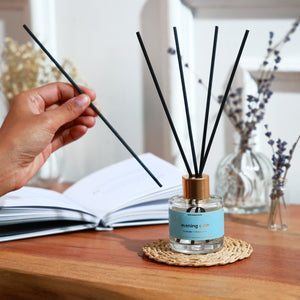
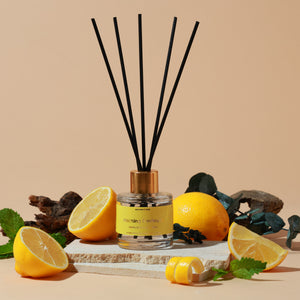
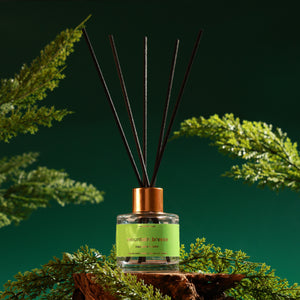
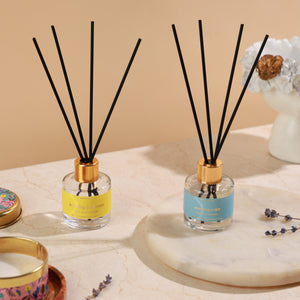

Mechanism one — the walk past: a reed diffuser is a point source with no transport, so concentration is highest at the bottle and falls with distance. Walking by takes you up and down that slope in a second or two, which is exactly the kind of stimulus the nose is best at.
Mechanism two — the sit still: olfactory adaptation. You can sit in a properly scented room and correctly report smelling nothing at all.
The diagnostic: leave the room for fifteen minutes and walk back in. And ask someone else — a visitor is a better instrument than the resident, because they are not adapted to your home.
The trap to avoid: raising the dose to beat adaptation. It does not work for long, and it hands everybody else a room that is far too strong.
2. Sitting still is a constant stimulus, and constant stimuli fade from report within minutes. This is olfactory adaptation, and it is not a failing of your nose or of the product. The molecules keep arriving at the receptors. The brain, having established that nothing is changing, stops passing the information upward. You can sit in a beautifully scented room and correctly say you cannot smell anything.
3. So the two readings are measuring different things, and both are honest. The walk past is a fairly good measurement of the gradient near the bottle. The sitting is a fairly good measurement of your own adaptation state. Neither is a measurement of how much fragrance is in the room, which is why arguing with yourself about it never settles anything.
4. Run the free diagnostic before changing anything. Leave the room for fifteen minutes and walk back in, and separately, ask somebody who does not live there. A visitor is a better instrument than the resident. If guests notice it and you do not, the room is working for everyone except its owner, which is annoying but not a fault.
5. If it really is the distance, the fixes are free before they are paid. Six reeds instead of three, the bottle at half the distance from where you actually sit, at nose height, out of the draught, door shut, ceiling fan on low. Only after all of that would I look at Sukoon at ₹1,899, and I would look no further up the range than that for one room.
Alcohol-free, phthalate-free, made in Pune. A portion of every order supports girl-child education through Nanhi Kali.
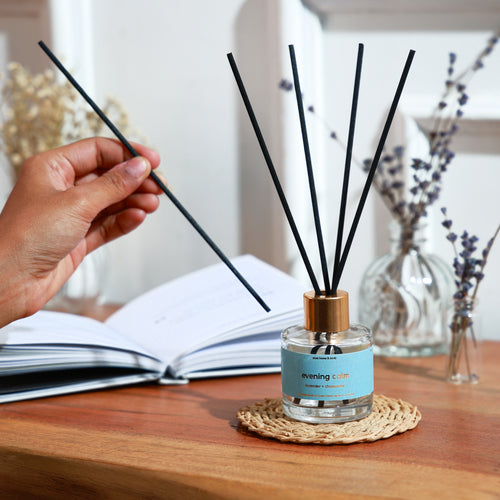
The two mechanisms, one at a time
It is worth separating them properly, because the remedies are completely different and applying the wrong one is how people end up with a house that everybody else finds overwhelming. One of these mechanisms lives in your room. The other lives in your head. Only the first can be bought or placed.
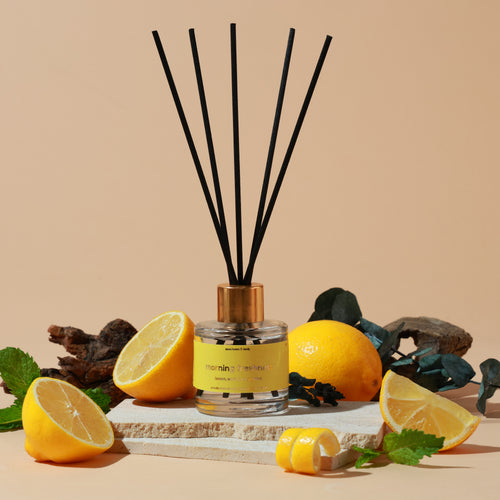
 Morning Freshness₹749Because a reed diffuser has no fan, no pump and no power, everything it produces stays concentrated near the reeds until the room's own air moves it. That makes a steep local gradient — and walking through it compresses the whole slope into a couple of seconds. The nose is built for exactly this. A rapidly rising concentration is the signal it evolved to catch, and it catches it emphatically. Sit down two metres away and the same air presents you with a level that is not only lower but unchanging, which is the hardest kind of stimulus for the system to keep reporting. The vividness of the walk past is not evidence that the bottle is strong. It is evidence that you moved.
 Garden Bloom₹799Sit in one place and within minutes the fragrance drops out of your awareness. This is ordinary olfactory adaptation, it happens to everyone, and it happens fastest to the person who lives in the house — because you are not adapting only over the last ten minutes, you are adapted over weeks. You can sit in a properly scented room and truthfully report smelling nothing. The reason this matters commercially is that it makes people spend money on the wrong thing. Adaptation looks identical, from the inside, to a diffuser that has stopped working, and the natural response to a diffuser that has stopped working is to buy a stronger one.
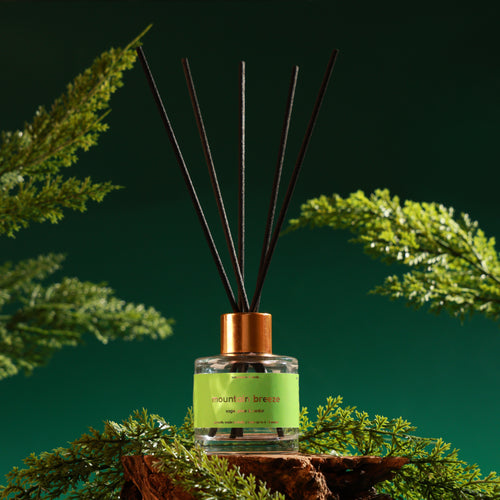
 Mountain Breeze₹849Each walk past re-arms your nose a little, and each period of sitting still puts it back to sleep, so across an evening you get a flickering, contradictory account of your own room. The dangerous conclusion is that the fragrance is fading, and the dangerous remedy is dose. More reeds, a deeper scent, a second bottle — all of which raise emission, none of which adds transport, and every one of which raises the level for the people who are not adapted. Guests are not adapted. This is exactly how a home ends up smelling, to everyone but its owner, of far too much of something perfectly nice. Almost any composition at too high a concentration flattens into one sweet or sharp impression, which is what people mean when they say a house smells of air freshener.
The fifteen-minute test, and the better instrument
Both tests are free and between them they settle the question in an evening. The first is to leave the room for fifteen minutes and then walk back in. Go and make tea, stand on the balcony, do something in another part of the house — and then come back through the door without pausing. If the fragrance greets you as you enter, adaptation was doing at least part of the work, and the room is scented more than your seated experience suggested. If you walk in and find nothing at all, then the fragrance genuinely is not reaching the doorway, and the answer is distance, containment or transport.
The second test is better still, and it is to ask someone else. A visitor is a genuinely superior instrument to the resident: they arrive with no adaptation to your home at all, and their first-second impression as they come through the door is closer to an objective reading of your room than anything you are capable of producing. Sensitivity varies a good deal between people in any case, so a second nose is useful even without the adaptation problem. If guests remark on it and you cannot find it, your room is working for everybody except you — and I would take their evidence over yours. Some of the most useful reviews we receive are of exactly this shape: somebody's mother arriving and asking where the smell was coming from.
There is a third, quieter test which I like because it needs nothing at all. Notice whether you smell it at transitions. Coming in from outside, waking up, returning from the kitchen, the first thirty seconds after a shower. If the answer is yes, everything is working, because that is precisely the pattern home fragrance is designed for. A diffuser you notice continuously, all evening, without interruption, is not a better diffuser — it is one set too strong for its room, and it is the commonest reason people eventually stop using something they liked.
Four readings of the same room, and what each one is worth
The same bedroom, the same bottle, the same evening, read four different ways. The right-hand column is what each reading is actually evidence of, which is not always what it feels like evidence of.
| The reading | What you experience | Which mechanism | What it is actually evidence of |
|---|---|---|---|
| Walking past the bottle | A vivid, complete impression of the fragrance | Gradient crossing | That the oil is intact and emitting properly |
| Sitting across the room | Nothing at all, or almost nothing | Distance plus adaptation, together | Very little on its own — two causes are confounded |
| Coming back after fifteen minutes | The room greets you, or it does not | Adaptation removed | How much fragrance is genuinely near the doorway |
| A visitor's first impression | They notice it, or they say nothing | No adaptation at all | The best reading available of your room |
| Adding reeds because you cannot smell it | A brief improvement, then the same silence | Emission raised, adaptation unchanged | A room that is now too strong for everyone else |
The free fixes, in order
If the fifteen-minute test came back empty — you walked in and found nothing — then the distance is real and these are the changes worth making, none of which costs anything. Reed count first. Every SOSA bottle contains six fibre reeds and a great many people use three, because three looks tidier on a table. Six is full projection; three is a soft bedside level and roughly doubles the life of the bottle. Then distance, which is the largest lever available. Halve the gap between the bottle and the chair or bed you actually occupy. Moving the diffuser to the table beside you is not a compromise — it is the correct use of a point source. At very close range use three reeds rather than six, or the near field becomes too much.
Then height: at or a little below nose height, on a surface, not on the floor and not on a high shelf. Then the draught: off the windowsill, out of the direct blast of a split unit and away from an open balcony door, because all three strip the reeds and throw the fragrance at one wall — but not in a dead corner behind a wardrobe either, where the vapour simply pools with nothing to pick it up. Then the door, because containment is half of this equation and closing one costs nothing at all. And flip the reeds every three to five days rather than daily; a flip restores output for a few hours, which is a real lift, but it adds no range whatsoever.
And then the best free advice in this entire cluster: put the ceiling fan on low. A fan is precisely the transport a reed structurally lacks. It takes the concentrated pocket around the reeds and moves it through the room, which is the only free way to make the far chair smell like the near one. There is also an elegant side effect that speaks directly to this page: moving air makes the concentration at any given spot fluctuate slightly rather than hold perfectly steady, and a fluctuating stimulus is much harder to adapt to than a constant one. The honest cost is bottle life — faster air across the reeds means faster evaporation. Both things are true and you get to choose. It is the same trade behind a closed bedroom smelling strongest at night with the air conditioning running: recirculation distributes beautifully and dry air empties the bottle sooner.
When it really is the room, and not your nose
If a visitor also finds nothing from the far side of the room, and the fifteen-minute return gives you nothing at the door, then adaptation has been ruled out and what remains is distance and transport. That is a legitimate requirement and a passive device cannot meet it, so here is the ladder in the order I would work through it — with the two purchases in our own range I would talk most readers out of set down in the last row where they belong.
| Step | What it is | When it is the right answer | Price |
|---|---|---|---|
| 1. The fifteen-minute test and a second opinion ★ | Leave, come back, and ask a visitor before changing anything | Always first. It decides which problem you actually have | Free |
| 2. Six reeds, half the distance, fan on low | Full emission, better placement, and the only free transport there is | If the test showed the room genuinely is quiet at the door | Free |
| 3. A 50ml reed beside where you sit | Six fibre reeds, refillable glass, 6–8 weeks, silent, no power, no maintenance | When a rich zone where you actually are is what you want | ₹749–₹849 |
| 4. Sukoon ultrasonic ★ | 500ml, 270–320 sq ft, 16–18 hours on low, three 15ml Hotel Collection scents included | When you want the far chair to smell like the near one | ₹1,899 |
| 5. Safar waterless | Named and sold as a car and travel diffuser. Undiluted oil, 20ml, cordless, three speeds, a 1 / 2 / 3-hour auto-off timer — not set-and-forget, and it needs recharging | For emphatic personal-scale projection with no water and no dilution | ₹3,999 |
| The gap, and the purchase to avoid: Vaayu, and a second bottle | Vaayu ₹11,999 is rated to 1000 m³, roughly 2,000–3,000 sq ft, and between Safar and Vaayu there is no mid-sized waterless bedroom nebuliser in this range. A second reed diffuser, meanwhile, makes two concentration hills with a valley between them rather than one even room, because neither source moves air | Vaayu is the wrong purchase for one bedroom. A second reed is right for a long or L-shaped room used at both ends, and wrong for evenness in one open volume | ₹11,999 / ₹749+ |

Versailles
Perfumery school teaches you very early that you cannot trust your own nose for long, and it teaches it by taking the nose away from you. You spend an hour with a material and by the end you would swear the bottle had been swapped for water. Adaptation is not a defect in the equipment; it is how the equipment is supposed to work. A sense that kept reporting an unchanging background would be useless. What it means for anyone living with home fragrance is uncomfortable but simple: you are the least reliable judge in your own house.
I think about this constantly when people describe the walk-past effect, because they usually describe it as a disappointment and it is in fact the sound of everything working. The oil is intact, the reeds are wicking, the composition is legible enough to register in the second and a half it takes to walk by. What they have discovered is not a weak diffuser. It is the shape of a gradient, and the shape of their own attention.
The advice I would give a friend is to stop asking themselves and start asking the door. Leave the room for a quarter of an hour and come back. Ask whoever visits on Sunday. If the answers are good, put all six reeds in, move the bottle nearer the sofa and spend nothing. If the answers are genuinely empty, then buy transport rather than dose — the Sukoon at ₹1,899 and not the machine at three times the price — and go in knowing the fragrance inside it will be a different one. Everything is composed in Pune, and a part of every order funds a girl's classroom through Nanhi Kali.
Frequently asked questions
- Why can I smell it only when I stand next to it? — the point-source explanation from the beginning.
- Amazing within two feet and nowhere else — is that normal? — yes, and here is why.
- Why doesn't the fragrance travel across the room? — molecular diffusion, and how slow it really is.
- Strong beside the bottle, weak from the bed — the distance problem, with the free answers.
- How far should it actually travel? — why no honest brand publishes a figure.
- One strong corner, the rest nothing — the smooth gradient and the edge that is not there.
- Is it weak if I have to walk close to it? — no, and what weak would really look like.
- It's definitely evaporating, so why can't I smell it? — where the millilitres actually go.
- I love the fragrance — how do I get it everywhere? — the full ladder, free fixes first.
- Brand: the SOSA founder story.
SOSA products — facts verified August 2026: Reed diffusers in 50ml and 130ml only. Morning Freshness ₹749 / ₹1,249 (9.0) · Evening Calm ₹799 / ₹1,299 (8.9, softest) · Garden Bloom ₹799 / ₹1,299 (8.9) · Mountain Breeze ₹849 / ₹1,349 (9.4) · Fresh Brew ₹849 / ₹1,349 (9.5, deepest); the scale describes perceived intensity, not quality or reach. 50ml suits rooms up to ~150 sq ft and lasts 6–8 weeks; 130ml suits above 150 sq ft and lasts 14–18 weeks; roughly ₹13–₹15 a day. Six fibre reeds in a refillable glass bottle, on a heat-stable CCT (caprylic/capric triglyceride) carrier rather than DPG, alcohol-free, phthalate-free, paraben-free, IFRA-compliant, 0 ppm formaldehyde, climate-tested at 45°C and 85% RH, composed in Pune. Duos ₹1,498–₹1,598 (50ml × 2). Refills 300ml ₹2,399 · 500ml ₹3,499, oil only. Machines: Boond ₹899 (300ml, ≤~150 sq ft, ~6h) · Sukoon ₹1,899 (500ml, 270–320 sq ft, 16–18h on low, three 15ml Hotel Collection scents included) · Megh ₹3,499 (6L, ~100h runtime, ~215 sq ft) · Safar ₹3,999, named and sold as a waterless car perfume diffuser, 20ml, 2000 mAh, up to 10 hours continuous or around 30 hours intermittent per charge, three speeds and a 1 / 2 / 3-hour auto-off timer, 6.9 cm — SOSA publishes no room coverage figure for it and none is given here · Vaayu ₹11,999 (up to 1000 m³, roughly 2,000–3,000 sq ft, 400ml, under 38 dB). Hotel Collection oils are water-based and ultrasonic-only: 15ml ₹299 · 100ml ₹999 · 300ml ₹1,799. Reed oil and Hotel Collection oil are not interchangeable in either direction and there is no hotel-inspired reed diffuser. Fragrance does not remove an unwanted smell, which is a matter of source, then ventilation, then fragrance. Free shipping above ₹499. A portion of every order supports girl-child education through Nanhi Kali. SOSA is an independent Indian fragrance house; the Hotel Collection scents are SOSA's own interpretations inspired by the world's finest hotels, and SOSA is not affiliated with or endorsed by any hotel brand. Prices subject to change — see the live product pages.