


When Should You Stop Searching for a “Stronger Hotel Reed Diffuser” and Change Diffusion Methods?
1. You are already running all six reeds and flipping every three to five days.
2. The bottle size matches the room — 50ml up to about 150 sq ft, 130ml above it.
3. The bottle sits within the room’s airflow, off the threshold and out of the AC blast.
4. The door is closed for the hours you are in the room.
5. A visitor who has just walked in from outside confirms what you are experiencing.
6. You want it even across the room, not just more.
7. You want to be able to switch it off when you leave the house.
Because points six and seven cannot be bought in this format at any price. Evenness needs moved air and a reed moves none; and a reed cannot be switched off — it evaporates into an empty room all day, which is its one genuine design limitation.
Keep the reed if: you want silence, no plug, nothing to fill or charge, nothing to remember, about ₹13–₹15 a day, and an object rather than an appliance. Nothing with a motor matches that list.
The honest gap: if you do change method, Sukoon ₹1,899 covers 270–320 sq ft but dilutes the oil in water; Safar ₹3,999 is waterless and undiluted but named and sold as a car and travel diffuser with no published room-coverage figure. There is nothing between it and the 2,000–3,000 sq ft Vaayu at ₹11,999.
2. Size — does the bottle match the room? A 50ml is specified for up to about 150 sq ft over six to eight weeks; a 130ml for above that over fourteen to eighteen. A 50ml being asked to hold a 300 sq ft open-plan room will read as weak while performing exactly to specification. Check this honestly with a tape measure rather than an impression, because it is the commonest silent mismatch.
3. Placement — is it in the path air already takes? Out of a dead corner, off the threshold, which is the most turbulent point in a home, and out of the direct blast of a split AC, which strips the lightest materials within days. A metre either way genuinely changes what you experience, and it costs nothing.
4. Cadence — are you flipping every three to five days? Flipping re-wets the dry upper length and restores the lift without opening a new bottle. If you find yourself flipping every day and still chasing intensity, that is not a maintenance routine, it is a signal that the format is being asked for something it cannot give.
5. Then score the seven statements below. Three or more and the search should stop, because at that point the two things you want — evenness across the room, and the ability to switch it off — are properties of a mechanism rather than of a bottle. No reed at any price from any brand supplies them.
Alcohol-free, phthalate-free, paraben-free, IFRA-compliant, 0 ppm formaldehyde. Free shipping above ₹499, and a portion of every order supports girl-child education through Nanhi Kali.
The four levers, and what each one is actually worth
Before any checklist is worth running, the levers have to have been pulled properly. A surprising number of readers who write to me describing an exhausted reed diffuser are running four sticks in a 200 sq ft room with the bottle behind a curtain. That is not the format failing; that is the format at about a third of its rated output. Here is what each lever is genuinely worth, so that you can tell an exhausted product from an under-used one.
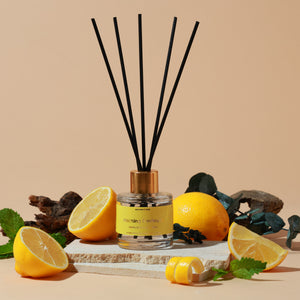
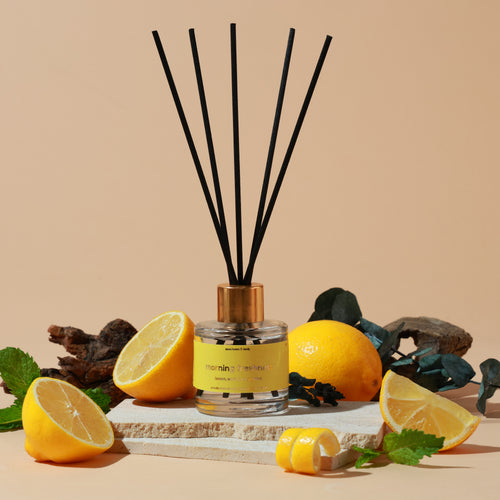
 Morning Freshness₹749Reed count is the big one — moving from three to six is close to a doubling of emitting surface, and it is free if the extra sticks are still in the box. Bottle size is duration rather than distance, except in the one case where the room is genuinely larger than the bottle’s specification, when it becomes the whole answer. Per week the 130ml is better value — fourteen to eighteen weeks against six to eight for roughly ₹500 more — but only if the room needs it; a 130ml in a 120 sq ft bedroom is over-specified and the honest recommendation there is the 50ml with fewer reeds. Placement is worth more than people expect and costs nothing. Cadence maintains what you have rather than adding to it. Four levers, one of them large, two of them free.
 Sukoon₹1,899Read them and mark each true or false, honestly. One: all six reeds are in and flipped every three to five days. Two: the bottle size matches the room by measurement rather than by feel. Three: the bottle is in the room’s airflow, off the threshold, out of the AC blast. Four: the door is closed for the occupied hours. Five: somebody arriving from outside has confirmed what you experience — you cannot judge your own home. Six: what you want is evenness, similar at the door and at the bed, not simply more. Seven: you want it off when you leave the house. Six and seven are the decisive ones. Evenness requires moved air, and a reed moves none; and a reed cannot be switched off, so it evaporates into an empty room all day. Those two are not solvable inside the format at any price.
 Evening Calm₹799Four situations where the checklist score is misleading and no purchase is warranted. Guests notice it and you do not — you are adapted to your own home, which is universal, fast and complete; the diffuser is working for everybody but you, and buying something stronger will make the room too much for them while you still notice nothing. It was strong in week one and quiet by week three — the first days run hot while the sticks saturate and the lightest materials leave first; week three is the heavier heart and base, which is the composition as designed. That is settling, not fading, and flipping restores the lift. You want to smell it constantly — a diffuser you perceive continuously in your own home is set too strong for the room. The room has a smell you are trying to cover — fragrance does not remove an odour; source, then ventilation, then fragrance, in that order and never rearranged.
Why the ceiling is structural, and why no brand can sell you past it
It is worth understanding why the search term fails, because the explanation is the thing that stops you resuming the search in a fortnight. A reed diffuser emits and does not deliver. Oil is drawn up six porous fibre reeds by capillary action and evaporates from the wetted surface into the thin layer of air touching it. From there, the only transport available is the room’s own slow convection and molecular diffusion, which over the distance of a bedroom is negligible on the timescale of an evening. So concentration is highest at the bottle and falls with distance, always, in every reed diffuser ever sold.
Each of the four levers acts on emission. More reeds means more wetted surface, so more molecules per hour. A bigger bottle means the same emission sustained for longer. A deeper composition means a higher perceived intensity at a given concentration. Flipping restores an emitting surface that had dried at the top. Every one of them raises the curve; none of them changes its shape, because the shape is set by the absence of transport. That is why doubling your reeds makes the corner more intense and leaves the far side of the room roughly where it was — and why a hypothetical “lobby-strength” reed would have to be so intense at the bottle as to be unbearable to sit beside.
Two further factors are outside the product entirely and worth naming before you spend. Air exchange subtracts. Concentration in a room is emission minus removal, and an open window, a gap under a door or a high-floor balcony where wind speed is considerably greater than at street level all remove faster than six reeds can supply. A home ventilating continuously is not a fragrance environment during those hours; it becomes one when it closes. And humidity changes the character rather than the strength — saturated monsoon air carries molecules less readily, so projection shortens and the scent hangs close to the source, which is exactly the season in which people conclude their bottle has failed. The same bottle honestly performs differently in June and in January.
| Statement | If FALSE — do this first, it is cheap | If TRUE — what it tells you |
|---|---|---|
| 1. All six reeds are in, flipped every 3–5 days | Add the rest of the sticks and wait 48 hours. Close to a doubling of emitting surface, and free | The largest lever is spent |
| 2. Bottle size matches the room by measurement | 50ml up to ~150 sq ft, 130ml above it. Per week the 130ml is better value — 14–18 weeks against 6–8 — but only if the room needs it | Sizing is not your problem |
| 3. It sits in the airflow, off the threshold, out of the AC blast | Move it a metre. The entrance is the most turbulent point in a home and the AC blast strips top notes in days | Placement is not your problem |
| 4. The door is closed for occupied hours | Close it. This cuts removal rather than raising emission, and it is the cheapest tool available | Containment is not your problem |
| 5. A visitor has confirmed what you experience | Ask one. Leave the room for fifteen minutes and walk back in. You cannot judge your own home — adaptation is complete within minutes | You have a real measurement rather than an impression |
| 6. You want evenness, not simply more | — | Decisive. Evenness comes from moved air and a reed moves none. Change the mechanism |
| 7. You want it off when you leave the house | — | Decisive. A reed cannot be switched off. This is its one genuine design limitation |
| Score three or more and stop searching. The honest gap you will meet next: Sukoon ₹1,899 covers the room but dilutes in water; Safar ₹3,999 is waterless but named and sold as a car and travel diffuser with no published room coverage; and there is nothing between it and Vaayu at 2,000–3,000 sq ft. | ||
 The levers · Morning Freshness₹749Shop →
  The change · Sukoon₹1,899Shop →
  The oils · Hotel Collection₹999Shop →
Three exits where the honest advice is to stop shopping entirely
Exit one: the room is already scented and you have adapted to it. If a visitor tells you the room smells lovely from the doorway and you cannot detect anything from the bed, the diffuser has succeeded and your receptors have stopped filing a report. That is universal and permanent, and no purchase reverses it. What changes is when you experience the fragrance: on the way in from outside, at transitions, in the first moments of the evening. Buying something stronger in this situation makes the room too much for everybody else while leaving you exactly where you were, and it is the most common way this problem gets worse.
Exit two: what you actually want is the arrival moment, not continuous presence. Those two setups are largely in tension. A room tuned so that you notice the fragrance all evening is over-dosed for its volume; a room tuned so that it announces itself when you open the door is doing exactly what home fragrance is designed to do. If it is the second, a reed with six sticks, the door closed for an hour beforehand and the bottle slightly inside the room rather than on the threshold will deliver it — and that costs nothing beyond a bottle you already own.
Exit three: the four things a reed does better matter more to you than reach. Be specific about them before you trade them away. It is silent, with nothing to measure. It needs no socket, so it goes on a shelf with no wiring within four metres and it works when the power is out. It has no consumable but the oil, nothing to fill, nothing to descale, no battery to degrade, and no white mineral dust on a dark bedside table. And it cannot be forgotten in either direction — never left on, never left off. At roughly ₹13 to ₹15 a day on a 50ml, with six fibre reeds in a refillable glass bottle that looks like an object rather than a device, that is a genuinely good specification. If you find yourself hesitating over the machine, it is usually one of those four you are reluctant to lose, and it is worth naming which.
If you do change method — what to buy, in order, and the rung that does not exist
Ordered by cost, with what each one gives up. The last row is the honest gap, and it is the reason a “change the method” verdict does not come with a single automatic answer.
| Step | What it is | When it is the right answer | Price |
|---|---|---|---|
| 1. Finish the levers ★ | All six reeds, the right bottle size for the measured room, better placement, a 3–5 day flip, door closed | Always first. A real share of these messages end here, and it costs nothing | ₹0 |
| 2. Two zones instead of one | A duo — two 50ml bottles, six fibre reeds each, refillable glass | For a long room or two connected spaces. Two zones, still not one even room, but often the cheaper right answer | ₹1,498–₹1,598 |
| 3. Change the mechanism, water acceptable | Sukoon — ultrasonic water mist, 500ml, 270–320 sq ft, 16–18 hours on low, three 15ml Hotel Collection scents included | The value answer when statements six or seven came back true. You accept dilution, humidity, refilling and a plug | ₹1,899 |
| 4. Change the mechanism, no water | Safar — waterless cold-air nebulising, undiluted oil, 20ml, 2000 mAh Type-C, up to 10 hours continuous or ~30 intermittent, 3 speeds, 1/2/3-hour auto-off, 6.9 cm. Named and sold as a car and travel diffuser, with bedside and hotel room among its stated uses | When water is the deal-breaker and control matters as much as reach. No published room-coverage figure, and it is not always-on | ₹3,999 |
| Never buy for reach: Megh | 6L tank, around 100 hours of runtime, about 215 sq ft of coverage | Less coverage than the ₹1,899 Sukoon. A runtime and humidity machine, never a coverage upgrade | ₹3,499 |
| The honest gap | No mid-sized waterless bedroom nebuliser exists at SOSA — nothing between Safar and Vaayu ₹11,999, rated to 1000 m³ or roughly 2,000–3,000 sq ft and nine-tenths wasted in one bedroom | Stated plainly, because it is why the end of the checklist is a choice rather than an instruction | — |
Versailles
The reason I wrote this as a checklist rather than an essay is that the search itself is the expensive part. People spend weeks comparing reed diffusers, buy a third bottle, and arrive at the same room they had in March. The four levers take a weekend to work through, and at the end of it you will know something definite instead of continuing to browse hopefully.
I would rather you did not buy a machine you do not need, and I would equally rather you did not buy a fourth reed that cannot help. Both of those are the same mistake in opposite directions — spending in a column that does not contain the answer. And I want to be honest that a meaningful proportion of the people who run this checklist find their score is one or two, which means the room is fine and they had simply stopped noticing it. That is not a disappointing outcome. It is ₹1,899 saved and a diffuser that was working all along.
If your score is three or more, change the method and keep a clear head about what you are giving up. You will gain reach, evenness and the ability to switch it off when you leave the house, which the reed genuinely cannot do. You will lose the silence, the freedom from a socket, the nothing-to-fill, and an object that looks like glass on a table. Buying a fragrance to solve a diffusion problem is the most natural mistake in this category, and nobody should feel foolish for having made it — the category has been describing this decision badly for years. Everything is composed in Pune, and part of every order funds a girl’s classroom through Nanhi Kali.
Frequently asked questions
- Can a reed make an entire bedroom smell like a hotel? — the answer in the first sentence.
- Strong beside the bottle, weak from the bed — the distance-decay page.
- I added more reeds and it still is not hotel-like — why the ceiling is structural.
- Two reeds or an upgrade? — two bottles give two zones, not one room.
- Flipping the reeds constantly — a 3–5 day cadence, not a daily fix.
- A fragrant corner instead of a scented room — emission, transport and removal.
- Are reeds the wrong format for me? — sometimes yes, said plainly.
- Is a reed designed for lobby projection? — two design briefs, compared.
- Did I actually need active scenting? — the family pillar.
- Brand: the SOSA founder story.
Facts verified August 2026: Three diffusion mechanisms are described — passive capillary (reed diffusers), ultrasonic water mist (Boond ₹899, 300ml, up to ~150 sq ft, ~6 hours, USB, night light; Sukoon ₹1,899, 500ml, 270–320 sq ft, 16–18 hours on low, three 15ml Hotel Collection scents included; Megh ₹3,499, 6L tank, ~100 hours runtime, ~215 sq ft, which is less coverage than Sukoon) and waterless cold-air nebulising (Safar ₹3,999, 20ml bottle, 2000 mAh Type-C battery, up to 10 hours continuous or around 30 hours intermittent, 3 speeds, 1/2/3-hour auto-off timer, 6.9 cm, named and sold as a car and travel diffuser with car, handbag, desk, bedside and hotel room among its stated uses, no published room-coverage figure; Vaayu ₹11,999, coverage up to 1000 m³ or roughly 2,000–3,000 sq ft, 400ml refillable tank lasting up to about 90+ days, Bluetooth app and onboard buttons, 1h/4h/8h/24h run windows, adjustable intensity, key-lock, under 38 dB, freestanding or wall/HVAC mount, 5W, CE, RoHS, SGS). SOSA reed diffusers: five scents, 50ml ₹749–₹849 lasting 6–8 weeks and suiting rooms up to ~150 sq ft, 130ml ₹1,249–₹1,349 lasting 14–18 weeks and suiting above 150 sq ft, six fibre reeds included and flipped every 3–5 days, about ₹13–₹15 a day, heat-stable CCT carrier rather than DPG, alcohol-free, phthalate-free, paraben-free, IFRA-compliant, 0 ppm formaldehyde, refillable glass bottle, climate-tested at 45°C and 85% RH, composed in Pune. Duos are two 50ml bottles at ₹1,498–₹1,598; 130ml duos ₹2,498–₹2,598; refills 300ml ₹2,399 and 500ml ₹3,499, oil only and never a first purchase. SOSA strength scale: Evening Calm 8.9, Garden Bloom 8.9, Morning Freshness 9.0, Mountain Breeze 9.4, Fresh Brew 9.5. Hotel Collection fragrance oils are water-based and ultrasonic-only at 15ml ₹299 (a refill), 100ml ₹999, 300ml ₹1,799 and a pack of seven at ₹1,799; they cannot be used in reed diffusers and reed oil cannot be used in ultrasonic machines, so no hotel-inspired reed diffuser exists. No health, air-quality, allergy or antimicrobial claims are made, and fragrance does not remove a smell — source, then ventilation, then fragrance. Free shipping above ₹499. A portion of every order supports girl-child education through Nanhi Kali. SOSA is an independent Indian fragrance house; the Hotel Collection scents referenced here are SOSA’s own interpretations inspired by the world’s finest hotels, and SOSA is not affiliated with, endorsed by or a supplier to any hotel brand. Prices subject to change — see the live product pages.