
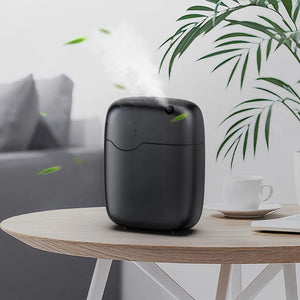
 Vaayu ₹11,999
  Sukoon ₹1,899
 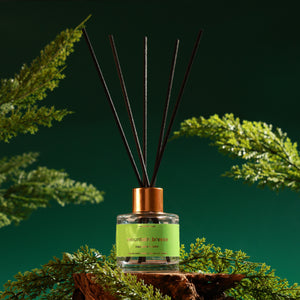 Mountain Breeze ₹849
 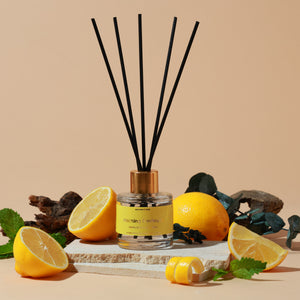 Morning Freshness ₹749
  Hotel Collection 300ml ₹1,799
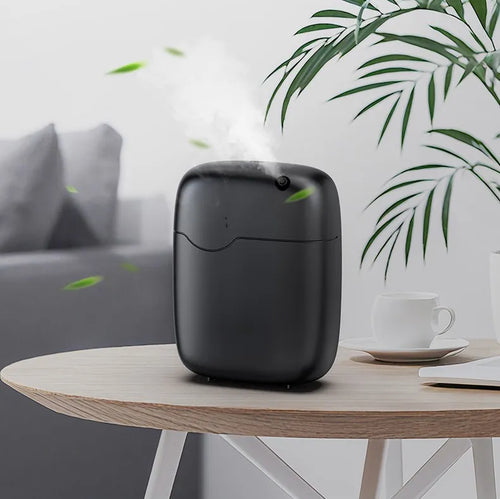
You are not buying coverage. The Vaayu is rated up to 1000 m³ — roughly 2,000–3,000 sq ft — which already exceeds any clinic reception. You are buying under 38 dB, a key-lock and 1h/4h/8h/24h run windows with day selection.
Size to the arrival zone, never to the clinic. Reception plus waiting is typically 150–400 sq ft in an Indian eye clinic. Under ~150 sq ft: a reed diffuser. 150–320 sq ft: Sukoon ₹1,899, even in a large building.
Two absolutes. Never HVAC-mount a diffuser in a clinic — it delivers fragrance into the clinical pathway. And confirm current Vaayu refill availability before committing: the 400ml supplied lasts roughly 90+ days and is the whole supply at the time of writing.
2. When you need the level locked. A clinic with three people on the desk across a week has three opinions about intensity, and without a lock the setting drifts upward across a season — somebody adapts, decides the room has gone flat, and raises it. The key-lock is a genuine operational feature rather than a marketing line, and no cheaper machine in the range has one.
3. When you need the hours fixed. 1h, 4h, 8h and 24h run windows with day selection mean the machine runs in clinic hours and is genuinely absent overnight and during the cleaning shift — which matters, because fragrance layered over cleaning chemistry produces a third smell that is worse than either.
4. When silence is decisive, which in an eye clinic it usually is. Under 38 dB is the specification I would put at the top of any clinic specification sheet. Patients in an eye practice wait a long time, often with dilated pupils and little ability to distract themselves, and a waiting room where a machine is audible is worse than one with no fragrance at all.
5. When it can stand freestanding in reception, away from the corridor to consultation. The Vaayu can be wall or HVAC mounted. In a clinic you must never HVAC-mount it. A central system serves your consultation cabins as well as your reception, so ducting fragrance into it delivers fragrance into the clinical pathway — the one outcome this entire cluster exists to prevent. If your plan only works with a duct, the plan is wrong, not the building.
6. When supply is confirmed, in writing, before the order. SOSA does not currently sell a separate Vaayu cold-air refill oil. The 400ml supplied in the box lasts roughly 90+ days — 400 ÷ 90 = 4.4ml a day at a mid setting — and is the whole supply available at the time of writing. A home buyer finds that inconvenient. A practice that has standardised a scent across a reception, a website and three branches finds it a business problem. Ask through the contact page first. The water-based Hotel Collection is never a substitute for it.
7. When it is not any of these, buy the smaller thing and feel no loss. Under ~150 sq ft of reception: a reed diffuser at ₹749–₹1,349, or a Sukoon if you want control. 150–320 sq ft: the Sukoon at ₹1,899 is the sized product, and I will say so on a page about large clinics. 3,000+ sq ft of connected public area: Aangan ₹25,999, and above that Meenar ₹38,500 — a hospital foyer rather than a clinic reception. And Megh ₹3,499 covers about 215 sq ft, less than a Sukoon, so it is never a coverage upgrade.
8. And under all of it, the conditions that do not change with the price. The clinical pathway stays fragrance-free. The correct intensity in a clinic is lower than in any retail or hospitality space — if a patient can name the fragrance, it is too strong. A fragrance-free seat must genuinely exist somewhere a person would ordinarily sit. Reception staff, who are in that air for nine hours while patients are in it for forty minutes, set the level and may switch it off without asking anybody. Nothing here is medical, clinical, ventilation, air-handling, infection-control, accreditation or regulatory advice; all of that belongs to your own clinicians and licensed contractors. Composed and made in small batches in Pune, and a portion of every order supports girl-child education through Nanhi Kali.
Part one — what the money actually buys
The gap between ₹1,899 and ₹11,999 is not a gap in reach, and until a practice understands that, every conversation about this machine goes wrong. Three things separate them: what the machine does to the air, what it lets you fix in place, and what you can rely on to keep it running. Only the second and third are worth ₹11,999 to a clinic, and the third is the one nobody asks about until it is too late.
 Sukoon 500ml₹1,899 · the sized answer under 320 sq ftTake noise first, because nobody else in my trade leads with it and in an eye clinic it decides more cases than coverage does. A waiting room in which a machine is audible is worse than a waiting room with no fragrance in it. Your patients sit for long stretches, frequently with dilated pupils, frequently unable to read or use a phone, in a room where the only sounds are the desk and each other. Anything that hums, ticks or cycles becomes the event of that hour. Under 38 dB is what makes an active machine acceptable in that room, and it is the specification I would ask any supplier for first. Now control. A clinic has several people on the desk across a week, and every one of them will at some point decide the room has gone flat — because their own noses adapt to a constant within minutes, and adapt hardest where they spend the day. Without a lock, that judgement becomes an adjustment, and adjustments only ever go one way. The key-lock exists to hold the level you chose; the run windows exist to hold the hours you chose. Together they turn a fragrance decision into a setting rather than a running negotiation. One important qualification: the lock should prevent the level being raised, never prevent the machine being switched off. Whoever is on the desk must be able to end it, on any day, without asking. They are in that air for a full shift and your patients are not.
Part two — the five conditions, as a pass or fail
Ask them in this order and stop at the first failure. Only a practice that passes all five has a Vaayu decision; everybody else has a smaller and cheaper one, and there is no shame in any row of the fourth column.
| Condition | Why a clinic specifically cares | The evidence that settles it | Where an unsatisfied condition sends you |
|---|---|---|---|
| 1 · Volume ★ | Most of a clinic is clinical space that takes nothing, so the arrival zone is the only figure with any meaning | A tape measurement of the public floor sharing unbroken air with reception, taken with the doors as they are during clinic | 150–320 sq ft: Sukoon ₹1,899. Under 150: a reed diffuser ₹749–₹1,349 |
| 2 · Level control | Several people work the desk across a week and every one of them adapts to the level, then judges it flat | A count of who can reach the machine, and whether anyone has changed a setting in the last six months | A Sukoon with a remote, plus one named person accountable for the setting |
| 3 · Hours control | Fragrance layered over cleaning chemistry makes a third smell, and nothing should run in an empty building | The housekeeping timetable set against opening hours, on one sheet | A Sukoon's steady, 2H and 4H modes, switched by hand at the desk |
| 4 · Noise | Patients wait a long time, often with dilated pupils and nothing to occupy them; an audible machine becomes the hour | Stand in the waiting bank at the quietest hour and listen to what is already there | Reeds — silent, no power, no humidity, and nobody can turn them up |
| 5 · Placement | A duct serves consultation and workup in the same breath as reception | A socket and a stable surface at the far end of the waiting area, plus a tissue held at the corridor mouth | Nothing. If the plan only works ducted into HVAC, do not buy it |
| 6 · Supply | A practice adopting a scent is adopting a standard, not buying a consumable | A written answer from SOSA on current cold-air fragrance availability | Wait. Ask through the contact page first, then decide |
| Disqualifier · the building | In a room that does not clear, everything added settles higher and holds longer | Two weeks of a deliberate airing routine, with a cold-nose check at four each afternoon | Buy nothing. More sources in a sealed room read heavier, not fresher |
| Disqualifier · the boundary | If the consultation corridor is open through every session, the waiting bank and the clinical rooms are one air path | The door census, taken at eleven on a clinic morning rather than after hours | A reed at two of six reeds by the entrance, or nothing at all |
| The honest caveat: these conditions are a way of ordering your own decision, not a standard, a protocol or an assessment of any building. Nothing on this page is medical, clinical, ventilation, air-handling, infection-control, accreditation or regulatory advice — which windows open, how your air is handled, what your housekeeping uses and every accreditation matter belong to your own clinicians and licensed contractors. No SOSA product or setting is described as safe or unsafe for any patient or staff group, and no claim is made about how any person perceives or responds to fragrance beyond the plain fact that some people are sensitive to it — which is exactly why the clinical pathway stays fragrance-free and why a fragrance-free seat must genuinely exist somewhere a patient would ordinarily sit. Fragrance adds a scent alongside what is already in the air; it removes, neutralises, masks or purifies nothing, and no claim is made that scenting affects ratings, footfall, patient numbers or revenue. Coverage figures are manufacturer specifications and vary with ceiling height, air exchange, occupancy and intensity. Never mount a Vaayu, or any diffuser, into a clinic's shared HVAC. | |||
 Sukoon · 150–320 sq ft, most clinics₹1,899Shop →
 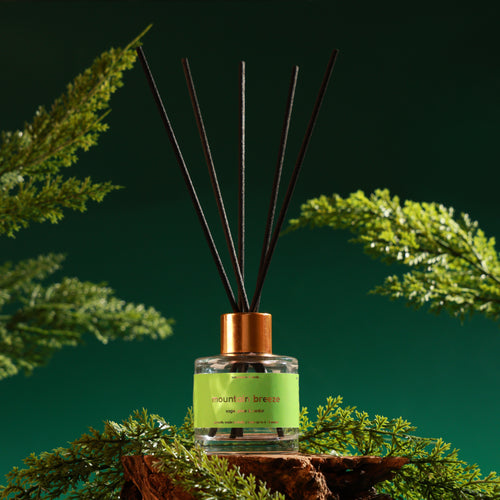 Mountain Breeze · under 150 sq ft₹849Shop → Vaayu · past all five conditions₹11,999Shop →
Part three — the three cases where I would refuse the sale
There are three configurations in which I would not supply a Vaayu to an eye clinic at any price, and stating them plainly is the point of this page existing at the end of a family rather than at the start. The first is the HVAC installation, and it is absolute. The machine is capable of wall and duct mounting, and an architect or an air-conditioning contractor may well propose it — it is the neat solution, it hides the hardware, and in a hotel it would be the right answer. In a clinic it is the wrong one, because a central system serves your consultation cabins, your workup room and your imaging room in exactly the same breath as it serves your reception. Ducting fragrance into it is a reliable, engineered method of delivering fragrance into the clinical pathway, which is the single outcome that every page in this cluster exists to prevent. There is no intensity low enough to make it acceptable, because the objection is not about dose; it is about where the material goes. If a proposal on your desk depends on duct integration, the correct response is to change the proposal. Freestanding in reception, waist to chest height, at the end of the waiting area furthest from the corridor mouth, away from every return grille, is the placement I would put in writing — and I would rather lose the order than see the other one installed.
The second refusal is the under-ventilated reception, and it is the one that costs practices the most when it is ignored. If your patient-side space has no openable window, opens onto an internal corridor rather than the street, is served by one recirculating system, and does not deliberately exchange air with outside between opening and closing, then it is a room in which everything added accumulates and very little leaves. In that room a continuous source settles at a higher level than you intended and holds there, which is felt as weight rather than as fragrance — heavier, not fresher — and the effect scales with the machine. An ₹11,999 unit will deliver that outcome more efficiently than an ₹849 bottle, which is the opposite of what the money was meant to buy. The correct project costs nothing and takes a fortnight: two openings on opposite sides of the arrival zone held open together for ten to fifteen minutes, mid-morning and mid-afternoon, daily, with somebody stepping outside for fifteen minutes and re-entering through the patient door at four o'clock to write one sentence before speaking to anybody. If the four o'clock sentence changes across the fortnight, ventilation was the answer and it was free. If your building genuinely cannot ventilate, the honest recommendation is less fragrance rather than more, or none — and what your air handling ought to be doing instead is a real question that belongs entirely to your clinicians and your facilities contractor. I will not offer a view on ventilation in a healthcare building, and I would be sceptical of anyone in my trade who did.
The third refusal is the one people find hardest to hear, because it sounds like a judgement about their practice rather than about their floor plan. If the corridor to consultation opens directly off the waiting bank with no door, and stays open through every clinic session, then a machine sized for that waiting bank will scent the corridor whether or not you intend it to. The physics does not care about intent. In that building the options are all small: fit a door closer or reroute the calling of patients so the door can stay shut; move the source to the entrance end of the room, twenty feet further away, and drop it to the bottom of its range; or accept a reed diffuser at two of six reeds by the entrance and nothing else in the building. That last option is not a consolation prize. A bounded fragrant zone at the arrival point is the only shape of fragrance that keeps its own promise in a clinic — present where people arrive, absent where people are examined, silent, powerless and incapable of being turned up by anybody. I have specified exactly that for practices of two and a half thousand square feet with beautiful interiors and a budget for something far larger, and none of them has come back unhappy. Reading the building correctly is not under-buying.
One more thing belongs here, because it is the commonest reason a practice reaches this page at all. A fair number of clinics arrive at the Vaayu question having already bought two or three reed diffusers and found the reception still uneven, and they read that as evidence that they need the largest machine available. It is not; it is evidence that they were using the wrong format, and it says nothing about which machine. Passive diffusers have a fixed output and no way to project it, so each one makes a zone rather than a floor, and three of them make three zones and three overlaps. The correct inference from "three bottles are not holding this room" is "this room needs one machine", and then the five conditions decide which. In practice the answer is a Sukoon at ₹1,899 more often than it is a Vaayu, because the arrival zone in question is usually under 320 sq ft — and because most of what those practices actually wanted was the thing every machine offers and no bottle does, which is an off switch and a schedule. Getting from three bottles to one machine is the real upgrade. Getting from one machine to a more expensive machine is a separate decision with its own five conditions, and it should be made on its own evidence.
Part four — the whole sizing family, resolved
Every question this family has asked, with the number that actually decides it and the honest answer. The Vaayu is right in three rows out of eleven, and that is the correct proportion rather than a modest one.
| The question you arrived with | The number that actually decides it | The honest answer | Is a Vaayu right here? |
|---|---|---|---|
| "How do I scent a 300–400 sq ft eye clinic?" ★ | Reception only — usually well under 200 sq ft | A reed diffuser, or a Sukoon ₹1,899 if you want control | No — comfortably oversized |
| "Best setup for a 500 sq ft ophthalmologist's clinic?" | An arrival zone of 150–200 sq ft | Sukoon ₹1,899, sited away from the corridor mouth | No |
| "750 sq ft with separate testing areas?" | Still one arrival zone; the testing rooms take nothing | More rooms means more boundaries to hold, not more machine | No — and separate rooms are an argument against, not for |
| "What system for a 1,000 sq ft clinic?" | Public floor, often 250–350 sq ft | Sukoon under 320; Vaayu only above it, on one path | Sometimes — the first size where it is defensible |
| "A 1,500 sq ft eye care centre?" | 250–450 sq ft of connected public floor | One source at the gathering point, never one per zone | Only above 320 sq ft on one unbroken path |
| "2,000+ sq ft with multiple patient areas?" | 350–700 sq ft, established by walking the doors | One machine, comfortably inside the Vaayu's range | Usually yes, if conditions 2–6 also pass |
| "One machine or several zones?" | The number of doors that actually close | Zones need boundaries; without them, one source is better | Only as the single source, never as one of several |
| "My reed is noticeable only at reception." | Nothing is wrong — that is the mechanism | A zone, not a floor. In a clinic, the right shape | No, unless you genuinely need a larger volume held |
| "Three reed diffusers still are not enough." | ~250–300 sq ft — the honest ceiling for reeds | One machine instead of a fourth bottle | Only if the volume and the other conditions pass |
| "We are a large eye hospital." | 3,000+ sq ft of connected public area | Aangan ₹25,999, above that Meenar ₹38,500 | No — a tier below what that foyer needs |
| "Someone offered us a Megh as an upgrade." | ~215 sq ft — less than a Sukoon | A runtime and humidity machine. Never a coverage upgrade | Not comparable; different job entirely |
Versailles
The largest single clinic enquiry I have handled came from a group planning a new flagship eye centre, and it arrived with a specification already drawn: a waterless machine integrated into the air handling, so that the whole floor would carry the same scent. It was, on its own terms, a well-made plan. It was also the one thing I will not sell into a medical building, and I had to say so in the first reply rather than the fifth.
What made the conversation interesting was that once we took ducting off the table, the rest of the specification collapsed downward rather than sideways. Without the ducts, the job was a single freestanding machine in one public volume — and when they measured that volume properly, with the doors in the position they hold at eleven on a clinic morning, it came to a little over four hundred square feet. One machine, at the entrance end, on a clinic-hours window, at the lowest intensity, key-locked. Their consultation wing, their imaging room and their theatre corridor took nothing, which is what they would have taken under any specification I would put my name to.
They asked me, near the end, why a fragrance company would write its own biggest opportunity out of a proposal. The honest answer is that this cluster only works if the boundary is real. If I am willing to blur it for a large order, then every other page I have written about keeping fragrance out of the clinical pathway is decoration, and a clinically trained reader will spot that in a paragraph. So: five conditions, all of them true, or a smaller product and no hard feelings. That is the whole of what I know about this decision. Composed and made in small batches in Pune, and a part of every order funds a girl's classroom through Nanhi Kali.
Frequently asked questions
- 300–400 sq ft, 500 sq ft and 750 sq ft with separate testing areas.
- 1,000 sq ft, 1,500 sq ft and 2,000 sq ft and above.
- One machine or several zones — how to tell which building you have.
- Why a reed is noticeable only at reception and why three bottles still are not enough.
- Brand: the SOSA founder story.
SOSA range, specifications and prices used in this guide (verified August 2026): Vaayu ₹11,999 — waterless cold-air nebulisation of undiluted fragrance oil; no water, no heat, no added humidity, no white mineral dust. Coverage up to 1000 m³, about 2,000–3,000 sq ft. 400ml refillable tank lasting roughly 90+ days at a mid setting. Bluetooth app plus onboard controls, 1h / 4h / 8h / 24h run windows, day selection, adjustable intensity, auto-stop and key-lock. Under 38 dB. DC 12V / 1A, 5W. Freestanding or wall / HVAC mount. CE, RoHS and SGS certified. SOSA does not currently sell a separate Vaayu cold-air refill oil; the 400ml supplied in the box is the fragrance available at the time of writing, so a practice planning continuous or multi-site use should confirm current refill availability with SOSA before committing. The water-based Hotel Collection is made for ultrasonic machines and must not be used in a Vaayu. Other machines: Boond 300ml ₹899 (~150 sq ft, ultrasonic) · Sukoon 500ml ₹1,899 (270–320 sq ft, 16–18 hours on low, remote and steady/2H/4H timers, three 15ml fragrances included, ultrasonic) · Megh 6L ₹3,499 (~215 sq ft — a runtime and humidity machine that covers less than a Sukoon, never a coverage upgrade) · Safar ₹3,999 (waterless cold diffusion, cordless, 20ml, about 6.9cm, three speeds, 1/2/3-hour auto-off — sold as a car and travel diffuser, personal-scale only; SOSA publishes no coverage figure for it) · Aangan ₹25,999 (HVAC nebulising, ~8,000–10,000 sq ft) · Meenar ₹38,500 (commercial HVAC, 12,000–18,000 sq ft). Water-based Hotel Collection for ultrasonic machines: 15ml ₹299 · 100ml ₹999 · 300ml ₹1,799 · pack of seven ₹1,799; scents are inspired by the atmosphere of well-known hotels — SOSA is an independent Indian brand and is not affiliated with, endorsed by or supplying any hotel group. Reed diffusers ₹749–₹1,349 (50ml 6–8 weeks, 130ml 14–18 weeks, six fibre reeds, no 100ml size; replacement reeds are not sold separately). Reed oil cannot be used in an ultrasonic machine and Hotel Collection oil cannot be used in reeds. SOSA sells no room spray or home spray — every SOSA spray is a car perfume. Nothing in this guide is medical, clinical or safety advice. A fragrance diffuser adds a scent to the air. It does not clean, purify, filter, sanitise or disinfect air, does not remove or neutralise disinfectant, damp or occupancy smells, and has no effect on comfort, anxiety, waiting time, recovery or any clinical outcome. Some people are sensitive to airborne fragrance, which is why this guide recommends that examination rooms, diagnostic areas, consultation cabins, procedure suites and post-operative areas remain fragrance-free, that a fragrance-free seating option always exist, and that a diffuser is never mounted into shared HVAC in a clinical building. Decisions about clinical policy, ventilation standards, infection control and patient suitability rest entirely with the practice and its clinicians. A persistent stale, damp or disinfectant smell is a ventilation, moisture or cleaning problem — SOSA sells no dehumidifier and no air purifier, and fragrance should never be used to cover one. Coverage, runtime and longevity figures are manufacturer specifications and typical ranges, not guarantees, and vary with room volume, ceiling height, air exchange, occupancy and season. SOSA publishes no commercial or bulk pricing, no corporate account, no annual maintenance contract, no installation service, no stated warranty term and no multi-location programme; warranty length, spare parts, servicing and app platform availability are unconfirmed, and larger or multi-site enquiries should go through the contact page before any commitment. Composed and made in small batches in Pune, India. Free shipping above ₹499. A portion of every order supports girl-child education through Nanhi Kali. Prices subject to change — see the live product pages.