

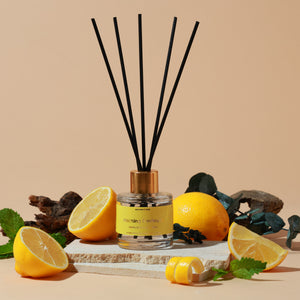


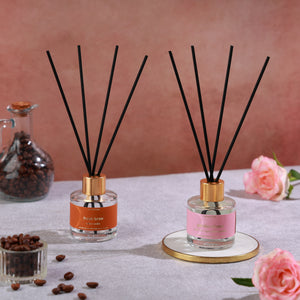
For the whole evening, with no effort at all: a reed diffuser from ₹749. Passive capillary diffusion, silent, no power, no water, nothing to switch on, about ₹13–₹15 a day. It builds slowly to a steady level and then holds it for weeks.
For both at once: active diffusion — Sukoon ₹1,899 for ultrasonic water mist over 270–320 sq ft, or Safar ₹3,999 for waterless cold-air nebulising of undiluted oil. Both let you run a burst before people arrive and then drop to a low level, which is exactly the shape a first impression wants.
The disclosure: Safar is named and sold as a car and travel diffuser. SOSA’s own product page also lists handbag, desk, bedside and hotel room among its uses, so the recommendation is legitimate — but SOSA publishes no room-coverage figure for it, and you should know the word “car” is on the box before you buy rather than after.
The honest gap: there is no SOSA room spray at all, and between Safar and the ₹11,999 Vaayu — rated to 1000 m³, roughly 2,000–3,000 sq ft — there is no mid-sized waterless machine built for one room.
2. Understand the spray for what it physically is: one dose, released at once, with nothing behind it. An aerosol or pump spray puts its whole payload into the air in a second, usually carried on alcohol, which travels fast and then leaves. That gives an extremely high concentration for a very short time and then a steep decay, because there is no reservoir replacing what disperses and settles. That is not a flaw in any particular product; it is what a spray is. It also means the effect is entirely dependent on you being there to press it, which is the reason it fails as a first-impression strategy the moment your guests are ten minutes early. SOSA does not make a room spray — every SOSA spray is a car perfume — so I have no product to sell you in this row and no reason to soften it.
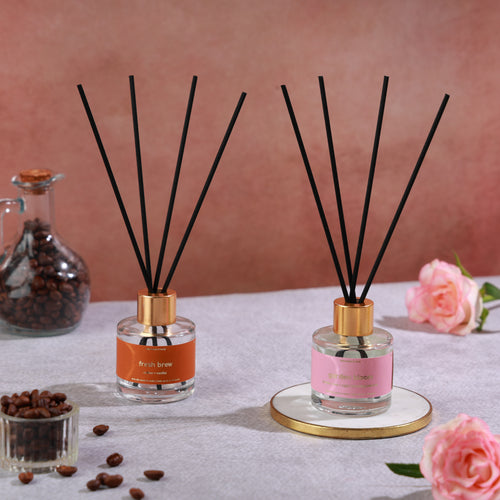
3. Understand the reed for what it physically is: a source at equilibrium. Oil climbs six fibre reeds by capillary action and evaporates from their surface at whatever rate the room’s temperature, humidity and airflow allow. Nothing is pushed. That gives a slow build over the first day or two, then a flat, unglamorous, extremely reliable level for six to eight weeks on a 50ml. The concentration is highest at the bottle and falls with distance, so what you get is a fragrant zone rather than a fragranced room. It cannot produce a doorway event. It can absolutely produce a room that has smelled consistently of one thing all evening, which is a different and, for most homes, more valuable achievement.
4. Understand active diffusion for what it physically is: a source with a throttle. Ultrasonic water mist — a piezo plate vibrating a water-and-oil mixture into a visible wet mist — moves air and covers a room, at the cost of dilution, refilling and added humidity. Waterless cold-air nebulising shatters undiluted oil into a dry micro-mist that travels with the room’s own airflow, with no water, no dilution, no added humidity and no white mineral dust. Either way, the thing you are buying is not a better smell. It is control: intensity you can raise before people arrive and lower afterwards, on a schedule you set.
5. Then check the free thing before you spend, because for a great many people it is the answer. If the room you want the impression in is at the top of its size, use all six reeds rather than three; if it is above about 150 sq ft, the 130ml is the specified size and a 50ml in that room is performing correctly while reading as weak. Move the bottle out of a corner into the path air already takes — but slightly inside the entrance rather than on it, because a doorway is the most turbulent point in a home. That costs nothing and it fixes more “weak” complaints than any purchase on this page.
Alcohol-free, phthalate-free, paraben-free, IFRA-compliant, 0 ppm formaldehyde. Free shipping above ₹499, and a portion of every order supports girl-child education through Nanhi Kali.
The three categories, and what each one is actually doing to the air
Almost every comparison of these three is written as though they were three strengths of the same thing, with the spray as the loud one, the reed as the quiet one and the machine as the expensive one. That framing is wrong and it is why people keep buying the wrong one. They are three different relationships between a source and a room. One releases everything at once and stops. One releases slowly and never stops. One releases at a rate you choose, for a period you choose. Everything else — the reach, the longevity, the first-impression behaviour, the cost — falls out of that difference, and once you can see it you can predict how any product in any of the three categories will behave without smelling it.
 Morning Freshness₹749I want to be scrupulous here, because we have nothing to gain from this row. A room spray genuinely is the fastest way to raise the fragrance concentration in a room, and nothing in our catalogue competes with it on that one measure. The mechanism is simple: the whole dose enters the air in an instant, in fine droplets, most of them carried on alcohol. Alcohol is very good at carrying fragrance quickly and then leaving, which is exactly what you want in something meant to act in seconds and exactly what you do not want in something meant to run for weeks. From the moment you stop pressing, the concentration only goes down — air exchanges, droplets settle onto surfaces, and there is nothing behind the first dose to replace them. That is the whole shape.
 Evening Calm₹799A reed diffuser has no energy input and moves no air. Oil climbs six fibre reeds by capillary action, wets their surface, and evaporates into whatever air happens to pass. The rate is set by the room rather than by you — temperature, humidity and airflow do the deciding — which is why the same bottle reads differently in a cool sealed study and a warm open kitchen. The consequence for first impressions is unavoidable: there is no way to make a reed do something at eight o’clock that it was not already doing at seven. It has no burst in it. What it has instead is a level, and the level is remarkably durable: 6–8 weeks on a 50ml, 14–18 on a 130ml, with reed count as the volume dial — six for full projection, three for a soft bedside level and roughly double the life.
 Sukoon₹1,899Active diffusion is not one thing, it is two, and the difference matters for a first impression. Ultrasonic water mist — Boond ₹899, Sukoon ₹1,899, Megh ₹3,499 — uses a piezo plate to shatter a water-and-oil mixture into a visible wet mist. It genuinely moves air and covers a room; the oil is diluted in water, the output adds humidity, and in hard-water cities it can leave a white mineral dust. Waterless cold-air nebulising — Safar ₹3,999, Vaayu ₹11,999 — uses pressurised air to shatter undiluted oil into a dry micro-mist. Same oil, different payload per droplet, which is most of the perceived intensity difference between the two. This is the technology hotels actually use, and the honest reason a lobby behaves as it does.
The first sixty seconds, the first ten minutes, and the evening
Here is the part that makes the comparison decidable rather than a matter of taste. Take one guest arriving at eight and staying until eleven, and ask what each category is doing at four points in that evening. At sixty seconds, if you sprayed just before the bell, the spray is at a concentration nothing else on this page reaches — and your guest, arriving un-adapted from outside, will register it clearly. At ten minutes the spray has decayed substantially, and your guest has begun adapting to whatever is in the room; olfactory receptors stop reporting a constant, unchanging stimulus within minutes. At an hour the spray is essentially over, and only a continuous source is still producing anything. At eleven o’clock the reed is at precisely the level it was at seven, having done nothing dramatic all evening, and the room has smelled of one coherent thing throughout — which is, in the end, most of what people mean when they say a house smells expensive.
The uncomfortable implication is that the spray’s advantage is real and it is also almost entirely a timing trick. It requires you to be standing there with a bottle a minute before somebody arrives, which works for an invited dinner and fails for everything else: the friend who comes early, the neighbour at the door, the courier, the family who live there. It also has the specific failure mode everybody has experienced from the receiving end, which is walking into a room where something has obviously just been sprayed over something else. Adding a pleasant odour to an unpleasant one produces a mixture rather than a cancellation, and the mixture is frequently worse, because the brain now has two things to track. Fragrance does not remove a smell. Source, then ventilation, then fragrance — air the room before, never spray over it.
Active diffusion resolves the timing trick by automating it, and that is genuinely the whole of its advantage over the other two. You are not buying more fragrance; you are buying the ability to put the peak where you want it without being in the room. Run a device up before people arrive and let it drop back afterwards, and you get a doorway moment and a liveable evening from one machine and one oil. That is the shape a hotel uses, at a scale a hotel needs, and it is why the same oil in the same room feels so different coming out of a machine than off a set of reeds. The cost is not just the sticker price. It is power, refilling or recharging, cleaning, and a small appliance in a room where you may have wanted a glass object on a console table.
| Category | Mechanism | First 60 seconds | After an hour | What it costs you |
|---|---|---|---|---|
| Spray (no SOSA product) | One manual dose released at once, usually alcohol-carried, no reservoir behind it | Wins outright — the highest concentration, fastest | Largely gone. Air exchange and settling, with nothing replacing it | You have to be there to press it, every time |
| Passive capillary — reed diffuser | Oil climbs six fibre reeds and evaporates. No power, no air moved, no control | Loses. It cannot produce an event; it was already doing this at seven o’clock | Wins. Exactly the same level it had all evening, for 6–8 weeks | ₹749–₹849, about ₹13–₹15 a day, and no attention at all |
| Ultrasonic water mist — Sukoon | A piezo plate shatters oil diluted in water into a visible wet mist, and moves air | Strong, if you run it up beforehand. Not instant, but genuinely fast | Still going — 270–320 sq ft, 16–18 hours on low | ₹1,899, plus power, refilling, dilution, added humidity, possible white dust |
| Waterless cold-air nebulising — Safar | Pressurised air shatters undiluted oil into a dry micro-mist. No water, no dilution, no white dust | Strong at personal scale. Three speeds, so you can put the peak where you want it | Depends on the timer — 1, 2 or 3 hours, then it stops | ₹3,999, recharging, no published room-coverage figure, and it is sold as a car diffuser |
| The honest gaps, both of them: SOSA does not make a room spray, so if the spray column is what you want, we are not the answer and I would rather say so than sell you something adjacent. And between Safar at personal scale and Vaayu ₹11,999 — rated to 1000 m³, roughly 2,000–3,000 sq ft, and plainly the wrong purchase for one bedroom — there is no mid-sized waterless machine built for a single room. | ||||
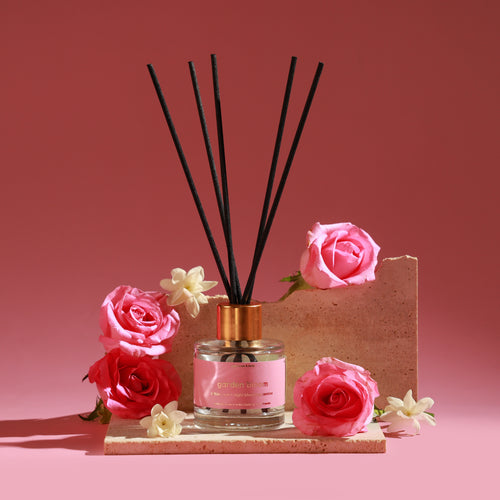
Passive · Garden Bloom₹799Shop →  Active, with water · Sukoon₹1,899Shop →
 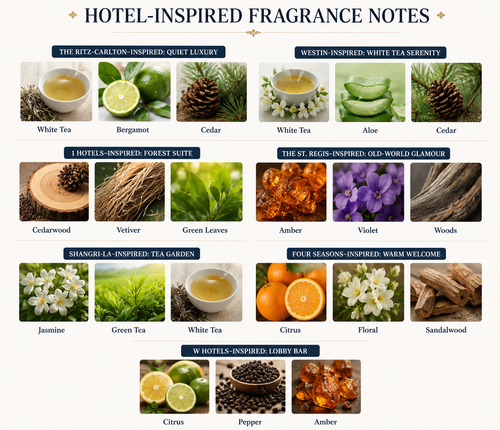 For the machine · Hotel Collection₹999 / 100mlShop →
What the reed does that neither of the others can
Having spent two sections explaining why a reed diffuser cannot win the first sixty seconds, I want to be equally precise about the column it wins outright, because it is our core product and because the win is real. It is silent. No fan, no piezo hum, no pump, nothing that turns on in the night. It uses no power, so a cut does not interrupt it and there is no cable to hide. There is nothing to fill, nothing to charge, nothing to descale, no timer to remember and no app to open. It cannot be left running by accident because it is always running, and it cannot be forgotten because there is nothing to forget. It costs roughly ₹13 to ₹15 a day. And it looks like a glass object on a table rather than a small appliance, which is the honest reason a great many people would not put a machine in a bedroom or a hallway at any price.
There is also a specific way to use a reed for arrival that works better than most people expect, and it comes straight from the mechanism rather than from optimism. Since the concentration is highest at the bottle and falls with distance, put the bottle where the person will be, not where the door is. Slightly inside the entrance, on a console, out of the draught — an entrance is the most turbulent point in a home, and anything placed on the threshold itself gets repeatedly stripped by the door opening and then hit at close range when it is not. A metre or two inside, at chest height, in the path air already takes, gives a better first impression and a longer bottle. And use the size the room is specified for: a 50ml is built for up to about 150 sq ft, a 130ml for above it, and a 50ml in a 300 sq ft open-plan room reads as weak while performing exactly to specification.
The last thing in the reed’s favour is the one people find hardest to believe until they have lived with it, which is that consistency reads as luxury more reliably than intensity does. A room that smells of the same thing every day for two months, at a level nobody has to think about, is doing what a hotel does — a hotel’s signature is memorable largely because it is held constant for years, not because it is loud. A room that is dramatic on Saturday and neutral on Wednesday reads as an event rather than as a home. If you can only have one of the two, the flat line is usually the better buy, and it is by a distance the cheapest.
What to buy, in order — and the two things that are missing
In the order I would actually spend, starting with the row that costs nothing. The last row is the gap in our own range, stated plainly, because on this particular page there are two of them and pretending otherwise would be the easiest thing in the world.
| Do this | What it is | When it is the right answer | Price |
|---|---|---|---|
| 1. Fix the dose and the placement ★ | All six fibre reeds rather than three in the room people enter first; the 130ml if that room is above ~150 sq ft; the bottle slightly inside the entrance and out of the draught, never on the threshold; flipped every 3–5 days | First, always. It is free, and an under-dosed room is the single commonest reason a first impression does not land | ₹0 |
| 2. A reed in the entry room | Passive capillary. Six fibre reeds, refillable glass, 6–8 weeks on 50ml and 14–18 on 130ml, silent, no power, no water, about ₹13–₹15 a day | When you want the room to smell consistently of one thing all evening and you do not need a doorway event | ₹749–₹1,349 |
| 3. Sukoon — the value answer for both | Ultrasonic water mist. 500ml, 270–320 sq ft, 16–18 hours on low, three 15ml Hotel Collection scents included. Run it up before people arrive, drop it after | When you want a real arrival moment and a covered room, and you can accept dilution, refilling and added humidity | ₹1,899 |
| 4. Safar — undiluted, at personal scale | Waterless cold-air nebulising. 20ml, 2000 mAh Type-C, up to 10 hours continuous or ~30 intermittent, 3 speeds, 1/2/3-hour auto-off, 6.9 cm. Named and sold as a car and travel diffuser, with handbag, desk, bedside and hotel room among its stated uses | When you want the hotel mechanism and no added water. No published room-coverage figure — personal and small-space scenting, and it needs recharging | ₹3,999 |
| Not for one room: Vaayu | Waterless cold-air nebulising at building scale. 1000 m³, 400ml lasting about 90+ days, Bluetooth scheduling in 1h/4h/8h/24h windows, under 38 dB | Only for an open-plan living-dining, a whole floor, a large home, a villa, a clinic, a salon or a reception. In one bedroom nine-tenths of it is wasted | ₹11,999 |
| Never a coverage upgrade: Megh | 6L tank, around 100 hours of runtime, about 215 sq ft — less than the ₹1,899 Sukoon | A runtime and humidity machine. It is the easiest product in our own range to misread as the bigger one | ₹3,499 |
| The honest gaps | There is no SOSA room spray — every SOSA spray is a car perfume — so the fastest-acting column on this page has no product of ours in it. And no mid-sized waterless bedroom nebuliser exists between Safar and Vaayu | Both said plainly rather than papered over. If a spray is genuinely what you want, buy one; I am not going to point you at the nearest thing we happen to sell | — |
Versailles
This is the only page in the series where the honest answer to part of the question is a product category we do not sell, and I decided early that I would rather write it that way than not write it. If what you actually want is the highest possible concentration in the shortest possible time, a spray does that and nothing of mine does. There is no SOSA room spray. Every spray we make is a car perfume. I have not priced anybody else’s, and I am not going to, because a comparison written by a manufacturer is worth reading only if the manufacturer is willing to lose a row.
What I would push back on is the assumption underneath the question — that a first impression is a strength contest. It is not. It is a concentration at a threshold met by a nose that has not yet adapted, and the reason a hotel does it so well is not that the oil is louder but that a machine is putting a consistent level into moving air on a schedule, in the same scent it has used for years. Consistency is doing at least half of the work you are attributing to intensity. That is also why the cheapest genuine improvement available to most people is not a purchase at all: use six reeds instead of three in the room people walk into, buy the size the room is specified for, and move the bottle a metre inside the door and out of the draught.
And then be honest with yourself about how long you need the impression to survive. If it is sixty seconds, buy a spray from somebody who makes one. If it is an evening, buy a reed — ours is silent, unpowered, refillable and about ₹13 to ₹15 a day. If it is both, you want a machine, and you should know before you spend that our small waterless one is named and sold as a car diffuser with no published room coverage, and that the one above it is built for a whole floor. Everything is composed in Pune, and part of every order funds a girl’s classroom through Nanhi Kali.
Frequently asked questions
- How hotels do it in seconds — threshold concentration and a scent held constant for years.
- The “wow, your home smells amazing” effect — one scent, one room, ventilate before.
- Guests noticing before they sit down — placement inside the entrance, out of the draught.
- An arrival moment at the bedroom door — why a closed door is the cheapest tool you own.
- Nice once you sit inside, but no immediate impact — the concentration gradient explained.
- A signature scent at your own bedroom door — and the honest limit on getting it yourself.
- Why you notice a lobby and not your own home — olfactory adaptation, and the fifteen-minute test.
- Arrival effect vs continuous background — two setups in tension, and how to choose.
- Stronger fragrance or better diffusion? — the pillar, and the one free exception.
- Brand: the SOSA founder story.
Facts verified August 2026: Three diffusion mechanisms are described — passive capillary (reed diffusers), ultrasonic water mist (Boond ₹899, 300ml, up to ~150 sq ft, ~6 hours, USB, night light; Sukoon ₹1,899, 500ml, 270–320 sq ft, 16–18 hours on low, three 15ml Hotel Collection scents included; Megh ₹3,499, 6L tank, ~100 hours runtime, ~215 sq ft, which is less coverage than Sukoon and never a coverage upgrade) and waterless cold-air nebulising (Safar ₹3,999, 20ml bottle, 2000 mAh Type-C battery, up to 10 hours continuous or around 30 hours intermittent, 3 speeds, 1/2/3-hour auto-off timer, 6.9 cm, named and sold as a car and travel diffuser with car, handbag, desk, bedside and hotel room among its stated uses, no published room-coverage figure; Vaayu ₹11,999, coverage up to 1000 m³ or roughly 2,000–3,000 sq ft, 400ml refillable tank lasting up to about 90+ days, Bluetooth app and onboard buttons, 1h/4h/8h/24h run windows, adjustable intensity, key-lock, under 38 dB, freestanding or wall/HVAC mount, 5W, CE, RoHS, SGS). SOSA reed diffusers: five scents, 50ml ₹749–₹849 lasting 6–8 weeks and suiting rooms up to ~150 sq ft, 130ml ₹1,249–₹1,349 lasting 14–18 weeks and suiting above 150 sq ft, six fibre reeds included and flipped every 3–5 days, six reeds for full projection and three for a soft bedside level, about ₹13–₹15 a day, heat-stable CCT carrier rather than DPG, alcohol-free, phthalate-free, paraben-free, IFRA-compliant, 0 ppm formaldehyde, refillable glass bottle, climate-tested at 45°C and 85% RH, composed in Pune. SOSA strength scale: Evening Calm 8.9, Garden Bloom 8.9, Morning Freshness 9.0, Mountain Breeze 9.4, Fresh Brew 9.5. Duos are two 50ml bottles at ₹1,498–₹1,598; 130ml duos ₹2,498–₹2,598; refills 300ml ₹2,399 and 500ml ₹3,499, oil only and never a first purchase. Hotel Collection fragrance oils are water-based and ultrasonic-only at 15ml ₹299 (a refill), 100ml ₹999, 300ml ₹1,799 and a pack of seven at ₹1,799; they cannot be used in reed diffusers and reed oil cannot be used in ultrasonic machines, so no hotel-inspired reed diffuser exists. Free shipping above ₹499. A portion of every order supports girl-child education through Nanhi Kali. SOSA is an independent Indian fragrance house; the Hotel Collection scents referenced here are SOSA’s own interpretations inspired by the world’s finest hotels, and SOSA is not affiliated with, endorsed by or a supplier to any hotel brand. Prices subject to change — see the live product pages.