

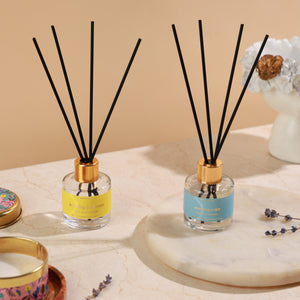

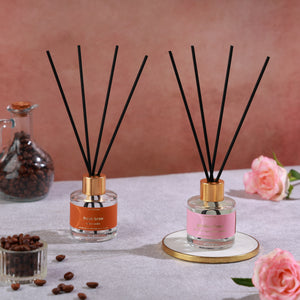

Why not six: a bottle in every room of a 3BHK at 130ml each is ₹7,494. Two of those rooms are borrowing through open doors and one is a kitchen.
What changes with eight people: the shared bottle. Expect 14 weeks rather than 18 — about ₹89 a week instead of ₹78 — because the doors are opening all day.
2. Count doors, not people. This is the rule that saves you the most money and it does not care how many of you there are. Fragrance does not pass a closed door and passes an open one freely, so a 1,150 sq ft 3BHK with every bedroom door shut is five or six air spaces and the same flat with the doors hooked back is one large volume plus the bathrooms. A bottle in each of six rooms at 130ml is ₹7,494, and in most joint-family homes at least two of those rooms are open to a space you have already scented. Four bottles at ₹3,546 is ₹3,948 less for the same result.
3. What eight people genuinely change is the running cost. A busy household opens the front door forty times a day, cooks two or three times, and keeps internal doors moving from six in the morning until late. A closed, still room exchanges roughly 0.2 to 0.5 of its air an hour; a household in constant motion pushes the shared space well past that. So expect the living-dining 130ml at about fourteen weeks rather than eighteen — roughly ₹89 a week instead of ₹78. That is the honest premium for a full house, and it is a running-cost difference, not a bottle-count one.
4. One neutral blend in the shared space, character behind the doors. A joint-family living room is a negotiated space with six or eight votes in it, and fragrance is the one furnishing everybody has an opinion about. Run something clean and broadly liked there — Morning Freshness or Mountain Breeze — and save the strongly characterful blends for bedrooms, where one person chooses for one room behind a door that closes. This is not a compromise; it is the only arrangement that survives a year.
5. And leave three spaces off the list entirely. The kitchen, because an extractor pulls the air out of it by design and no passive source holds a room that is being emptied. The corridor, because it is crossed in four seconds. And any bedroom whose door stands open onto the living-dining all day — it is already borrowing, and if it reads flat when someone uses it, closing that door for two hours does more than a ₹1,249 bottle would.
Made in India, composed by an ISIPCA Versailles-trained perfumer — and a portion of every order supports girl-child education through Nanhi Kali.
Why more people does not mean more bottles
Coverage is a property of a room, not of the household inside it. A 150 sq ft bedroom under a nine-foot ceiling contains about 1,350 cubic feet of air whether one person sleeps there or three, and a reed diffuser on six reeds holds a closed, still room of up to about 150 sq ft either way. People do not dilute fragrance. They move it. So the counting rule for a joint family is exactly the counting rule for anybody else: count the doors that are genuinely closed for hours at a time, add one for the shared volume, and that is close to your bottle count. In a typical 3BHK that is four, not six, and the two rooms that fall off the list are usually a bedroom with its door hooked back and a kitchen.
Where a full house is genuinely different is in the rate at which air is replaced, and that shows up as running cost rather than coverage. A closed, still room exchanges roughly 0.2 to 0.5 of its air an hour. A living-dining in a household of eight — front door opening constantly, the kitchen working, someone crossing the room every few minutes — sits far above that, and a passive evaporative source cannot charge air that is being carried away. The visible consequence is that the shared bottle finishes at fourteen weeks rather than eighteen, taking it from about ₹78 a week to about ₹89. The invisible consequence is more interesting: the room reads a little quieter than the same bottle would in a still flat, and the temptation is to buy a second bottle for it. Resist that. A second bottle in one room buys a second starting point, not a wider circle. The exception is shape — an L-shaped living-dining, or a run longer than about twenty-two feet, both of which are common in 3BHK plans and are a genuine reason for two sources rather than one.
The three decisions for a full 3BHK
 Four bottles₹3,546One 130ml at ₹1,249 in the living-dining. One 50ml at ₹799 and one at ₹749 in the two bedrooms whose doors genuinely close. One 50ml at ₹749 in the shared bathroom. ₹1,249 + ₹799 + ₹749 + ₹749 = ₹3,546. A 130ml in each of six rooms would be ₹7,494 — ₹3,948 more for two rooms that are already borrowing through open doorways and a kitchen that cannot hold anything. Walk the flat at nine in the evening and count which doors are actually shut; that number is the honest one.
Sizing by space — a 3BHK with eight people in it
Mark which of these rooms you actually have and which doors are genuinely shut. Three rows here cost nothing, and in a joint family they are the three rooms people most often buy for.
| Space | What it needs | How many | Cost |
|---|---|---|---|
| Living-dining, 220–280 sq ft, in use from morning to late evening ★ | One 130ml on six reeds, off the front-door line — expect 14 weeks rather than 18 | One 130ml | ₹1,249 |
| Grandparents' bedroom, door closed at night | One 50ml on three reeds — long occupancy needs less, not more, because everyone in it adapts | One 50ml | from ₹749 |
| A second bedroom, door genuinely closed for hours | One 50ml on three or four reeds, and the blend is that room's own choice | One 50ml | from ₹749 |
| Shared bathroom in constant use | One 50ml on two or three reeds. Six reeds in 40 sq ft is not stronger, only faster | One 50ml | from ₹749 |
| The third bedroom, used as a study or store with the door open | Nothing. It borrows from the living-dining and nobody sits in it long enough to notice | None | ₹0 |
| The kitchen, extractor running through three meals a day | Nothing. A passive source cannot hold air that is being pulled out of the room by design | None | ₹0 |
| A note on all of the above: coverage of up to about 150 sq ft on six reeds assumes a closed room, still air and a standard ceiling — a condition a busy joint-family flat rarely meets during the day. Expect the shared bottle at the faster end of its range, and note that an L-shaped or unusually long living-dining is a real reason for a second source, where household size on its own is not. | |||
One room · the unitFrom ₹749Shop → 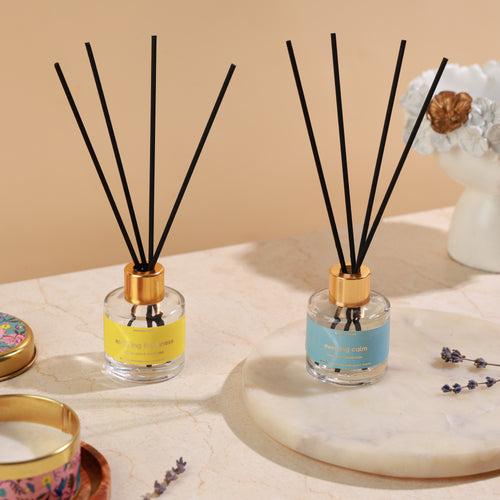 Two rooms · better value₹1,498Shop →
  Large room · a switch₹1,899Shop →
Reeds, placement, and a house with children and elders in it
Six reeds in the shared room, three or four in the bedrooms, two in the bathroom. Reed count is the only volume control a reed diffuser has, and it moves strength and lifespan together. The living-dining genuinely needs all six because the volume is large and the air keeps moving; a bedroom occupied for eight hours does not, and three reeds there is both the right level and the longer bottle. There is a specific point for a full house here: people who are home all day are the worst judges of their own rooms, because olfactory adaptation is essentially complete within about twenty minutes. Ask whoever visits, or judge on your own first breath after being out — not from the sofa where you have been sitting since lunch.
Placement matters more in a busy flat than in a quiet one, and safety matters most of all. Keep bottles above the reach of children and away from where anyone might catch them with a bag or an elbow — a console at the side of the living-dining rather than a low centre table, a chest of drawers rather than a bedside within arm's reach of a cot. Stand every bottle on a tray or coaster: reed oil marks polished wood permanently and is difficult to remove from fabric. Keep them out of direct sunlight, off the path of an AC vent or ceiling fan, and out of the straight line between the front door and the balcony, which in a joint family is the busiest air in the house and the fastest way to empty a bottle you have just bought.
Then standardise, because a full house has too many moving parts already. If all four bottles run the same blend, one 300ml refill at ₹2,399 tops up any of them, nothing sits half-used, and there is no argument about which room gets what when a delivery arrives. Let the bottles drift out of step deliberately rather than filling everything on one day, so the whole flat never goes quiet at the same time. Fit fresh reeds at every refill — clogged fibre, not empty liquid, is the usual reason a house that smelled right in month one reads tired in month four. And for the bedroom that wants its own character, Evening Calm is the quietest of the five to sleep in.
What to buy
Four lines cover a full 3BHK. Here is what each option in the range is genuinely for in a household this size.
| Buy | What it covers | Lasts | Price |
|---|---|---|---|
| One 50ml | A single reed diffuser — each bedroom that closes, and the shared bathroom — three or four reeds, and that room's own choice of blend | 6–8 weeks | from ₹749 |
| One 130ml ★ | The value size — the living-dining on six reeds — budget fourteen weeks and about ₹89 a week in a busy house | 14–18 weeks | from ₹1,249 |
| The duo | Day & Night duo — two bedrooms started together, if two members of the household want their own blend at once | 6–8 weeks each | ₹1,498 |
| Sukoon | 500ml ultrasonic — a living-dining past about 300 sq ft, where a passive bottle is being asked to hold more than it can | Runs when you switch it on | ₹1,899 |
| 300ml refill | The running cost — the running cost, once all four bottles share one blend and any of them can take a top-up | Roughly 2 × 130ml fills | ₹2,399 |
Versailles
The assumption I most often have to unpick with joint families is that more people means more product. It does not. A 3BHK has the same rooms and the same air whether two of you live there or nine. What changes is how fast the shared bottle goes, and my honest advice is to budget for fourteen weeks in a busy living room rather than the eighteen a quiet flat gets.
The harder problem in a full house is not sizing at all. It is that a living room belongs to everybody, and fragrance is the one thing in it that you cannot look away from. I have sat with families where one person has silently disliked the hall for months. So keep the shared space clean and uncomplicated, and let people have what they want behind their own doors. That is where the interesting blends belong anyway.
And skip the kitchen. I say this constantly and it is still the most common line on a joint-family list. The extractor is doing its job — pulling the air out of the room — and a passive diffuser standing in that airflow is money going straight out of the duct. Put the ₹749 into the bathroom instead, which is used by everybody, several times a day, and which almost nobody thinks to buy for. A portion of every order funds a girl's classroom through Nanhi Kali.
Frequently asked questions
- Does a household of four need more than one? — people move it, they do not dilute it.
- When the family is home all day — adaptation, and why you over-buy.
- Counting doors, not square feet — the rule this whole answer rests on.
- The complete sizing and quantity guide — every home type, three builds.
- Brand: the SOSA founder story.
SOSA products & prices (verified August 2026): Hotel Collection water-based ultrasonic diffuser fragrance 15ml ₹299 · 100ml ₹999 · 300ml ₹1,799 · Pack of 7 (15ml, all fragrances) ₹1,799; refills 100ml from ₹999. Seven scents: The Ritz-Carlton-inspired (white tea · bergamot · cedar), Westin-inspired (white tea · aloe · cedar), 1 Hotels-inspired (cedarwood · vetiver · green leaves), The St. Regis-inspired (amber · violet · woods), Shangri-La-inspired (jasmine · green tea · white tea), Four Seasons-inspired (citrus · floral · sandalwood), W Hotels-inspired (citrus · pepper · amber). Diffusers: Boond 300ml ₹899 · Sukoon 500ml ₹1,899 · Megh 6L ₹3,499. Water-based, phthalate-free, composed to IFRA standards for home diffusion; 3–6 drops per tank. Made in India, Pune. The Hotel Collection scents are SOSA's own interpretations inspired by the world's finest hotels; all hotel names are trademarks of their respective owners and are used only to describe the scent style — SOSA is an independent Indian fragrance house, not affiliated with or endorsed by any hotel brand. Prices and availability subject to change — see the live product pages.