


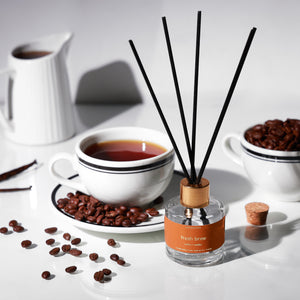

Where the ceiling comes from: a reed moves no air. Vapour leaves the reeds and then waits for the room to carry it, and a still room carries it almost nowhere. Every reed diffuser ever made shares that ceiling.
The free version of what you want: a ceiling fan on low in a closed room. It is the transport a reed lacks, it is already installed, and it will get you closer to the effect than any number of sticks. It shortens the bottle, which is the honest cost.
The paid version: active diffusion. Sukoon ₹1,899 covers 270–320 sq ft and moves air, and is very often the right bedroom answer. Vaayu ₹11,999 is the hotel technology, rated to roughly 2,000–3,000 sq ft, and is the wrong purchase for one bedroom.
The honest gap: between Safar ₹3,999 — named and sold as a car and travel diffuser — and Vaayu, we have no mid-sized waterless machine built for a single bedroom.
2. The word you used is borrowed from personal fragrance, and the borrowing is the problem. On skin, projection describes how far a scent throws off a wearer who is walking about, warm, and constantly stirring the air around themselves. A bottle on a shelf has none of those advantages. Translate the ambition into a room and it becomes a transport specification, which no dose satisfies.
3. What you are actually picturing is a hotel lobby or a good hotel room, and that is a different technology. Waterless cold-air nebulising shatters undiluted oil into a dry micro- or nano-mist that travels with the air the building is already moving. No water, no dilution, no added humidity, no white dust. It is the effect where fragrance is simply present on arrival, everywhere, with no object to trace it back to.
4. Free first, and it will surprise you how far it gets. Ceiling fan on low in a closed room, bottle at nose height on a surface within reach of where you sit, out of the direct draught but not in a dead corner, door shut. A fan is transport, delivered by something already screwed to your ceiling. It will not be a hotel lobby. It will be a materially different room, at no cost, and it is the change I would make before spending anything.
5. If free is not enough, buy the mechanism, not more of the substance. Sukoon ₹1,899 is the honest first machine — 500ml, 270–320 sq ft, 16–18 hours on low — and should never be skipped on the way to something dearer. Do not buy Vaayu ₹11,999 for one bedroom; it is rated to 1000 m³, roughly 2,000–3,000 sq ft, and nine-tenths of it would be wasted in 120 sq ft.
Alcohol-free, phthalate-free, IFRA-compliant, composed in Pune. A portion of every order supports girl-child education through Nanhi Kali.
What “monster projection” actually describes
It is worth unpacking the phrase, because people who use it know exactly what they mean and are rarely given a straight answer. They mean fragrance that is already there. Not a scent you find by approaching a bottle, but one that meets you at the door and is present in the middle of the room, at the far end, and in the space you were not expecting. Crucially, they mean it without an object in view. The signature of the effect is that you cannot locate the source.
That signature is diagnostic, and it rules out passive diffusion by definition. A reed diffuser cannot produce an unlocatable fragrance, because the fragrance is at its strongest precisely where the bottle is — that is what a point source means. The gradient is smooth, but perception compresses it, so the room reads as a corner with an edge rather than a slope. You can raise the height of that corner as much as the bottle allows. You cannot make the corner stop being the place the smell comes from.
And this is why the hotel comparison keeps coming up in these conversations. People ask why they can never find the diffuser in a hotel room, and the honest answer is that there often is not one in the room to find. The scent is introduced into the air the building is already circulating, so it arrives with the air rather than radiating from a table. That is a transport-first design. It is a completely fair thing to want at home, and it is worth knowing that what you are admiring is an air-handling decision rather than a stronger perfume.
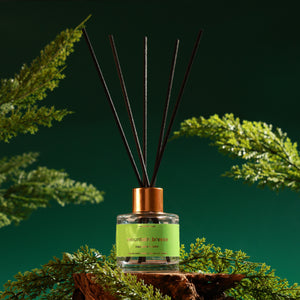
 Mountain Breeze₹849A machine converts electricity into air movement or into pressure that shatters a liquid. A reed converts nothing. Capillary action lifts oil up the fibre, and evaporation carries it into the layer of air touching the reed, and there the process ends as far as the device is concerned. Everything after that belongs to the room. This is not a shortcoming to be engineered out at a higher price point — it is the reason the object is silent, needs no socket, has nothing to fill or charge, and carries on working through a power cut.
 Garden Bloom₹799Concentration around a point source falls away sharply with distance. Multiply a sharply falling curve by a modest factor and the point at which it crosses your detection threshold moves very little — you raise the whole curve without changing its shape. This is why the sixth reed is clearly audible at the bottle and inaudible at the far wall. It is also why chasing the far wall by dose is an unbounded exercise: each addition costs you weeks of bottle life and returns a few centimetres of edge.
 Evening Calm₹799This one is worth knowing before you spend anything. Receptors adapt to a constant stimulus within minutes: the molecules keep arriving and the brain stops reporting them. A room scented to a level a visitor finds strong will feel ordinary to the person living in it within a quarter of an hour. So a home fragrance you can smell continuously is generally set too strong for the room rather than correctly strong — it is meant to be noticed on arrival and at transitions. Test with the fifteen-minute walk-back, and ask a visitor. A visitor is a better instrument than you are.
The ceiling is physics, not a SOSA limitation
I want to be careful here, because it would be easy to read this page as a brand explaining away its own product. So let me put it plainly: every reed diffuser in the world shares this ceiling. A ₹500 reed and a ₹5,000 reed both work by capillary action and evaporation, and neither moves air. A luxury brand's rattan sticks do not have an engine in them. If a listing promises you room-filling projection from a passive bottle, it is describing a wish rather than a mechanism, and it is worth being sceptical of the numbers next to that promise too — nobody, us included, publishes an honest projection distance for a reed diffuser, because it depends on the volume of your room, whether the door is shut and what the air is doing.
The one thing I would add, in fairness to the object you already own, is that the ceiling comes with a floor nothing else has. A reed diffuser is silent. It uses no power and no water. There is nothing to fill, nothing to charge, nothing to switch on and nothing to remember. It works during a power cut. It costs roughly ₹13–₹15 a day for a 50ml, which is a fairer reading of ₹749 than the sticker price. It is an object rather than an appliance, and it never breaks. Those are not consolation prizes — for a bedside table they are frequently the deciding factors, and plenty of people who could afford a machine still keep a reed where they sleep.
There is also a failure mode in chasing intensity that I would rather warn you about than watch. Dose is what separates a fragrance that reads as expensive from the same fragrance reading as cheap. Almost any composition, pushed to too high a concentration, collapses into one flat sweet or sharp impression — the thing people are describing when they say a room smells like an air freshener. It is nothing to do with the quality of the materials. So a reader who keeps adding sticks in pursuit of a monster can end up with a corner that is too much and a room that is still quiet, which is the worst of both, and a bottle finished in half the time.
What each mechanism can and cannot deliver
Three ways of putting fragrance into a room, marked against the specific outcome you asked for. I have not scored anything on price here, because the honest point is that the outcome is not for sale on the reed shelf at any price.
| Mechanism | How it moves fragrance | Can it produce the effect? | What it costs you |
|---|---|---|---|
| Reed diffuser, any stick count | Capillary rise and evaporation. No air moved | No — a fragrant zone, not a fragranced room. This is the design, not a defect | Nothing but bottle life, which more reeds spend faster |
| Reed plus a ceiling fan on low | The room's own air, deliberately circulated past the bottle | Much closer than you would expect, and free | Bottle life again, plus having the fan on |
| Ultrasonic — Sukoon ₹1,899 | A piezo plate throws a water-and-oil mist outward; 270–320 sq ft, 16–18h on low | Yes, within its coverage and while it is running | Oil diluted in water, added humidity, possible white dust in hard-water cities, a socket and refilling |
| Waterless at personal scale — Safar ₹3,999 | Pressurised air shatters undiluted oil into a dry mist; three speeds, 20ml, cordless | The right mechanism at a personal scale — and it is named and sold as a car and travel diffuser, with a 1, 2 or 3-hour timer and a battery to recharge, so it is not set-and-forget | Recharging, a small oil bottle, and no room coverage figure exists for it — we publish none and will not invent one |
| Waterless at building scale — Vaayu ₹11,999 | The same dry-mist technology, sized to 1000 m³ — roughly 2,000–3,000 sq ft, under 38 dB, 400ml tank | Yes — this is the effect, properly. And it is the wrong purchase for one bedroom: in 120 sq ft nine-tenths is wasted | ₹11,999, and a scale you almost certainly do not need |
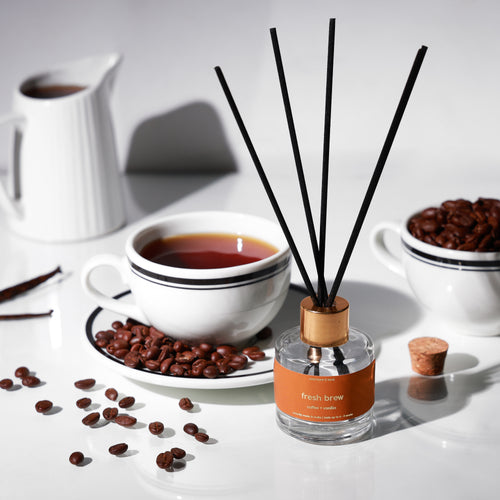
Passive · Fresh Brew 9.5₹849Shop →  Active · Sukoon 270–320 sq ft₹1,899Shop →
  Machine oil · water-based only₹299Shop →
The honest route to the effect you want
Start with the fan, because it is free and because it is genuinely the closest a reed diffuser comes to the thing you asked for. Ceiling fan on low, door shut, bottle at nose height on a surface where you actually spend time. Not directly under the blades at full speed, which dries the reeds and throws everything upward; low and steady, so the room's air turns over past the bottle again and again. What you are doing is borrowing a machine's fan without buying the machine. The cost is bottle life — moving air over the reeds evaporates oil faster — and I would still do it first, every time.
Then remove the things that undo it. An open window or balcony door is not a neutral condition: air that leaves takes the fragrance with it, so a room being aired is not a fragrance environment during those hours, and becomes one the moment the openings close. Cross-ventilation is a straight line between two openings, so keep the bottle off that line. A running AC in a closed room is your friend here, distributing well while drying the air and speeding evaporation — better distribution, shorter bottle. The single placement to rule out is directly in the AC blast, which strips the reeds and throws everything at one wall.
And if that is still not the room you want, buy the mechanism rather than more of the substance — but check the oil before you check the price. Switching mechanism usually means switching scent. Reed oil cannot go into an ultrasonic machine. The water-based Hotel Collection cannot go into reeds. Safar takes pure fragrance oil. The unhappiest messages we receive are not from people whose rooms were too quiet; they are from people who bought a machine assuming their favourite reed scent would come with them. It does not, and knowing that in advance turns a disappointment into a decision.
What I would buy, and what I would refuse to sell you
In order, from free to the machine that genuinely produces the effect — with the two purchases I would talk you out of clearly marked, one of them because of price and one because of what it is actually for.
| Step | What it delivers | When it is right | Cost |
|---|---|---|---|
| 1. Ceiling fan on low, door shut ★ | The transport a reed structurally lacks — the closest free approach to what you asked for | Before spending anything at all | Free, minus some bottle life |
| 2. Reed count set deliberately, not maximally | Six for a large room, three for a bedside — and three roughly doubles the weeks | Once you accept that dose is not the lever for reach | Free |
| 3. Sukoon ultrasonic | 270–320 sq ft on demand, 16–18h on low, three 15ml scents included — a real change of mechanism | The honest first machine, and very often the correct final answer for a bedroom | ₹1,899 |
| 4. Safar waterless | Undiluted oil, no water, no humidity, three speeds, cordless — the waterless mechanism at personal scale | Only with the disclosure: named and sold as a car and travel diffuser, timer runs 1, 2 or 3 hours, battery needs recharging | ₹3,999 |
| The two I would refuse for one bedroom: Vaayu and Megh | Vaayu is the technology behind the effect you described — and it is built for 1000 m³, roughly 2,000–3,000 sq ft, so it earns its price on a whole floor, an open-plan living-dining, a villa, clinic or reception. Megh's six litres buy runtime, not coverage: only about 215 sq ft, less than the ₹1,899 Sukoon | The honest gap: between Safar and Vaayu we have no mid-sized waterless bedroom machine. Nothing in the range is a Vaayu for one room | ₹11,999 / ₹3,499 |
Versailles
I like this question, because the person asking it knows precisely what they want and has simply been pointed at the wrong shelf. Nobody who says “monster projection” is confused about the outcome. They are confused about which quantity produces it — and that is our fault as an industry, because the whole category sells reach in the language of strength.
So here is the sentence I would print on the back of every reed diffuser sold anywhere, ours included. This bottle controls how much fragrance there is. Your room controls where it goes. Once you hold those two apart, the shopping gets simple: if you want more fragrance, adjust the reeds; if you want it further away, adjust the air. And it is worth knowing that the second adjustment starts free.
The part I would not want lost is that none of this is a criticism of the thing you own. A reed diffuser is one of the few objects in a modern home that asks nothing of you — no socket, no water, no filling, no app, no switching on, and it does not stop when the power does. I keep one by my own bed, knowing exactly what it cannot do, because at a bedside the list of things it does not need is worth more to me than a metre of reach. Everything is composed in Pune, and part of every order funds a girl's classroom through Nanhi Kali.
Frequently asked questions
- Will more reed sticks reach further? — higher, not further.
- All the sticks in, and it still stays near the bottle — why the ceiling is structural.
- Projection, or just evaporation? — the deflating but honest answer.
- Five reeds to ten, and still nothing across the room — what to change instead.
- How many reeds do I actually need? — six, three, and the bathroom exception.
- Does over-reeding just finish the bottle faster? — the arithmetic, written out.
- More reeds against better diffusion — the two scored side by side.
- Every reed in the box and still not enough — a completed experiment with a useful result.
- When to stop adding reeds altogether — the stopping rule, as a checklist.
- Brand: the SOSA founder story.
SOSA facts verified August 2026: Reed diffusers in 50ml and 130ml only — Morning Freshness ₹749 / ₹1,249, Evening Calm ₹799 / ₹1,299, Garden Bloom ₹799 / ₹1,299, Mountain Breeze ₹849 / ₹1,349, Fresh Brew ₹849 / ₹1,349. 50ml suits rooms up to about 150 sq ft and lasts 6–8 weeks; 130ml suits above 150 sq ft and lasts 14–18 weeks. Six fibre reeds included; three reeds roughly doubles bottle life; flip every 3–5 days; about ₹13–₹15 a day for a 50ml. SOSA strength scale, perceived intensity only: Evening Calm 8.9, Garden Bloom 8.9, Morning Freshness 9.0, Mountain Breeze 9.4, Fresh Brew 9.5. Alcohol-free on a heat-stable CCT carrier, phthalate-free, paraben-free, IFRA-compliant, 0 ppm formaldehyde, refillable glass, tested at 45°C and 85% RH, composed in Pune. Machines: Boond ₹899, Sukoon ₹1,899 (500ml, 270–320 sq ft, 16–18h on low, three 15ml Hotel Collection scents included), Megh ₹3,499 (6 litres, about 100h runtime, about 215 sq ft), Safar ₹3,999 (named and sold as a waterless car and travel perfume diffuser; 20ml, 2000 mAh, up to 10 hours continuous or about 30 intermittent per charge, three speeds, 1/2/3-hour auto-off timer, 6.9 cm), Vaayu ₹11,999 (waterless cold-air nebulising, up to 1000 m³ or roughly 2,000–3,000 sq ft, 400ml tank, up to about 90+ days, Bluetooth app and onboard buttons, 1h/4h/8h/24h windows, under 38 dB, 5W, CE, RoHS, SGS). Between Safar and Vaayu there is no mid-sized waterless bedroom machine. Reed oil and the water-based Hotel Collection are not interchangeable in either direction, and there is no hotel-inspired reed diffuser. Free shipping above ₹499. SOSA is an independent Indian fragrance house; the Hotel Collection is SOSA's own interpretation inspired by the world's finest hotels, and SOSA is not affiliated with or endorsed by any hotel brand. Prices subject to change — see the live product pages.