



Does it change the running cost? Yes. More traffic means more air changes, so expect 14 weeks from a 130ml rather than 18.
The ₹2,000 list: 130ml at ₹1,249 for the shared living space, 50ml at ₹749 for the bathroom everyone uses. ₹1,998, change ₹2.
2. It usually lowers the number of bottles, because the doors are open. This is the part that surprises people. A house full of people all day is a house with internal doors standing open — for light, for air, for the children, for the cooking. Fragrance does not pass a closed door, but it moves freely through an open one, so a flat with five open doors is not five air spaces but two or three. Count the air spaces as they actually are at three in the afternoon, not as the floor plan draws them.
3. It does raise the running cost, and you should expect that. Evaporation rises with heat and airflow. A busy home has doors opening constantly, fans running, more cooking, more movement — so the same 130ml that reaches eighteen weeks in a quiet, closed, air-conditioned bedroom will land nearer fourteen in a shared living room. Plan for 14 weeks rather than 18 and it will feel like accurate information rather than a disappointment.
4. Do not buy for the bedrooms yet. They are empty for exactly the hours everybody is awake. A bedroom bottle is genuinely worth having — eight hours a night is real occupancy — but in an all-day household it is the third or fourth purchase, not the second. The second is the bathroom everyone uses, at ₹749 on two or three reeds, because it is the cheapest complete room in the house and it is entered dozens of times a day.
5. And accept that you are the worst judge of your own home. Olfactory adaptation is essentially complete within about twenty minutes, and a household that never leaves is a household permanently adapted. This is the main reason all-day families over-buy: nobody in the house can smell the diffuser, so a second one gets bought, then a third. Judge it from the doorway after half an hour out, or ask the first person who visits.
Made in India, composed by an ISIPCA Versailles-trained perfumer — and a portion of every order supports girl-child education through Nanhi Kali.
Why more people in the house can mean fewer bottles in it
The instinct is that a full house needs more fragrance, and the arithmetic points the other way for a specific structural reason: occupancy and open doors travel together. Fragrance does not pass a closed door and is heavily diluted crossing an open one, so the useful unit is not the room but the air space. A 900 sq ft flat with five closed doors is five air spaces and needs bottles accordingly. The same flat with everybody at home — the bedroom door open for light, the kitchen door open for heat, the study door open because a child is in and out — is two or three spaces, and a single well-placed bottle in the largest of them does work that two bottles would have done in the closed-door version. Count the doors as they sit at three in the afternoon rather than as the plan draws them, and the shopping list usually shrinks.
What genuinely does rise is consumption, and it is worth saying plainly rather than letting people discover it. Evaporation is driven by exposed reed surface, temperature and air-change rate, and a busy household raises two of those three. Doors open and close, fans run, cooking heats the flat, people move air around simply by walking through it. A 130ml that reaches eighteen weeks in a still, cool, closed bedroom will land nearer fourteen in a shared living room — the same bottle, about ₹89 a week of use instead of ₹69. That is not a defect and it is not a reason to buy a second bottle for the same room; a second bottle in one space buys a second starting point, not a wider circle. It is simply the real running cost of a room that is genuinely being lived in, and it is money well spent because somebody is there for every week of it.
Three things an all-day household should change
 The shared roomFrom ₹1,249One 130ml at ₹1,249, six reeds, in whichever room the household actually collects in — usually the living room, sometimes a dining space, occasionally a bedroom that has become the daytime room. At twelve hours of occupancy a day it works out at roughly ₹0.93 an hour, or about ₹0.23 per person-hour with four people in the room. Nothing else you can buy for the house comes close to that, and it is why concentration wins over spreading here more decisively than in any other household type.
Sizing by space — an all-day household, room by room
Read this against how your flat actually sits during the day, with the doors where they really are. Two rows here buy nothing, and in an all-day household one of them is usually a bedroom.
| Space | What it needs | How many | Cost |
|---|---|---|---|
| The shared room everybody collects in, 180–220 sq ft, twelve hours a day ★ | One 130ml on six reeds. Expect 14 weeks rather than 18 — traffic and airflow shorten it | One 130ml | ₹1,249 |
| The bathroom everybody uses, under about 40 sq ft | One 50ml on two or three reeds. The cheapest complete room in the house and the second purchase here | One 50ml | ₹749 |
| An open living-dining-kitchen run of 300 sq ft or more, doors never closed | One air space, not three. Two positions within it, or a Sukoon at about 270–320 sq ft plus ₹299 of fragrance to run it | Two bottles or one machine | ₹2,548 or ₹1,899 + ₹299 |
| The main bedroom, empty from breakfast until night | A real purchase eventually — eight hours a night is genuine occupancy — but third or fourth here, not second | One, later | from ₹749 |
| A second bedroom used only for sleeping by one person | Nothing, until the rooms above are done. Its hours are real but few, and it is behind a closed door for most of them | None yet | ₹0 |
| The kitchen, in use several hours a day | Nothing. Cooking, extraction and an open window change the air several times an hour, and no passive source can hold air moving that fast | None | ₹0 |
| A note on all of the above: coverage of up to about 150 sq ft on six reeds assumes a closed, still room. An all-day household is rarely closed or still, so read every figure here at its shorter end — and use the extra reeds you own before you consider an extra bottle. | |||
One room · the unitFrom ₹749Shop → 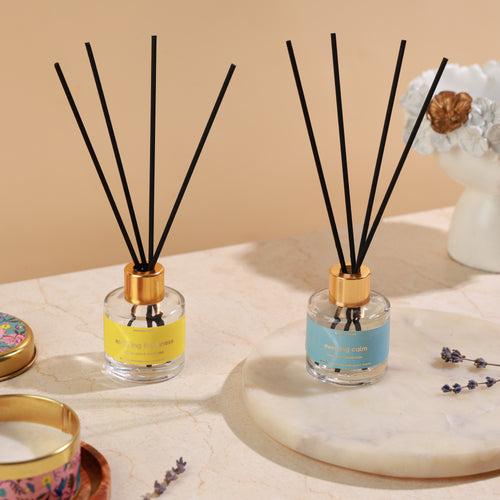 Two rooms · better value₹1,498Shop →
  Large room · a switch₹1,899Shop →
Reeds, open doors, and the adaptation that makes families over-buy
Use the reeds before you use the wallet. In a busy household the commonest complaint is that the living room has stopped smelling of anything, and the commonest correct response is to add a reed — free, instant, and effective — or to reverse the reeds you have, dry ends into the liquid, which lifts the throw sharply for several days. Six reeds is the right setting for a shared room and four for a bedroom, and clogged fibre after a few months is a far more likely explanation than an empty bottle. Only when six fresh reeds in a well-placed bottle still cannot be detected by a visitor is the answer more product, and even then it is usually a second position within a large open space rather than a second room.
Place it where the traffic is, but not in the draught. A diffuser needs gentle air movement to distribute, so in an open-plan flat the best position is near where people pass rather than tucked behind a sofa — but not in the direct path of a fan or an AC vent, which empties the bottle fast and pushes everything against one wall. Keep it out of direct sunlight, which fades fragrance and heats the oil, and stand it on a tray, because reed oil marks polished wood permanently if knocked. In a household with children and pets moving through all day this matters more than usual: a high shelf with air movement beats a low table every time, and the fragrance should be kept out of reach either way.
Then plan the reorder around fourteen weeks, not eighteen. A shared room in constant use will run at the fast end of the range, so a 130ml is roughly a fourteen-week bottle here — about ₹89 a week of use. That is the honest cost of a room somebody is in for every one of those weeks, and it is still the best-value money in the house. Once two rooms are running, a 300ml refill at ₹2,399 fills a 130ml roughly twice and is the point at which an all-day household stops finding this expensive. Refilling is also the natural moment to fit fresh reeds. Morning Freshness suits a daytime shared room; Fresh Brew suits one that is used mostly in the evening.
What to buy
Two lines of this table are the purchase for a household at home all day. The bedroom line is a real purchase too — just not this month.
| Buy | What it covers | Lasts | Price |
|---|---|---|---|
| One 50ml | A single reed diffuser — the bathroom everybody uses, on two or three reeds — the second purchase in this household, not the fourth | 6–8 weeks | from ₹749 |
| One 130ml ★ | The value size — the shared room, six reeds — about ₹0.93 an hour of occupancy and the best value in the house | 14–18 weeks | from ₹1,249 |
| The duo | Day & Night duo — the shared room and one bedroom together, if you would rather start both at 6–8 weeks and learn from it | 6–8 weeks each | ₹1,498 |
| Sukoon | 500ml ultrasonic — an open-plan living-dining-kitchen past about 200 sq ft, plus ₹299 of Hotel Collection to run it | Runs when you switch it on | ₹1,899 |
| 300ml refill | The running cost — the point where a busy home stops finding two running bottles expensive | Roughly 2 × 130ml fills | ₹2,399 |
Versailles
The expectation is that a full house needs more, and I understand why — more people, more cooking, more life. But the count is set by air spaces, and a house full of people is a house with its doors open. Open doors merge rooms into one space. That is usually fewer bottles rather than more, and it is the first thing I would check before adding anything.
What does change is speed. A shared room in constant use will empty a 130ml in about fourteen weeks rather than eighteen, because air movement and warmth drive evaporation. I would rather tell you that now than have you feel short-changed in month four. It is also the best money in the house — under a rupee an hour of occupancy, and about twenty-three paise per person-hour with four of you in the room.
The trap is that none of you can smell it. Everybody has been home since morning, everybody is adapted, and the conclusion is that the diffuser has stopped working. It almost never has. Step out for half an hour and judge the first breath coming back, or ask the next person who visits. Then add a reed, not a bottle. A portion of every order funds a girl's classroom through Nanhi Kali.
Frequently asked questions
- The hours threshold — the same arithmetic, room by room.
- When every door stays open — counting merged air spaces.
- Four people or one — what household size really changes.
- Which three rooms come first — the order of purchase.
- Brand: the SOSA founder story.
SOSA products & prices (verified August 2026): Hotel Collection water-based ultrasonic diffuser fragrance 15ml ₹299 · 100ml ₹999 · 300ml ₹1,799 · Pack of 7 (15ml, all fragrances) ₹1,799; refills 100ml from ₹999. Seven scents: The Ritz-Carlton-inspired (white tea · bergamot · cedar), Westin-inspired (white tea · aloe · cedar), 1 Hotels-inspired (cedarwood · vetiver · green leaves), The St. Regis-inspired (amber · violet · woods), Shangri-La-inspired (jasmine · green tea · white tea), Four Seasons-inspired (citrus · floral · sandalwood), W Hotels-inspired (citrus · pepper · amber). Diffusers: Boond 300ml ₹899 · Sukoon 500ml ₹1,899 · Megh 6L ₹3,499. Water-based, phthalate-free, composed to IFRA standards for home diffusion; 3–6 drops per tank. Made in India, Pune. The Hotel Collection scents are SOSA's own interpretations inspired by the world's finest hotels; all hotel names are trademarks of their respective owners and are used only to describe the scent style — SOSA is an independent Indian fragrance house, not affiliated with or endorsed by any hotel brand. Prices and availability subject to change — see the live product pages.