
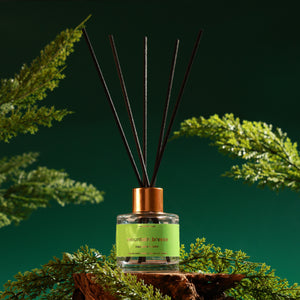
 Mountain Breeze ₹849
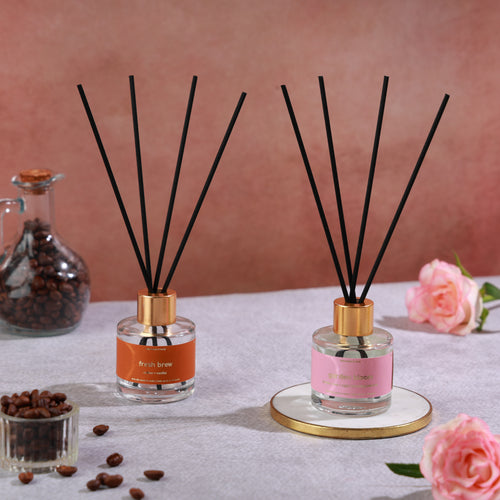
 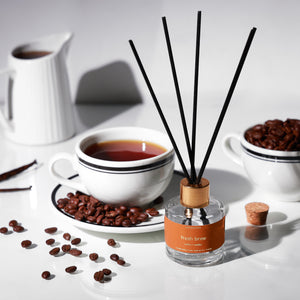 Fresh Brew ₹849
 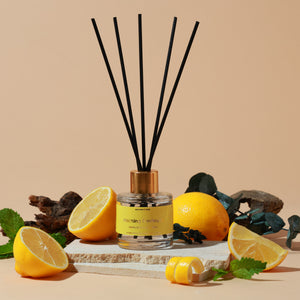 Morning Freshness ₹749
 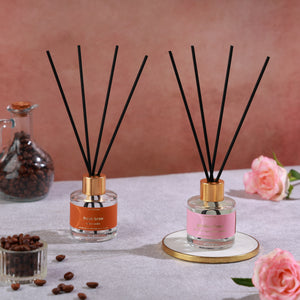 Oil refill 500ml ₹3,499
 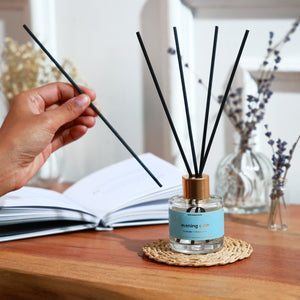 Evening Calm ₹799
One thing it cannot buy. Reach. A passive bottle projects as far as its exposed reed surface and the room's air volume allow. Money changes the level; the room decides the distance.
The per-millilitre ladder inside one range. A fresh 50ml is roughly ₹15–17 per ml because it includes glass and reeds. A 130ml at ₹1,249 is ₹9.61. A 500ml refill at ₹3,499 is ₹7.
Do the free things first. Chest height, near a doorway, clear space, off the draught, room closed for an hour. None of that costs anything and all of it changes what you perceive more than a price step does.
2. Not worth it in two places. Heavier glass and a better box are real costs and they change nothing in your room. Neither does the cost of marketing. Both are legitimate things for a brand to spend on; neither is a reason for you to pay more.
3. Load is the honest one. A composition can carry more concentrate per millilitre or less. More concentrate raises the level of the plateau — the flat, settled state a bottle holds from about week two to the end. It does not push the fragrance further across the room.
4. The carrier is the one nobody explains. SOSA runs on a heat-stable coconut-derived CCT base, alcohol-free and phthalate-free. Solvent chemistry chosen to push fragrance hard off a reed wins the first week and degrades in heat, turning sharp by around week six. I have made the opposite trade deliberately: a smaller opening and a longer, flatter plateau. That is a trade and I say so out loud rather than selling it as superiority.
5. Reeds are a real cost difference. SOSA supplies six fibre reeds, not rattan, because rattan's pores clog in Indian humidity. Reeds are the consumable and the oil is the stable part — most people replace the oil and keep the reeds, and it is almost always the other way round.
6. Inside one range, paying more per purchase lowers the rate per millilitre. A fresh 50ml is ₹15–17 per ml; ₹1,249 ÷ 130ml = ₹9.61; ₹2,399 ÷ 300ml = ₹8.00 and ₹3,499 ÷ 500ml = ₹7.00. Same composition, same carrier, a rate that halves.
7. Spend nothing first. Chest height, clear space, near a doorway, away from the AC vent and the fan, room closed for an hour before you judge it. If that changes what you perceive, the price step was never the variable.
Composed and handmade in small batches in Pune, tested through 45°C summer heat and 85% monsoon humidity; a portion of every order supports girl-child education through Nanhi Kali.
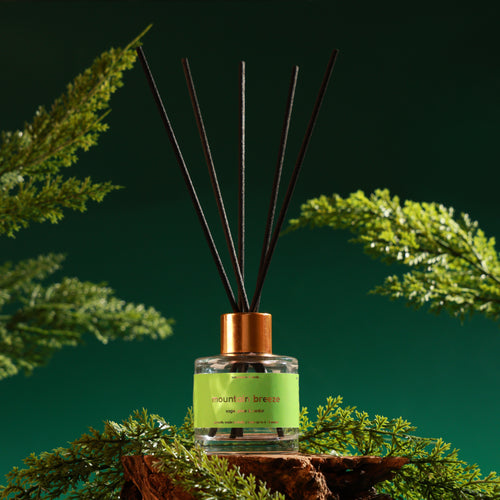
Part one — the three things money can buy
There is no fan in a reed diffuser and no heat. Everything that reaches you has travelled up a fibre reed by capillary action and evaporated off its surface into still air. That single fact narrows the list of things a price difference can honestly change to three.
 Fresh Brew₹849 · 50mlConcentrate has to be carried in something, and the something is not neutral. Phthalate solvents push fragrance hard off a reed and win the first week convincingly; they also degrade in sustained heat and can turn acrid by around week six. SOSA is phthalate-free on a heat-stable coconut-derived CCT base, which means a smaller opening and a longer, flatter plateau — tested through 45°C summer heat and 85% monsoon humidity, because that is the year an Indian flat actually has. I am not telling you that is better for everyone. It is a trade: I have given up some of week one to keep weeks three to eight intact. Fresh Brew at ₹849 is the fullest thing I make on that base, at 9.5 on my own internal scale at six reeds.
Part two — where each rupee lands
Five destinations for a price difference, judged on one question: does it arrive in the room? Three of them do, two do not, and the last column is how you can settle it at home rather than taking my word for any of it.
| What the extra money can be buying | What it changes in the room | What it changes over the bottle's life | What it cannot change | How to check it at home |
|---|---|---|---|---|
| Fragrance load ★ | A higher settled level from about week two onward | Nothing — 50ml still runs 6–8 weeks at six reeds | How far it carries, or the size of room it can fill | Doorway test at week three, not week one |
| Carrier chemistry | The shape of the curve: a big opening, or a flat plateau | How it behaves after weeks of heat | The ceiling set by the room's air volume | Smell it at week six and see whether it has stayed itself |
| Reed material and count | Distribution — six fibre reeds expose more usable surface than clogged ones | Whether the wet line keeps rising to the end | The composition inside the glass | Lift one reed and look at where the dark line sits |
| Glass and packaging | Nothing at all | Nothing, though a refillable vessel saves money later | Everything above | Look at it. That is the whole benefit, and it is a real one |
| Brand and marketing | Nothing | Nothing | Everything above | No test exists, which is the point |
| Paying more later instead of more now | Nothing — same composition | The rate: ₹15–17 per ml fresh against ₹7–8 refilled | Nothing, provided you kept the vessel and reeds | ₹2,399 ÷ 300 = ₹8.00 · ₹3,499 ÷ 500 = ₹7.00 |
| The honest caveat: this table describes how reed diffusers are built in general and how SOSA's are built in particular. No competing product or brand is named, priced or rated anywhere on this page, and nothing here claims that a SOSA bottle projects further, lasts longer or performs better than any specific product. Strength positions such as 9.4 and 9.5 are places on SOSA's own internal scale at six reeds — not an industry standard, not a concentration and not a quality ranking. Longevity figures are typical ranges, not guarantees: warmth raises the evaporation rate so a bottle finishes sooner in a hot room, high humidity slows evaporation from the reed surface so a monsoon month can feel quieter while the bottle lasts longer, and airflow carries scent away from the bottle. Those are directions of effect with no rate claimed. The first three days of any bottle are its loudest, so a comparison taken on day one is a comparison of openings rather than of compositions. | ||||
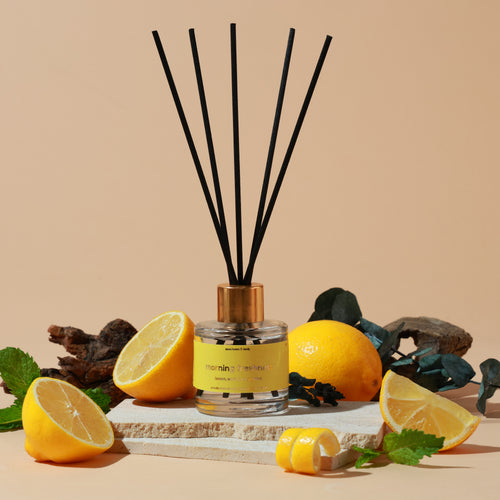 Morning Freshness 50ml · ₹14.98 per ml₹749Shop → Mountain Breeze 130ml · ₹10.38 per ml₹1,349Shop →
  500ml refill · ₹7.00 per ml, oil only₹3,499Shop →
Part three — what no price buys
Reach is what readers are usually trying to purchase when they ask this question, and it is the one thing not for sale in a bottle. A reed diffuser is passive: fragrance leaves the exposed surface of the reeds and then depends entirely on the room's air to go anywhere. Double the load and the air immediately around the bottle is richer; the far corner of a large connected space is still governed by how much air sits between you and the reeds. That is why the useful lever is reed surface, not oil price, and why two bottles at opposite ends of a room beat one expensive bottle in the middle.
The second unpurchasable thing is your own nose's attention. Olfactory adaptation means you stop registering a constant smell in your own home, and it is strongest exactly where you spend the most time. A dearer oil does not exempt you from it. The honest test is arrival, not occupancy — leave the room for a while and use the first breath on the way back in, or ask somebody who has just walked in from outside. If a guest reads the room and you do not, nothing is wrong with the bottle and no purchase will fix what is not broken.
And the third is a job the format does not do. If what you want is a room scented at a chosen moment, or a connected open space beyond roughly 250–300 sq ft, more expensive oil is the wrong purchase in a straightforward way — a reed diffuser has no switch and never will. That is the Sukoon at ₹1,899: 270–320 sq ft, 16–18 hours on low, remote and steady/2H/4H timers, three 15ml Hotel Collection fragrances in the box, bought for control rather than for strength. It is a different product line and the fragrances are not interchangeable: reed oil never goes into a machine and the water-based Hotel Collection never goes into a reed bottle. Whichever format you end up with, a reed diffuser adds a fragrance alongside whatever is already in your air — it removes, neutralises and cleans nothing, so a smell you want gone is a source-and-ventilation problem first and a fragrance question second.
Part four — what you actually mean by "projects better"
The phrase covers at least six different complaints, and only two of them are answered by money. Find your sentence in the left-hand column; the free step in the third column comes before the purchase in the fourth, every time.
| What you mean by "it projects better" | Is money the lever | Do this first, at no cost | Then buy this, and what it costs |
|---|---|---|---|
| "I want the settled room to smell stronger" ★ | Partly — this is a load question | Chest height, near the doorway, clear space, off the draught | Fresh Brew ₹849, the fullest in the range at six reeds |
| "I want it to reach the far end of the room" | No. That is air volume and reed surface | Move the bottle to where people walk past it | A second bottle from ₹749 at the far end, not a dearer one |
| "It was strong for three days, then went quiet" | No. That is the curve every bottle has | Judge it at week three, from the doorway, on arrival | Nothing. The plateau is the product |
| "It fades by week six and smells different" | Yes — this is a carrier question | Keep it out of sun and off warm surfaces | Mountain Breeze ₹849 on the heat-stable CCT base |
| "The level stopped falling and the room went quiet" | No. That is the reeds, not the oil | Flip all six; check where the wet line sits | A fresh bottle from ₹749 — reeds are not sold separately |
| "I want it loud only when guests arrive" | No. That is control, not strength | Close the room for an hour before they come | Sukoon ₹1,899, plus fragrance from ₹299 |
Versailles
At ISIPCA you learn to build a composition and to defend it in front of people who can take it apart. What you are not taught is how to answer the question a customer in Pune actually asks, which is never about accords. It is: where is my money going, and will I be able to tell?
The first version of this range had a carrier that opened much bigger. It was thrilling for four days and by week six, in a flat that had been at 40°C for a fortnight, it had gone somewhere I had not designed. I rebuilt everything on a heat-stable coconut-derived base and accepted a smaller opening for it. That is a trade, not a triumph, and a customer who wants the big opening should know that I have deliberately not sold them one.
So when someone asks whether to pay more for oil, I answer with a list rather than a claim. Load, carrier, reeds. If the extra money is going there, you will be able to tell by week three. If it is going into a heavier bottle and a nicer box, you will be able to tell by looking, which is a fair thing to want and a poor thing to pay for twice. And nothing on this page compares my bottle with anyone else's, because I have not tested theirs and would not know how to be fair about it. Made in small batches in Pune, and a part of every order funds a girl's classroom through Nanhi Kali.
Frequently asked questions
- A cheap bottle you can barely smell — cost per scented week, and the multiplier.
- Is a ₹749 reed diffuser worth it? — "worth it" broken into four measurable things.
- ₹1,000 a month living alone and the honest number for a 2BHK.
- Not smelling strong enough — the complete diagnostic, free steps first.
- Brand: the SOSA founder story.
SOSA range, specifications and prices used in this guide (verified from the live store, 27 August 2026): Reed diffusers — alcohol-free, phthalate-free, paraben-free and IFRA-compliant compositions on a heat-stable coconut-derived (CCT) carrier, low-VOC, in a refillable glass bottle with six fibre reeds; flip weekly. 50ml lasts 6–8 weeks and 130ml lasts 14–18 weeks; there is no 100ml reed diffuser size. Morning Freshness (Malabar lemon · peppermint · Nilgiri eucalyptus) 50ml ₹749 · 130ml ₹1,249; Garden Bloom (British rose · night-blooming jasmine) ₹799 · ₹1,299; Evening Calm (Kashmir lavender · chamomile) ₹799 · ₹1,299; Fresh Brew (Coorg coffee · Kerala vanilla) ₹849 · ₹1,349; Mountain Breeze (Himalayan pine · sage · Indian cedar) ₹849 · ₹1,349. Duo sets ₹1,498–₹1,598 for 2 × 50ml and ₹2,498–₹2,598 for 2 × 130ml. Oil-only refills 300ml ₹2,399 · 500ml ₹3,499 — the glass vessel and reeds are not included, and replacement reeds are not sold as a separate product. Machines: Boond 300ml ₹899 (~150 sq ft, about 6 hours a fill) · Sukoon 500ml ₹1,899 (270–320 sq ft, 16–18 hours on low, three 15ml fragrances included) · Megh 6L ₹3,499 (~215 sq ft — a runtime and humidity machine that covers less than a Sukoon, never a coverage upgrade) · waterless Vaayu ₹11,999 · Safar ₹3,999 (a car and travel product) · Aangan ₹25,999 · Meenar ₹38,500. The water-based Hotel Collection for ultrasonic machines (15ml ₹299 · 100ml ₹999 · 300ml ₹1,799 · pack of seven 15ml ₹1,799) cannot be used in a reed bottle or a Vaayu. Below ₹749: jar candles ₹379, Sandalwood or Smoked Oudh candle ₹449, wax melts ₹474 (a burner is required and not included), mugs ₹474, bubble and taper candles ₹569, Amber Rose candle ₹599, ceramic trinket dish and candle two-pack ₹664. A reed diffuser adds fragrance to a room. It does not clean, purify or filter air, remove or neutralise cooking, damp or smoke smells, reduce humidity, or change how anyone feels. A reed diffuser adds no moisture to the air; ultrasonic machines work by aerosolising water and therefore do. A persistent musty smell indicates moisture that needs finding and drying, and SOSA sells no dehumidifier or air purifier. Ventilate or extract first; add fragrance second. Evaporation rate rises with warmth and falls with humidity, and airflow carries scent away from the bottle — so performance varies with season, ventilation, ceiling height and room use; longevity figures are typical ranges, not guarantees. Not noticing a constant fragrance is ordinary olfactory adaptation; the reliable checks are leaving the room and returning, or asking someone who has just arrived. Strength figures are positions on SOSA’s own internal scale, not an industry standard. Fragrance oil is flammable — keep bottles away from open flame and out of direct sunlight, and out of reach of children and pets. Composed and handmade in small batches in Pune, India; tested through 45°C summer heat and 85% monsoon humidity. Free shipping above ₹499. A portion of every order supports girl-child education through Nanhi Kali. Prices subject to change — see the live product pages.