


For a normal bedroom, the honest three-way: a reed ₹749–₹849 — silent, unpowered, maintenance-free, about ₹13–₹15 a day, and a fragrant zone rather than a fragranced room. Sukoon ₹1,899 — real coverage of 270–320 sq ft, 16–18 hours on low, on demand, with the oil diluted in water. Safar ₹3,999 — waterless cold-diffusion of undiluted oil, 3 speeds and a 1/2/3-hour auto-off; named and sold as a car and travel diffuser, with no published room-coverage figure.
Vaayu is not on that list, and that is deliberate. Vaayu ₹11,999 is rated to 1000 m³ — roughly 2,000 to 3,000 sq ft. In a 120 sq ft bedroom nine-tenths of it is wasted. It earns its price on a whole floor, an open-plan living-dining, a large home, a villa, a clinic, a salon or a reception, or when you genuinely want one machine scenting the entire flat.
The honest gap, one final time: between Safar and Vaayu, SOSA has no mid-sized waterless bedroom nebuliser. There is no half-Vaayu. That absence is the whole reason a single bedroom gets three imperfect answers instead of one obvious product, and it is the most useful sentence in this cluster.
And the sentence the whole series rests on: the hotel smell is a diffusion-technology outcome, not a fragrance-oil outcome.
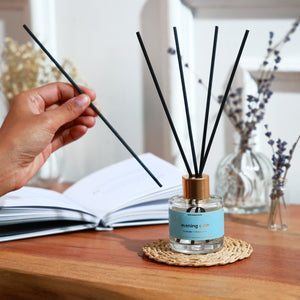
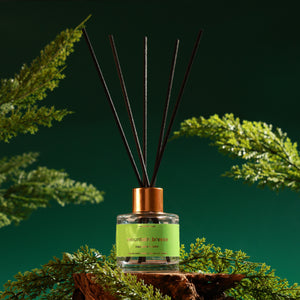
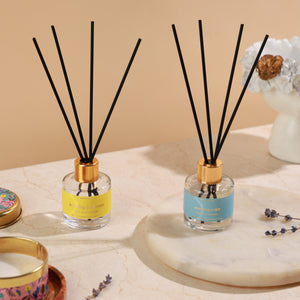
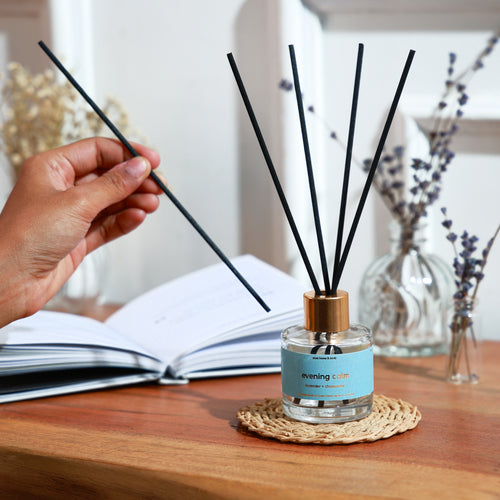
2. Start with the reed, because for a great many bedrooms it is the correct answer and it costs ₹749. Passive capillary diffusion: oil climbs six fibre reeds and evaporates from their surface at whatever rate the room’s temperature, humidity and airflow allow. A 50ml is specified for rooms up to about 150 sq ft and runs 6–8 weeks; a 130ml is for above that and runs 14–18. Six reeds is full projection, three is a soft bedside level and roughly doubles the life. It produces a fragrant zone rather than a fragranced room — and in a small closed bedroom, that zone is most of the room. It is silent, uses no power, needs no charging or filling, has nothing to remember, costs about ₹13–₹15 a day, and looks like an object rather than an appliance.
3. Move to Sukoon at ₹1,899 the moment you want the whole room, on demand. Ultrasonic water mist: 500ml, 270–320 sq ft of coverage, 16–18 hours on low, three 15ml Hotel Collection scents included. In a 120 or 150 sq ft bedroom it is over-specified, which is exactly why you can run it gently. The costs are real and I state them every time: the oil is diluted in water, the output adds humidity, the tank needs filling, and hard water can leave a fine white mineral dust nearby. For most bedrooms this is the best-value real answer in the range, and it is the one I recommend most often.
4. Choose Safar at ₹3,999 when water is the thing you will not accept. Waterless cold-diffusion of undiluted oil — the hotel mechanism at personal scale. 20ml bottle, 2000 mAh Type-C battery, up to 10 hours continuous or around 30 intermittent, three speeds, a 1/2/3-hour auto-off timer, 6.9 cm across. Two disclosures you must have before you buy: it is named and sold as a car and travel diffuser, although SOSA’s own product page also names bedside and hotel room among its intended places, and SOSA has published no room-coverage figure for it — so it is described as personal and small-space scenting, never as a room machine. It also needs recharging and its timer runs out.
5. Then let the projection preference break the tie. If you want fragrance to be a pleasure you meet when you pass it, take the reed. If you want the room to hold a level you notice from the bed, take Sukoon. If you want the undiluted dryness of the hotel mechanism and will accept personal scale, take Safar. And if what you actually want is a floor rather than a room, that is when Vaayu stops being extravagant and starts being correct.
Alcohol-free, phthalate-free, paraben-free, IFRA-compliant, 0 ppm formaldehyde across the reed range. Free shipping above ₹499, and a portion of every order supports girl-child education through Nanhi Kali.
The method, in four questions — the whole cluster in one place
Question one: how big is the room, and what is connected to it? Not adjectives — a number. Length times width gives you square feet; multiply by ceiling height for cubic metres, which is the honest unit once a space is large or tall. Then count only what is connected, meaning everything the air can move between without passing a closed door. This one measurement does more of the buying decision than every review you will read, because coverage figures are the only comparable numbers in this category and they are meaningless until you have something to compare them against. A 50ml reed is specified up to about 150 sq ft; Sukoon covers 270–320; Vaayu covers up to 1000 m³. Put your number beside those three and two of the four options usually eliminate themselves.
Question two: do you want it on a schedule, or always? This is the question people skip and then regret, and it is the one where the products separate most cleanly. A reed diffuser cannot be switched off. That is its one genuine design limitation and pretending otherwise costs trust: it runs while you sleep, while you are at work, and while the room is empty, and the only control you have is how many sticks are in it. Safar gives you three speeds and a 1/2/3-hour auto-off, runs up to 10 hours continuous or around 30 intermittent, and needs recharging — so it is controllable but not set-and-forget. Vaayu gives you a Bluetooth app with 1h, 4h, 8h or 24h windows, a choice of days, adjustable intensity and a key-lock, at under 38 dB. If “on when I am home, off when I am not” is genuinely part of what you want, the reed is out before any other consideration.
Question three: is water acceptable? Ultrasonic machines dilute the oil in water, add humidity to the room, need filling, and in hard-water cities can leave a fine white mineral dust on nearby surfaces. For many people none of that matters and the humidity is welcome in a dry winter room. For others — a coastal flat in a monsoon, a room where nothing may get damp, or simply a strong preference — it is disqualifying, and that single answer cuts the range in half. Say it out loud before you shop, because it decides more than price does. Question four is the easy one: given the three answers above, which mechanism is left? Usually one or two, and at that point the choice is between scents rather than between technologies, which is a far more pleasant decision to make.
 Garden Bloom₹799Three genuinely different experiences, and none of them is a worse version of another. A fragrant zone is a gradient around a bottle: lovely when you pass it, thinner across the room, and permanently there without any decision from you. A controlled personal presence is a small dry cloud of undiluted oil in the part of the room you occupy, for one, two or three hours, when you choose. An even covered volume is what a hotel does: the same level everywhere, on a timetable, for years, so the space acquires a character rather than a smell. Decide which of those three sentences describes what you have been imagining, and the hardware follows.
 Sukoon₹1,899Concentration in a space is what enters the air minus what leaves it, divided by how much air there is. A bedroom has very little air and one door, which means it reaches a perceptible level quickly and holds it — the opposite of an open-plan floor, where the air you have scented keeps mixing with air you have not. Closing the door is the cheapest tool in scenting and it is available to you and not to the reader with the open plan. A running air conditioner helps too: it recirculates air within a closed room, which distributes fragrance evenly, and it dries the air, which speeds evaporation — better distribution and a shorter bottle life in the same season.
 Day & Night duo₹1,498A 50ml reed is roughly ₹13 a day for Morning Freshness or Garden Bloom and about ₹15 for Mountain Breeze, Fresh Brew or Evening Calm — a fairer number than the sticker, because a ₹749 bottle running six to eight weeks is a different purchase from a ₹749 object. Beyond that, here is the unasked money question answered plainly: “Am I paying for the fragrance or the machine?” Mostly the machine, and that is the honest answer to the whole hotel question. A ₹1,000 reed and an ₹11,999 nebuliser can run closely related scents and produce completely different rooms, because what the higher price buys is transport, control and evenness rather than a better smell.
The three mechanisms, side by side one last time
Passive capillary. Oil climbs six fibre reeds and evaporates from their surface. No energy in, no air moved, so the concentration is highest at the bottle and falls with distance. That is a fragrant zone rather than a fragranced room, and it is the design rather than a defect — it is precisely why the thing is silent, needs no power and never has to be switched on. Fibre rather than rattan, because rattan is a natural cane with irregular internal channels that wicks unevenly in high humidity and fades at the dry end, which matters far more in an Indian monsoon than in the European climates most reed diffusers were designed for. What it does better than any machine: everything except reach.
Ultrasonic water mist. A piezo plate vibrates a water-and-oil mixture into a visible wet mist. It moves air and covers a room, which is a genuine step up in reach — but the oil is diluted in water, the output adds humidity, the tank needs filling, and in hard-water cities it can leave white mineral dust. Boond ₹899 covers up to about 150 sq ft on 300ml for around six hours. Sukoon ₹1,899 covers 270–320 sq ft on 500ml with 16–18 hours on low and three 15ml Hotel Collection scents included — and that 16–18 hours is worth noting, because “I do not want to fill something every day” overstates the burden considerably. The SOSA Hotel Collection oils are water-based and made for exactly these machines.
Waterless cold-air nebulising. Pressurised air shatters undiluted fragrance oil into a dry micro- or nano-mist that travels with the room’s own airflow. No water, no dilution, no heat, no added humidity, no white dust. This is the technology luxury hotels actually use, and it is the honest answer to every “why doesn’t my home smell like a hotel” question in this series. The undiluted payload is also most of why the same composition reads as more present from a nebuliser than from a water machine. In this range it exists at two sizes: Safar ₹3,999 at personal scale, named and sold as a car and travel diffuser with no published room coverage, and Vaayu ₹11,999 at up to 1000 m³. Above them sit commercial HVAC machines — Aangan ₹25,999 at about 8,000–10,000 sq ft and Meenar ₹38,500 at 12,000–18,000 — which belong in hotels and showrooms and never in a home.
| Option | Mechanism | Space it suits | Control | Water | Price |
|---|---|---|---|---|---|
| Reed diffuser ★ | Passive capillary — six fibre reeds, no air moved | 50ml up to ~150 sq ft for 6–8 weeks; 130ml above that for 14–18. A zone, not a room | None — it cannot be switched off. Reed count is the only dial: six full, three soft | None. No power, no charging, no filling, nothing to remember | ₹749–₹1,349 |
| Sukoon | Ultrasonic water mist — oil diluted in water | 270–320 sq ft. Genuine coverage of a real bedroom, and over-specified in a small one | On demand, 16–18 hours on low from 500ml. Three 15ml Hotel Collection scents included | Yes — dilution, added humidity, refilling, and white mineral dust in hard-water cities | ₹1,899 |
| Safar | Waterless cold-diffusion of undiluted oil — the hotel mechanism at personal scale | Personal and small-space scenting. No published room-coverage figure. Named and sold as a car and travel diffuser | 3 speeds, 1/2/3-hour auto-off, 2000 mAh Type-C, up to 10h continuous or ~30h intermittent. Needs recharging | None. No dilution, no humidity, no white dust. 20ml bottle, 6.9 cm | ₹3,999 |
| Vaayu | Waterless cold-air nebuliser at building scale | Up to 1000 m³ — roughly 2,000–3,000 sq ft. For one bedroom, nine-tenths wasted | Bluetooth app plus onboard buttons, 1h/4h/8h/24h windows, choice of days, adjustable intensity, key-lock, under 38 dB | None. 400ml tank up to about 90+ days, 5W, freestanding or wall/HVAC mount | ₹11,999 |
| Megh | Ultrasonic water mist — six-litre tank, around 100 hours of runtime | About 215 sq ft — less than the ₹1,899 Sukoon | A runtime and humidity machine. Buy it for those two things or not at all | Yes, and a great deal of it. The easiest product in our range to misread as the big one | ₹3,499 |
| The honest gap, one final time: nothing exists between Safar and Vaayu. There is no mid-sized waterless bedroom nebuliser in the SOSA range and no half-Vaayu — nothing that gives one room the dry, undiluted output of the hotel mechanism at room scale. That is why a single bedroom gets a three-way compromise rather than one obvious product, and it is the sentence this whole series has been built to say out loud. | |||||
Start here · Evening Calm₹799Shop →  Room coverage · Sukoon₹1,899Shop →
  The oils · Hotel Collection₹999Shop →
The gap in the middle of the range, said plainly for the last time
If you have read anything else in this series you will have met this paragraph before, and it belongs here most of all. Between Safar at personal scale and Vaayu at 2,000–3,000 sq ft, SOSA makes nothing. There is no mid-sized waterless nebuliser, nothing that is “a Vaayu for one room”, no half-Vaayu at ₹6,000. If you want the dry, undiluted, no-water output of the hotel mechanism, sized honestly for a 120 or 150 sq ft bedroom, with a published coverage figure you can hold us to, we do not sell it. I would rather write that sentence at the close of a hundred pages than let a reader work it out by elimination after buying twice.
That absence is not a footnote; it is the reason the honest answer for a single bedroom is a three-way compromise. Keep the reed and adjust your expectation — which is genuinely right for more people than the internet suggests, because a small closed room plus six fibre reeds plus decent placement is a lovely thing and costs ₹749. Accept the water and buy Sukoon — the best value in the range for a real bedroom and the answer I give most often. Or accept personal scale and buy Safar, understanding that it is named and sold as a car and travel diffuser, that no room-coverage figure has been published for it, that it needs recharging and that its auto-off runs one, two or three hours. Each of those three is a real answer with a real cost, and the cost is what the missing product would have removed.
One last correction, because it has run through this whole series and it belongs in the close. There is no hotel-inspired reed diffuser. The Hotel Collection is water-based and ultrasonic-only; reed oil cannot go into an ultrasonic machine and Hotel Collection oil cannot go into reeds. If your search has been for the intersection of those two lines, the search has been failing for a structural reason rather than a stock one. And if anything on this page has read as SOSA talking down its own reeds, let me finish that thought properly instead: a reed diffuser is the only thing in this range that works every hour of every day for six to eight weeks with no power, no charging, no filling, no schedule and nothing whatsoever to remember, in silence, for about ₹13–₹15 a day, looking like an object you chose rather than a device you installed. No machine I sell does any of that, and it is not a small list.
What to buy, in order — and the rung that does not exist
The complete answer for a normal bedroom, in the order I would actually spend, with the honest gap in the final row where it has been on every page in this series.
| Buy | What it is | When it is the right answer | Price |
|---|---|---|---|
| 1. A reed diffuser, used properly ★ | Passive capillary — six fibre reeds in a refillable glass bottle, 50ml up to ~150 sq ft for 6–8 weeks, 130ml above 150 sq ft for 14–18. Heat-stable CCT carrier, alcohol-free, about ₹13–₹15 a day | For most normal bedrooms, first. Silent, unpowered, nothing to remember, and in a small closed room the fragrant zone is most of the room. All six reeds, out of the AC blast, door shut | ₹749–₹1,349 |
| 2. Sukoon | Ultrasonic water mist — 500ml, 270–320 sq ft, 16–18 hours on low, three 15ml Hotel Collection scents included | When you want the whole room at a level you notice from the bed, on your own schedule, and can accept dilution in water, added humidity and refilling. The best-value real answer in the range | ₹1,899 |
| 3. Safar | Waterless cold-diffusion of undiluted oil — 20ml, 2000 mAh Type-C, up to 10h continuous or ~30h intermittent, 3 speeds, 1/2/3-hour auto-off, 6.9 cm. Named and sold as a car and travel diffuser | When water is unacceptable and personal scale is understood. No published room-coverage figure; it needs recharging and the timer runs out | ₹3,999 |
| 4. Vaayu — but not for a bedroom | Waterless cold-air nebuliser — up to 1000 m³ or roughly 2,000–3,000 sq ft, 400ml tank up to about 90+ days, Bluetooth app with 1h/4h/8h/24h windows, adjustable intensity, key-lock, under 38 dB, 5W, wall or HVAC mount | Only for a whole floor, an open-plan living-dining, a large home, a villa, a clinic, a salon or a reception — or when you want one machine doing the entire flat. In one bedroom it is the wrong purchase | ₹11,999 |
| Never a coverage upgrade: Megh | Six-litre tank, around 100 hours of runtime, about 215 sq ft of coverage | Less coverage than the ₹1,899 Sukoon. A runtime and humidity machine, and never the answer to a reach problem | ₹3,499 |
| The honest gap | Nothing exists between Safar and Vaayu — no mid-sized waterless bedroom nebuliser, no half-Vaayu. And no hotel-inspired reed diffuser exists at all: the Hotel Collection is water-based and ultrasonic-only, and the two systems do not mix in either direction | Said plainly, for the last time in this series. It is the reason one bedroom gets three compromises instead of one right product | — |
Versailles
This is the last page of a hundred, and I want to close it with the thing I have been saying in a hundred different rooms. People come to us asking which fragrance is strongest, and the honest translation of that question is almost always “why does my home not feel like the hotel did”. The answer is not in a bottle. It is that a hotel runs a machine, at a set intensity, into moving air, on a schedule, in the same scent for years — and that consistency and evenness are as much of the effect as strength ever was.
Which puts me in an odd position commercially, because the product that built this company is a reed diffuser and the true answer to a great many of these questions is a machine. So I have tried to be exact rather than loyal. A reed makes a fragrant zone, not a fragranced room, and no reed anywhere does otherwise. It is also silent, unpowered, maintenance-free, works every hour without being asked, costs ₹13–₹15 a day and looks like an object rather than an appliance — and for a small closed bedroom, used with all six sticks and placed in the airflow, it is frequently the right purchase and I would not want a hundred pages of mechanism talk to obscure that.
The part I am least comfortable with, and the part I have refused to write around, is the gap. We do not make a mid-sized waterless machine. If you want the hotel mechanism sized honestly for one bedroom, with a coverage figure you can hold us to, it is not in the catalogue — Safar is personal scale and sold as a car and travel diffuser with no published coverage, and Vaayu is built for a floor. Naming that has probably cost us orders across this series. It is also the only reason I would expect you to believe the rest of it.
So: measure your room. Decide whether you want it on a schedule or always. Decide whether water is acceptable. Then buy the cheapest thing that satisfies all three, and give it a fortnight before you judge it — and judge it by walking in from outside, or by what a visitor says, because you will have stopped noticing it within minutes and that is not a fault in the fragrance. Everything is composed in Pune, and part of every order funds a girl’s classroom through Nanhi Kali.
Frequently asked questions
- A 100 sq ft bedroom and a hit at the door — the cheapest real answer to the arrival moment.
- A 10 × 12 AC bedroom where the reed only works near the bottle — distance decay, and what recirculating air is worth.
- Mumbai, small, humid, no water — the constraint stack that most exposes the range’s gap.
- 150 sq ft, strong fragrance, on only when I’m home — the control question, answered honestly.
- Bedroom only, not the whole 2BHK — no, and here is what to buy instead.
- Safar in one room, Vaayu in the other — why two machines is usually the wrong shape.
- Expensive oil, no scent cloud — the oil decides whether you like it; the mechanism decides whether it is there.
- What type of diffuser should I search for — the words that make your next search work.
- “Strongest hotel reed diffuser” — why that product does not exist anywhere.
- Brand: the SOSA founder story.
Facts verified August 2026: Three diffusion mechanisms are described — passive capillary (reed diffusers), ultrasonic water mist (Boond ₹899, 300ml, up to ~150 sq ft, ~6 hours, USB, night light; Sukoon ₹1,899, 500ml, 270–320 sq ft, 16–18 hours on low, three 15ml Hotel Collection scents included; Megh ₹3,499, 6L tank, ~100 hours runtime, ~215 sq ft, which is less coverage than Sukoon and never a coverage upgrade) and waterless cold-air nebulising (Safar ₹3,999, 20ml bottle, 2000 mAh Type-C battery, up to 10 hours continuous or around 30 hours intermittent, 3 speeds, 1/2/3-hour auto-off timer, 6.9 cm, named and sold as a car and travel diffuser with car, handbag, desk, bedside and hotel room among its stated uses, no published room-coverage figure; Vaayu ₹11,999, coverage up to 1000 m³ or roughly 2,000–3,000 sq ft, 400ml refillable tank lasting up to about 90+ days depending on intensity and scheduled hours, Bluetooth app and onboard buttons, 1h/4h/8h/24h run windows, choice of days, adjustable mist intensity, key-lock, under 38 dB, freestanding or wall/HVAC mount, 5W, CE, RoHS, SGS, and to be used with alcohol-free water-free oils formulated for cold-air diffusion). Aangan ₹25,999 (~8,000–10,000 sq ft) and Meenar ₹38,500 (12,000–18,000 sq ft) are commercial HVAC machines and are named in this cluster only as the top of the ladder, never as a home recommendation. SOSA reed diffusers: five scents, 50ml ₹749–₹849 lasting 6–8 weeks and suiting rooms up to ~150 sq ft, 130ml ₹1,249–₹1,349 lasting 14–18 weeks and suiting above 150 sq ft, six fibre reeds included and flipped every 3–5 days, six reeds for full projection and three for a soft bedside level, about ₹13–₹15 a day, heat-stable CCT carrier rather than DPG, fibre reeds rather than rattan, alcohol-free, phthalate-free, paraben-free, IFRA-compliant, 0 ppm formaldehyde, refillable glass bottle, climate-tested at 45°C and 85% RH, composed in Pune. Duos are two 50ml bottles at ₹1,498–₹1,598; 130ml duos ₹2,498–₹2,598; refills 300ml ₹2,399 and 500ml ₹3,499, oil only and never a first purchase. SOSA strength scale: Evening Calm 8.9, Garden Bloom 8.9, Morning Freshness 9.0, Mountain Breeze 9.4, Fresh Brew 9.5 — a measure of perceived intensity in a room, not of quality, concentration or projection. Hotel Collection fragrance oils are water-based and ultrasonic-only at 15ml ₹299 (a refill), 100ml ₹999, 300ml ₹1,799 and a pack of seven at ₹1,799; they cannot be used in reed diffusers and reed oil cannot be used in ultrasonic machines, so no hotel-inspired reed diffuser exists. Between Safar and Vaayu, SOSA makes no mid-sized waterless nebuliser. No health, air-quality, allergy or antimicrobial claims are made, and fragrance does not remove a smell — source, then ventilation, then fragrance. Free shipping above ₹499. A portion of every order supports girl-child education through Nanhi Kali. SOSA is an independent Indian fragrance house; the Hotel Collection scents referenced here are SOSA’s own interpretations inspired by the world’s finest hotels, and SOSA is not affiliated with, endorsed by or a supplier to any hotel brand. Prices subject to change — see the live product pages.