

Rule two — keep it for a year. Hotels run the same fragrance for years so that regulars recognise a building by walking into it. Repetition is the mechanism. Changing scent every eight weeks guarantees no signature at all.
Rule three — one or two places, not every room. Choose the room people enter first, or the room you occupy most. A flat that smells identical everywhere stops registering as anything within a week.
Which mechanism: passive capillary — a reed diffuser, ₹749–₹1,349 — is unusually good for a signature, because it never has to be switched on and therefore is never off. Ultrasonic water mist (Sukoon ₹1,899, 270–320 sq ft) gives real room coverage but dilutes oil in water and adds humidity. Waterless cold-air nebulising (Safar ₹3,999) throws undiluted oil dry — and is named and sold as a car and travel diffuser, with no published room-coverage figure.
The honest gap: there is no hotel-inspired reed diffuser — the Hotel Collection is water-based and ultrasonic-only, and the two systems cannot be mixed in either direction. And between Safar and the 2,000–3,000 sq ft Vaayu ₹11,999 there is no mid-sized waterless bedroom nebuliser. SOSA is independent and not affiliated with any hotel brand.
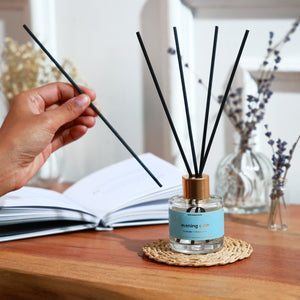
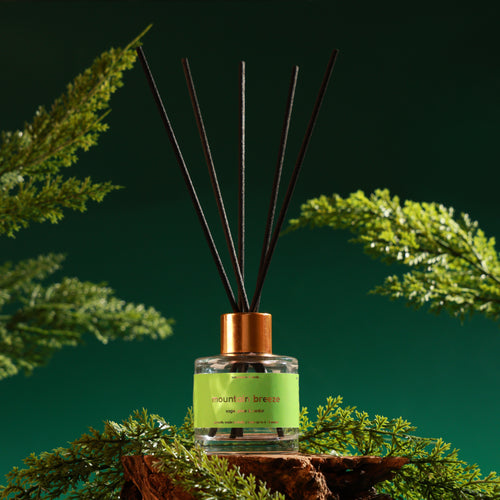
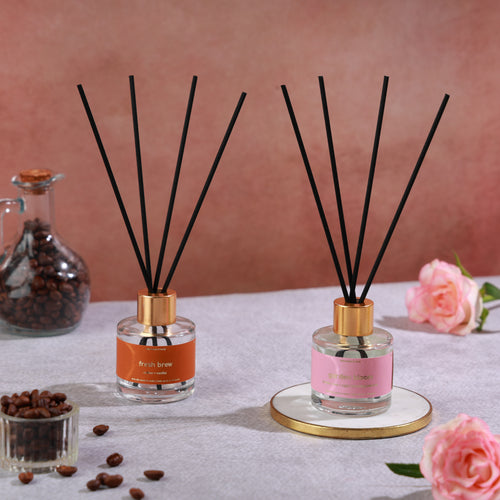
2. Choose it for the twelfth month rather than the first. The scent that impresses you in a shop is rarely the scent you want on a wet Tuesday in month nine. Softer and less polarising compositions wear better over long periods; deep, characterful ones are exciting quickly and tiring eventually. On our own scale, Evening Calm at 8.9 is the gentlest thing we make and the easiest to live with for a year. Mountain Breeze at 9.4 is the least sweet and the least gendered, which is why it suits a shared household. Fresh Brew at 9.5 is superb and is the one I would think hardest about as a year-long signature.
3. Use it in one or two places, never everywhere. Pick the room people enter first, or the room you spend your evenings in — ideally not both, at least to begin with. A flat that smells identical in every room stops registering as a smell within a week, and it also costs three or four times as much to run. Restraint here is not economising; it is the thing that makes the signature legible.
4. Get the dose right, which is usually lower than instinct. Six reeds is full projection, three is a soft bedside level and roughly doubles the life of the bottle. Match size to room: 50ml for up to about 150 sq ft over 6–8 weeks, 130ml above that over 14–18. Almost any composition at too high a concentration flattens into a single sweet or sharp impression — the thing people mean when they say air freshener — while the same oil at a lower dose reads as layered, because the nose has room to resolve the separate materials.
5. Choose the mechanism last, and by what you want from it. A reed is unusually well suited to a signature: it is silent, unplugged, needs no filling or charging, cannot be forgotten and therefore is never accidentally off — a signature that runs itself for about ₹13–₹15 a day. What it gives up is evenness and control. Sukoon at ₹1,899 buys genuine 270–320 sq ft coverage at the cost of water, humidity and refilling. Safar at ₹3,999 buys dry undiluted diffusion at personal scale, and is named and sold as a car and travel diffuser with no published room-coverage figure.
Alcohol-free, phthalate-free, paraben-free, IFRA-compliant, 0 ppm formaldehyde. Free shipping above ₹499, and a portion of every order supports girl-child education through Nanhi Kali.
The three rules, and why the cheapest one does the most work
Everything below is available to somebody spending ₹749, and none of it depends on the size or the value of the home it happens in. A signature is a discipline, and discipline is distributed more evenly than money. The three rules are one scent, a long time, and a small number of places. They sound modest. They are the entire difference between a home that smells of something and a home that smells of several things.
 Evening Calm₹799A signature is a recognisable identity, and identity requires a single answer to the question what does this place smell of. The moment there are two strong answers, a visitor’s nose stops trying to categorise and simply reports a pleasant confusion. This is the rule Indian homes break most often and for the most sympathetic reasons: we like the lavender in the bedroom and the citrus in the kitchen and the coffee in the study, and each of those choices is individually correct. As a signature strategy it fails, because nothing repeats often enough to be learned. Choosing one register and letting it be the house’s answer is the single highest-return decision on this page, and it is free. If you genuinely need two — a large flat, or a household that cannot agree — keep them far apart and make one clearly the primary.
 Refills₹2,399The reason a hotel is recognisable is that it has not changed. A guest who stays twice a year builds an association across visits, and the association is doing as much work as the composition. At home the equivalent is finishing the bottle and buying the same one again, which sounds obvious and is remarkably hard to do in a category that releases something new every season. If you want a signature, the correct behaviour is boring on purpose. This is where refills earn their place: a 300ml at ₹2,399 or 500ml at ₹3,499 tops up the bottle and reeds you already own, which makes staying with one scent cheaper than switching. To be clear, a refill is oil alone and is never a first purchase — it is an incomplete product without the bottle, and the item on our own shelf most often bought by mistake.
 Garden Bloom₹799Hotels concentrate their scenting in the spaces where impressions are formed and where people pass through, not uniformly through every cubic metre of the building. Copy that. Pick the room people meet first — usually the entrance area or the drawing room — or the room you actually live in during the evening, and put the signature there. Two locations is the maximum I would recommend at the start. Uniform scenting is expensive, and it also defeats itself: a difference is what a nose reports, so a home with a fragrant zone and quieter rooms around it produces more noticeable moments than a home fragranced flat throughout. Placement inside the room matters too. Slightly in from the entrance, out of the draught, beats the threshold itself — a doorway is the most turbulent point in a home, repeatedly stripped by air exchange and then met at close range.
Choosing the one — and why you should probably choose downwards
People choose a signature the way they choose a perfume in a shop: by what impresses them fastest. That is precisely the wrong test, because a signature is judged over months by a nose that will be adapted to it within minutes of each arrival. The correct test is: would I be content to smell this on an unremarkable Tuesday in month nine. Compositions that pass that test tend to be softer, less sweet and less obviously characterful than the ones that win a five-second comparison.
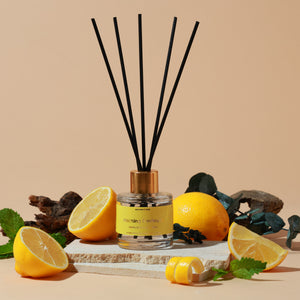
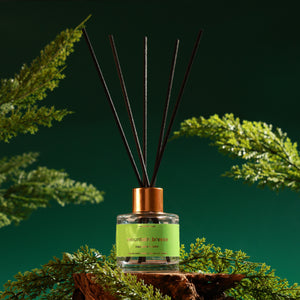
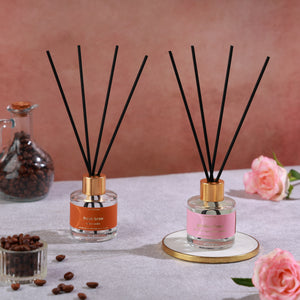
The SOSA strength scale exists for exactly this decision, and it is worth understanding what it measures: perceived intensity in a room, not quality and not concentration. Evening Calm at 8.9 — Kashmir lavender, chamomile, soft musk — is the gentlest thing we make and the safest year-long choice for a bedroom or a guest room. Garden Bloom is also 8.9, British rose with night-blooming jasmine, and is a beautiful signature for somebody who is certain they like florals; anti-floral is a common and firmly held position, so it is a poor choice for a shared household where the question has not been asked. Morning Freshness at 9.0 is bright citrus-mint and is the one register that complements cooking rather than fighting it, which makes it the sensible answer for an open kitchen-living plan. Mountain Breeze at 9.4 is the least sweet and least gendered, and my usual recommendation where several people share the space. Fresh Brew at 9.5 is the deepest — Coorg coffee, Kerala vanilla, soft caramel — and it is superb, and it is the one I would think hardest about committing to for a year.
One honest limitation about the hotel register specifically, because a lot of readers arrive here wanting it. There is no hotel-inspired reed diffuser. The Hotel Collection — the white tea, aloe and cedar register, the white tea, bergamot and cedar one, and five more — is water-based and formulated only for ultrasonic machines, and reed oil cannot go into an ultrasonic machine either. They are different physical systems and cannot be mixed in either direction. So if the hotel register is what you want as your signature, the route is a machine plus those oils, from ₹1,899 for the Sukoon with three 15ml scents included. If what you want is a signature that never has to be switched on, the reed line is the better tool and the register will be an Indian one rather than a hotel one. Both are legitimate; they are simply different purchases, and I would rather you knew which one you were making.
| Mechanism | Always running? | Evenness | What it asks of you | Price |
|---|---|---|---|---|
| Passive capillary — the reed diffuser | Yes, always. It cannot be forgotten, and it cannot be switched off either | A fragrant zone around the bottle, decaying with distance | Four minutes every 3–5 days to flip the reeds. No power, water, filling or charging. About ₹13–₹15 a day | ₹749–₹1,349 |
| Ultrasonic water mist — Sukoon (also Boond, Megh) | When you switch it on — 16–18 hours on low, so not a daily chore | Genuine room coverage: Sukoon 270–320 sq ft, Boond up to ~150, Megh only ~215 | Mains power, refilling, oil diluted in water, added humidity, possible white mineral dust in hard-water cities | ₹1,899 (₹899 / ₹3,499) |
| Waterless cold-air nebulising — Safar, Vaayu | Scheduled. Safar has a 1/2/3-hour auto-off and needs recharging; Vaayu has app windows of 1h/4h/8h/24h | Undiluted oil thrown dry — the hotel mechanism. Safar: no published room-coverage figure. Vaayu: 1000 m³, roughly 2,000–3,000 sq ft | Charging or power and a visible device. Safar is named and sold as a car and travel diffuser | ₹3,999 / ₹11,999 |
| The honest gap, twice over: there is no hotel-inspired reed — the Hotel Collection is water-based and ultrasonic-only, so a hotel-register signature requires a machine. And between Safar, a personal-scale car and travel device, and Vaayu, which is nine-tenths wasted in one bedroom, SOSA has no mid-sized waterless bedroom nebuliser. | ||||
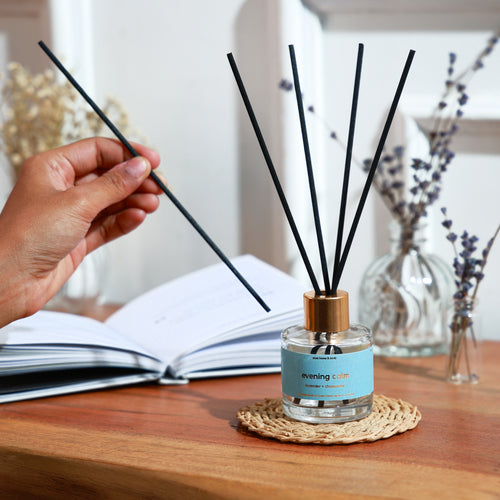 8.9 softest · Evening Calm₹799Shop →
 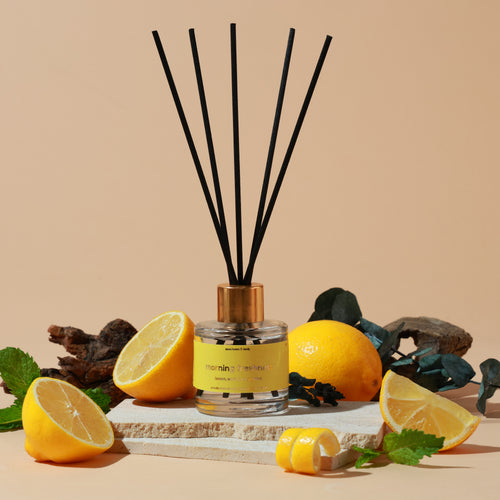 9.0 bright · Morning Freshness₹749Shop → 9.4 least sweet · Mountain Breeze₹849Shop →
Where to put it, and how to judge whether it is working
Start with the room people enter first. That is where an impression is formed, and it is the room a signature is really for. Place slightly inside it rather than on the threshold: an entrance is the most turbulent point in a home, exchanging air wholesale every time the door opens, so anything sitting there is repeatedly stripped and then met at very close range. A metre or two in, out of the draught but still in the path air already takes, gives a better impression and a longer bottle. The second location, if you want one, should be the room you actually occupy in the evening — and put it near where you sit rather than where it looks best, because a passive diffuser makes a zone and there is no point placing that zone in the part of the room nobody uses.
Then accept that you are the worst possible judge of your own signature. Olfactory receptors stop reporting a constant, unchanging stimulus within minutes; you are adapted to your own home completely and quickly, and no product corrects that. This produces the most common complaint I receive from people who have done everything right: everyone else can smell it except me. That is expected, not a fault. Sensitivity to individual materials varies enormously between people, and on top of that you live there. If guests remark on it and you cannot detect it, the signature is working for everybody but you — and buying something stronger will overwhelm them while you still notice nothing, which is how a good setup gets ruined.
So judge it with other people’s noses and with arrivals. Ask the next visitor what they notice at the door. Pay attention to the first three seconds when you come home from outside, before your nose settles. And be realistic about the reward: you will get your own signature on returning from work or from a trip, and almost never while sitting in the middle of an ordinary evening. That is not a deficiency in the setup. It is what a signature is, and it is the same reason the hotel worked so well on you — you were arriving, and you did not live there.
What to buy, in order — and the rung that does not exist
Cheapest first, as always, because the two free rules do more for a signature than any purchase. The last row is the honest gap in our range, and the row above it is the product I most often talk people out of.
| Do this | What it is | When it is the right answer | Price |
|---|---|---|---|
| 1. Decide the rules before you shop ★ | One scent; one or two locations, not every room; a twelve-month commitment; the dose set low rather than high; judged by visitors and by your own arrivals rather than by sitting in it | First, always. Two of the three rules of a signature cost nothing at all, and they are the two nobody follows | ₹0 |
| 2. The signature itself | One reed diffuser — Evening Calm 8.9 the softest, Mountain Breeze 9.4 the least sweet and least gendered, Morning Freshness 9.0 the one that suits an open kitchen. Six fibre reeds, refillable glass | When you want a signature that is silent, unplugged and never accidentally switched off. 50ml up to ~150 sq ft, 130ml above | ₹749–₹1,349 |
| 3. Staying with it | Reed refills — 300ml ₹2,399, 500ml ₹3,499, oil only, topping up the bottle and reeds you already own | Once one scent is clearly the one you keep going back to. Never a first purchase — without the bottle it is an incomplete product | ₹2,399–₹3,499 |
| 4. If the signature must be a hotel register | Sukoon ₹1,899 — ultrasonic, 270–320 sq ft, 16–18 hours on low, three 15ml Hotel Collection scents included; refills 100ml ₹999, 300ml ₹1,799 | The only route to a hotel-inspired scent, because those oils are water-based and ultrasonic-only. You accept dilution, humidity and refilling | ₹1,899 |
| 5. A dry, undiluted signature at personal scale | Safar — waterless cold-air nebulising, 20ml bottle, 2000 mAh Type-C, up to 10 hours continuous or around 30 intermittent, 3 speeds, 1/2/3-hour auto-off, 6.9 cm. Named and sold as a car and travel diffuser, with bedside and hotel room among its stated uses | When water is out and you want undiluted oil thrown dry. No published room-coverage figure, and the auto-off means it is not always-on — which is a genuine drawback for a signature | ₹3,999 |
| Never for a signature: Megh | 6L tank, around 100 hours of runtime, about 215 sq ft | Less coverage than the ₹1,899 Sukoon. A runtime and humidity machine, never a coverage upgrade | ₹3,499 |
| The honest gap | No hotel-inspired reed diffuser exists, and no mid-sized waterless bedroom nebuliser exists — nothing between Safar and Vaayu ₹11,999, which is rated to 1000 m³ or roughly 2,000–3,000 sq ft and belongs to a whole floor rather than a bedroom | Said plainly, because both gaps shape what a home signature can actually be | — |
Versailles
This is my favourite question in the whole cluster, because the honest answer costs almost nothing and I get to say so. A signature is not a product you buy; it is a decision you keep. The hotels you are thinking of are not using a fragrance you cannot afford. They are using one composition, in a small number of places, at a level chosen once, for years on end — and they are not tempted by the interesting new one, because a hotel has no personal taste to indulge.
Which is where it gets difficult for the rest of us, because we do. I make fragrance for a living and I still have to stop myself rotating what is in my own hallway. The discipline is the hard part, not the shopping, and anybody who tells you the answer is a more expensive oil is selling you the easy half of the problem.
The other thing I want to say, warmly, is about the disappointment that sometimes follows a good hotel stay. It is very common to set all of this up correctly and then feel that your own home still does not hit you the way that lobby did. It will not, and that is not a failure. You adapt to your own house within minutes; you had no such advantage in a building you were visiting. Your signature is doing its work on your guests and on you in the first three seconds after you come in from outside, and if you know to look for it there, you will find it. Everything is composed in Pune, and part of every order funds a girl’s classroom through Nanhi Kali.
Frequently asked questions
- My house smells boring after the hotel — novelty, adaptation and the practical ladder.
- I loved the smell of my hotel room on holiday — what is reproducible and what is not.
- The resort you could smell on arrival — scale and scheduling.
- Why a ₹1,000 reed feels nothing like a hotel — the ceiling is the mechanism, not the budget.
- Making coming home feel like a hotel — the scheduling answer.
- That hotel smell every evening — reasoning from your occupied hours.
- A resort feeling in a normal Indian apartment — humidity and open windows, named.
- You do not need a luxury home — presence is mechanism and consistency.
- What to buy first — the family pillar, cheapest honest option first.
- Brand: the SOSA founder story.
Facts verified August 2026: SOSA reed diffusers — five scents: Morning Freshness (Malabar lemon · peppermint · eucalyptus globulus) 50ml ₹749 / 130ml ₹1,249, 9.0 on the SOSA strength scale; Evening Calm (Kashmir lavender · chamomile · soft musk) ₹799 / ₹1,299, 8.9, the softest in the range; Garden Bloom (British rose · night-blooming jasmine) ₹799 / ₹1,299, 8.9; Mountain Breeze (Himalayan pine · sage · Indian cedar) ₹849 / ₹1,349, 9.4; Fresh Brew (Coorg coffee · Kerala vanilla · caramel) ₹849 / ₹1,349, 9.5, the deepest. 50ml lasts 6–8 weeks and suits rooms up to ~150 sq ft; 130ml lasts 14–18 weeks and suits above 150 sq ft. Six fibre reeds in every bottle, flipped every 3–5 days, six for full projection and three for a soft bedside level; about ₹13–₹15 a day; heat-stable CCT carrier rather than DPG; alcohol-free, phthalate-free, paraben-free, IFRA-compliant, 0 ppm formaldehyde; refillable glass; climate-tested at 45°C and 85% RH; composed in Pune. Duos are two 50ml bottles at ₹1,498–₹1,598; 130ml duos ₹2,498–₹2,598; refills 300ml ₹2,399 and 500ml ₹3,499, oil only and never a first purchase. Machines: Boond ₹899 (300ml, up to ~150 sq ft, ~6 hours, USB, night light), Sukoon ₹1,899 (500ml, 270–320 sq ft, 16–18 hours on low, three 15ml Hotel Collection scents included), Megh ₹3,499 (6L tank, ~100 hours runtime, ~215 sq ft, less coverage than Sukoon), Safar ₹3,999 (waterless cold-air nebulising, 20ml bottle, 2000 mAh Type-C, up to 10 hours continuous or around 30 hours intermittent, 3 speeds, 1/2/3-hour auto-off timer, 6.9 cm, named and sold as a car and travel diffuser with car, handbag, desk, bedside and hotel room among its stated uses, and no published room-coverage figure) and Vaayu ₹11,999 (up to 1000 m³ or roughly 2,000–3,000 sq ft, 400ml tank lasting up to about 90+ days, Bluetooth app and onboard buttons, 1h/4h/8h/24h run windows, adjustable intensity, key-lock, under 38 dB, freestanding or wall/HVAC mount, 5W, CE, RoHS, SGS). Hotel Collection fragrance oils are water-based and ultrasonic-only at 15ml ₹299 (a refill), 100ml ₹999, 300ml ₹1,799 and a pack of seven at ₹1,799; they cannot be used in reed diffusers and reed oil cannot be used in ultrasonic machines, so no hotel-inspired reed diffuser exists. Fragrance does not remove a smell — source, then ventilation, then fragrance. Free shipping above ₹499. A portion of every order supports girl-child education through Nanhi Kali. SOSA is an independent Indian fragrance house; the Hotel Collection scents referenced here are SOSA’s own interpretations inspired by the world’s finest hotels, and SOSA is not affiliated with, endorsed by or a supplier to any hotel brand. Prices subject to change — see the live product pages.