




What the oil is genuinely responsible for: whether the materials read as real rather than as a shorthand for real; whether the composition holds together at low dose instead of collapsing into one sweet note; whether it is still interesting in hour three when the top notes have gone. Those are worth paying for and you have not wasted the money.
The two-minute diagnostic: smell at the bottle, at one metre, and at the door. Strong at the bottle and gone at one metre means the oil is fine and the transport is missing. If it is weak even at the bottle, that is a different page.
What to change: passive capillary (a reed) gives a fragrant zone. Sukoon ₹1,899 — ultrasonic water mist, 270–320 sq ft, 16–18 hours on low — gives genuine room coverage with the oil diluted in water. Safar ₹3,999 gives waterless cold-diffusion of undiluted oil at personal scale; it is named and sold as a car and travel diffuser and has no published room-coverage figure. Vaayu ₹11,999 covers up to 1000 m³, roughly 2,000–3,000 sq ft, and is the wrong purchase for one bedroom.
One premise to correct kindly: if what you bought was described to you as a hotel-inspired reed diffuser, no such product exists at SOSA. The Hotel Collection is water-based and ultrasonic-only; reed oil cannot go into a machine and Hotel Collection oil cannot go into reeds.
The honest gap: between Safar and Vaayu, SOSA has no mid-sized waterless bedroom nebuliser. If you want a cloud without water in one room, the range does not have a perfect object for you and I will not pretend it does.
2. Understand what a cloud actually is, because the word is doing real work. What you noticed in the hotel was a volume of air holding fragrance at a perceptible concentration, evenly, continuously. That requires four things: enough material entering the air per minute, droplets fine and dry enough to stay suspended rather than fall, air movement to distribute them, and a supply rate faster than the rate at which ventilation carries them away. Only the first of those is influenced by which oil you bought. The other three belong entirely to the device.
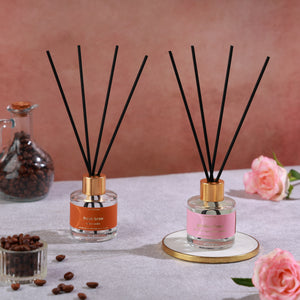
3. Name the mechanism you own. If your fragrance is standing in a bottle with sticks in it, that is passive capillary diffusion — oil climbing six fibre reeds and evaporating from their surface at whatever rate the room’s temperature, humidity and airflow allow. No energy goes in and no air is moved, so concentration is highest at the bottle and falls with distance. That produces a fragrant zone, not a cloud, and it is the design rather than a defect. If it is in a machine making a visible wet plume, that is ultrasonic water mist, which does move air and does cover a room, with the oil diluted in water. If it is in a machine producing no visible mist at all, that is waterless cold-air nebulising, which is what hotels use.
4. Change the mechanism before you change the fragrance. Sukoon at ₹1,899 covers 270–320 sq ft, runs 16–18 hours on low from a 500ml tank and includes three 15ml Hotel Collection scents. It dilutes the oil in water, adds humidity and needs filling, and in hard-water cities can leave a fine white mineral dust — all true and all worth knowing. It is still the best-value way to find out whether your problem was ever the fragrance, because it takes the same family of oil and gives it a room.
5. If water is unacceptable, the waterless mechanism is the honest answer and the range is honest about its shape. Safar ₹3,999 shatters undiluted oil into a dry mist — 20ml bottle, 2000 mAh Type-C battery, up to 10 hours continuous or around 30 intermittent, three speeds, a 1/2/3-hour auto-off timer, 6.9 cm across. It is named and sold as a car and travel diffuser, though SOSA’s own page names bedside and hotel room among its uses, and SOSA publishes no room-coverage figure for it. Vaayu ₹11,999 covers up to 1000 m³ — roughly 2,000 to 3,000 sq ft — and in one bedroom is nine-tenths wasted.
Alcohol-free, phthalate-free, paraben-free, IFRA-compliant, 0 ppm formaldehyde across the reed range. Free shipping above ₹499, and a portion of every order supports girl-child education through Nanhi Kali.

What a scent cloud physically is, and why an oil cannot make one on its own
People use “cloud” loosely and it turns out to be the most accurate word available, so let us take it literally. What you walked into in the hotel was a volume of air carrying fragrance at a concentration high enough to cross your perception threshold, spread evenly enough that it did not change as you moved, and sustained long enough that it was still there when you came back down for breakfast. Producing that requires supply, suspension, distribution and persistence, and a bottle of oil supplies only the raw material for the first of them. Everything else is done by the machinery around it, or is not done at all.
Take the four in turn. Supply is how much material enters the air per minute. A reed diffuser’s supply is evaporation from the wetted surface of six fibre sticks — a fixed, small surface, running at whatever rate the room’s temperature and humidity allow. An ultrasonic machine’s supply is a piezo plate vibrating a water-and-oil mixture into a visible wet mist. A cold-air nebuliser’s supply is pressurised air shattering undiluted oil into a dry micro- or nano-mist. Those three supply rates are not variations of the same thing; they are different orders of the same physical quantity, and no choice of oil moves you between them.
Suspension is whether what you produce stays in the air. Fine and dry stays up; large and wet falls, which is why a water machine also puts moisture on the surface below it and why a nebuliser does not. Distribution is air movement, and this is where the reed loses decisively: it adds none. Molecules leave the reeds and go wherever the room’s own air was already going, which in a still room is very nearly nowhere. Persistence is supply against removal — open windows, an extractor, a door that keeps opening. A hotel wins persistence by running a machine on a schedule into a space that was designed around it. In a flat you win it by closing a door. Notice that the fragrance appears in exactly one of those four sentences, and that it appears as the material rather than as the cause.
 Hotel Collection₹999Here is the unasked question that explains more of the gap between your room and the hotel than any note list will: “Why does undiluted oil smell stronger than the same oil in a water diffuser?” Because it is not competing with water. An ultrasonic machine throws a mixture of oil and water; a cold-air nebuliser shatters neat oil. Same composition, different payload per droplet — and the dry mist adds no humidity and leaves no white mineral dust. That single difference is a large part of why hotels use cold-air nebulising and why a home water diffuser, however good, reads as softer.
 Garden Bloom₹799Some readers arriving at this page do not have too little fragrance in the room; they have too much of it in one place. Almost any composition pushed to too high a concentration flattens into a single sweet or sharp impression — which is precisely what people mean when they say something smells like an air freshener. The same oil at a lower dose reads as layered, because the nose has room to resolve the separate materials. If your room smells strongly of something you paid a lot for and it still does not feel luxurious, the problem may be dose rather than transport, and the fix is fewer reeds or a lower intensity, which costs nothing.
 Evening Calm₹799Olfactory receptors adapt to a constant, unchanging stimulus within minutes: the signal still arrives and the brain stops reporting it because nothing has changed. Part of what made the hotel remarkable is that you arrived un-adapted, from outside, into a space you had never smelled before. In your own flat you have neither of those advantages. Before concluding that nothing is happening, leave for fifteen minutes and walk back in, or ask someone who does not live there. A visitor is a better instrument than you are, and it is common for everyone in a household to notice a fragrance except the person who bought it.
In defence of the fragrance you bought
I am not going to tell you the oil does not matter, partly because it is untrue and mostly because it is the sort of thing said by people who sell machines. Composition decides whether you like the smell, and liking the smell is not a small part of this. A well-made hotel-inspired oil is doing several difficult things at once, and none of them shows up in a note list. It is using materials that read as the real object rather than as a shorthand for it — the difference between a rose and a rose soap, or between cold-pressed lemon and the lemon in a floor cleaner, is entirely a materials decision and it is where most of the cost goes.
It is also holding a shape at low concentration. This is the underrated craft in home fragrance: a composition that is beautiful when you sniff the bottle can collapse into one flat note once it is spread thin across a room, and building something that stays legible at low dose is harder than building something impressive at high dose. And it is behaving over time. Every accord has an evaporation curve; the lightest, most volatile materials leave first, which is why a diffuser runs hot in week one and settles by week three into the heavier heart and base. That is not fading, it is the composition as designed — and whether hour three is still interesting or has become a single sweet note is a decision the perfumer made and you paid for.
What the oil cannot do is move. There is no material, at any price, that adds air movement to a room, and this is the part the category is quietly dishonest about. Listings say “highly concentrated” and “long lasting” and “powerful”, and every one of those words describes the bottle rather than the room. You bought a fragrance to solve a diffusion problem, which is the most natural mistake in this category and one that the way products are marketed makes almost inevitable. It is not carelessness and it is not a wasted purchase. Keep the oil; change what is throwing it. One correction while we are here, kindly meant: if the thing you bought was sold to you as a hotel-inspired reed diffuser, there is no such product at SOSA. Our Hotel Collection is water-based and ultrasonic-only, reed oil cannot go into a machine and Hotel Collection oil cannot go into reeds — so what you have is either a reed with a hotel-style fragrance, or an oil looking for hardware.
| Mechanism | What it puts into the air | What the room feels like | Cost of the trade | Price |
|---|---|---|---|---|
| Passive capillary — reed diffuser | Evaporation from six fibre reeds. No air moved | A fragrant zone around the bottle, falling away with distance. Lovely close up | No control at all — it cannot be switched off. But nothing to charge, fill or remember | ₹749–₹1,349 |
| Ultrasonic water mist — Sukoon ★ | Oil diluted in water as a visible wet mist. Moves air, covers 270–320 sq ft | Genuine room coverage, on demand, 16–18 hours on low. The best-value change for most bedrooms | Dilution, added humidity, refilling, and white mineral dust in hard-water cities | ₹1,899 |
| Ultrasonic — Megh | Same mechanism, six-litre tank, around 100 hours of runtime | About 215 sq ft — less coverage than the ₹1,899 Sukoon | A runtime and humidity machine, never a coverage upgrade. The easiest product in our range to misread | ₹3,499 |
| Waterless cold-air — Safar | Undiluted oil shattered into a dry mist. No water, no dilution, no humidity, no dust | Personal and small-space presence. No published room-coverage figure | Named and sold as a car and travel diffuser. Needs recharging; auto-off runs 1, 2 or 3 hours | ₹3,999 |
| Waterless cold-air — Vaayu | The same mechanism at building scale. Up to 1000 m³ — roughly 2,000–3,000 sq ft | An even, dry, undiluted cloud across a connected volume, on an app schedule | ₹11,999, and in one bedroom nine-tenths of it is wasted. It earns its price on a floor | ₹11,999 |
| The honest gap: there is nothing between Safar and Vaayu — no mid-sized waterless bedroom nebuliser, no half-Vaayu. So if your requirement is “a cloud, in one room, without water”, the range gives you a personal device bought with its limits understood, or a machine sized for a floor. That is the shape of the catalogue and it is better said than discovered. | ||||
Room coverage · Sukoon₹1,899Shop →  The oils · Hotel Collection₹999Shop →
  Close range, always on · Garden Bloom₹799Shop →
The three checks worth running before you spend anything
Placement. A reed diffuser has no fan and relies on the room’s own air movement, so a bottle in a corner behind a lamp is doing almost nothing. Move it into the path air already takes — near a doorway, on a console, on the counter a metre from where you stand — but out of the direct blast of a split AC, which strips the top notes in days and leaves you with the base. On the other side, an entrance is the most turbulent point in a home, so slightly inside the door beats on it. This costs nothing and it fixes a meaningful share of the letters I receive.
Dose and containment. Six reeds for full projection, three for a soft level and roughly double the life; add reeds before you conclude a bottle is weak, and remove them if the room reads as flat and sweet. Then close the door. Concentration in a space is what enters the air minus what leaves it, so cutting air exchange raises the level more reliably than raising output does. A closed 120 sq ft bedroom reaches a perceptible concentration far faster than an open floor, which is why the same bottle can feel generous in one room and absent in another. And if the room needs more than it is getting, remember that a 50ml is specified for up to about 150 sq ft and a 130ml above that — a 50ml in a 300 sq ft living room reads as weak while performing exactly to specification.
The adaptation test. Leave for fifteen minutes, come back, and pay attention to the first three seconds. That reading is the only honest one you can take yourself. Better still, ask a visitor. If they say it is lovely and you cannot smell a thing, the diffuser is working and what you are missing is the arrival contrast rather than the fragrance — which is a different problem with a different solution. Only when all three checks come back clean is it time to spend money, and then the thing to buy is a mechanism rather than another bottle.
What to change, in order — and the rung that does not exist
In the order I would actually spend, starting with the changes that cost nothing. The last row is our own gap, stated plainly, because a reader whose requirement is a cloud in one room without water is a reader the range cannot perfectly serve, and saying so is more useful than steering you into the nearest thing.
| Change | What it is | When it is the right answer | Price |
|---|---|---|---|
| 1. Placement, reed count and the closed door ★ | Move the bottle into the room’s airflow and out of the AC blast; six reeds for full projection or three for soft; shut the door for the hours that matter | First, always. A meaningful share of these complaints are placement or dose, and the fix is free | ₹0 |
| 2. Sukoon | Ultrasonic water mist — 500ml, 270–320 sq ft, 16–18 hours on low, three 15ml Hotel Collection scents included | When you want real room coverage and control, and can accept dilution in water, added humidity and refilling. The best-value change in the range | ₹1,899 |
| 3. Safar | Waterless cold-diffusion of undiluted oil — 20ml, 2000 mAh Type-C, up to 10h continuous or ~30h intermittent, 3 speeds, 1/2/3-hour auto-off, 6.9 cm. Named and sold as a car and travel diffuser | When water is unacceptable and you want the hotel mechanism at personal scale, understanding that there is no published room-coverage figure and that it needs recharging | ₹3,999 |
| 4. Vaayu | Waterless cold-air nebuliser, up to 1000 m³ or roughly 2,000–3,000 sq ft. 400ml tank up to about 90+ days, Bluetooth app with 1h/4h/8h/24h windows, adjustable intensity, under 38 dB, wall or HVAC mount | Only when the space is a whole floor, an open-plan living-dining, a large home or a villa. For one bedroom it is the wrong purchase | ₹11,999 |
| Do not buy: another bottle of oil | A second expensive composition, in the same device that failed to project the first one | Never, for this problem. It is the same experiment with a different variable held constant | — |
| The honest gap | Nothing exists between Safar and Vaayu — no mid-sized waterless bedroom nebuliser. And there is no hotel-inspired reed diffuser at all: the Hotel Collection is water-based and ultrasonic-only, and the two systems cannot be mixed in either direction | Said plainly. If your requirement is a cloud in one room with no water, the range answers it imperfectly and I would rather you knew that now | — |
Versailles
I compose fragrance for a living, so you would expect me to argue that the oil is what matters, and in most conversations I do. This is the conversation where I have to say the other thing. When somebody writes to me with a good bottle and a disappointing room, the fragrance is almost never the reason, and the pretence that a better composition would fix it is the most expensive misunderstanding in this whole category.
What makes it hard to say is that the pretence is not a lie exactly. Composition genuinely decides whether you like the smell — whether the rose reads as a garden or as a soap, whether hour three is still layered or has gone flat and sweet, whether the thing survives being spread thin across a room instead of collapsing into one note. Those are real, they are difficult, and they are where the money in a good oil actually goes. None of them is transport. There is no material at any price that adds air movement to a room, and transport is what you were shopping for without knowing the word.
So keep the bottle. Run the two-minute test — nose at the source, then a metre back, then the doorway — and if it is rich up close and thin at a distance, you have your answer and it is not a criticism of anything you bought. Then change the mechanism rather than the fragrance. And I will say the awkward part once more, because it is the reason this cluster exists: we do not make a mid-sized waterless machine, so a reader who wants a cloud in one bedroom with no water is choosing between a compromise and a machine built for a floor. I would rather write that sentence than sell around it. Everything is composed in Pune, and part of every order funds a girl’s classroom through Nanhi Kali.
Frequently asked questions
- A 100 sq ft bedroom and a hit at the door — the cheapest real answer to the arrival moment.
- A 10 × 12 AC bedroom where the reed only works near the bottle — distance decay, and what recirculating air is worth.
- Mumbai, small, humid, no water — the constraint stack that most exposes the range’s gap.
- 150 sq ft, strong fragrance, on only when I’m home — the control question, answered honestly.
- Bedroom only, not the whole 2BHK — no, and here is what to buy instead.
- Safar in one room, Vaayu in the other — why two machines is usually the wrong shape.
- What type of diffuser should I search for — the words that make your next search work.
- “Strongest hotel reed diffuser” — why that product does not exist anywhere.
- Reed, Safar or Vaayu — the whole method in one page.
- Brand: the SOSA founder story.
Facts verified August 2026: Three diffusion mechanisms are described — passive capillary (reed diffusers), ultrasonic water mist (Boond ₹899, 300ml, up to ~150 sq ft, ~6 hours, USB, night light; Sukoon ₹1,899, 500ml, 270–320 sq ft, 16–18 hours on low, three 15ml Hotel Collection scents included; Megh ₹3,499, 6L tank, ~100 hours runtime, ~215 sq ft, which is less coverage than Sukoon and never a coverage upgrade) and waterless cold-air nebulising (Safar ₹3,999, 20ml bottle, 2000 mAh Type-C battery, up to 10 hours continuous or around 30 hours intermittent, 3 speeds, 1/2/3-hour auto-off timer, 6.9 cm, named and sold as a car and travel diffuser with car, handbag, desk, bedside and hotel room among its stated uses, no published room-coverage figure; Vaayu ₹11,999, coverage up to 1000 m³ or roughly 2,000–3,000 sq ft, 400ml refillable tank lasting up to about 90+ days depending on intensity and scheduled hours, Bluetooth app and onboard buttons, 1h/4h/8h/24h run windows, choice of days, adjustable mist intensity, key-lock, under 38 dB, freestanding or wall/HVAC mount, 5W, CE, RoHS, SGS, and to be used with alcohol-free water-free oils formulated for cold-air diffusion). Aangan ₹25,999 (~8,000–10,000 sq ft) and Meenar ₹38,500 (12,000–18,000 sq ft) are commercial HVAC machines and are named in this cluster only as the top of the ladder, never as a home recommendation. SOSA reed diffusers: five scents, 50ml ₹749–₹849 lasting 6–8 weeks and suiting rooms up to ~150 sq ft, 130ml ₹1,249–₹1,349 lasting 14–18 weeks and suiting above 150 sq ft, six fibre reeds included and flipped every 3–5 days, six reeds for full projection and three for a soft bedside level, about ₹13–₹15 a day, heat-stable CCT carrier rather than DPG, alcohol-free, phthalate-free, paraben-free, IFRA-compliant, 0 ppm formaldehyde, refillable glass bottle, climate-tested at 45°C and 85% RH, composed in Pune. Duos are two 50ml bottles at ₹1,498–₹1,598; 130ml duos ₹2,498–₹2,598; refills 300ml ₹2,399 and 500ml ₹3,499, oil only and never a first purchase. SOSA strength scale: Evening Calm 8.9, Garden Bloom 8.9, Morning Freshness 9.0, Mountain Breeze 9.4, Fresh Brew 9.5 — a measure of perceived intensity in a room, not of quality or concentration. Hotel Collection fragrance oils are water-based and ultrasonic-only at 15ml ₹299 (a refill), 100ml ₹999, 300ml ₹1,799 and a pack of seven at ₹1,799; they cannot be used in reed diffusers and reed oil cannot be used in ultrasonic machines, so no hotel-inspired reed diffuser exists. Between Safar and Vaayu, SOSA makes no mid-sized waterless nebuliser. No health, air-quality, allergy or antimicrobial claims are made, and fragrance does not remove a smell — source, then ventilation, then fragrance. Free shipping above ₹499. A portion of every order supports girl-child education through Nanhi Kali. SOSA is an independent Indian fragrance house; the Hotel Collection scents referenced here are SOSA’s own interpretations inspired by the world’s finest hotels, and SOSA is not affiliated with, endorsed by or a supplier to any hotel brand. Prices subject to change — see the live product pages.