


Where: one at the seating end, one at the far end of the dining zone. Never in the kitchen, and never in the path between the main door and the balcony.
What it costs: ₹1,998 for a 130ml plus a 50ml, or ₹2,498 for two 130ml — which works out at about ₹156 a week for the entire ground floor of the flat.
2. Count the run, not the square feet. This is the part that changes the answer. Fragrance from a passive source does not radiate in a neat circle to the edge of its rated area; it charges the air immediately around it and then depends on whatever gentle movement the room has. Over about twenty-two feet of straight run, a second source is doing something a bigger bottle cannot. Under eighteen feet, it is a second starting point in air one bottle already holds.
3. The kitchen end gets nothing. It is the most common third purchase and the least useful. While you cook, the food is the dominant smell in the flat and no reed diffuser is going to sit above it. While you are not cooking, the exhaust hood has usually just finished pulling several room-volumes of air out through the wall. Add to that the oil vapour that shortens reed life, and the kitchen is the one zone where the honest recommendation is an open window.
4. One scent across the whole plan. People buy two scents because they are thinking in rooms — lemon for the dining end, lavender for the sofa. There is no door between those zones. The two blends meet somewhere near the middle of the room and neither reads as itself. Buy two bottles of the same blend, or a 130ml and a 50ml of it. Different scents belong on the far sides of closed doors.
5. If the balcony door stays open, move a bottle rather than buy one. An open plan with a permanently open balcony door is not a 380 sq ft room; it is a 380 sq ft room being flushed three to eight times an hour. No number of bottles fixes that. What helps is putting the source out of the draught line between the main door and the balcony, usually against an inside wall, where the air is slow enough to hold something.
Made in India, composed by an ISIPCA Versailles-trained perfumer — and a portion of every order supports girl-child education through Nanhi Kali.
Why an open plan is counted along its length, not across its area
The single most useful rule in sizing home fragrance is count doors, not square feet — a 900 sq ft flat with five closed doors is five separate air spaces, and the same 900 sq ft with everything open is one. An open-plan living-dining-kitchen is the pure case of that rule: it has no internal doors at all, so it is unambiguously one air space, and three bottles for "three zones" is a category error. But the rule cuts the other way too. One air space does not mean one bottle, because a bottle does not have a range that expands to fill whatever it is put in.
A reed diffuser is passive. Fragrance climbs each reed by capillary action, evaporates from the exposed length, and from there the room decides. The stated coverage of up to about 150 sq ft on six reeds describes an equilibrium — the size of pocket a bottle can keep charged when the air is closed and still. Distance is what defeats it, and open plans are full of distance. A 380 sq ft plan is rarely a nineteen-foot square; it is far more often twenty-four feet by sixteen, which puts the far end well beyond anything a source at the sofa can hold. Height compounds it: 380 sq ft under a nine-foot ceiling is about 3,420 cubic feet, against the roughly 1,350 cubic feet that a single bottle is rated to. And an open plan is the most ventilated space in the flat — main door at one end, balcony at the other, kitchen exhaust in the middle. A closed room exchanges perhaps 0.2 to 0.5 of its air an hour; this one can run at three to eight. That is the honest picture, and it is why two bottles placed properly beat three bought carelessly.
The three decisions for an open plan
 Two bottlesFrom ₹1,998Walk the longest straight line in the space and measure it. Under about eighteen feet, one bottle on six reeds is genuinely enough and a second is a second starting point in air already held. Between eighteen and about twenty-eight feet, two — one near the seating, one at the far end of the dining zone, both on inside walls rather than in the draught line. Beyond that you are not sizing a room any more, you are sizing a floor, and a Sukoon at the living end doing the work actively is a better answer than a third passive bottle.
Sizing by space — open plans, end to end
Measure your longest straight run before you read this table, because that number decides more than the floor area does. Two rows here tell you to buy nothing at all.
| Space | What it needs | How many | Cost |
|---|---|---|---|
| Open plan of 300–450 sq ft, run of 18–28 ft ★ | Two sources at opposite ends of the long axis, same scent — the case in this article | Two | ₹1,998 or ₹2,498 |
| Compact open plan under about 250 sq ft, run under 18 ft | One 130ml on six reeds, placed roughly central on an inside wall | One | from ₹1,249 |
| The kitchen end of any open plan | Nothing. Cooking outranks it, the exhaust removes it, and oil vapour clogs reeds | None | ₹0 |
| A formal dining zone nobody eats in on weekdays | Nothing. It is inside the same air space and borrows from the living end already | None | ₹0 |
| Open plan with the balcony door open most of the day | Not a count problem — move the source out of the main-door-to-balcony flow path first | Two, repositioned | ₹2,498 |
| Open plan over about 500 sq ft, or double-height | Past passive range — a Sukoon at the living end plus one bottle at the far end | One machine, one bottle | ₹3,148 |
| A note on all of the above: every coverage figure here assumes closed, still air at a standard ceiling height, and an open plan is the least closed and least still room in an Indian flat. Treat the numbers as the best case and expect a real plan with a balcony to sit slightly under them — which is an argument for better placement, not for a third bottle. | |||
One room · the unitFrom ₹749Shop → 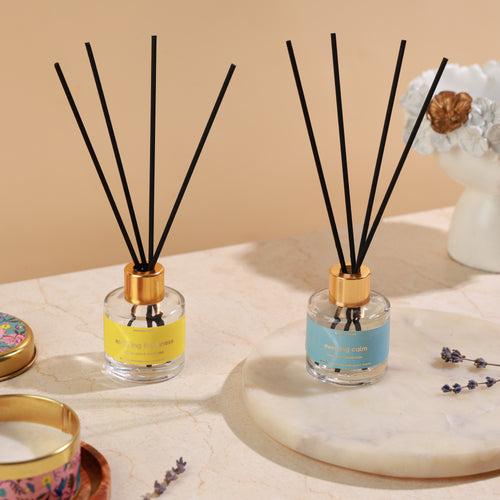 Two rooms · better value₹1,498Shop →
  Large room · a switch₹1,899Shop →
Placement, reeds and the scent rule
Place both bottles out of the flow path, and put them where people stop. Draw the line in your head from the main door to the balcony door — that is the corridor of moving air in most open plans, and anything sitting in it is being emptied into the outside. Put the first bottle on a console or side table near the seating, at roughly chest height rather than floor level, and the second at the far end of the dining zone on an inside wall. Both want gentle air movement, not a draught, and both want to be away from direct sun and out of the throw of an AC vent or a ceiling fan, which will empty a bottle in half its stated life and push everything against one wall while it does it. Stand them on a tray, because reed oil permanently marks a polished finish if the bottle is knocked.
Six reeds in the living-end bottle, four to six at the dining end. Reed count is the only volume control a reed diffuser has, and an open plan is the one place in the home where six is genuinely correct rather than excessive — it is a large volume with real air movement, entered repeatedly by people arriving from outside with unadapted noses. Give it two full days before you judge anything: reeds have to saturate along their whole length before they throw properly, and a first-day verdict is meaningless. Then judge it from the doorway on the way in, not from the sofa, because after twenty minutes in the room you cannot smell it and never will be able to. If the far end reads quiet after that, add a reed there before you consider adding a bottle — going from four reeds to six is free.
Then buy one scent, and buy the refill rather than the bottle next time. Two 130ml of the same blend is ₹2,498 and gives you 14–18 weeks. When they run low, a 300ml refill at ₹2,399 fills a 130ml roughly twice, so a single refill carries both bottles through their next cycle for less than buying them again — and refilling is the natural moment to fit fresh reeds, since clogged fibre is the commonest reason a bottle that started well seems weak three months later. For an open plan with a kitchen in it, Morning Freshness is the safest choice of the five; Garden Bloom is the one to pick if the space is used for entertaining more than for cooking.
What to buy
Two lines of this table cover almost every open plan. The rest is here so you can see what the other options are genuinely for.
| Buy | What it covers | Lasts | Price |
|---|---|---|---|
| One 50ml | A single reed diffuser — the dining end of a plan whose seating end already has a 130ml — about ₹105 a week | 6–8 weeks | from ₹749 |
| One 130ml ★ | The value size — the seating end of any open plan, and the better half of the two-bottle build at about ₹78 a week | 14–18 weeks | from ₹1,249 |
| The duo | Day & Night duo — two rooms behind two closed doors — not two ends of one open plan, where one scent is the rule | 6–8 weeks each | ₹1,498 |
| Sukoon | 500ml ultrasonic — an open plan over about 500 sq ft or a double-height room, where passive diffusion has run out | Runs when you switch it on | ₹1,899 |
| 300ml refill | The running cost — keeping two open-plan bottles going without buying two bottles again | Roughly 2 × 130ml fills | ₹2,399 |
Versailles
Open plans are where we sell fewer bottles than people arrive intending to buy. Someone writes in describing a living-dining-kitchen and asks for three — one for each zone — and the honest answer is two and a window in the kitchen. You are not scenting three rooms. You are scenting one long room with a cooker in it.
The mistake I care about more is the scent one, because it wastes the whole purchase rather than a third of it. Two different blends in a space with no doors do not divide it. They meet. And you will not hear about it from anyone, because your own nose has stopped registering both within twenty minutes of walking in, while every guest gets the full collision on arrival. If you want two scents in your home, put a door between them.
So: measure the long wall, buy two bottles of one blend, put them at the ends and not in the draught, six reeds each, and leave the kitchen alone. If the far end still reads quiet after two days, add a reed — it is free — before you spend another ₹1,249. A portion of every order funds a girl's classroom through Nanhi Kali.
Frequently asked questions
- A home with no internal doors — when the whole flat is one air space.
- An L-shaped living room — the one shape a second bottle really fixes.
- When to stop adding reeds — the honest crossover point.
- The complete sizing and quantity guide — every home type, three builds.
- Brand: the SOSA founder story.
SOSA products & prices (verified August 2026): Hotel Collection water-based ultrasonic diffuser fragrance 15ml ₹299 · 100ml ₹999 · 300ml ₹1,799 · Pack of 7 (15ml, all fragrances) ₹1,799; refills 100ml from ₹999. Seven scents: The Ritz-Carlton-inspired (white tea · bergamot · cedar), Westin-inspired (white tea · aloe · cedar), 1 Hotels-inspired (cedarwood · vetiver · green leaves), The St. Regis-inspired (amber · violet · woods), Shangri-La-inspired (jasmine · green tea · white tea), Four Seasons-inspired (citrus · floral · sandalwood), W Hotels-inspired (citrus · pepper · amber). Diffusers: Boond 300ml ₹899 · Sukoon 500ml ₹1,899 · Megh 6L ₹3,499. Water-based, phthalate-free, composed to IFRA standards for home diffusion; 3–6 drops per tank. Made in India, Pune. The Hotel Collection scents are SOSA's own interpretations inspired by the world's finest hotels; all hotel names are trademarks of their respective owners and are used only to describe the scent style — SOSA is an independent Indian fragrance house, not affiliated with or endorsed by any hotel brand. Prices and availability subject to change — see the live product pages.