
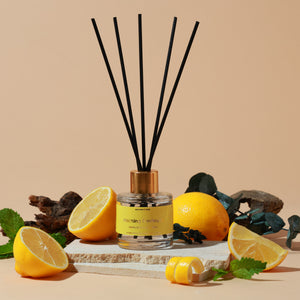


Why the room reads quieter: closed windows mean air exchange collapses. A reed diffuser has no fan — it releases and waits for the room to distribute. In a sealed flat there is nothing doing the distributing.
Fibre, not rattan: rattan's natural pores swell and clog in damp air, which is why so many imported diffusers stall in week two of the rains. Every SOSA bottle ships with six fibre reeds for exactly this reason.
The competitor nobody names: damp cotton, wet concrete, a cupboard that has not been opened in a fortnight. Air the room first. Fragrance layered onto must makes a third smell nobody designed.
2. Humidity works on the reed. Damp air is already carrying a great deal of water, so it takes up new molecules a little more grudgingly. On fibre this is a mild slowing. On natural rattan it is often terminal — the pores swell, then clog, and the stick becomes decorative. This is precisely why SOSA ships six fibre reeds rather than rattan.
3. The closed house is the bigger factor. For weeks at a time the windows stay shut, the balcony door stays shut, and the only air exchange in the flat happens when someone walks through a doorway. A reed diffuser is a point source with no propulsion; if nothing carries it, it pools.
4. The room develops its own smell. Damp cotton, wet stone and concrete, the mustiness that comes out of a cupboard opened after a fortnight. Fragrance does not delete that. Air the room first, then let the diffuser do its work — otherwise you get a third smell that nobody composed.
5. Do the free things before you spend. Ten minutes of cross-ventilation when the rain pauses; all six reeds flipped, gloves on; the bottle moved off a damp sill or an exterior wall to an interior console at waist to chest height.
6. Then adjust the composition, not the size. Cold, sharp and dry fragrances read better in wet air than heavy sweet ones. A 130ml is not louder than a 50ml at the same six reeds — it simply lasts 14–18 weeks instead of 6–8.
Composed and handmade in small batches in Pune, and a portion of every order supports girl-child education through Nanhi Kali.
Part one — the three things a monsoon actually changes
It helps to separate them, because they have different fixes and only one of them has anything to do with the fragrance you bought. The first is the reed, which is a materials question. The second is the house, which is an airflow question and by far the largest of the three. The third is the room's own developing smell, which is a housekeeping question that no fragrance can solve on your behalf. Diagnose in that order and you will usually find the answer in the second one. The figures below are SOSA's working guidance from in-house testing and years of monsoon correspondence, not laboratory measurement; a Konkan flat in August and a Delhi flat in August are not the same experiment.
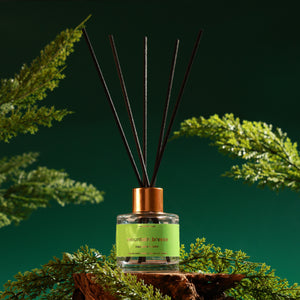
 Mountain Breeze₹849 · 9.4/10This is the big one, and it is almost never the one people suspect. Through the wet months the windows stay shut against rain and insects, the balcony door stays shut, and the fans that would have stirred a room in April are off because the flat is cool. A reed diffuser does not project; it releases and depends on the room to carry. Take the carrying away and the fragrance sits in a pocket a foot or two across, exactly where you cannot smell it from the sofa. This is why the classic monsoon complaint is strong at the bottle, absent everywhere else — which is an airflow report, not a strength report. The fix costs nothing: put the bottle where feet pass, near a doorway or on a hallway console, and let ordinary household traffic do the work the wind used to.
Part two — what 85% humidity does to each part of the system
Below is the whole mechanism laid out part by part, because "the monsoon affects it" is too coarse to act on. Notice how little of the column marked what to do involves buying anything. Our compositions are tested through 85% relative humidity, which is the top of what an Indian monsoon ordinarily delivers indoors; the descriptions here are SOSA's working guidance rather than measured laboratory figures.
| Part of the system | What 85% humidity does to it | What you notice | What to do about it |
|---|---|---|---|
| The fibre reed ★ | Handover to the air slows modestly; the pore structure does not swell | A slightly lower, flatter output — and a bottle that often outlasts its window | Flip all six weekly. Refresh the reeds if they are months old |
| Natural rattan (what we do not use) | Organic pores take up water, swell, then clog with the heavy fraction | A bottle that seems full and delivers nothing from week two | Nothing rescues a clogged rattan stick — this is why we ship fibre |
| The oil itself | Nothing. The CCT carrier is stable through heat and damp alike | No thinning, no separation, no change of character in the glass | Ignore it. The oil is the part of this system that is not moving |
| The air in the room | Stops being replaced — windows shut, fans off, no cross-draught | Strong at the bottle, nothing at the sofa. The classic July email | Ten minutes of cross-ventilation daily; move the bottle into passing traffic |
| Soft furnishing and the room's own odour | Curtains, rugs and mattresses hold damp; cupboards go stale | A background of wet cotton and concrete that fragrance sits on top of | Air and dry first. Never ask a fragrance to do a dehumidifier's job |
| The honest caveat: a reed diffuser will not make a damp room smell dry. It cannot lower humidity, it cannot dry a wall, and used as a cover for genuine damp it will make the problem harder to notice rather than easier. If a room smells of mould rather than mustiness, deal with the wall and leave the fragrance out of it until you have. | |||
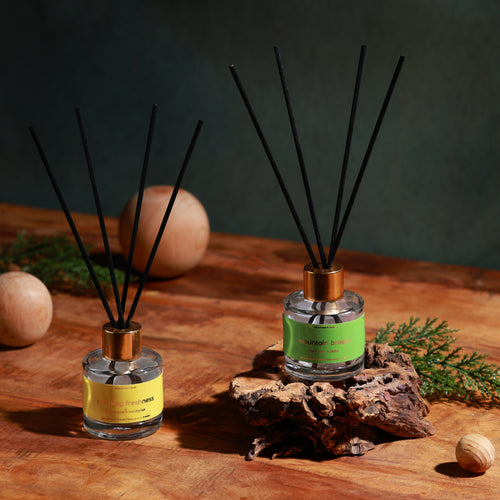
Morning Freshness · 9.0/10from ₹749Shop → 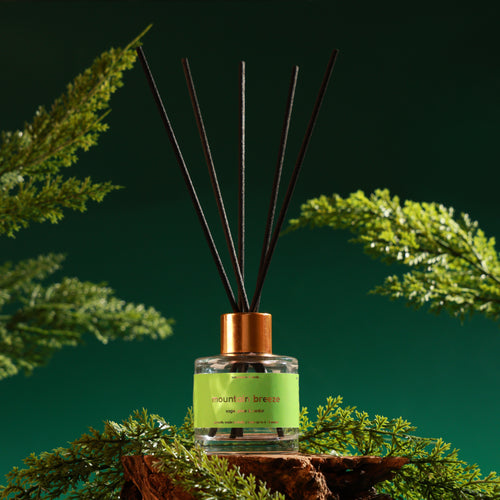 Mountain Breeze · 9.4/10from ₹849Shop →
 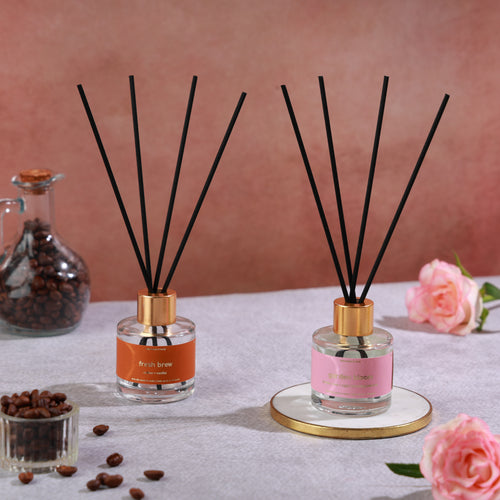 Oil refill · 300ml₹2,399Shop →
Part three — the closed house, and the ten-minute habit that fixes most of it
If you take one practical thing from this page, take this. On any day when the rain pauses — and in most of India it does pause, even in the wettest week — open two windows on opposite sides of the flat, or a window and the main door, and let the air cross for ten minutes. That is enough to replace a good part of the room's volume. Do it before you decide whether the diffuser is working, because you are then judging a room with air in it rather than a sealed box. Almost every monsoon complaint I have answered has been an air-exchange complaint wearing a fragrance costume. Afterwards, close up again and let the reeds re-establish; you will usually notice the fragrance within the hour, in the same way you notice it when you come home from work.
Which brings up the second thing the closed house does to you: it makes you a very poor judge. Olfactory adaptation is the commonest cause of "it stopped working" at any time of year, and it gets worse in a monsoon because you are simply indoors more. Your nose stops reporting a constant within minutes, and it adapts hardest at home, where the smell is familiar and unthreatening. In July you may not have stepped out of that constant for a day and a half. Guests are better witnesses than you are. If somebody arrives dripping from the lift and says the flat smells lovely, believe them over your own nose, and put your money into airing the space rather than into a stronger bottle.
And one honest note about machines, since people ask me every monsoon whether they should switch. An ultrasonic diffuser such as the Sukoon at ₹1,899 is genuinely the right tool when you want scent on demand — before guests, after cooking — and it covers 270–320 sq ft with timers and three Hotel Collection fragrances in the box. But it works by putting a cool water mist into the room, and in a flat already near 85% relative humidity you may not want more moisture in the air; run it in short bursts on the two-hour timer. The 6L Megh at ₹3,499 is a runtime and humidity machine — about 100 hours a fill but only around 215 sq ft — never a coverage upgrade, and a monsoon is the worst month to buy one. Reed oil never goes into any of these machines, and the water-based Hotel Collection never goes into a reed bottle.
Part four — the monsoon setup, room by room
Here is how I would arrange a flat for the wet months. The reed counts below are deliberate: in a closed, damp room a lower count often reads better than a higher one, because the fragrance is not being carried away and instead accumulates. Reed count is the only true volume control a passive diffuser has, and it is free and reversible in ten seconds.
| Room | What goes wrong in the rains | Reeds I would run | What I would put there |
|---|---|---|---|
| Entryway ★ | Wet umbrellas, damp shoes, the first thing anyone smells | Six — this is the room that earns the full dose | Garden Bloom ₹799, or Morning Freshness ₹749 |
| Bedroom | Closed all night, no cross-draught, everything reads heavy | Four to five — drop one from the usual six | Evening Calm ₹799 at 8.9, the softest we make |
| Living room | Air stops moving once the balcony door is shut for the season | Six, on a console near the doorway rather than mid-room | Mountain Breeze ₹849 — dry pine against wet concrete |
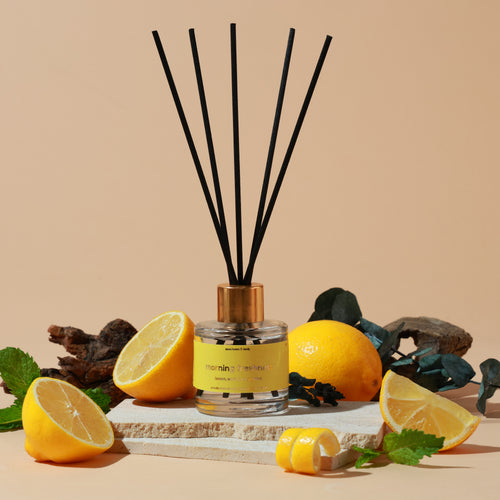
| Bathroom | Never fully dries; towels stay damp; the extractor works overtime | Four in a small bathroom, six in a large one | Morning Freshness ₹749 — cold citrus and eucalyptus |
| Kitchen | Cooking smells hang because nothing ventilates them out | Six, well away from the hob and off the counter you work on | Extractor and window first, then Fresh Brew ₹849 |
| Wardrobe or storeroom | Stale air, and the source of most of the flat's musty background | None — do not put a reed diffuser in a closed cupboard | Air it open for an hour a week. Fragrance is not the answer here |
Versailles
I trained in Versailles, where the brief for a home fragrance assumes a dry, temperate, ventilated European interior. Almost nothing about that assumption survives a Pune July, and the first monsoon after I started composing for Indian homes taught me more than a year of coursework. The failures were never in the fragrance; they were in the hardware and the house. Rattan sticks that swelled shut. Bottles on windowsills with water running down the glass behind them. Flats that had not had a window open in three weeks.
So the range was built around those facts rather than around a European room. Fibre reeds, because they keep a consistent pore structure when rattan does not. A coconut-derived CCT carrier, because it holds its character through heat and damp instead of turning sharp. And a strength calibration set at six reeds in an ordinary Indian room, which is a room that is closed for a good part of the year.
What I cannot build into a bottle is a window. If your flat has been shut for a fortnight and the cupboards have gone stale, the most valuable ten minutes you will spend on your home fragrance this month costs nothing and involves no product of mine at all. Open the place up. Then judge the diffuser. Everything is composed and handmade in small batches in Pune, and a part of every order funds a girl's classroom through Nanhi Kali.
Frequently asked questions
- Does humidity affect reed diffuser performance? — the reed-level mechanism in full.
- Getting better performance in humid weather — why bright compositions read better in wet air.
- Using SOSA diffusers across Indian seasons — the twelve-month plan, month by month.
- The complete weather and climate guide — this page and the eight around it, in one place.
- Brand: the SOSA founder story.
SOSA reed diffuser range & prices (verified August 2026): alcohol-free, phthalate-free, paraben-free and IFRA-compliant compositions on a heat-stable coconut-derived (CCT) carrier, low-VOC, supplied in a refillable glass bottle with six fibre reeds; 50ml lasts 6–8 weeks and 130ml lasts 14–18 weeks. Morning Freshness (Malabar lemon · peppermint · Nilgiri eucalyptus) 50ml ₹749 · 130ml ₹1,249 · 9.0/10; Garden Bloom (British rose · night-blooming jasmine) 50ml ₹799 · 130ml ₹1,299 · 8.9/10; Evening Calm (Kashmir lavender · chamomile) 50ml ₹799 · 130ml ₹1,299 · 8.9/10; Fresh Brew (Coorg coffee · Kerala vanilla) 50ml ₹849 · 130ml ₹1,349 · 9.5/10; Mountain Breeze (Himalayan pine · sage · Indian cedar) 50ml ₹849 · 130ml ₹1,349 · 9.4/10. Reed diffuser refills are oil only — you reuse your own vessel and reeds: 300ml ₹2,399 (roughly 8–11 months) · 500ml ₹3,499 (roughly 14–18 months), about ₹7–8 per ml against ₹15–17 per ml for a 50ml bottle. Duo sets ₹1,498–₹1,598 for 2 × 50ml and ₹2,498–₹2,598 for 2 × 130ml. Strength figures are positions on SOSA’s own internal strength scale, not an industry standard. Replacement reeds are not sold as a separate SKU; SOSA guidance is to refresh reeds every few months. The reed line is separate from the water-based Hotel Collection for ultrasonic machines (15ml ₹299 · 100ml ₹999 · 300ml ₹1,799) and the two are not interchangeable. Diffusers: Boond 300ml ₹899 · Sukoon 500ml ₹1,899 · Megh 6L ₹3,499 · waterless Vaayu ₹11,999. Composed and handmade in small batches in Pune, India; tested through 45°C summer heat and 85% monsoon humidity. Free shipping above ₹499. A portion of every order supports girl-child education through Nanhi Kali. Prices subject to change — see the live product pages.