

Test two · the held reed: hold that reed an inch from your nose. Strong here means the bottle is delivering and the problem is distribution or adaptation, not supply.
Test three · the returning visitor: fifteen minutes out of the house, then walk back in through the front door. Or simply ask someone who has just arrived.
The test that is not a test: the oil level. It moves a few millimetres a week and tells you almost nothing before week four.
2. Then hold that reed an inch from your nose. Do not sniff the bottle neck — the neck always smells, because vapour pools there. The reed is the emitting surface, and it is what the room is actually being offered. If the held reed is strong, the bottle is fine and your problem is downstream of it. If the held reed is faint, you have a genuine supply problem and the fix is a flip or more reeds.
3. Then leave the house for fifteen minutes. Balcony, stairwell, a walk to the gate — anywhere with different air. Come back in through the front door and pay attention to the first three seconds. Fifteen minutes is enough to reset a great deal of adaptation, and those three seconds are the closest you will get to smelling your own home as a guest does.
4. Better still, use an actual guest. Do not announce the diffuser. Let someone who has just arrived from outside spend two minutes in the room, then ask them a neutral question about it. A visitor's nose is an uncalibrated instrument, but it is an unadapted one, and unadapted beats calibrated here.
5. Do not use the oil level as your test. A 50ml consumes something like six to eight millilitres a week, which is a few millimetres of glass — invisible in week one and only conclusive by around week four. The level answers a different question, and answers it slowly.
6. Three passes means it is working, whatever your armchair tells you. A wet line climbing, a strong held reed and a visitor who notices is a bottle doing its job. At that point the remaining conversation is about placement, reed count or whether you have bought a composition quieter than the room needs.
Composed and handmade in small batches in Pune, and a portion of every order supports girl-child education through Nanhi Kali.
Part one — three tests, three different stages of the same journey
A reed diffuser does three things in sequence, and each one can fail independently. Oil has to climb the fibre; the exposed length has to release it into the air; and the room has to carry it to where you are sitting. Almost all the confusion in this category comes from people using a single impression to judge all three stages at once. The three tests below separate them. Run them in order — they take about a minute in total — and stop at the first failure, because a failure at stage one makes the later readings meaningless.
 Garden Bloom₹799 · 8.9/10Still holding the same reed, bring it to about an inch from your nose and breathe normally rather than sniffing hard. This matters more than it sounds: the reed is the emitting surface, and the bottle neck is not. Vapour pools in the neck of any diffuser, so a neck sniff will smell wonderful on a bottle that has completely stopped delivering — it is the single most misleading check people run. A held reed that is unmistakably strong tells you the composition is intact, the oil has not degraded, and the surface is releasing. Note also that adaptation barely affects this reading, because you have only just introduced the smell at close range. If the held reed is strong and your room is silent, you have proved the fault lies in the room rather than the bottle, and you have done it in ten seconds.
Part two — reading the three results together
Individually each test is useful; together they are diagnostic. The combination of passes and failures maps onto a specific cause, and the causes have very different prices. Here is the whole matrix in one place, with the first action for each — and note that the first action is free in every row but the last.
| Wet line | Held reed | Visitor test | What it means | First move — free |
|---|---|---|---|---|
| Pass ★ | Pass | Pass | Working. You have adapted to it, which is normal and not a fault | Nothing. Enjoy it and stop measuring |
| Pass | Pass | Fail | Supply is fine, the room is not carrying it — dead air or a draught | Move to passing air near a doorway, waist to chest height |
| High and dark | Fail | Fail | Saturated and stalled — the classic unflipped bottle | Flip all six reeds with gloves; judge again in 24 hours |
| Barely above oil | Fail | Fail | Under-wicking — too few reeds, too little immersion, or tired fibre | Push reeds deeper, add reeds, then consider refreshing them |
| Pass | Fail | Fail | Rare. Usually a bottle left in direct sun or a very hot spot | Move out of sun and heat; expect a partial recovery only |
| Pass | Pass | Pass, faintly | Working, but quieter than the room needs — composition or scale | Add reeds, then consider a second bottle rather than a bigger one |
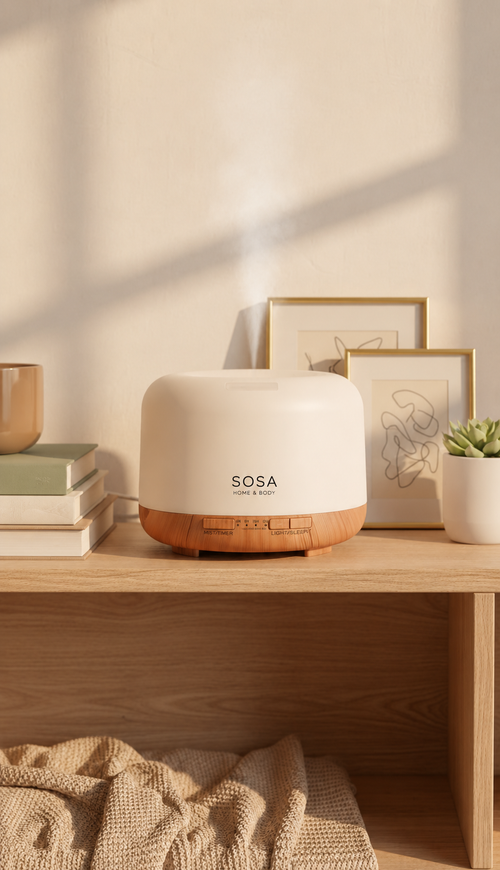
| The honest caveat: this matrix diagnoses a bottle, not a room. If all three tests pass and the space is still not what you pictured, the honest reading is that you have reached the ceiling of a passive format — likely past roughly 250–300 sq ft of connected open volume, or you want scent on demand rather than constantly. That is a job for a Sukoon at ₹1,899, not for a third reed bottle. | ||||
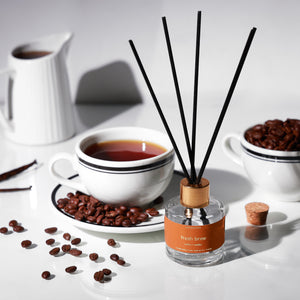
 Fresh Brew · 9.5/10from ₹849Shop →
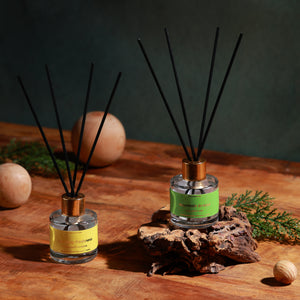
  Fresh & Grounded duo · two sources₹1,548Shop →
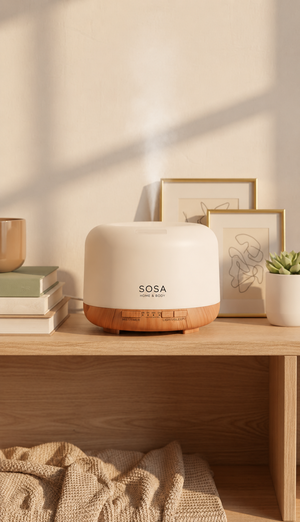
  Sukoon · when you want it on demand₹1,899Shop →
Part three — why you are the wrong witness in your own house
Olfactory adaptation is not a defect and it is not a matter of concentration. Your olfactory receptors report change; a constant, unvarying stimulus stops being news within minutes, and the brain quietly files it under background. This is why a scent you chose, paid for and live with becomes the one scent in the world you cannot smell, while the same bottle in a friend's flat is immediately obvious to you. It also explains the shape of the complaint. Almost nobody writes to say a diffuser never worked; they write to say it worked beautifully for a few days and then stopped. That arc — a vivid start, an apparent decline, a plateau you cannot detect — is the arc of adaptation laid on top of a completely normal three-phase curve.
The curve is worth stating because it compounds the effect. A new bottle has three days of genuine spike: the reeds are dry and drink hard, and the lightest, most volatile top notes leave first and fastest. Then there is a settle across the first fortnight as those tops finish and the heart of the composition takes over. Then comes the plateau, which holds fairly flat until the oil runs out. The plateau is the product. It is what a passive format is for — a constant low background rather than an event. But it arrives at almost exactly the moment your nose finishes adapting, so the two effects stack, and the subjective experience is of a product that has failed. Nothing has failed. You are simply reading a flat line with an instrument that only responds to slopes.
Which is why I keep pushing people towards witnesses. The fifteen-minute doorway test is free and works better than people expect, because it takes surprisingly little clean air to partially reset. A visitor is better still. And there is a third witness available to anyone: the household member who is out longest each day. If your flatmate who returns at eight in the evening can smell the living room and you, working from the next room since nine in the morning, cannot, then the bottle is not the variable. In an ordinary Indian flat with the doors open, gentle incidental traffic past the bottle is doing the distribution work, and the person who has been walking through that traffic all day is exactly the person least able to report on it.
Part four — what to do about each failure, in cost order
Having identified which stage failed, here is the action list. It is ordered by what it costs rather than by how appealing it sounds, and a great many people never need to reach the paid rows at all.
| Which test failed | Do this | How long before you judge | Cost |
|---|---|---|---|
| Wet line high and dark ★ | Flip all six reeds, gloves on, both ends coated | A few hours for the surge, 24 hours for the truth | Free |
| Wet line barely above the oil | Check immersion depth, then add two to four reeds | One to two days for the line to climb | Free — but shortens the bottle |
| Held reed faint after a flip | Refresh the reeds — fibre that has served months clogs | Two days | Reeds are not sold separately; use a new bottle's set |
| Visitor test failed, reed strong | Move to gentle passing air near a doorway, waist to chest, clear space | A full day of ordinary household traffic | Free |
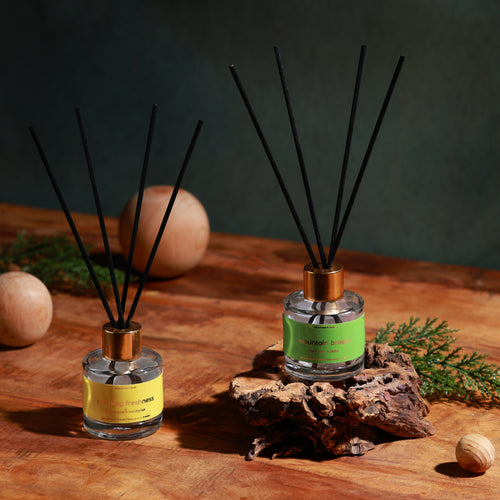
| Visitor test faint after moving | Add a second source at the far end rather than a bigger bottle | Immediately obvious | Duo set from ₹1,548 |
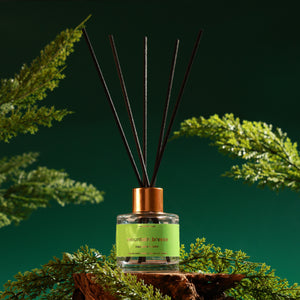
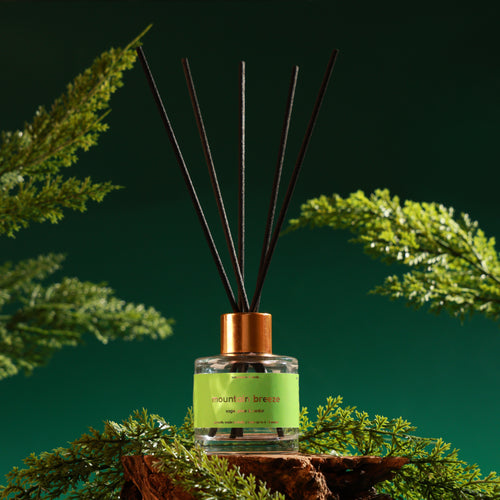
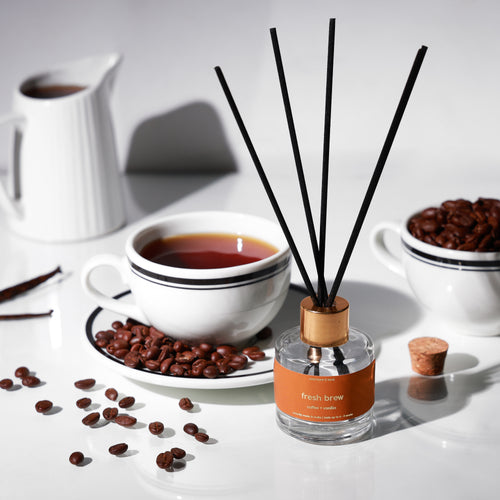
| All three pass, room still quiet | Move up the composition scale — Fresh Brew 9.5 or Mountain Breeze 9.4 | Days 1–3 will flatter it; judge at week two | From ₹849 |
| All three pass, space too large | Accept the ceiling and change format | Same evening | Sukoon ₹1,899 · 270–320 sq ft |
Versailles
At Versailles you are taught early that your own nose is an instrument that drifts, and that the discipline is knowing when not to trust it. Evaluators work in short bursts, on blotters, with clean air between, precisely because a continuous exposure destroys your ability to judge. Then we all go home and try to assess a fragrance we have been sitting inside for eleven hours.
The held-reed test is really just a blotter, improvised. It gives you a fresh, close, unadapted reading of what the composition is actually doing, separate from what the room is doing with it — and it takes ten seconds. I would rather teach that than have someone buy a second bottle because they could not tell a supply failure from an adapted nose.
The part of this I find hardest to communicate is that a working reed diffuser is supposed to disappear on you. It is a background, not an event. If you want a room that announces itself when you walk in and quietens when you want it quiet, that is a different machine and I would rather sell you the right one. Everything here is composed and handmade in small batches in Pune, and a part of every order funds a girl's classroom through Nanhi Kali.
Frequently asked questions
- Does slow evaporation mean it isn't working? — why the level is the wrong metric in the first place.
- Should the oil level go down every week? — the weekly arithmetic, and the four-week checkpoint.
- Should I replace the reeds if the oil isn't going down? — flip first, then judge.
- Lasting too long but not smelling — the complete guide, plus why can't I smell my reed diffuser?
- Brand: the SOSA founder story.
SOSA reed diffuser range & prices (verified August 2026): alcohol-free, phthalate-free, paraben-free and IFRA-compliant compositions on a heat-stable coconut-derived (CCT) carrier, low-VOC, supplied in a refillable glass bottle with six fibre reeds; 50ml lasts 6–8 weeks and 130ml lasts 14–18 weeks. Morning Freshness (Malabar lemon · peppermint · Nilgiri eucalyptus) 50ml ₹749 · 130ml ₹1,249 · 9.0/10; Garden Bloom (British rose · night-blooming jasmine) 50ml ₹799 · 130ml ₹1,299 · 8.9/10; Evening Calm (Kashmir lavender · chamomile) 50ml ₹799 · 130ml ₹1,299 · 8.9/10; Fresh Brew (Coorg coffee · Kerala vanilla) 50ml ₹849 · 130ml ₹1,349 · 9.5/10; Mountain Breeze (Himalayan pine · sage · Indian cedar) 50ml ₹849 · 130ml ₹1,349 · 9.4/10. Reed diffuser refills are oil only — you reuse your own vessel and reeds: 300ml ₹2,399 (roughly 8–11 months) · 500ml ₹3,499 (roughly 14–18 months), about ₹7–8 per ml against ₹15–17 per ml for a 50ml bottle. Duo sets ₹1,498–₹1,598 for 2 × 50ml and ₹2,498–₹2,598 for 2 × 130ml. Strength figures are positions on SOSA’s own internal strength scale, not an industry standard. Replacement reeds are not sold as a separate SKU; SOSA guidance is to refresh reeds every few months. The reed line is separate from the water-based Hotel Collection for ultrasonic machines (15ml ₹299 · 100ml ₹999 · 300ml ₹1,799) and the two are not interchangeable. Diffusers: Boond 300ml ₹899 · Sukoon 500ml ₹1,899 · Megh 6L ₹3,499 · waterless Vaayu ₹11,999. Composed and handmade in small batches in Pune, India; tested through 45°C summer heat and 85% monsoon humidity. Free shipping above ₹499. A portion of every order supports girl-child education through Nanhi Kali. Prices subject to change — see the live product pages.