How Do I Stop My Bedroom Smelling Closed Every Single Morning?

How Do I Stop My Bedroom Smelling Closed Every Single Morning?

★ ★ The bedroom that smells fine at midnight and wrong at seven · what is actually happening overnightCandle ₹379 · reed ₹749 · Boond ₹899 · Sukoon ₹1,899 · free shipping above ₹499A portion funds girl-child education
★ SOSA · find the cause, then scent the room
Eight hours, one closed door and two people breathing. The morning smell is not dirt — it is air that has not been anywhere
★ ★ ★ ★ ★
★★★★★
"Turned out to be nothing I owned. Window open ten minutes before bed and ten on waking, and the smell I had been chasing for a year simply stopped."
Devika R. Bedroom, Pune
Free fix · ventilation
★★★★★
"I had washed everything twice. It was the mattress, which nobody had thought to mention. Two hours in the sun and it was a different room."
Harsh M. Mattress, Ahmedabad
Diagnosed the source
★★★★★
"Was ready to buy three reeds. Was told to check the bathroom drain first because the room had been shut for a fortnight. That was it. Cost me a mug of water."
Sneha T. Bedroom, Bengaluru
Told not to buy
★★★★★
"Bedroom is the one room I now under-scent rather than over-scent. Three drops on the 2H timer, off before I sleep. Completely different from what I was doing."
Arjun K. Sukoon · 3 drops
2H timer
★★★★★
"Summer made it much worse and I could not work out why. Warmth speeds everything up — that one sentence explained six years of it."
Lakshmi N. Summer bedroom, Chennai
Understood the cause
★★★★★
"Evening Calm on the chest of drawers, nothing plugged in, nothing to switch off. The bedroom just holds one quiet level now."
Rehan A. Evening Calm reed
₹799 · no electricity
★★★★★
"Turned out to be nothing I owned. Window open ten minutes before bed and ten on waking, and the smell I had been chasing for a year simply stopped."
Devika R. Bedroom, Pune
Free fix · ventilation
★★★★★
"I had washed everything twice. It was the mattress, which nobody had thought to mention. Two hours in the sun and it was a different room."
Harsh M. Mattress, Ahmedabad
Diagnosed the source
★★★★★
"Was ready to buy three reeds. Was told to check the bathroom drain first because the room had been shut for a fortnight. That was it. Cost me a mug of water."
Sneha T. Bedroom, Bengaluru
Told not to buy
★★★★★
"Bedroom is the one room I now under-scent rather than over-scent. Three drops on the 2H timer, off before I sleep. Completely different from what I was doing."
Arjun K. Sukoon · 3 drops
2H timer
★★★★★
"Summer made it much worse and I could not work out why. Warmth speeds everything up — that one sentence explained six years of it."
Lakshmi N. Summer bedroom, Chennai
Understood the cause
★★★★★
"Evening Calm on the chest of drawers, nothing plugged in, nothing to switch off. The bedroom just holds one quiet level now."
Rehan A. Evening Calm reed
₹799 · no electricity
✓ Find the source first · two windows for twenty minutes beats any product for a closed smell ✓ Fragrance is the finishing layer. It does not remove damp, a dry drain or a loaded sofa ✓ Sukoon ₹1,899 · 270–320 sq ft · 16–18 hours per fill · three 15ml scents included


Founder Diaries · Home Fragrance · Why Your Bedroom Smells
By Sonal Sahani · ISIPCA Versailles 11 min read Updated August 2026
Everything on this page is a habit rather than a purchase, which is why it works. A bedroom that smells closed every morning is not asking to be cleaned more thoroughly; it is asking for two ten-minute windows and for the bed to be left alone for an hour. What follows is a routine with times attached — daily, weekly, monthly and seasonal — arranged in the order that gives the most result for the least effort, because a routine nobody keeps is worth nothing. The fragrance step is at the end, it is the smallest step, and it is genuinely optional.
Quick answers — read this first
Daily: ten minutes of cross-ventilation before bed and ten on waking, with two openings rather than one. And throw the bed open on waking rather than making it — a made bed traps overnight moisture in the mattress.

Weekly: bedlinen. Fabric is where a bedroom keeps its memory.

Monthly: pillows and mattress in direct sun for two hours; AC filter out and washed while the machine is in season; a mug of water down the attached bathroom's drains if the room is used rarely.

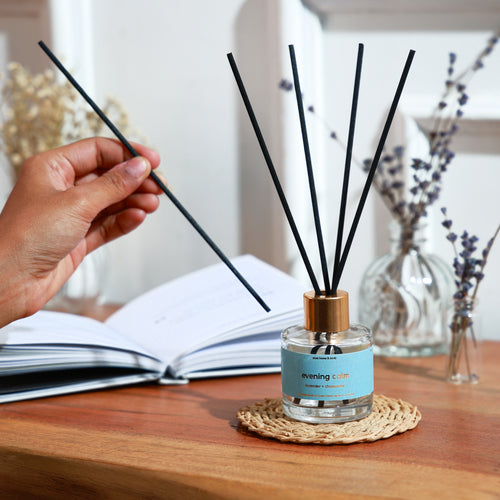
Last, and smallest: three drops on a 2H timer in the evening, or Evening Calm at ₹799 if you would rather have nothing to switch on — lavender and chamomile is the one reed composed for a room you sleep in.
The short answer
Short answer: two openings on opposite walls for ten minutes before bed and ten on waking, and stop making the bed immediately. Throw the duvet back and leave the bed open for an hour so the mattress can release the moisture it took from you overnight — a made bed seals it in. Those two habits, both free, solve most closed-bedroom cases outright.
Then the calendar: bedlinen weekly; pillows and mattress in direct sun for two hours monthly; the AC filter washed every two to four weeks while it is in daily use; a mug of water down the attached bathroom's floor drain and basin if that bathroom is used rarely, because the trap seal evaporates in two to four weeks.
Then, last: three drops of the Hotel Collection at ₹299 on the 2H timer in the evening, or Evening Calm at ₹799 — Himalayan lavender and chamomile, the one reed composed for a bedroom — if you would rather nothing to switch on. The Sukoon is ₹1,899 with three 15ml scents included; the Boond is ₹899. Free shipping above ₹499.
Straight answer
What is the actual daily routine that stops a bedroom smelling closed every morning?
1. Ten minutes before bed, ten minutes on waking, two openings each time. A window and the door, or two windows on opposite or adjacent walls. One opening is ventilation; two is exchange, and twenty minutes of genuine cross-draught beats an hour of a single window ajar.

2. Do not make the bed straight away. Throw the duvet right back, uncover the sheet, and leave it for an hour while you get on with the morning. You put moisture into that mattress all night and a made bed seals it in under a fitted sheet where it cannot dry.

3. Bedlinen weekly. Fabric is where a room keeps its memory: it absorbs perspiration and body oil and hands them back all week. This is the cheapest improvement in the whole cluster and the most immediately noticeable.

4. Monthly, three things. Pillows and mattress in direct sun for two hours on a dry day. The AC filter out, washed and dried, while the machine is in daily use. And if the bedroom has an attached bathroom that gets little use, a mug of water down the floor drain and basin, because the U-bend seal evaporates in two to four weeks and then the drain vents into the room.

5. Only then, and it is the smallest step: three drops on a 2H timer in the evening. Or a reed, if you would rather own nothing with a switch — Evening Calm at ₹799, Himalayan lavender and chamomile, is the one composed for a room you sleep in. Neither of them will do any of the four steps above, and I would rather you skipped this step than swapped it for one of those.

A portion of every order supports girl-child education through Nanhi Kali.
TL;DR: ten minutes of cross-ventilation before bed and ten on waking; the bed thrown open rather than made, so the mattress can dry; bedlinen weekly; pillows and mattress in sun monthly; AC filter monthly in season; a mug of water down a rarely used bathroom's drains. Then, last and smallest, three drops on a 2H timer, or Evening Calm at ₹799.
Evening Calm reed diffuser
The step with nothing to switch on
Evening Calm reed diffuser ₹799
Himalayan lavender and chamomile, alcohol-free, in the separate reed diffuser line with its own scents. Of the five reeds it is the one composed for a room you sleep in, and it is the right shape for a routine because it has no button — it holds a single quiet level for months and asks nothing of you at eleven at night. The honest part of the specification: a reed takes 24 to 72 hours to reach its level, so it is the wrong purchase for tomorrow morning and the right one for the next four months. ₹799 for the standard size and ₹1,299 for 130ml, with 300ml refills at ₹2,399.

The two ten-minute windows, and the bed you do not make

Two habits carry most of the result, and neither of them costs anything or takes more than ten minutes. The first is bracketing the night with air exchange at both ends. The second is the one people resist, because it looks like untidiness: leaving the bed open in the morning instead of making it immediately. They address two different halves of the same problem — the air in the room, and the water in the mattress — and doing one without the other is why so many people find that airing the room helps a little and then stops helping.

1
HABIT ONE
Ten minutes at each end of the night, with two openings
Start with the exchange, and be specific about the shape of it. One open window is ventilation and it is weak; two openings on opposite or adjacent walls is exchange, and it is a completely different event. With a single opening, air has to leave through the same gap it comes in by, so what you get is a slow shuffle at the edge of the room. With two, you get a pressure difference and a through-draught, and the whole volume of a bedroom turns over several times in ten minutes. The bedroom door counts as one of the two, which matters in flats where a bedroom only has one exterior window: open the door and the window together and you have a path. A ceiling fan on low helps by stirring the room so that stagnant corners join in. Then the timing, which is the part I would defend hardest: do it before bed as well as on waking. Most people only air out in the morning, which treats the symptom. The evening ten minutes matters more, because it means you are sealing yourself in with air that has just been changed rather than with a whole day's accumulation — a bedroom shut since eight in the morning has been off-gassing into itself for fourteen hours before you even get into it. Ten minutes at ten o'clock, ten minutes at seven. In winter and the dry parts of summer this is straightforward. The one genuine exception is a wet monsoon night, when opening a window imports moisture into a room that is already above 60% humidity and makes things worse rather than better; on those nights, run the air-conditioner in dry mode instead and do your exchange in a dry hour of the morning.
2
HABIT TWO
Throw the bed open rather than making it — the counterintuitive one
Now the habit that sounds wrong and is not. A sleeping adult puts a substantial amount of water into the bed every night, through perspiration and through breath, and most of it goes downward into the sheet, the mattress protector and the top few centimetres of the mattress itself. In the morning that moisture wants to evaporate, and it will, given air and an hour. What most of us do instead is pull a duvet and a bedcover over the whole thing within about four minutes of standing up, which seals a warm damp foam surface under two layers of textile for the next sixteen hours. Every night adds to what has not dried from the night before. Over months that is how a mattress becomes the source of a room's smell — not through dirt, but through never being allowed to dry. The fix is to throw the duvet right back over the footboard, uncover the sheet completely, and leave it while you shower and have breakfast. Make the bed after that if you like a made bed; an hour is enough. If the room is one you can air at the same time, the two habits compound, because now the moisture leaving the mattress has somewhere to go rather than simply relocating into the room's air. This is also the reason a plastic or fully waterproof mattress protector is a false economy in a warm climate: it stops the mattress absorbing anything, and it also stops everything it does absorb from ever leaving. A washable cotton or bamboo-terry protector, washed with the sheets, gives you the protection and lets the foam breathe.
The rule I would put on a bedroom wall: air the room at both ends of the night, and give the bed an hour open in the morning. Between them those two habits fix more closed-bedroom cases than everything else on this site put together.
3
THE REST OF THE CALENDAR
Weekly, monthly and seasonal — and what each one is for
Then the maintenance, which is short and specific. Weekly: bedlinen, and pillowcases more often than that if the room runs warm. Textiles are the memory of a room; they absorb perspiration, skin oil and whatever is in the air, and re-release it slowly for as long as they stay on the bed. Nothing else in this list changes a bedroom as immediately, which is why a room reliably smells best on the night the sheets are changed. Monthly: pillows and mattress in direct sun for two hours on a dry day. Sunlight and dry moving air do to foam what no product does, and pillows matter more than the mattress here because per unit of volume they take the most moisture in the room and are the hardest thing to wash properly. Monthly in season: the air-conditioner filter, out, washed under a tap, dried and replaced. A split unit runs a cold wet coil in a warm room, biofilm grows on the coil and the filter, and it gets blown at you in the first minute after start-up. If your morning smell is sharpest in that first minute, this is the fix and it is the whole fix. And, if the bedroom has an attached bathroom that is used rarely: a mug of water down the floor drain, the basin and the shower outlet. A U-bend holds a water seal that keeps sewer gas out, that seal evaporates in two to four weeks of disuse, and then the drain vents quietly into your bedroom all night through an open door. It is the single most commonly missed cause in this entire cluster and it costs a mug of water. Do it monthly, and every time you come back from a trip.

The whole routine, with times attached

The complete schedule in one table, arranged by how often rather than by how important, with the time each step actually takes and what it costs. Everything above the last row is free. The last row is the fragrance step, which is deliberately at the bottom: it is the smallest item on this list and the only one that will not change anything if you skip it.

The bedroom routine
Daily, weekly, monthly and seasonal — with the minutes each one takes
How often What to do How long Why it works Cost
Twice daily ★ Two openings — window and door, or two windows — before bed and on waking 10 min + 10 min One opening is ventilation; two is exchange. The evening one matters more than people think ₹0
Daily Throw the duvet back and leave the bed open before making it 1 min, then leave it an hour A night's moisture leaves the mattress instead of being sealed under a bedcover for sixteen hours ₹0
Weekly Bedlinen, and pillowcases more often in warm weather 10 min Fabric is the memory of a room. It absorbs and re-releases for as long as it stays on the bed ₹0
Monthly Pillows and mattress in direct sun on a dry day 2 hours, unattended Sunlight and dry air do what no product does, and pillows hold the most moisture per unit of volume ₹0
Monthly in season AC filter out, washed under a tap, dried, replaced 10 min Biofilm on a cold wet coil and filter is what you meet in the first minute after start-up ₹0
Monthly, or after a trip A mug of water down the attached bathroom's drains 1 min Refills the U-bend seal, which evaporates in two to four weeks and then vents sewer gas into the room ₹0
Evening, optional Three drops on a 2H timer, or Evening Calm with nothing to switch on 2 min to set up The background layer, once the six rows above are in place. It replaces none of them ₹299 / ₹799
Shop this guide
The last step, once the routine is in place
The SOSA principle
A made bed looks tidy and seals a night's moisture into the mattress for sixteen hours. Throw it open for an hour and make it afterwards.
With the two ten-minute windows, that is the whole of the daily routine — and between them they solve more closed-bedroom cases than every product on this site.

The last step, and the smallest one

Now the fragrance layer, framed honestly: it is step seven of seven, it is optional, and it is the one thing on the list that changes nothing about why the room was closed. What it does is give a room that has been properly aired a character of its own rather than merely an absence. The Hotel Collection is composed at three to six drops per tank and a bedroom takes three, which is the lowest dose I recommend for any room in the house. The reasons are structural: it is the smallest scented volume you own, it has the fewest air changes of any room in the flat, and you are inside it, unbroken and horizontal, for eight hours, so everything the machine puts into the air simply stays. Run it on low with the 2H timer while you are getting ready for bed, and let it stop before you do. A room scented at nine is still pleasantly scented at midnight because the heavier end of a composition carries on working long after the mist has stopped, whereas a machine running all night puts eight hours of output into a sealed room and produces exactly the heaviness people complain about. The dose is per tank rather than per litre, since you are scenting the mist and not the water, so a 300ml Boond at ₹899 takes the same three drops as a 500ml Sukoon at ₹1,899 — and for a bedroom the smaller machine is often the better one, because less water in the tank means less mist per hour into a small room. If you would rather own nothing with a button, Evening Calm at ₹799 — Himalayan lavender and chamomile from the separate alcohol-free reed diffuser line — is the one reed composed for a room you sleep in, and the reason to name it here specifically is that a routine works best when it has as few switches in it as possible.

Placement and scent choice next, both of which matter more in a bedroom than anywhere else. Put the machine across the room from the pillow, at waist height or above, and well away from the wardrobe. Cool mist falls rather than rises, so a diffuser on the floor is scenting a rug, and anything within a metre of open shelving or hanging clothes will be handed back to you out of your own jumpers for days afterwards. Keep it out of the direct path of the AC or a fan: a draught strips the lighter top off a composition and leaves the heavy end standing on its own, which is how a quiet scent starts reading as thick without the dose having changed. On scent, the bedroom rewards restraint — the Ritz-Carlton-inspired Quiet Luxury (white tea, bergamot, cedar), the Westin-inspired White Tea Serenity (white tea, aloe, cedar) and the 1 Hotels-inspired Forest Suite (cedarwood, vetiver, green leaves) are the three I would put in a room you sleep in, all at ₹299 for 15ml. A reed is a different shape of product rather than a smaller one: it takes 24 to 72 hours to reach its level, which makes it useless for tonight and ideal for a habit, since after that it holds one steady level for months with no electricity and nothing to remember. The two lines do not cross in either direction — reed oil is undiluted and will clog a 2.4MHz misting plate, and water-based Hotel Collection fragrance will not climb reed sticks.

Then the two things that undo a good routine. The first is habituation. You will stop being able to smell your own bedroom within roughly a fortnight, because a nose reports change and discards constants, and in this room you are more exposed to it than in any other — eight hours a night in a sealed space is the fastest possible route to adaptation. The instinct that produces is to add drops, which is the opposite of what the room needs and is the mechanism by which people end up with a bedroom every visitor finds overwhelming and they cannot detect at all. Do not adjust by nose in this room. Set three drops, leave it, and ask one honest person a fortnight later. The second is expecting the last step to do the work of the first six. Fragrance is a finishing layer on air that is already clean and moving; it does not remove damp, a dry drain trap, a mattress that has never been allowed to dry or a filter that needs washing, and layered over any of those it gives you two smells instead of one. A cool-mist ultrasonic also adds 30 to 50 millilitres of water an hour, so in a monsoon bedroom already above 60% humidity it is the wrong machine and a reed or a candle is the right one. The routine is the product here. The three drops are the finish on it.

Six free habits and one optional purchase, in that order. If you only ever do two of them, do the two ten-minute windows and leave the bed open.
— Sonal Sahani, SOSA

The SOSA edit

The routine as a buying order, which for once is mostly not a buying order at all. Six of the seven rows cost nothing and are listed in the sequence that gives the most result for the least effort. The seventh is the fragrance step, at the smallest dose recommended for any room in the house, with the honest note that a reed needs three days before it is doing its job.

The SOSA edit
The closed-bedroom routine, in the order to build it
Step What it is When it matters most Cost
1. Two openings, ten minutes, twice a day ★ Before bed and on waking — a window and the door, or two windows Every night. The evening ten minutes is the one people skip and the one that matters more ₹0
2. Leave the bed open for an hour Duvet thrown back, sheet uncovered, made later if at all Daily. A made bed seals a night's moisture into the mattress for sixteen hours ₹0
3. Bedlinen weekly Sheets, pillowcases, and the mattress protector with them Weekly, more often in summer. The most immediately noticeable free change there is ₹0
4. Sun, filter and drain Pillows and mattress in sun two hours; AC filter washed; a mug of water down the drains Monthly. The drain one applies to any attached bathroom used rarely, and after every trip ₹0
5. Hotel Collection 15ml at three drops White tea and cedar, or cedarwood and vetiver — the quiet end of the range Evening, on the 2H timer, before you sleep rather than while you sleep ₹299
6. Evening Calm reed, as the alternative Himalayan lavender and chamomile, alcohol-free, no electricity and nothing to switch off If you would rather have no switch in the routine. Needs 24–72 hours to establish, then holds for months ₹799
Honest notes for buyers: fragrance is the last step, never the first. It layers on air that is already clean and moving, and it will not remove a source — not damp, not a dry drain trap, not a loaded sofa, not a filter that needs washing. Deal with the cause, change the air, then scent the room. On timing: a candle puts scent into a room in fifteen to twenty minutes and a Sukoon reaches a steady level in about twenty, while a reed diffuser needs a day to three days before it is doing its job — the wrong buy for a deadline and the right buy for a room you want to hold one level for months. SOSA does not make a room or linen spray for the home; the sprays in the range are car perfumes. A cool-mist ultrasonic adds 30–50 ml of water an hour to the air, so it is the wrong machine for a room you are trying to dry out. The Hotel Collection is water-based and runs in the Sukoon, Boond and Megh only — not in reeds and not in the waterless Vaayu. Reed diffusers are a separate alcohol-free line with their own scents. Candles must be attended and put out. The Hotel Collection scents are SOSA's own interpretations inspired by the world's finest hotels; SOSA is an independent Indian fragrance house, not affiliated with or endorsed by any hotel brand. A portion of every order supports girl-child education through Nanhi Kali.
SOSA reed diffusers · alcohol-free
Five reeds, and only one of them belongs beside a bed
SOSA reed diffusers · alcohol-free from ₹749
Morning Freshness — Malabar lemon, peppermint and eucalyptus, ₹749 — is the one people buy for a bedroom and regret, because it is composed to wake a room rather than to settle one; it is excellent on a landing or in a bathroom. Evening Calm at ₹799 is the bedroom scent, Mountain Breeze at ₹849 the drier alternative if lavender is not for you, and Fresh Brew belongs anywhere except a room you sleep in. No electricity, no timer and nothing to remember, which is the entire argument for a reed in a room where the routine is already long enough.
SS
ISIPCA
Versailles
A note from Sonal

I have written a great many routines over the years and the ones that survive have two things in common: they are short, and every step has a reason attached that the person can feel. So of everything on this page, the two I would fight for are the ten minutes before bed and the hour with the bed left open, because both are immediate, both are free, and both produce a difference you can smell within about three days. The evening ventilation in particular is the one almost nobody does. We air out in the morning, having spent the night in it, which is a little like washing your hands after dinner.

The unmade bed is the one I get argued with about, usually on grounds of tidiness, and I understand the objection. But a mattress that is covered within four minutes of you getting out of it never gets to dry, and a mattress that never dries is, within a year or two, the smell of the room. An hour is enough. Make it before lunch and nobody will ever know. As for the fragrance — three drops on a timer, or a reed on the chest of drawers if you would rather not own another thing to switch off — that is genuinely the last and smallest item, and if you did the other six and skipped it entirely the room would still smell right. I would rather write that plainly than pretend otherwise.

Everything is made and supported from Pune, and a part of every order funds girl-child education through Nanhi Kali. You get a home that smells like somewhere you chose; a girl gets a classroom. That equation has always felt right to me.

Frequently asked questions

What is the minimum daily routine that stops a bedroom smelling closed?
Two openings for ten minutes before bed and ten on waking — a window and the bedroom door, or two windows on opposite walls — and throwing the bed open for an hour in the morning rather than making it straight away. Those two habits are free and between them solve most cases.
Is it really better not to make the bed straight away?
For the smell of the room, yes. You put moisture into the mattress all night, and a duvet and bedcover pulled over it within minutes seal a warm damp foam surface for the next sixteen hours. Throw the covers right back, leave it an hour, then make it if you want to.
How often should I wash bedlinen to keep a bedroom smelling fresh?
Weekly as a minimum, and pillowcases more often in warm weather. Fabric is the memory of a room: it absorbs perspiration and body oil and re-releases them for as long as it stays on the bed. It is the cheapest and most noticeable improvement available.
Where does fragrance come in the routine?
Last, and it is the smallest step. Three drops of the Hotel Collection at ₹299 on a 2H timer in the evening, before you sleep rather than while you sleep, or Evening Calm at ₹799 if you would rather have nothing to switch on. It gives an aired room a character; it does not air the room.
Is a reed diffuser or a machine better for a bedroom?
A reed suits a routine better because it has no switch and holds one level for months, and Evening Calm — Himalayan lavender and chamomile, ₹799 — is the one composed for a room you sleep in. The trade-off is that it needs 24 to 72 hours to establish. A diffuser gives you control and a timer; a reed gives you one less thing to remember.
The routine, and the one optional step
Six free habits — then three drops, or nothing to switch on
Evening Calm is ₹799 for the standard size and ₹1,299 for 130ml, with 300ml refills at ₹2,399 and duos from ₹1,498; reeds start at ₹749 and need 24 to 72 hours to establish. The Hotel Collection is ₹299 for 15ml, ₹999 for 100ml and ₹1,799 for 300ml at about ₹6 per millilitre. The Sukoon is ₹1,899 with steady, 2H and 4H timers and three 15ml scents of your choice included; the Boond is ₹899. Free shipping above ₹499, and a portion of every order supports girl-child education through Nanhi Kali.
See Evening Calm · ₹799 See the Sukoon · ₹1,899
Continue the read
More from SOSA
Editorial standards & sources
About this guide: Written by Sonal Sahani, ISIPCA Versailles-trained founder and perfumer at SOSA Home & Body — the complete daily, weekly and monthly routine for a bedroom that smells closed every morning, covering why cross-ventilation needs two openings rather than one and why the ten minutes before bed matters more than the ten on waking, why leaving the bed open for an hour lets a mattress release the moisture a made bed seals in, the weekly and monthly maintenance for linen, pillows, the air-conditioner filter and an attached bathroom's drain traps, and why the fragrance step belongs last and smallest.

Facts verified August 2026: Diagnostic facts used in this guide: a closed room accumulates what it cannot exchange, so cross-ventilation needs two openings rather than one; a drain's U-bend water seal evaporates in roughly two to four weeks of disuse and then admits sewer gas, which is corrected by pouring water down the drain; microbial growth in fabric and on surfaces accelerates above about 60% relative humidity, and Indian monsoon indoor humidity commonly runs 80–95%, which is the one situation where ventilating on a wet day can import moisture rather than remove it; an air-conditioner's cold, wet evaporator coil and filter grow biofilm that is blown into the room on start-up; textiles adsorb cooking aerosol and body oils and re-release them for weeks; and olfactory adaptation makes a constant household smell undetectable to its residents within about a fortnight while visitors still perceive it. Timings: a scented candle scents a normal room in roughly 15–20 minutes, a Sukoon ultrasonic diffuser reaches a steady level in about 20 minutes from cold, and a reed diffuser needs roughly 24–72 hours. SOSA products and prices: Sukoon 500ml ₹1,899 (270–320 sq ft, 16–18h on low, 9–12h high, 30–50 ml/h, 2.4MHz cool mist, remote, steady/2H/4H timers, BPA-free, auto shut-off, includes three 15ml Hotel Collection scents of your choice); Boond 300ml ₹899; Megh 6-litre ₹3,499; waterless Vaayu ₹11,999 (up to 1000m³); Aangan ₹25,999. Hotel Collection water-based fragrance 15ml ₹299, 100ml ₹999, 300ml ₹1,799, Pack of 7 at 15ml ₹1,799; dose 3–6 drops per tank. Reed diffusers (separate alcohol-free line): Morning Freshness from ₹749, Garden Bloom and Evening Calm from ₹799, Fresh Brew and Mountain Breeze from ₹849; 130ml from ₹1,249; duos from ₹1,498; 300ml refills ₹2,399. Scented candles: Bookshop 80g ₹379, Amber Rose 130g ₹599 and 220g ₹799, Smoked Oudh 130g ₹449, ceramic jar candles ₹949, Pure Calm wax melt set ₹854. Free shipping above ₹499. SOSA does not make a room or linen spray for the home. The Hotel Collection scents are SOSA's own interpretations; SOSA is not affiliated with or endorsed by any hotel brand. Prices subject to change — see the live product pages.
Zurück zum Blog