



Genuinely finished looks like this: fresh reeds change nothing, or the liquid is down to the last 10–15ml the reeds can no longer lift.
What it costs to get wrong: a 130ml binned at week ten instead of week sixteen has cost about ₹125 a week rather than ₹78.
2. If fresh reeds change nothing, it is finished. Two clean sets of fibre failing in the same liquid is the only reliable verdict there is. At that point the useful fragrance really has evaporated out and what remains is the heavier, less volatile end of the blend — it will still smell of something in the bottle and still do very little in the room. Refill it or replace it.
3. Ignore the liquid level. It is a bad gauge. A 130ml with a third left can be completely spent in the ways that matter, and a 130ml that looks low can still have weeks in it. Saturated reeds hold liquid of their own, so the line on the glass moves in fits and starts. A genuinely finished bottle keeps roughly 10–15ml that the reeds can no longer lift — that residue is normal and is not something you have wasted.
4. Do not trust your own nose on this at all. Olfactory adaptation is essentially complete within about twenty minutes, so the person who lives with the bottle stops registering it within days of buying it. That is the single commonest reason a perfectly good diffuser gets replaced. Leave the flat for half an hour and read the first breath on the way back in, or ask whoever visits next.
5. Watch the interval, not the day. A 50ml runs 6–8 weeks and a 130ml runs 14–18, both on six reeds in a closed room. If a bottle goes quiet a long way inside that window — week five of a 50ml, week nine of a 130ml — the reeds are the first suspect, not the liquid. If it goes quiet at the far end of the window, it is probably simply done.
Made in India, composed by an ISIPCA Versailles-trained perfumer — and a portion of every order supports girl-child education through Nanhi Kali.
What actually stops working, and why it is almost never the fragrance
A reed diffuser has no fan and no pump. Fragrance climbs the porous core of each reed by capillary action, reaches the exposed length above the collar, and evaporates from there. Everything about how the bottle performs depends on that one journey working. Over months the fibre clogs: the heavier, less volatile parts of the blend do not evaporate at the tip at the same rate they arrive, so they accumulate inside the core and progressively block it. The liquid is unchanged. The room goes quiet anyway. This is the ordinary ageing of a wick, it happens to every reed diffuser of every brand, and it is the reason "replace the reeds, not the liquid" is the first rule of owning one.
The second thing that changes is the blend itself, and it changes from the top down. A fragrance is built in layers of different volatility — the citrus and mint in Morning Freshness evaporate faster than the cedar and sage in Mountain Breeze, and within any single bottle the lightest materials leave first. So a bottle in its last weeks does not smell like a fainter version of week one; it smells like the bottom half of the blend. That is a real signal of a bottle nearing its end, and it is a different signal from a clogged reed. Clogged reeds make the room quieter without changing the character. A spent bottle changes the character while the volume may hold up surprisingly well up close. Learn to tell those two apart and you will stop replacing bottles early.
The three ways a bottle looks finished when it is not
 Fresh reedsIncludedThis is the majority case and the easiest to fix. The room has gone flat over two or three weeks, the fragrance still smells right when you put your nose to the collar, and the level in the glass has hardly dropped since you last looked. Falling consumption is the tell. A working diffuser drinks its liquid; a clogged one stops drinking, which is why the level stalls. Fit a fresh set of reeds, wait forty-eight hours, and judge from the doorway. In a 130ml this frequently recovers five or six weeks of use for ₹0.
Reading your own bottles — what each one actually needs
Find the bottle you are holding. Note how many of these rows end in ₹0, because that is the honest distribution: most quiet bottles do not need replacing.
| Space | What it needs | How many | Cost |
|---|---|---|---|
| 130ml in a living room, week 9–10, gone flat, liquid barely moved ★ | Clogged reeds. Fit a fresh set from the box and wait two days — this recovers weeks of use | Nothing. Change the reeds | ₹0 |
| Any bottle you personally stopped noticing on about day four | Adaptation, not failure. Judge it from the doorway after half an hour out, or ask a visitor | Nothing | ₹0 |
| 50ml in a bathroom, week 7, still detectable on walking in | Working exactly as specified. A 50ml is rated 6–8 weeks and a low reed count stretches it further | Nothing yet | ₹0 |
| 130ml at week 16, roughly 10–15ml left, reeds no longer wicking | Genuinely finished. The residue is normal — a wick needs depth to draw from | Refill it | ₹2,399 for 300ml |
| 130ml where fresh reeds revived it, then it faded again three weeks later | The reeds were the first problem and the liquid is now the second. This one really is at its end | Refill or replace | ₹2,399 or from ₹1,249 |
| A bottle standing in a spare room nobody uses | Nothing. Do not replace it when it ends — move it to a room somebody sits in | None | ₹0 |
| A note on all of the above: the 14–18 week and 6–8 week figures assume six reeds in a closed room of standard ceiling height. Heat and airflow speed evaporation, so the same bottle finishes sooner in a hot hallway than in an air-conditioned bedroom — and a bottle that finishes early because it has been sitting in the sun is genuinely finished, not clogged. | |||
One room · the unitFrom ₹749Shop → 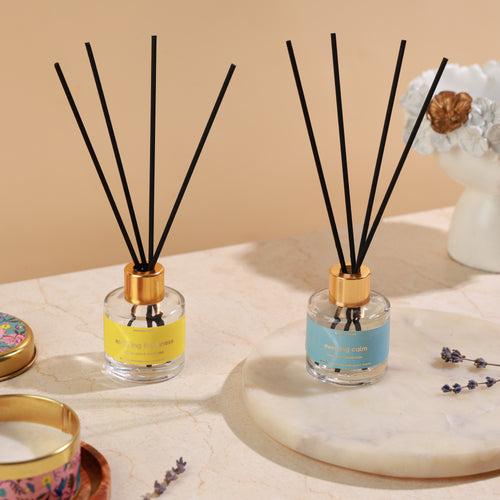 Two rooms · better value₹1,498Shop →
  Large room · a switch₹1,899Shop →
How to run the test properly, and what to do with the answer
Run the test before you decide anything, and run it with clean hands. Pull the old reeds out and stand them on a tissue rather than back in the bottle. Wipe the neck of the glass, because oil creeps and a sticky collar will mark whatever the bottle stands on. Put in a fresh set — the same number you were running, so you are comparing like with like — and leave it for forty-eight hours without touching it. Do not flip the old reeds and call that a test: flipping wets the dry end and gives you two or three days of noticeable improvement from a wick that is still clogged, which is exactly the sort of false positive that makes people distrust the method.
Then judge it from outside the room. Leave the flat for half an hour and read the first breath on the way back in, or wait until somebody visits and see whether they notice before you mention it. This is the only reading that means anything, because you adapted to that room within twenty minutes of the reeds going in. If the room has come back, put the date in your phone and expect the recovered bottle to run several more weeks; in a 130ml caught at week nine or ten, five or six weeks is a normal recovery. If nothing has changed after two full days with clean fibre, the bottle is finished and you can stop wondering.
When it really is finished, refill rather than rebuy — and change the reeds at the same moment. A 300ml refill at ₹2,399 fills a 130ml roughly twice, which works out at about ₹8.00 a millilitre against ₹9.61 for the liquid inside a new ₹1,249 bottle. The glass and the collar were always the durable part. Rinse the bottle out with a little warm water and let it dry fully before refilling, especially if you are changing blend, and fit new reeds as you go — refill day and reed day are the same day, and treating them as one habit is what stops the next bottle going quiet at week nine.
What to buy
The honest answer for most people reading this is the first row: nothing. If the test says otherwise, the rest of the table is what you are choosing between.
| Buy | What it covers | Lasts | Price |
|---|---|---|---|
| One 50ml | A single reed diffuser — a small room, or a blend you want to try before committing a 130ml to it | 6–8 weeks | from ₹749 |
| One 130ml | The value size — the value size — 14–18 weeks and about ₹78 a week, against ₹105 for a 50ml | 14–18 weeks | from ₹1,249 |
| The duo | Day & Night duo — two rooms reaching their end together, solved in one purchase | 6–8 weeks each | ₹1,498 |
| Sukoon | 500ml ultrasonic — a room past about 200 sq ft where reed count was never going to be the answer | Runs when you switch it on | ₹1,899 |
| 300ml refill ★ | The running cost — the right way to end a bottle — about ₹8.00 a millilitre against ₹9.61 in a new bottle | Roughly 2 × 130ml fills | ₹2,399 |
Versailles
The commonest message I get is a photo of a bottle with liquid in it and the line "this has stopped working". It almost never has. Nine times in ten the reeds have clogged and the fragrance is fine, and the test is a free one because we put six reeds in every box precisely so you have a second set when you need it. It costs a customer nothing to try, and it costs me a sale. I would still rather you tried it.
The reason this matters commercially, from your side rather than mine, is the arithmetic. A 130ml is meant to run 14–18 weeks. If you replace it at week ten because it went quiet, you have paid about ₹125 for each week you got instead of about ₹78, and you will do that three or four times a year without ever knowing why reed diffusers feel expensive. Nothing about the product changed. The wick did.
So my rule for the house is simple: reeds are the first thing you change, liquid is the second, and the bottle is almost never the thing that needs changing at all. Keep the spare set from each box in a drawer, swap them when a room goes flat, and refill rather than rebuy when the test finally fails. A portion of every order supports girl-child education through Nanhi Kali.
Frequently asked questions
- Schedule, or wait until it runs out? — neither — replace on throw.
- How many spare reeds to keep — one set per active bottle.
- Leaving a bottle empty for a month — less dramatic than you think.
- When a 300ml refill starts paying — the per-millilitre crossover.
- Brand: the SOSA founder story.
SOSA products & prices (verified August 2026): Hotel Collection water-based ultrasonic diffuser fragrance 15ml ₹299 · 100ml ₹999 · 300ml ₹1,799 · Pack of 7 (15ml, all fragrances) ₹1,799; refills 100ml from ₹999. Seven scents: The Ritz-Carlton-inspired (white tea · bergamot · cedar), Westin-inspired (white tea · aloe · cedar), 1 Hotels-inspired (cedarwood · vetiver · green leaves), The St. Regis-inspired (amber · violet · woods), Shangri-La-inspired (jasmine · green tea · white tea), Four Seasons-inspired (citrus · floral · sandalwood), W Hotels-inspired (citrus · pepper · amber). Diffusers: Boond 300ml ₹899 · Sukoon 500ml ₹1,899 · Megh 6L ₹3,499. Water-based, phthalate-free, composed to IFRA standards for home diffusion; 3–6 drops per tank. Made in India, Pune. The Hotel Collection scents are SOSA's own interpretations inspired by the world's finest hotels; all hotel names are trademarks of their respective owners and are used only to describe the scent style — SOSA is an independent Indian fragrance house, not affiliated with or endorsed by any hotel brand. Prices and availability subject to change — see the live product pages.