

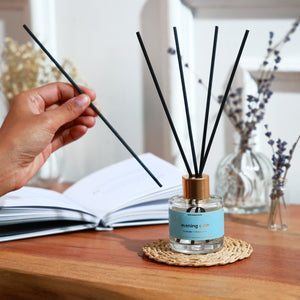


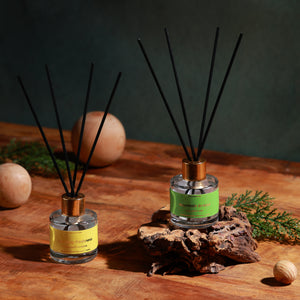
What is left: passive capillary — a reed diffuser at ₹749–₹849, which adds no water and no air — and waterless cold-air nebulising, which shatters undiluted oil into a dry mist with no water at all.
The one waterless device sized for a bedroom: Safar ₹3,999 — and it is named and sold as a car and travel diffuser. SOSA’s own product page also names bedside and hotel room among its uses, so the recommendation is legitimate, but you should know the word “car” is on the box before you pay rather than after.
The honest gap, stated plainly: between Safar at personal scale and Vaayu at ₹11,999 and 1000 m³, SOSA makes no mid-sized waterless bedroom nebuliser, and has published no room-coverage figure for Safar at all. Your constraint lands exactly in that hole. That is a fact about our range, and you deserve it up front.
2. That leaves two mechanisms, and only two. Passive capillary — oil climbing six fibre reeds and evaporating from their surface, with no water, no power and no air added. And waterless cold-air nebulising — pressurised air shattering undiluted oil into a dry micro-mist that travels with the room’s own airflow, again with no water. The second is the technology hotels actually use, which is why this constraint, awkward as it is, has pointed you at the right family.
3. Of the two waterless SOSA machines, only one is remotely bedroom-shaped. Vaayu at ₹11,999 is rated to 1000 m³, roughly 2,000 to 3,000 sq ft. In a bedroom, nine-tenths of that machine is wasted, and I will not sell it to you for one room. Safar at ₹3,999 is the same physics at personal scale — and it is named and sold as a car and travel diffuser, with no published room-coverage figure.
4. So the honest answer is Safar with clear eyes, or a reed with adjusted expectations. There is no third option that is dry, room-sized and made by us. I would rather write that sentence than invent a machine that does not exist by describing Safar in language SOSA has never published about it.
5. Before either, use the free lever Mumbai gives you. A running split AC in a closed bedroom does two useful things at once: it recirculates air inside the room, which distributes fragrance far more evenly than still air ever will, and it pulls moisture out of that air, which is exactly the condition in which fragrance travels better. Your closed, cooled bedroom is a genuinely better scenting environment than your open flat, and it costs nothing to test.
Free shipping above ₹499, and a portion of every order supports girl-child education through Nanhi Kali.

What “no humidifier” actually eliminates, and why it eliminates so much
Most people who write this sentence to me think they are excluding a category of appliance. They are in fact excluding two-thirds of the diffuser market, because the cheap, popular, well-reviewed machine that everybody recommends for a bedroom is an ultrasonic one, and an ultrasonic diffuser is a humidifier that has been given a fragrance job. The mist you can see leaving it is water. The oil is suspended in that water at a low proportion, which is why the plume is visible in the first place — pure fragrance oil atomised into a dry mist is invisible. Once you know that, the whole product category reorganises itself in your head, and the Mumbai version of the question answers itself.
 Sukoon₹1,899All three work identically and differ only in scale. Boond at ₹899 holds 300ml, covers up to about 150 sq ft and runs around six hours. Sukoon at ₹1,899 holds 500ml, covers 270–320 sq ft, runs 16–18 hours on low and includes three 15ml Hotel Collection scents. Megh at ₹3,499 has a six-litre tank and about a hundred hours of runtime and yet covers only around 215 sq ft — less than the Sukoon at half the price, because it is a runtime and humidity machine rather than a coverage upgrade. On any other page one of these would be my recommendation, and on most single-bedroom pages Sukoon is. Here all three are eliminated by a single word in your question.
 Mountain Breeze₹849Oil climbs six fibre reeds by capillary action and evaporates from their surface at whatever rate the room’s temperature, humidity and airflow permit. It adds no water whatsoever, which is precisely what you asked for, and no air either, which is the limitation you are buying. Concentration is highest at the bottle and falls away with distance, so what you get is a fragrant zone rather than a fragranced room. That is the design and not a defect — it is the reason the format is silent, needs no power point, no charging, no filling and no schedule, runs at roughly ₹13–₹15 a day and looks like a glass bottle rather than a small appliance with a light on it. Fibre reeds rather than rattan matters here more than anywhere: rattan is a natural cane with irregular internal channels and it wicks unevenly in humid coastal air, giving the fade-then-nothing pattern people blame on the oil.
 Safar₹3,999Pressurised air shatters undiluted fragrance oil into a dry micro-mist which then travels with the room’s own air. No water, no dilution, no heat, no added humidity, no white mineral film in a hard-water building. This is the mechanism behind the smell you are trying to reproduce, and the reason it feels different from a home diffuser is not the composition in the bottle: it is that each droplet is fragrance rather than fragrance-in-water, and something is actively moving those droplets away from the device. Undiluted payload plus moved air, in that order. SOSA makes two: Safar at ₹3,999 and Vaayu at ₹11,999, and the distance between those two in capability is very large.
What SOSA Safar actually is, before you decide anything
I would rather you read this paragraph on a page than discover it on a carton. Safar is named and sold as a car perfume diffuser, at ₹3,999. Its own product page names car, handbag, desk, bedside and hotel room among its intended places and carries a whole travel and hotels section, so recommending it into a bedroom is supported by our own copy and I am comfortable doing it. But the word “car” is in the product name, and a reader who finds that out after paying will reasonably feel handled, which matters more to me than the order.
The verified specification, and nothing beyond it. Waterless cold diffusion of pure fragrance oil, with no water, no heat, no dilution and no white dust. A 20ml oil bottle, of which a few drops is all it takes. A 2000 mAh rechargeable battery over Type-C, so it is fully cordless in use, giving up to 10 hours continuous or around 30 hours intermittent per charge. Three speed settings and a 1, 2 or 3-hour auto-off timer — which means it is a device you switch on for a stretch, not a set-and-forget appliance that runs itself for a season. It is 6.9 cm, palm-sized. It runs on SOSA fragrance oils or good-quality pure essential oil; thick, sticky or water-based blends can clog the mechanism, which specifically rules out putting water-based Hotel Collection oil into it.
And now the sentence that governs this page. SOSA has published no room-coverage figure for Safar, so I will not give you one, imply one, or describe it as a room-scenting machine. It is personal and small-space scenting: the hotel mechanism, honestly, at personal scale. Above it sits Vaayu at 1000 m³, roughly 2,000–3,000 sq ft, which in a bedroom is nine-tenths wasted. Between those two, SOSA makes nothing. There is no mid-sized waterless bedroom nebuliser in this range, and a Mumbai reader who has ruled out water has walked directly into that gap. You are not imagining the difficulty of this purchase. The difficulty is real and it is ours, not yours.
| Option | Mechanism | Adds humidity? | Coverage as published | Control | Price |
|---|---|---|---|---|---|
| Reed diffuser ★ | Passive capillary, six fibre reeds | No — nothing but fragrance leaves it | 50ml up to ~150 sq ft, 130ml above — as a zone, not a filled room | None. No off switch; reed count is the only dial | ₹749–₹849 |
| Boond | Ultrasonic water mist | Yes — ruled out by your question | Up to ~150 sq ft, 300ml, about 6 hours | On/off, USB, night light | ₹899 |
| Sukoon | Ultrasonic water mist | Yes — ruled out, and it is the one I would otherwise recommend | 270–320 sq ft from a 500ml tank, 16–18 hours on low | On demand | ₹1,899 |
| Megh | Ultrasonic water mist, six-litre tank | Yes, considerably — and it is the least appropriate machine here | Only ~215 sq ft — less than Sukoon. Never a coverage upgrade | About 100 hours of runtime | ₹3,499 |
| Safar ★ | Waterless cold-air nebulising, undiluted oil | No — dry mist, no water at all | None published. Personal and small-space scenting; named and sold as a car and travel diffuser | 3 speeds, 1/2/3-hour auto-off, 2000 mAh Type-C, up to 10h continuous | ₹3,999 |
| Vaayu | Waterless cold-air nebulising, 400ml tank | No | Up to 1000 m³, roughly 2,000–3,000 sq ft — wrong for one bedroom | App plus onboard, 1h/4h/8h/24h windows, under 38 dB | ₹11,999 |
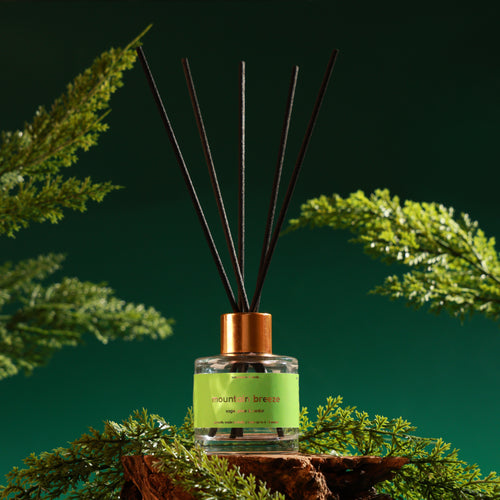 Dry, silent · Mountain Breeze₹849Shop →
 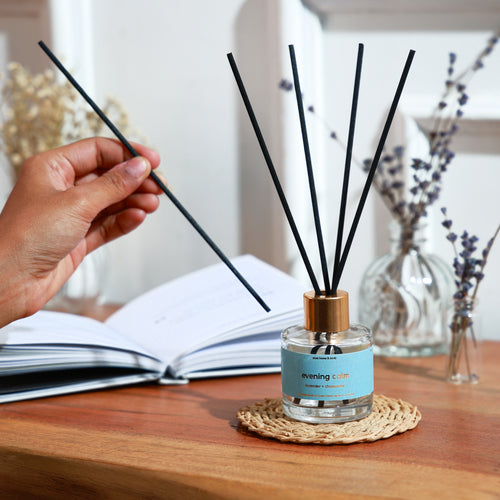 Softest · Evening Calm₹799Shop → Waterless · Safar₹3,999Shop →
The reed answer, argued properly rather than offered as a consolation
If ₹3,999 for a device named after a car is not a purchase you want to make, the reed is a genuinely good answer and I am not going to soften that into a lesser option. A reed diffuser is the only format on this page that adds nothing to the room but fragrance. No water, no air, no noise, no light, no heat, no power draw, no cable, no tank, no schedule and no thought for six to eight weeks. It never surges and never cycles, which means within its zone it produces the steadiest output of any format there is — exactly the property you want on a bedside table at two in the morning. And it is on a heat-stable CCT carrier rather than DPG, which can crack and go bitter above 40°C, so it will not turn on you in a hot coastal flat the way cheaper reeds do.
What you must do differently in Mumbai is accept that humid air carries fragrance molecules less readily than dry air does. Saturated air shortens projection and holds the scent closer to the source, so the same bottle that fills a dry room to arm’s length will hold to half that here. This is not the oil failing. It is the air being full. The correct response is placement rather than more oil — move the bottle into the path the room’s air already takes, on a chest of drawers or a console near the doorway rather than into a bookshelf recess or the dead space behind a curtain, and never directly into the blast of a split AC, which strips the top notes within days and leaves you with the base alone. Use all six reeds for full projection, or three for a soft bedside level and roughly double the life. Flip them every three to five days.
There is also a question of your own nose that no purchase solves, and it accounts for a large share of the letters I get about weak diffusers. Olfactory receptors stop reporting an unchanging stimulus within minutes. The molecules are still arriving; your brain has concluded that nothing has changed and stopped mentioning it. It is why you can smell your own home only after being away from it, and why a hotel registers so strongly — you arrive at it un-adapted. Before you spend anything, leave the bedroom for fifteen minutes with the door closed, then walk back in. If the room greets you, the diffuser is working and the problem was never the product. A guest is a better instrument than you are.
What to buy, in order — and the gap you have landed in
Free adjustments first, then the dry passive product, then the dry machine. Everything ultrasonic is absent from this ladder by your own instruction, and the last row is the honest gap, which on this page is doing more work than on any other in the city set.
| Step | What it is | When it is the right answer | Price |
|---|---|---|---|
| 1. Closed door, AC running, bottle moved into the airflow ★ | A cooled, closed bedroom recirculates its own air and holds less moisture — better distribution and better carriage, for nothing | Always first. It is the one advantage a Mumbai bedroom has over a Mumbai living room | ₹0 |
| 2. The correctly sized reed | 50ml for up to ~150 sq ft lasting 6–8 weeks, 130ml above that lasting 14–18; six fibre reeds, flipped every 3–5 days, about ₹13–₹15 a day | When you want something permanent, silent and undemanding, and can accept a fragrant zone rather than a filled room | ₹749–₹1,349 |
| 3. Safar ★ | Undiluted oil, waterless, cordless on 2000 mAh Type-C, 3 speeds, 1/2/3-hour auto-off, 20ml bottle, 6.9 cm | When water is genuinely ruled out and you want the hotel mechanism rather than the hotel bottle. Named and sold as a car and travel diffuser; no published room coverage | ₹3,999 |
| 4. Vaayu | 1000 m³, 400ml tank lasting up to about 90+ days, app scheduling, under 38 dB, wall or HVAC mountable | A whole floor, an open-plan living-dining, a villa, a clinic or a showroom. Not one Mumbai bedroom | ₹11,999 |
| Not for you: Megh | Six-litre tank, ~100 hours of runtime, ~215 sq ft — less coverage than the ₹1,899 Sukoon, and the most humidity of anything we sell | Never, on this page. It is a runtime and humidity machine, and humidity is the thing you excluded | ₹3,499 |
| The honest gap | A mid-sized waterless nebuliser built for one bedroom — which SOSA does not make. Safar has no published room coverage; Vaayu is rated to 2,000–3,000 sq ft. Nothing sits between them | Said plainly, because a reader who has ruled out water has landed in exactly that hole and deserves to know it before spending ₹3,999 | — |
Versailles
Of all the city questions we get, this is the one I find hardest to answer well, and it is not because Mumbai is difficult. It is because the constraint is correct. Somebody who does not want more water in a coastal bedroom has reasoned properly about their own home, and the reward for reasoning properly should not be that the range narrows to two imperfect answers. But it does, and pretending otherwise would be worse.
So let me be exact about the shape of it. Sukoon at ₹1,899 is the machine I recommend most often for a bedroom anywhere else in India, and it is out here on a single word. Safar is a genuinely good piece of engineering — undiluted oil, three speeds, a timer, cordless on a Type-C charge — and it is called a car perfume diffuser because that is what it was built for and where most people use it. We have not measured it in a room and we have not published a coverage figure, so I will not pretend to one. Above it, Vaayu is rated to 1000 m³ and would be faintly ridiculous in a bedroom. The middle of that ladder is missing, and it is missing exactly where a great many Mumbai readers are standing.
What I would actually do, in your flat. Close the door, run the AC, and put a reed where the room’s air already moves — that combination is free and it is more of the answer than people expect, because a cooled closed room both recirculates and dries its own air. Live with it for a fortnight. If you still want a level rather than a zone, and you still will not have water, then Safar, knowing precisely what it is. Everything is composed in Pune, and part of every order funds a girl’s classroom through Nanhi Kali.
Frequently asked questions
- A small Mumbai apartment — the same city, a different constraint: size, not water.
- Pune with the windows open — air exchange rather than humidity.
- A Pune 2BHK at the end of the day — scheduling and arrival.
- A Bengaluru work-from-home bedroom — ten occupied hours, and why the answer is less.
- A closed AC bedroom in Gurgaon — the easiest room in this whole series.
- Delhi without candles or incense — what the exclusions leave.
- Humid Chennai: passive or active? — why saturated air argues for moved air.
- Hyderabad, large open living spaces — the one city page where Vaayu is the right answer.
- A humid Kolkata flat — ventilation and damp before mechanism.
- Brand: the SOSA founder story.
Facts verified August 2026: Passive capillary — SOSA reed diffusers, five scents, 50ml ₹749–₹849 for rooms up to ~150 sq ft lasting 6–8 weeks, 130ml ₹1,249–₹1,349 above 150 sq ft lasting 14–18 weeks, six fibre reeds included (six for full projection, three for a soft bedside level and roughly double the life), flipped every 3–5 days, about ₹13–₹15 a day, heat-stable CCT carrier, alcohol-free, phthalate-free, paraben-free, IFRA-compliant, 0 ppm formaldehyde, refillable glass, tested at 45°C and 85% RH, composed in Pune; duos from ₹1,498; refills 300ml ₹2,399 and 500ml ₹3,499, oil only and never a first purchase. Ultrasonic water mist — Boond ₹899 (300ml, up to ~150 sq ft, ~6 hours, USB, night light), Sukoon ₹1,899 (500ml, 270–320 sq ft, 16–18 hours on low, three 15ml Hotel Collection scents included), Megh ₹3,499 (6L tank, ~100 hours, ~215 sq ft — less than Sukoon, and never a coverage upgrade); all three dilute oil in water and add humidity. Waterless cold-air nebulising — Safar ₹3,999 (20ml bottle, 2000 mAh Type-C, up to 10 hours continuous or around 30 hours intermittent per charge, 3 speeds, 1/2/3-hour auto-off, 6.9 cm, named and sold as a car and travel diffuser with bedside and hotel room among its stated uses, no published room-coverage figure) and Vaayu ₹11,999 (up to 1000 m³ or roughly 2,000–3,000 sq ft, 400ml tank lasting up to about 90+ days, Bluetooth app plus onboard buttons, 1h/4h/8h/24h run windows, choice of days, adjustable intensity, key-lock, under 38 dB, freestanding or wall/HVAC mount, 5W, CE, RoHS, SGS). Between Safar and Vaayu there is no mid-sized waterless bedroom nebuliser in the SOSA range. Hotel Collection oils are water-based and ultrasonic-only — 15ml ₹299 (a refill), 100ml ₹999, 300ml ₹1,799, pack of 7 ₹1,799 — and cannot be used in reed diffusers or waterless nebulisers, nor reed oil in ultrasonic machines; there is no hotel-inspired reed diffuser. No health, air-quality, allergy or antimicrobial claims are made, and fragrance does not remove a smell: source, ventilation, then fragrance. Free shipping above ₹499. A portion of every order supports girl-child education through Nanhi Kali. SOSA is an independent Indian fragrance house; the Hotel Collection scents referenced here are SOSA’s own interpretations inspired by the world’s finest hotels, and SOSA is not affiliated with, endorsed by or a supplier to any hotel brand. Prices subject to change — see the live product pages.