

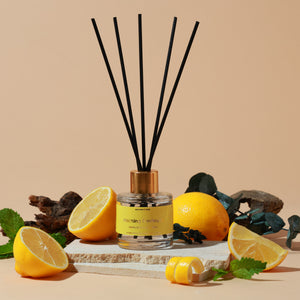
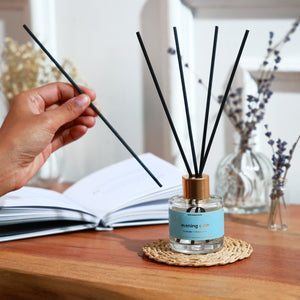
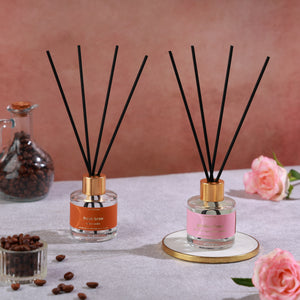
One scent, not four. A home running four compositions in five rooms produces a fifth smell in the corridor that nobody selected. One composition throughout reads as a decision; several read as a shelf of products.
Step the dose, not the scent. Put your highest concentration in the room people enter first — a 130ml reed with all six reeds, or a machine — and keep the rest of the house deliberately lower. Same scent, two levels.
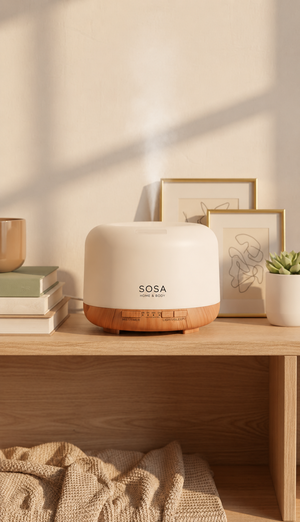
Mechanism, then product: a reed is passive capillary and produces a fragrant zone; Sukoon ₹1,899 is ultrasonic water mist and covers a published 270–320 sq ft; Safar ₹3,999 is waterless cold-air nebulising at personal scale, named and sold as a car and travel diffuser.
Two things not to buy: Megh ₹3,499 is not a coverage upgrade — about 215 sq ft, less than the ₹1,899 Sukoon. And SOSA has no room spray at all; every SOSA spray is a car perfume.
2. Choose one scent for the whole home. This is the instruction that separates homes people compliment from homes people politely say nothing about. Four compositions in five rooms do not read as variety; they meet in the hallway and produce a sixth smell that nobody chose and that no perfumer would have signed off. One composition throughout is what a hotel does, and it is why a hotel reads as designed. If you want two, make them a deliberate pair in rooms that do not share air — not a collection.
3. Put the strongest dose in the room people enter first, and go deliberately lower everywhere else. Same scent, stepped concentration. In practice that is a 130ml bottle with all six reeds in the entry room and 50ml bottles with three reeds elsewhere, or an active machine in the entry room and reeds beyond it. The visitor meets the peak first and then walks into a home that is coherent rather than uniform.
4. Place it slightly inside the entrance, not on the threshold. An entrance is the most turbulent point in a home. The door opens, air exchanges with the corridor or the street, and anything sitting on the threshold is repeatedly stripped and then met at very close range — which reads as a burst rather than as an atmosphere, and empties the bottle faster. A metre or two inside, out of the direct draught but in the path the air already takes, is better for the impression and better for the bottle.
5. Then judge it on a walk-in, and only on a walk-in. You cannot assess your own home from the sofa — receptors stop reporting a constant stimulus within minutes, which is precisely why your friend’s flat has a smell and yours does not. Leave for fifteen minutes, come back, grade it at the door. If a guest has ever remarked on your home while you could smell nothing, you already have the result.
Free shipping above ₹499, and a portion of every order supports girl-child education through Nanhi Kali.
The three rules, and the physical reason each one works
Every instruction on this page is doing one of two things: raising the concentration a visitor meets at the moment they walk in, or preventing that concentration from being contaminated by something else. Nothing here is about buying a more beautiful oil, because the compliment you are hoping for is almost never about the composition. People do not say “your home smells amazing” because the jasmine was well chosen. They say it because the air is clean, the level is right, and there is only one thing to smell.
 Evening Calm₹799A flat is not a set of sealed boxes. Air moves between rooms through open doors and gaps, so two compositions running twenty feet apart are not two experiences — they are one blend, and it is a blend neither perfumer designed. This is the commonest and most expensive mistake I see in Indian homes, and it is a mistake of enthusiasm rather than of cheapness: people who care buy more bottles. Evening Calm at ₹799 is the safest single choice for a whole-home signature because at 8.9 it is the softest thing we make and it offends nobody; Garden Bloom ₹799 is the one buyers most often describe in hotel language.
 Sukoon₹1,899A visitor arrives un-adapted, and that state lasts about as long as it takes them to hand you a bag. Everything they smell after the first minute is being reported by a nose that has already begun to stop reporting it. So the entry room is worth over-serving and the rest of the house is worth under-serving. Practically: all six reeds and the larger bottle where they arrive, three reeds and the smaller bottle elsewhere. If the entry space is a big open-plan living-dining rather than a hall, a reed will produce a fragrant zone rather than a fragranced room and you want something that moves air — Sukoon ₹1,899 covers a published 270–320 sq ft and can be switched on an hour before people are due.
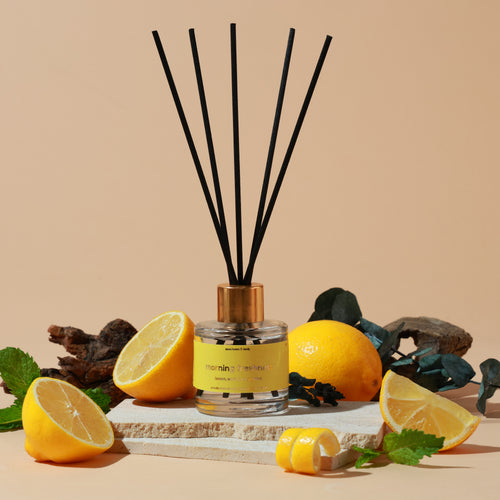
 Morning Freshness₹749Adding a pleasant odour to an unpleasant one gives the brain two things to track, and it tracks both. That is why a room that has been sprayed over reads as covered and a room that has been aired reads as clean. Ventilation removes the airborne fraction quickly; what it cannot reach is the fraction that has condensed onto fabric, and that keeps re-releasing for hours. So the honest sequence is: fix the source, open everything for twenty minutes, close up, then let the fragrance build into air that has nothing else in it. Morning Freshness ₹749 is the one I put in kitchens, not because it removes anything — it does not — but because citrus sits alongside food rather than arguing with it.
Source, ventilation, fragrance — and why the order is the whole thing
I would like to be blunt about this because it is the single most useful paragraph on the page and it costs us sales. No diffuser removes a smell. Not a reed, not an ultrasonic machine, not a cold-air nebuliser, not anything at any price. What a fragrance does is add a new set of molecules to the air, and the nose is perfectly capable of resolving two sets at once — which is why the result of scenting over cooking is not a fragrant home, it is a home that smells of two things and appears to be hiding one of them. That impression is worse than either smell alone, and visitors read it instantly.
The practical work list is short and unglamorous. Bins emptied and the bin itself washed, not just relined. Drying laundry moved somewhere ventilated, because slow-drying fabric releases several litres of water into the air over a day and supports the microbial growth that produces the musty note — that is a moisture problem with an odour symptom, and fragrance layered onto it produces scented damp. Shoes out of the entry cupboard. Kitchen cloths dried rather than left folded and wet. Extractor run for longer than feels necessary after cooking, and windows opened wide for a short burst rather than left ajar all day — a short strong exchange clears air far better than a permanent trickle, and a permanent trickle also carries your fragrance out with it.
Then, and only then, the fragrance, and here is where the mechanism decides what is realistic. A reed diffuser is passive capillary diffusion: oil climbs six fibre reeds and evaporates from their surface at whatever rate the room allows, with no air moved and therefore a concentration that is highest at the bottle and falls with distance. In a hall or a normal-sized room that is genuinely enough, and it is silent, unpowered, maintenance-free, refillable, and about ₹13–₹15 a day — no machine on this page matches that list. In a large open-plan entry it is not enough, and no number of extra reeds changes that, because more reeds raises output and shortens life without altering the transport mechanism. That is the point at which a machine is a legitimate purchase rather than an upgrade for its own sake.
| Where | Mechanism that fits | What I would actually put there | Reed count / setting | Price |
|---|---|---|---|---|
| Entry hall or small entry room ★ | Passive capillary is enough — the volume is small | 130ml reed, placed a metre or two inside, out of the draught | All six reeds, flipped every 3–5 days | ₹1,249–₹1,349 |
| Open-plan living-dining as the entry | Passive capillary under-delivers; you need air moved | Sukoon ₹1,899, run for an hour before people arrive | Low setting; 16–18 hours from 500ml | ₹1,899 |
| Bedrooms and study beyond the entry | Passive capillary, deliberately under-dosed | The same scent as the entry, 50ml | Three reeds — softer, and roughly double the life | ₹749–₹849 |
| Kitchen | Ventilation does the work; fragrance sits alongside | Morning Freshness 130ml — citrus complements food rather than fighting it | Six reeds in ~200 sq ft | ₹1,249 |
| Bathroom | Small sealed volume — the most efficient placement there is | 50ml of the house scent | Two or three reeds — a 50ml then runs close to three months | ₹749–₹849 |
| Anywhere, if water is ruled out | Waterless cold-air nebulising — undiluted oil, dry mist | Safar ₹3,999. Named and sold as a car and travel diffuser; no published room coverage | 3 speeds, 1/2/3-hour auto-off; recharging required | ₹3,999 |
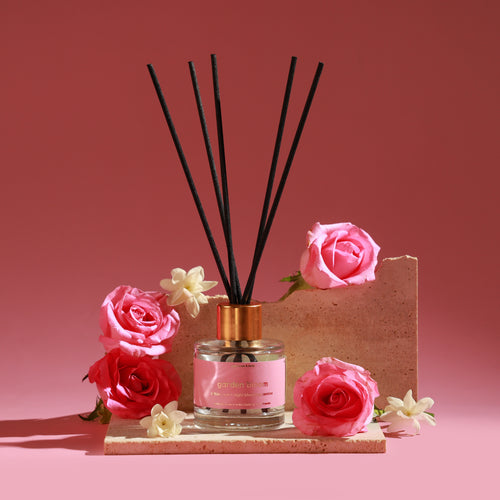
Entry room · Garden Bloom₹799Shop → 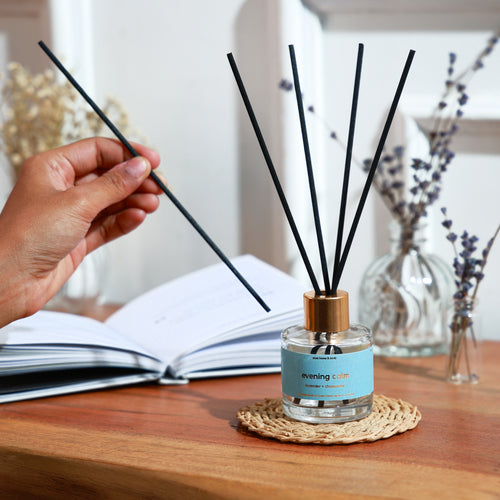 Whole home · Evening Calm₹799Shop →
 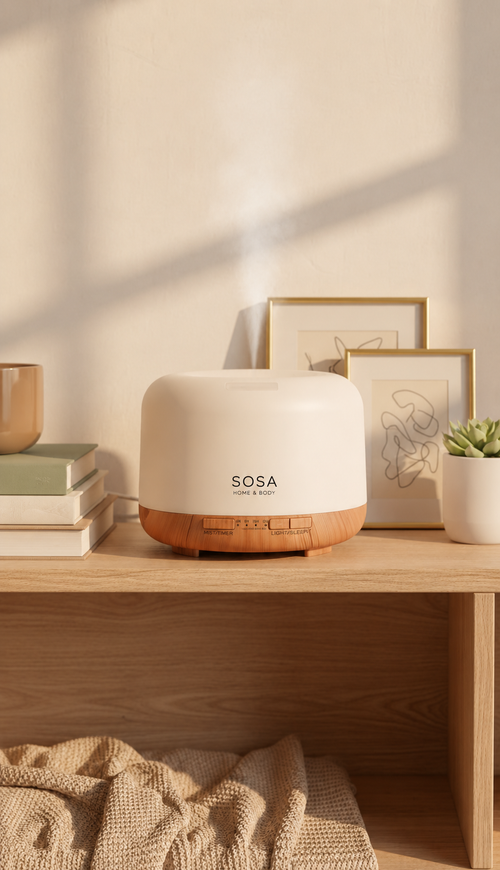 Large entry · Sukoon₹1,899Shop →
Why dose, not price, decides whether it reads as expensive
Here is something I would rather customers heard from me than discovered by wasting money. Almost any composition at too high a concentration flattens into a single sweet or sharp impression — and that flattened impression is exactly what people mean when they say something smells like air freshener. The materials are still all there; the nose simply cannot resolve them because it is saturated. The same oil at a lower dose reads as layered, because there is room to hear the separate parts. This is why “cloying” is far more often a description of over-dosing than of a bad composition, and why the fix for a home that smells cheap is usually to remove reeds rather than to buy a better bottle.
The corollary matters for this page in particular: you should not be able to smell your own home continuously. Home fragrance is designed to be noticed on arrival and at transitions — walking in, coming out of a bathroom, opening a bedroom door. If you can smell it constantly while sitting still in the room, the projection has overshot the volume, and every visitor is meeting a level you have adapted to and they have not. Six reeds is full projection and belongs in a living room or a large kitchen. Three is a soft bedside level and roughly doubles the bottle’s life. In a small sealed room, six is usually too many.
One more thing, since the word “spray” comes up in nearly every version of this question. SOSA does not make a room spray or a home spray; every spray we sell is a car perfume, so I have nothing to sell you in that category and can be straightforward about it. As a category, a spray is peak-and-crash delivery: it wins the first sixty seconds decisively and has nothing left by minute ten, and used over a smell rather than after ventilation it produces exactly the covered impression this page is trying to avoid. If you are going to use one, use it as a finishing touch on air that is already clean, never as the strategy.
What to buy, in the order I would actually buy it
The free steps come first because they are genuinely the ones producing the compliment, and because a purchase made before the ventilation habit is a purchase that will underperform. Then one scent, then a stepped dose, then a machine only where the entry space is too large for passive diffusion. The last row is the honest gap in our own range, and it is the reason this page recommends a ₹1,899 machine to most readers rather than anything above it.
| Step | What it is | When it is the right answer | Price |
|---|---|---|---|
| 1. Source, then ventilation, then fragrance ★ | Bins, damp cloths, drying laundry and shoes dealt with; twenty minutes of real cross-ventilation; then close up and let the scent build into clean air | Always first, always free, and the step that decides whether anything below it works. Fragrance does not remove a smell | ₹0 |
| 2. One scent for the whole home — a 130ml reed in the first room ★ | Passive capillary, six fibre reeds, refillable glass, 14–18 weeks, placed a metre or two inside the entrance and out of the draught | For almost everybody. This is the complete method at its cheapest, and for a hall or a normal-sized room it is genuinely enough | ₹1,249–₹1,349 |
| 3. The same scent at 50ml, three reeds, everywhere else | Deliberate under-dosing beyond the entry — softer, and roughly double the life per bottle | When you want the home to read as one thing at two levels rather than as several products | ₹749–₹849 each |
| 4. Sukoon in a large or open-plan entry | Ultrasonic water mist, 270–320 sq ft published, 16–18 hours on low, three 15ml Hotel Collection scents included | When the room people walk into is bigger than a reed can serve. Accept water, dilution, added humidity and filling a tank | ₹1,899 |
| 5. Safar, if water is ruled out | Waterless cold-air nebulising of undiluted oil, 3 speeds, 1/2/3-hour auto-off, 2000 mAh Type-C, 20ml, 6.9 cm | Humid coastal flats, or rooms you do not want more moisture in. Named and sold as a car and travel diffuser, no published room coverage, needs recharging | ₹3,999 |
| The honest gap, and what not to buy | Megh ₹3,499 is not a coverage upgrade — about 215 sq ft, less than the ₹1,899 Sukoon. Vaayu ₹11,999 is rated to 2,000–3,000 sq ft and is wrong for a hall. And between Safar and Vaayu we make no mid-sized waterless machine at all | Stated plainly, because two of the three most expensive things on this page are the wrong purchase for this question | — |
Versailles
The homes I have walked into and immediately wanted to ask about were never the ones with the most fragrance in them. They were the ones where there was clearly one decision — one scent, chosen a while ago, running slightly hot in the hall and quietly everywhere else, in a house where somebody had opened the windows that afternoon. That is the entire recipe, and it is almost embarrassingly cheap. What it asks for is restraint, which is harder to sell than a bottle.
The instruction I most want people to take is the sequence, because it is the one that costs us money to give. Source, then ventilation, then fragrance. I would rather you emptied the bin and aired the flat and bought nothing than bought a ₹1,349 bottle and put it on top of a smell. Fragrance layered over cooking or damp does not cancel anything — it gives the nose two things and, worse, gives the visitor the impression that something is being hidden. Every one of us can read that in a second, in someone else’s home.
And do please use the reeds as a dial. Six for the room where people arrive, three for the bedrooms, two or three in a small bathroom where a 50ml will then last close to three months. It is free, it takes ten seconds, and it is the adjustment almost nobody makes before deciding a fragrance is too much or too little. Everything is composed in Pune on a heat-stable CCT carrier, and a part of every order funds a girl’s classroom through Nanhi Kali.
Frequently asked questions
- How hotels do it in seconds — threshold concentration, scheduling and consistency.
- Guests noticing before they sit down — placement slightly inside, out of the draught.
- An arrival moment at the bedroom door — why closing a door is the cheapest tool you own.
- Nice once you sit inside, but no immediate impact — the concentration gradient explained.
- Reed, spray or active diffusion — the first sixty seconds versus the evening.
- A signature scent at your own door — and the honest limitation of scenting for yourself.
- Why a lobby lands and your own home does not — adaptation, in full.
- Arrival effect or background scent — two setups mostly in tension.
- Stronger fragrance or better diffusion — the family pillar.
- Brand: the SOSA founder story.
Facts verified August 2026: Passive capillary — SOSA reed diffusers, five scents, 50ml ₹749–₹849 for rooms up to ~150 sq ft lasting 6–8 weeks, 130ml ₹1,249–₹1,349 above 150 sq ft lasting 14–18 weeks, six fibre reeds included (six for full projection, three for a soft bedside level and roughly double the life), flipped every 3–5 days, about ₹13–₹15 a day, heat-stable CCT carrier rather than DPG, alcohol-free, phthalate-free, paraben-free, IFRA-compliant, 0 ppm formaldehyde, refillable glass, tested at 45°C and 85% RH, composed in Pune; duos ₹1,498–₹1,598 for 50ml × 2; refills 300ml ₹2,399 and 500ml ₹3,499, oil only and never a first purchase. Ultrasonic water mist — Boond ₹899 (300ml, up to ~150 sq ft, ~6 hours, USB, night light), Sukoon ₹1,899 (500ml, 270–320 sq ft, 16–18 hours on low, three 15ml Hotel Collection scents included), Megh ₹3,499 (6L tank, ~100 hours, ~215 sq ft — less than Sukoon, and never a coverage upgrade). Waterless cold-air nebulising — Safar ₹3,999 (20ml bottle, 2000 mAh Type-C, up to 10 hours continuous or around 30 hours intermittent per charge, 3 speeds, 1/2/3-hour auto-off, 6.9 cm, named and sold as a car and travel diffuser with bedside and hotel room among its stated uses, no published room-coverage figure) and Vaayu ₹11,999 (up to 1000 m³ or roughly 2,000–3,000 sq ft, 400ml tank lasting up to about 90+ days, Bluetooth app plus onboard buttons, 1h/4h/8h/24h run windows, choice of days, adjustable intensity, key-lock, under 38 dB, freestanding or wall/HVAC mount, 5W, CE, RoHS, SGS). Between Safar and Vaayu there is no mid-sized waterless bedroom nebuliser in the SOSA range. Hotel Collection oils are water-based and ultrasonic-only — 15ml ₹299 (a refill), 100ml ₹999, 300ml ₹1,799, pack of 7 ₹1,799 — and cannot be used in reed diffusers, nor reed oil in ultrasonic machines; there is no hotel-inspired reed diffuser. SOSA sells no room spray or home spray; every SOSA spray is a car perfume. No health, air-quality, allergy or antimicrobial claims are made, no claim is made that fragrance improves sleep, mood or concentration, and fragrance does not remove a smell: source, ventilation, then fragrance. Free shipping above ₹499. A portion of every order supports girl-child education through Nanhi Kali. SOSA is an independent Indian fragrance house; the Hotel Collection scents referenced here are SOSA’s own interpretations inspired by the world’s finest hotels, and SOSA is not affiliated with, endorsed by or a supplier to any hotel brand. Prices subject to change — see the live product pages.