



What you gave up: concentration. Eighteen weeks of a quieter room instead of sixteen weeks of a fuller one. The oil itself is still ₹9.61 a millilitre.
The test: if a visitor still notices it from the doorway on four reeds, keep the ₹451. If they do not, put the reeds back — a bottle nobody registers has cost you ₹1,249, not ₹69 a week.
2. You are not getting free fragrance. You are buying duration with intensity. This is the part that gets lost. The liquid costs ₹9.61 a millilitre in a 130ml bottle whether you run six reeds or three. Nothing about the oil got cheaper. What changed is the rate at which it leaves — less exposed reed, less surface, slower evaporation — so the room settles at a lower steady concentration and stays there longer. Eighteen quieter weeks instead of sixteen fuller ones is a trade, not an upgrade.
3. Whether that trade is a saving depends on one thing only. Does the lower level still do the job in that room? If three or four reeds is genuinely enough — and in a bedroom, a study or a bathroom it very often is — then the saving is completely real and you should take it. If the level drops below noticeable, you have not saved ₹451. You have spent ₹1,249 on a room that smells of nothing, and the cost per useful week is not ₹69, it is the entire bottle.
4. It is not a proportional dial. Going from six reeds to four removes a third of the evaporating surface but does not add a third to the bottle's life. Fragrance still leaves from the open neck, and the reeds that remain are saturated along their full length rather than working harder in some partial way. Expect a useful extension, not a step change. Anyone telling you three reeds doubles a bottle is selling you a story.
5. In some rooms fewer reeds is simply the correct setting, savings aside. A 40 sq ft bathroom on six reeds is not a stronger bathroom — it is the same bathroom with the bottle emptying four times faster than the volume can absorb. Same for a small bedroom you sleep in for eight hours. In those rooms the reduction is not a money-saving trick at all; it is the right level, and the lower running cost is a side effect you happen to get for free.
Made in India, composed by an ISIPCA Versailles-trained perfumer — and a portion of every order supports girl-child education through Nanhi Kali.
What removing a reed actually changes — and what it does not
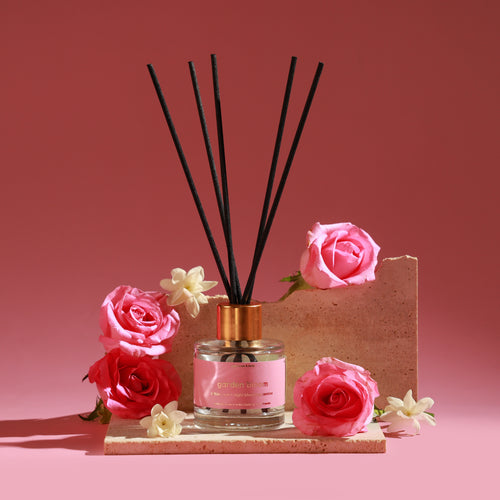
A reed diffuser has no fan, no pump and no switch. Fragrance travels up the porous core of each reed by capillary action, reaches the length standing in open air, and evaporates from there. The exposed reed is the evaporating surface, and the number of reeds is therefore the only rate control the object has. Six reeds present roughly half again as much surface as four. Less surface means fewer molecules leaving the bottle each hour, which means two things at once: the room reaches a lower steady concentration, and the liquid lasts longer. Those are not two separate effects you can pick between. They are the same effect described from two ends.
What does not change is the price of what is in the bottle. A 130ml at ₹1,249 works out at ₹9.61 a millilitre, and it stays ₹9.61 a millilitre on three reeds, six reeds or none. So the phrase "saves money" needs to be stated precisely: you are not paying less for fragrance, you are getting more weeks of room out of the same fragrance — at a lower level. That is a genuine improvement in cost per week, from about ₹78 to about ₹69, and it is also a genuine reduction in quality of coverage. Which of those two facts matters more is decided by the room, not by the arithmetic. In a 100 sq ft bedroom the lower level is usually still plenty and the ₹9 a week is free money. In a 200 sq ft living room with a balcony door, four reeds may be below the threshold at which anyone notices anything, and then the correct reading of your cost per week is not ₹69 — it is ₹1,249 for a decorative bottle. Evaporation also rises with heat and airflow, so the same four-reed setting behaves differently in an air-conditioned bedroom and a hot west-facing hall.
The three decisions when you are thinking about reed count
 One 130ml₹1,249Sixteen weeks on six reeds is ₹1,249 ÷ 16 = about ₹78 a week. Eighteen weeks on four is ₹1,249 ÷ 18 = about ₹69. Across a year of unbroken running the two routes come to roughly ₹4,059 and ₹3,608, a difference of about ₹451 — and that is before counting the reorders you did not have to place. It is a saving worth having. It is not the halving that gets repeated, and it never touches the ₹9.61 a millilitre you paid for the oil.
Sizing by space — where fewer reeds saves and where it simply switches off
The right reed count is set by the room, not by the budget. Two rows here save you the entire price of a bottle, because the correct number of reeds in them is none at all.
| Space | What it needs | How many | Cost |
|---|---|---|---|
| 100–150 sq ft bedroom, door closed ★ | Four reeds — the saving is real here, about ₹69 a week against ₹78 | Four of six | ₹1,249 over ~18 weeks |
| A 40 sq ft bathroom | Two or three reeds. Six is not a stronger bathroom, only a faster one | Two or three | from ₹749 |
| 180–200 sq ft living room, doors closed | Six. Cutting to four here usually drops below the threshold anyone notices | All six | ₹1,249 over ~16 weeks |
| A 150 sq ft room with the balcony door open | Six, and even then the air is being replaced faster than a passive source can charge it | All six | ₹1,249 over less than 16 weeks |
| A guest bedroom used twice a year | Nothing. Running it on two reeds to save money still costs ₹1,249 a bottle over time | None | ₹0 |
| A corridor between bedrooms | Nothing. Seconds of occupancy in the fastest air in the flat — no reed count fixes that | None | ₹0 |
| A note on all of the above: the 14–18 week figure assumes a closed room, still air and a standard ceiling. Heat and airflow raise the evaporation rate whatever the reed count, so the same four-reed setting will run longer in an air-conditioned bedroom than in a hot hallway. Reeds also clog over months — if throw drops away, the answer is fresh reeds rather than more of the old ones. | |||
One room · the unitFrom ₹749Shop → 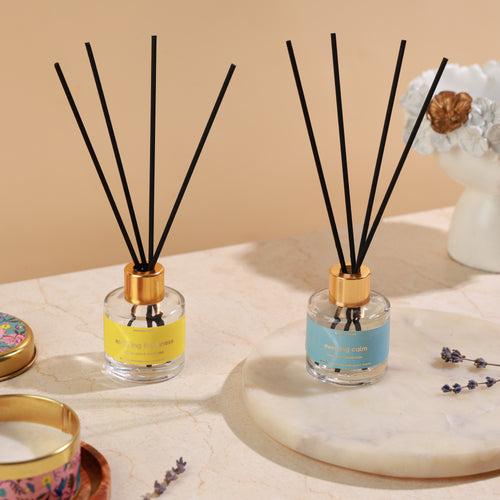 Two rooms · better value₹1,498Shop →
  Large room · a switch₹1,899Shop →
Setting the reeds, and reading the result honestly
Start at the room's correct number, not at the cheapest one. Six reeds for a living room or an entrance, four for a bedroom, two or three for a bathroom. Put that number in, wait forty-eight hours for the fibre to saturate along its whole length, and only then form a view — an enormous number of people declare a diffuser weak on day one when it has simply not started yet. If you are trying to economise, take one reed out at a time and give each change two full days. Reed count moves strength and lifespan together, so every reed you remove is a small decision about both, and taking three out at once tells you nothing about which one was the mistake.
Then judge from the doorway, because you cannot judge from inside. Olfactory adaptation is essentially complete in about twenty minutes; after that your own home reads as neutral to you no matter what is in it. Walk out for half an hour and assess the first breath on returning, or ask whoever visits next. This is the single most useful habit in home fragrance and it is the reason people over-buy — they cannot smell what they own, so they conclude they need more of it. Placement matters as much as count: a bottle near a doorway with gentle air movement will outperform the same bottle on four reeds in a still corner. Keep it out of direct sunlight and out of the path of an AC vent or fan, both of which raise the evaporation rate and cost you the weeks you were trying to buy. Stand it on a tray — reed oil marks polished wood permanently.
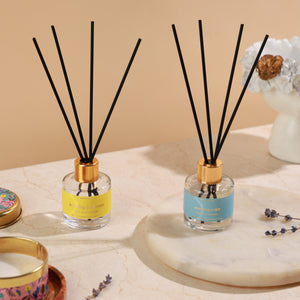
And spend the saving on the right thing, which is usually reeds rather than liquid. If throw drops off after several weeks with plenty of oil still in the bottle, the fibre has clogged — the heavier fragrance molecules saturate the core over months and the reed stops wicking properly. Fresh reeds restore it; more liquid does not. When the bottle does run out, a 300ml refill at ₹2,399 fills a 130ml roughly twice and is the moment to fit new reeds. For a bedroom running four, Evening Calm holds its character at a low level better than most; Morning Freshness is bright enough that three reeds still reads clearly in a small bathroom.
What to buy
Reed count is free to change and costs nothing to get wrong twice. These are the purchases that sit behind it, and what each one is genuinely for.
| Buy | What it covers | Lasts | Price |
|---|---|---|---|
| One 50ml | A single reed diffuser — a bathroom or a small study where two or three reeds is the right level anyway | 6–8 weeks | from ₹749 |
| One 130ml ★ | The value size — a bedroom on four reeds — about ₹69 a week, against ₹78 on six | 14–18 weeks | from ₹1,249 |
| The duo | Day & Night duo — two rooms at once, each set to its own reed count rather than a shared compromise | 6–8 weeks each | ₹1,498 |
| Sukoon | 500ml ultrasonic — a room where you want an actual off switch instead of a level you have to guess at | Runs when you switch it on | ₹1,899 |
| 300ml refill | The running cost — the running cost once you know which reed count each room settled on | Roughly 2 × 130ml fills | ₹2,399 |
Versailles
People ask me this expecting me to say no, because it sounds like the sort of thing a fragrance company would want to deny. It is true. Four reeds instead of six on a 130ml is roughly ₹69 a week against ₹78, and across a year that is about ₹451. I would rather you had that money than I did.
What I will not let pass is the idea that it is free. It is not. You have bought two extra weeks by accepting a quieter room for all eighteen of them, and in some rooms that is exactly right and in others it is the difference between a home that smells of something and one that does not. Nobody adds up the cost of a bottle standing on a shelf doing nothing, because there is no invoice for it — but it is the most expensive thing in this whole article.
So my rule is simple. Set the reeds to what the room needs, check it from the doorway after two days, and if the lower setting passes, keep the difference with my blessing. If it fails, put the reeds back and stop trying to economise on a ₹1,249 bottle by ₹9 a week. And if a room only passes on two reeds because nobody goes in there anyway, take the bottle out and put it somewhere it earns its keep. A portion of every order funds a girl's classroom through Nanhi Kali.
Frequently asked questions
- Six reeds for less time, or three for longer? — the same trade, priced out.
- What one extra reed costs over a bottle — the per-reed arithmetic.
- Cost per week: 50ml against 130ml — why the big bottle is the cheap one.
- The complete sizing and quantity guide — every home type, three builds.
- Brand: the SOSA founder story.
SOSA products & prices (verified August 2026): Hotel Collection water-based ultrasonic diffuser fragrance 15ml ₹299 · 100ml ₹999 · 300ml ₹1,799 · Pack of 7 (15ml, all fragrances) ₹1,799; refills 100ml from ₹999. Seven scents: The Ritz-Carlton-inspired (white tea · bergamot · cedar), Westin-inspired (white tea · aloe · cedar), 1 Hotels-inspired (cedarwood · vetiver · green leaves), The St. Regis-inspired (amber · violet · woods), Shangri-La-inspired (jasmine · green tea · white tea), Four Seasons-inspired (citrus · floral · sandalwood), W Hotels-inspired (citrus · pepper · amber). Diffusers: Boond 300ml ₹899 · Sukoon 500ml ₹1,899 · Megh 6L ₹3,499. Water-based, phthalate-free, composed to IFRA standards for home diffusion; 3–6 drops per tank. Made in India, Pune. The Hotel Collection scents are SOSA's own interpretations inspired by the world's finest hotels; all hotel names are trademarks of their respective owners and are used only to describe the scent style — SOSA is an independent Indian fragrance house, not affiliated with or endorsed by any hotel brand. Prices and availability subject to change — see the live product pages.