


The price, on a 50ml rated 6–8 weeks: 4 reeds runs beyond the stated window, 8 reeds roughly five to six weeks, 9 about five, 10 about four to five. Strength and duration are the same dial turned opposite ways.
The free moves first: flip all six weekly, move the bottle into gentle passing air at waist-to-chest height, close the room for an hour and walk back in. One of those three is usually the real answer.
Where counting stops: past roughly 250–300 sq ft of connected open space, or when you want scent on demand, no count works. Two bottles, or a Sukoon at ₹1,899.
2. Three or four for small, sealed or sensitive rooms. A bathroom, a nursery, a box room, or any home where somebody reacts to fragrance. Less exposed surface, a quieter room, and a bottle that comfortably outlasts its stated window.
3. Eight to ten for large or hosting rooms, knowing the price: a 50ml rated at six to eight weeks runs roughly five to six at eight reeds and four to five at ten. Ten is the ceiling. Beyond it you crowd the neck of the bottle, reeds lean and wick unevenly, and oil creeps down the outside of the glass onto your furniture.
4. Do the three free things before you add a reed. Flip all six weekly with gloves; move the bottle into gentle passing air near a doorway at waist-to-chest height, away from AC vents and out of direct sun; and close the room for an hour, then walk back in. Free strength always comes before paid strength.
5. Remember which way the trade runs. Reed count buys presence and spends weeks. Bottle size buys weeks and spends nothing on presence — a 130ml at the same count projects about the same as a 50ml and simply lasts 14–18 weeks instead of 6–8. Never buy a larger bottle as a strength upgrade.
6. Use two bottles rather than one heroic one in an open living-dining. Output per bottle is fixed, so the only way to raise the total in a space is another source. Two 50ml at opposite ends beat one 130ml in the middle every time.
7. Know where counting stops. Past roughly 250–300 sq ft of connected open volume, or whenever what you want is scent on demand rather than continuously, reeds are the wrong tool and a Sukoon at ₹1,899 is the answer.
Composed and handmade in small batches in Pune, and a portion of every order supports girl-child education through Nanhi Kali.
Part one — why six is a dose rather than a default
When we finish a composition, the last decision is not the bottle or the label — it is the count. A fragrance is balanced against a specific quantity of exposed reed surface, in an ordinary room, at an ordinary flip cadence, because that is what determines how much of each material actually reaches the air and in what proportion. Six is a recipe written for a pan of a particular size. You can cook in a different pan; you simply need to know what changes when you do. Three properties of the system explain every recommendation in this guide.
 Evening Calm₹799 · 8.9/10A 50ml bottle contains a fixed quantity of oil, and raising the rate at which it leaves shortens the time it takes to leave entirely. The published 6–8 weeks assumes six reeds, weekly flipping, no draught and no direct sun. At eight reeds expect roughly five to six weeks; at nine about five; at ten, four to five. Going the other way is just as real: four reeds comfortably outlasts the stated window and three more so. None of this is a fault in the bottle and none of it is irreversible — it is simply the exchange rate, and the only mistake is spending without knowing it. The people who write to me feeling cheated are almost always people who added reeds for a party and were never told what the party cost.
Part two — the count ladder, three to twelve
The complete ladder, with what each setting does to a room, what it does to a 50ml bottle, and the characteristic way each one goes wrong. Bottle-life figures assume weekly flipping, no draught and no direct sun; heat and moving air shorten every row. These are SOSA's working figures from in-house testing and customer correspondence, not laboratory measurements.
| Reeds | What the room does | 50ml bottle life | Best for | How it goes wrong |
|---|---|---|---|---|
| 6 · the dosed setting ★ | The level every composition was balanced for | 6–8 weeks, as stated | Bedrooms, kitchens, closed living rooms, studies | Too much for a small sealed bathroom |
| 3 | Deliberately faint — noticed at the doorway, forgotten inside | Comfortably beyond the stated window | Nurseries, box rooms, small bathrooms, sensitive homes | Oil ages in the bottle if the reeds are never refreshed |
| 4 | Gentle but present; a soft, long bedroom setting | Beyond the stated window | Bedrooms with the door shut, entryways, reading corners | Reads as weak in an open-plan room and gets blamed for it |
| 8 | Clearly fuller — the practical strong setting | Roughly 5–6 weeks | Large living rooms, hosting season, high ceilings | Weekly flipping stops being optional at this count |
| 10 · the ceiling | The most a passive diffuser produces | Roughly 4–5 weeks | A festive month, a week of guests, a winter drawing room | Expensive as a permanent habit; run it on refills |
| 12 or more | Little audible gain over ten | Shorter again, for nothing | Nothing, in a 50ml | Crowded neck, leaning reeds, oil creeping down the glass |
| The honest caveat: these are working figures, not measurements, and three things move them more than a reed does. Direct sun and heat thin the oil and raise the rate — a west-facing shelf in May can halve a bottle. A direct draught from a split AC or fan strips the reeds and empties the bottle weeks early while making the room smell of less, which is the worst outcome available. And a room in an 85 per cent humidity August behaves differently from the same room in January. Stand every bottle on a tray, out of sunlight, several feet from a vent. | ||||
Part three — the three questions that set your count
Rather than memorising a table, answer three questions and the number falls out of them. The first is how much air the diffuser is actually being asked to fill. Not floor area — volume, and connected volume at that. A 150 sq ft living room that opens onto a dining area, a passage and a balcony is one lobe of a much larger space, and the bottle is trying to scent all of it. A bedroom with the door closed is exactly what it looks like. High ceilings add volume that does not appear on any floor plan. Pace the room, look at how far you can see from the doorway, and add a reed for a high ceiling or an open door; subtract one for a small, sealed, hard-surfaced room such as a bathroom, where there is little air and almost nothing soft to absorb what you release.
The second question is who lives there. This is the one that overrides everything else. A household with a fragrance-sensitive person in it — migraines, a respiratory condition, sensitivity that arrived with pregnancy — should start at three reeds and put distance in as well as taking reeds out, placing the bottle outside the room that person occupies most. A home with a baby or small children wants a low count, a bottle standing on a tray well out of reach, and Evening Calm rather than anything at the loud end. Our compositions are alcohol-free, phthalate-free, paraben-free, low-VOC and IFRA-compliant, which removes the harsh solvent edge people most often react to — but it does not make fragrance right for someone whose body says no. If a person in your home reacts at three reeds in another room, the honest answer is an unscented house, and I would far rather write that than sell you a different bottle.
The third question is what you are optimising for, and it is worth being explicit rather than assuming. If you want a room that greets people, you want four to six reeds near the entrance, and you will judge the result by what visitors say rather than by what you can smell. If you want a room that holds a mood all evening — a study, a bedroom, a yoga corner — six is right and the composition matters more than the count. If you want the space to be noticeably scented for a specific occasion, that is a staging problem: run six through an ordinary week, add three more on a Friday afternoon, take them out on Sunday, and you have hosting strength for two days at almost no cost in weeks. And if what you actually want is a big room scented on demand at the press of a button, then no answer in this guide is your answer, and I would point you at the Sukoon at ₹1,899 instead. Most homes I know end up running both formats, in different rooms, for entirely different jobs.
Part four — the six ways people get the count wrong
Six years of correspondence, condensed. Each row is a real complaint, what is actually happening underneath it, and the correction — which in five of the six cases costs nothing at all.
| What you say | What is actually happening | The correction | Cost |
|---|---|---|---|
| "It is overpowering in the bathroom" ★ | Six reeds in a small sealed volume with nothing to absorb it | Take three reeds out; stand them upright in a glass | Free |
| "It has faded, so I added reeds" | An unflipped bottle at week six is running below its own baseline | Flip all six first and wait a day before adding anything | Free — and it saves weeks |
| "Ten reeds and the room is still empty" | A draught or dead air — distribution, not output | Move it into gentle passing air, waist to chest height, away from the AC | Free |
| "My last diffuser said use ten sticks" | That instruction was written for rattan, which loses its rate fast | Start at six fibre reeds and adjust from there | Free |
| "I bought the 130ml and it is no louder" | Correct — size buys duration, not projection | Enjoy the 14–18 weeks; buy presence in reeds or composition | Already spent |
| "It empties in a month" | High count plus heat, sun or a direct draught, compounding | Back to six, off the sunny shelf, away from the vent | Free |
| The honest caveat: there is a seventh complaint that no correction on this list addresses — "I cannot smell it any more, but guests can." That is olfactory adaptation, it is the commonest cause of a diffuser being called weak, and adding reeds does not fix it because you will adapt to the new level too. Run the doorway test instead: step outside for fifteen minutes and come back in. And never pour good oil through spent reeds — the refill is oil only, so refresh the reeds when you refill. | |||
Part five — count by composition
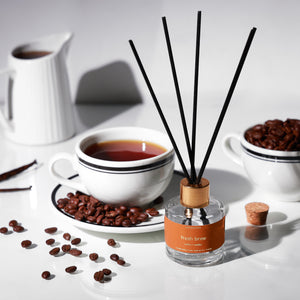
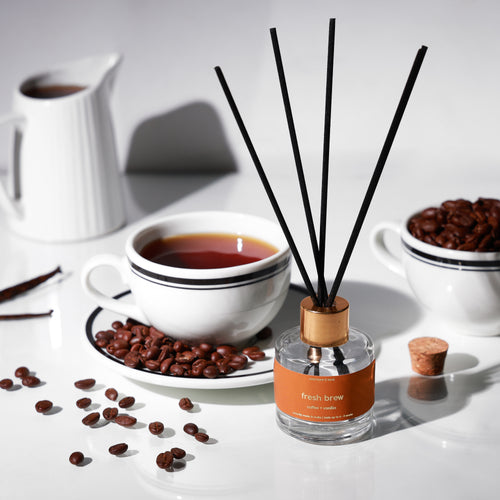
The count and the composition are not independent decisions, because strength lives in both. Our five reed fragrances sit between 8.9 and 9.5 on SOSA's own internal scale — a position measured at six reeds in an ordinary Indian room, not an industry standard, not a concentration and not a ranking of quality. Three reeds of Fresh Brew at 9.5 is still unmistakably a coffee-and-vanilla room; the character does not thin out just because the volume does. That is the single most useful thing to understand before you start adjusting reeds: the count sets how much, and the composition sets what.
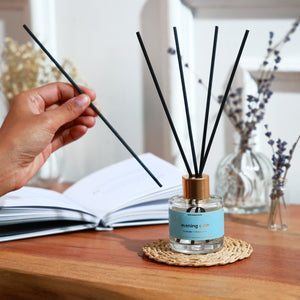
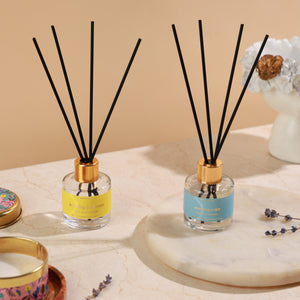
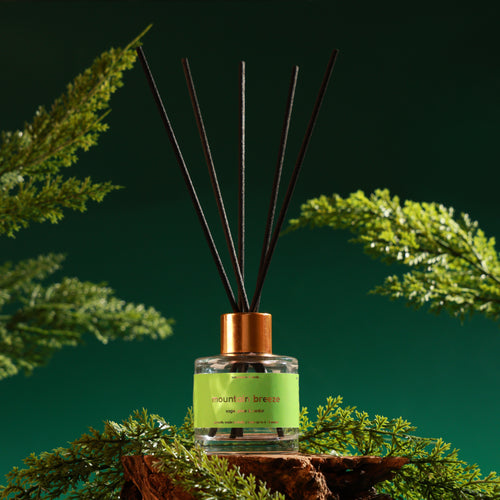
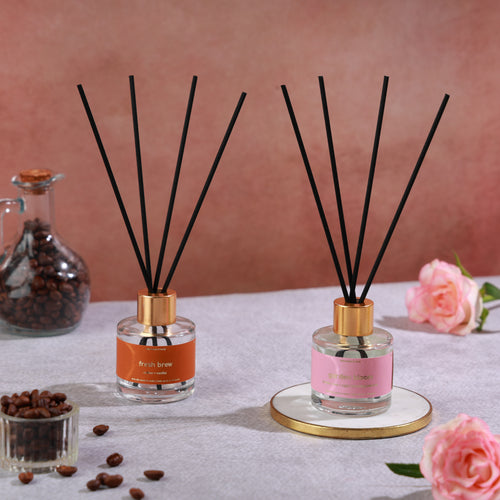
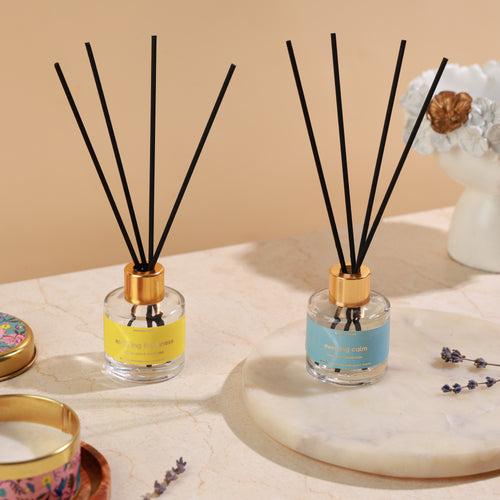
In practice I set them together. Fresh Brew at 9.5 and Mountain Breeze at 9.4, both ₹849, are the two I would run at six to eight reeds in living rooms, studies and libraries — Mountain Breeze when you want that presence with no sweetness anywhere in it. Morning Freshness at 9.0 and ₹749 measures lower but reads louder than its number in a humid room, because cold, sharp notes cut through where warm ones sit down; three reeds is usually enough in a bathroom. Garden Bloom and Evening Calm at 8.9 and ₹799 are the two soft ones — Bloom is soft and sociable, Calm is soft and quiet, and Calm is the one for nurseries and bedrooms at three or four reeds. I should also name what we do not make, because stretching the nearest product to cover a gap is how people end up disappointed: there is no oud, no musk-forward composition and no aquatic in the reed range.
One rule if you are running two bottles in one connected space, which is the correct answer for any open living-dining: the two compositions must share a note or you get a seam — a line in the middle of the room where one fragrance ends and another begins. Mountain Breeze and Morning Freshness meet on green eucalyptus, which is why they are sold together as the Fresh & Grounded duo at ₹1,548. Fresh Brew and Garden Bloom meet on warmth and a soft musk, which is the Warmth & Bloom duo at ₹1,598. Set each bottle to its own count — six at the busier end, four at the quieter one — and the room reads as one space rather than two.
Part six — the buying edit, and where reeds stop
Everything above as a purchase, by household rather than by room. Every row assumes you will set the counts yourself from the ladder in Part two, which is the only part of this guide you need to keep.
| If this is you | Buy | Set it to | Runs for | Price |
|---|---|---|---|---|
| First diffuser, ordinary bedroom ★ | Evening Calm 50ml | 6 reeds, then down to 4 if it is more than you want | 6–8 weeks | ₹799 |
| Nursery or a fragrance-sensitive home | Evening Calm 50ml, placed outside the room | 3 reeds | Beyond the stated window | ₹799 |
| Small bathroom | Morning Freshness 50ml | 3 reeds | Beyond the stated window | ₹749 |
| Living room you host in | Fresh Brew 130ml | 6 normally, 8–9 for a weekend, back to 6 | 14–18 weeks at six reeds | ₹1,349 |
| Whole 1BHK or 2BHK | Fresh & Grounded duo — two bottles, one shared note | 6 in the living space, 3–4 in the bedroom or bath | Two bottles on their own clocks | ₹1,548 |
| Open living-dining, two ends | Warmth & Bloom duo, one at each end | 6 and 6 | Two bottles, both 6–8 weeks | ₹1,598 |
| Running eight or ten reeds long term | 300ml oil refill — oil only, reuse your vessel | Refresh the reeds as you refill | Roughly 8–11 months at ordinary use | ₹2,399 |
| Past the ceiling, or you want it on demand | Sukoon — 270–320 sq ft, 16–18 hrs on low, remote and timers | Three 15ml Hotel Collection scents in the box | Water-based, a different product line | ₹1,899 |
| Not a count problem: a bigger bottle | 130ml at the same six reeds | Projects about the same as the 50ml | 14–18 weeks instead of 6–8 | From ₹1,249 |
Versailles
The reed count is the part of this product I have argued about most, internally and with customers. Six goes in the box because six is what each composition was balanced against — but a box cannot know whether it is going into a Mumbai studio bathroom or a double-height drawing room in Jaipur. So the number is a starting point I am confident about, and the rest of the decision is genuinely yours. That is the honest way to sell an object with no switch on it.
The reason I insist on publishing the cost alongside the gain is that this category has a long history of not doing so. Add reeds, get a louder room, discover in five weeks that the bottle is empty and feel quietly cheated. Nothing went wrong there except that nobody told you the exchange rate. It is roughly proportional, it applies in both directions, and once you know it you can spend it deliberately — nine reeds for Diwali week, six for the rest of the year, three in the nursery permanently.
Two things I would still like to fix. We do not sell reeds separately, which is absurd given that reeds are the consumable in this system and the oil is the stable part; until we do, keep your spares. And there is a ceiling to this format — roughly 250 to 300 square feet of connected space, and no scent on demand at all — which no count will lift. I would rather draw that line for you than sell you a third bottle for a hall that wanted a machine. Everything is composed and handmade in small batches in Pune, tested through 45°C heat and 85 per cent humidity, and a part of every order funds a girl's classroom through Nanhi Kali.
Frequently asked questions
- How many reeds should you put in a reed diffuser? — six as a dose rather than a default, in full.
- Too many reeds and too few — the failure modes at each end of the ladder.
- Does using more reeds make fragrance stronger? and do fewer reeds last longer? — surface area, and the long slow bedroom.
- Reeds for a mild room and reeds for a strong one — sensitive homes, and the ceiling.
- Reed count by room size and how many reeds with a SOSA bottle — the room table, and why fibre changes the number.
- Brand: the SOSA founder story.
SOSA reed diffuser range & prices (verified August 2026): alcohol-free, phthalate-free, paraben-free and IFRA-compliant compositions on a heat-stable coconut-derived (CCT) carrier, low-VOC, supplied in a refillable glass bottle with six fibre reeds; 50ml lasts 6–8 weeks and 130ml lasts 14–18 weeks. Morning Freshness (Malabar lemon · peppermint · Nilgiri eucalyptus) 50ml ₹749 · 130ml ₹1,249 · 9.0/10; Garden Bloom (British rose · night-blooming jasmine) 50ml ₹799 · 130ml ₹1,299 · 8.9/10; Evening Calm (Kashmir lavender · chamomile) 50ml ₹799 · 130ml ₹1,299 · 8.9/10; Fresh Brew (Coorg coffee · Kerala vanilla) 50ml ₹849 · 130ml ₹1,349 · 9.5/10; Mountain Breeze (Himalayan pine · sage · Indian cedar) 50ml ₹849 · 130ml ₹1,349 · 9.4/10. Reed diffuser refills are oil only — you reuse your own vessel and reeds: 300ml ₹2,399 (roughly 8–11 months) · 500ml ₹3,499 (roughly 14–18 months), about ₹7–8 per ml against ₹15–17 per ml for a 50ml bottle. Duo sets ₹1,498–₹1,598 for 2 × 50ml and ₹2,498–₹2,598 for 2 × 130ml. Strength figures are positions on SOSA’s own internal strength scale, not an industry standard. Replacement reeds are not sold as a separate SKU; SOSA guidance is to refresh reeds every few months. The reed line is separate from the water-based Hotel Collection for ultrasonic machines (15ml ₹299 · 100ml ₹999 · 300ml ₹1,799) and the two are not interchangeable. Diffusers: Boond 300ml ₹899 · Sukoon 500ml ₹1,899 · Megh 6L ₹3,499 · waterless Vaayu ₹11,999. Composed and handmade in small batches in Pune, India; tested through 45°C summer heat and 85% monsoon humidity. Free shipping above ₹499. A portion of every order supports girl-child education through Nanhi Kali. Prices subject to change — see the live product pages.