



The worst: a west- or south-facing windowsill. Direct sun both heats the oil and strips the reeds, so you lose weeks of bottle life and get a thinner room while you do.
The heat sources people miss: the top and sides of a fridge, a TV or set-top box, a router shelf, a laptop, an inverter, and the wall behind a geyser. Put a palm on the surface at four in the afternoon before you trust it.
What is not the answer: a bigger bottle. A 130ml lasts 14–18 weeks against 6–8, but at the same six reeds it projects the same. In heat, placement buys you far more than size.
2. Out of every patch of direct sun, at every hour. Not just where the sun is when you happen to be looking. Direct sunlight heats the oil and strips the reeds; it is the fastest way to lose weeks of a bottle you paid for.
3. Several feet from anything that radiates heat. The fridge, the TV and its set-top box, a router, a laptop dock, an inverter, the wall a geyser is fixed to, the back of a microwave. These run warm for hours and are rarely thought of as heat sources.
4. But still in moving air. Cool and stagnant is not a win. The right spot is a console or sideboard near a doorway or walkway at waist to chest height, where household traffic stirs the air a few times an hour. Cool and airless simply means you cannot smell it.
5. Not under the AC, and not in front of a fan. This catches people who have correctly worked out that they want a cooler spot. A direct draught strips the reeds, empties the bottle early and leaves the room smelling of very little — the opposite of what you were after.
6. On a tray, always. Reed oil marks wood and stone, and a warm surface makes a spill spread further and faster. Keep the bottle away from children and pets while you are at it.
Composed and handmade in small batches in Pune, and a portion of every order supports girl-child education through Nanhi Kali.
Part one — the three things that quietly make a surface hot
A room does not have one temperature. It has a warm side and a cool side, a wall that has been in the sun since noon and a wall that has not, a shelf beside a working appliance and a shelf beside nothing at all. In April and May those differences are large enough to change how long your bottle lasts. The skill is learning to read a room thermally rather than decoratively, because the prettiest surface in most Indian flats is the windowsill, and the windowsill is the worst place a reed diffuser can stand. Three things make a surface hot, and it is worth being able to name all three.
 Mountain Breeze₹849 · 9.4/10Put your palm flat on the top of your fridge at nine in the evening. Then on the TV console where the set-top box lives, then on the shelf holding the router, then beside the inverter. In most Indian flats at least two of those are noticeably warm for twelve or more hours a day — a far longer exposure than a two-hour patch of sun. A diffuser sitting on a permanently warm appliance is being run at an elevated rate around the clock. The fix is usually trivial: one shelf down, or eighteen inches along. Kitchens deserve a separate mention — the counter beside the hob is warm, greasy and directly in the path of cooking smells, and it is the single worst kitchen placement even though it is the most common.
Part two — the spot-by-spot summer audit
Every surface people actually use, ranked for hot weather, with the reason. The verdicts here are SOSA's working guidance from in-house testing and customer correspondence rather than laboratory measurement, and how badly a bad spot performs will depend on your floor, your aspect and how many hours of sun your building takes.
| Where the bottle stands | What happens to it in a hot week | What the room gets | Summer verdict |
|---|---|---|---|
| Interior-wall console near a doorway ★ | Stays close to the flat's average temperature all day | Steady output, distributed by ordinary foot traffic | Best in the house — cool and moving air together |
| Shelf in a north-facing room, away from the window | Coolest room in most flats through the hot months | Long, even plateau; often beats the stated bottle window | Excellent, if the room gets any traffic at all |
| Hallway or landing shelf, waist to chest height | Usually internal, usually shaded, always walked past | Reaches adjoining rooms as people move through | Very good — the underused spot in most homes |
| TV console, router shelf or beside an inverter | Warm for twelve hours a day, not two | Elevated rate around the clock; bottle short by weeks | Move it one shelf down or a foot and a half along |
| Top of or beside the fridge | Motor heat plus a warm cabinet side | Same as above, and kitchen odours join in | Avoid. Use an opposite counter or a shelf by the door |
| Directly under a split AC or in front of a fan | Cool, but the reeds are in a permanent draught | Stripped reeds, an early-empty bottle, a quiet room | The cool-spot trap. Keep several feet clear |
| West- or south-facing windowsill | Direct sun plus a hot pane behind the glass | Thin, top-heavy fragrance; four to five weeks, not eight | The worst spot there is, in any season and worse in May |
| The honest caveat: the coolest surface in a flat is often inside a cupboard, and that is not a placement — it is a hiding place. A reed diffuser in a closed cabinet, an alcove or behind a sofa cannot reach the room at all, and no amount of thermal virtue makes up for it. You are looking for the coolest spot among those that have air moving past them, not the coolest spot full stop. | |||
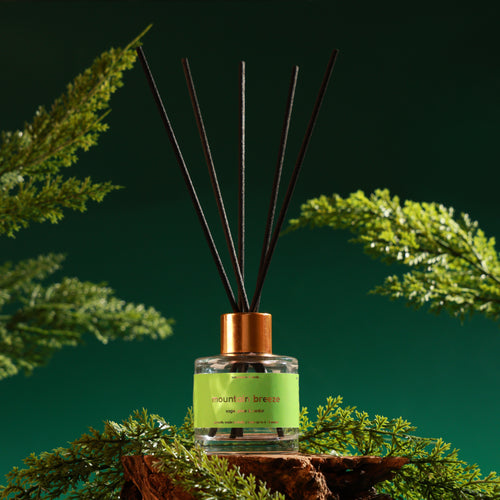 Mountain Breeze · 9.4/10from ₹849Shop → Evening Calm · 8.9/10from ₹799Shop →
 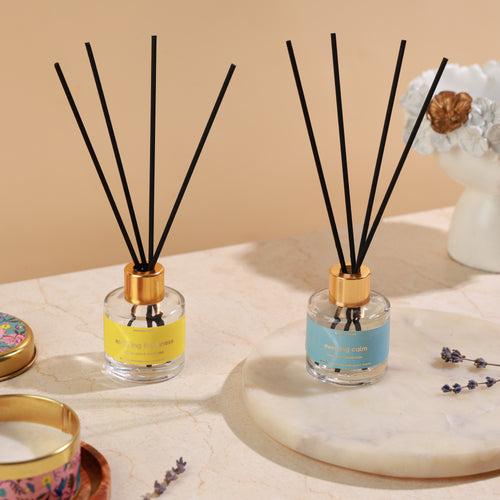 Day & Night duo₹1,498Shop →
Part three — the one-day audit you can run this week
Here is the whole method, and it takes about a minute of attention three times in a day. Pick the three or four plausible homes for the bottle: the console by the door, the sideboard, the open shelf, the dressing table. At ten in the morning, at two, and again at four, put your palm flat on each for a couple of seconds. You are not measuring anything — you are looking for the ones that are noticeably warmer, and for any that has moved into a patch of sun since you last looked. Nearly every home has at least one candidate that fails between two and four o'clock, and it is usually the one that looked best at breakfast. Then do the same at nine in the evening, when exterior walls and appliances are giving back what they took in.
Of the surfaces that pass, choose the one closest to a doorway or a walkway, at roughly waist to chest height, with clear space around the neck of the bottle. That last detail matters more than people expect: a bottle pushed to the back of a shelf behind photo frames is in still air even if the room is not. And leave several feet between the bottle and a split AC or a ceiling fan running at speed. The cool-spot trap is real — I have had customers move a diffuser directly beneath their AC on perfectly sound reasoning about temperature, only to find the reeds stripped and the room silent within a fortnight, because a constant draught takes the fragrance away from the room rather than through it.
One more thing worth saying plainly, because it is the reason this advice is not simply cosmetic. Heat does two different things to a fragrance: it raises the evaporation rate, which shortens the bottle, and in a poorly built formula it changes what the fragrance smells like. Many diffuser oils on the market use phthalate solvents that push scent hard off a reed and win the first week convincingly — and then degrade in sustained heat and turn faintly acrid by around week six. SOSA's reed range is phthalate-free on a heat-stable coconut-derived CCT carrier, tested through 45°C summer heat and 85% monsoon humidity, which buys a smaller opening and a longer, flatter plateau. Good placement protects the first problem; the base protects the second. You need both, and only one of them is something you can fix after you have bought the bottle.
Part four — the coolest useful surface in each room
Room by room, where I would put a bottle from roughly March through June — bearing in mind that the hot season starts and ends at very different times across the country, and this is general climate framing rather than a calendar. The reed counts are suggestions, not rules; six is the calibrated dose for every SOSA composition and dropping to four or five is a free, reversible way to slow a bottle down in heat.
| Room | The surface I would use in summer | The surface to give up | Reeds |
|---|---|---|---|
| Entryway ★ | Console against the internal wall beside the door | The shelf under a west-facing window or glass panel | Six |
| Living room | Sideboard on an interior wall in line with the main doorway | Coffee table in the sun path; the TV console | Six |
| Bedroom | Dressing table or shelf on the inner wall, away from the glass | Windowsill, and anywhere under the split AC | Four to five |
| Home office or study | An open shelf a metre or more from the desk | Beside the laptop, router or a warm monitor | Five to six |
| Kitchen | Shelf near the doorway, on the opposite side from the hob | The counter beside the hob; the top of the fridge | Six |
| Bathroom | A dry shelf away from the shower and the geyser wall | The window ledge, and any spot the geyser warms | Four to six by size |
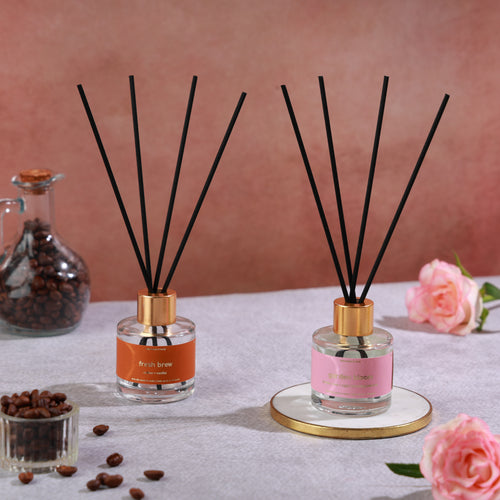
Versailles
When we were testing the range through a Pune summer, we ran identical bottles in the same flat on different surfaces — one on a west-facing sill, one on an interior hallway console, same six reeds, same day of filling. The gap between them was not subtle, and nothing about the fragrance was different. One had simply spent every afternoon being gently cooked. That test changed how I write our care card, and it is why placement comes before product on this page.
It also shaped the formula. A fragrance that is going to sit in an Indian room in May needs a carrier that does not sour under sustained heat, which is why we build on a coconut-derived CCT base and refuse phthalate solvents even though they would make our first week more impressive. The trade is honest and I would rather state it: a smaller opening, and a plateau that holds instead of turning.
If you do one thing after reading this, do the palm test at four in the afternoon. It takes a minute, it costs nothing, and in a hot month it is worth more than moving up our strength scale. Everything is composed and handmade in small batches in Pune, and a part of every order funds a girl's classroom through Nanhi Kali.
Frequently asked questions
- Does hot weather affect reed diffusers? — the two separate effects of heat, explained.
- Do reed diffusers evaporate faster in summer? — and how to plan the year around it.
- How Indian summer affects reed diffusers — why the base matters more than the notes at 45°C.
- The complete weather and climate guide — this page and the eight around it, in one place.
- Brand: the SOSA founder story.
SOSA reed diffuser range & prices (verified August 2026): alcohol-free, phthalate-free, paraben-free and IFRA-compliant compositions on a heat-stable coconut-derived (CCT) carrier, low-VOC, supplied in a refillable glass bottle with six fibre reeds; 50ml lasts 6–8 weeks and 130ml lasts 14–18 weeks. Morning Freshness (Malabar lemon · peppermint · Nilgiri eucalyptus) 50ml ₹749 · 130ml ₹1,249 · 9.0/10; Garden Bloom (British rose · night-blooming jasmine) 50ml ₹799 · 130ml ₹1,299 · 8.9/10; Evening Calm (Kashmir lavender · chamomile) 50ml ₹799 · 130ml ₹1,299 · 8.9/10; Fresh Brew (Coorg coffee · Kerala vanilla) 50ml ₹849 · 130ml ₹1,349 · 9.5/10; Mountain Breeze (Himalayan pine · sage · Indian cedar) 50ml ₹849 · 130ml ₹1,349 · 9.4/10. Reed diffuser refills are oil only — you reuse your own vessel and reeds: 300ml ₹2,399 (roughly 8–11 months) · 500ml ₹3,499 (roughly 14–18 months), about ₹7–8 per ml against ₹15–17 per ml for a 50ml bottle. Duo sets ₹1,498–₹1,598 for 2 × 50ml and ₹2,498–₹2,598 for 2 × 130ml. Strength figures are positions on SOSA’s own internal strength scale, not an industry standard. Replacement reeds are not sold as a separate SKU; SOSA guidance is to refresh reeds every few months. The reed line is separate from the water-based Hotel Collection for ultrasonic machines (15ml ₹299 · 100ml ₹999 · 300ml ₹1,799) and the two are not interchangeable. Diffusers: Boond 300ml ₹899 · Sukoon 500ml ₹1,899 · Megh 6L ₹3,499 · waterless Vaayu ₹11,999. Composed and handmade in small batches in Pune, India; tested through 45°C summer heat and 85% monsoon humidity. Free shipping above ₹499. A portion of every order supports girl-child education through Nanhi Kali. Prices subject to change — see the live product pages.