
Will a Diffuser Cover a Cooking Smell, Honestly?

Will a Diffuser Cover a Cooking Smell, Honestly?

★ Indian cooking, small flats and the smell that is still there at eleven · the order that actually worksCandle ₹379 · reed ₹749 · Boond ₹899 · Sukoon ₹1,899 · free shipping above ₹499A portion funds girl-child education
★ SOSA · find the cause, then scent the room
Extraction while you cook, ten minutes after, a door shut and the air changed — and only then anything with a scent in it
★ ★ ★ ★ ★
★★★★★
"Chimney on only while cooking was my mistake. Ten minutes afterwards was the whole difference, and it cost nothing."
Meghna K. Free fix · extraction
1BHK, Mumbai
★★★★★
"Fish for two days. Learned it was aerosol landing on fabric rather than air, washed what I could, and it went in an afternoon."
Joseph A. Fabric, not air
Kochi
★★★★★
"Asked straight out whether a diffuser would cover tadka. Was told no, and told why. I bought one anyway, for afterwards, and it is the right way round."
Preeti N. Honest answer
Told the truth
★★★★★
"Open kitchen, so containment was never going to work. Switched to a dry scent that sits somewhere completely different from food. That was the trick."
Rahul V. Forest Suite ₹299
Open kitchen
★★★★★
"Bedroom door shut during cooking. One sentence, free, and my clothes stopped smelling of dinner."
Shalini D. Free fix · shut the door
2BHK, Pune
★★★★★
"Sukoon on the 4H timer from six, not at eight when everyone arrives. The flat has already got there by then."
Imran H. Sukoon · 4H timer
₹1,899
★★★★★
"Chimney on only while cooking was my mistake. Ten minutes afterwards was the whole difference, and it cost nothing."
Meghna K. Free fix · extraction
1BHK, Mumbai
★★★★★
"Fish for two days. Learned it was aerosol landing on fabric rather than air, washed what I could, and it went in an afternoon."
Joseph A. Fabric, not air
Kochi
★★★★★
"Asked straight out whether a diffuser would cover tadka. Was told no, and told why. I bought one anyway, for afterwards, and it is the right way round."
Preeti N. Honest answer
Told the truth
★★★★★
"Open kitchen, so containment was never going to work. Switched to a dry scent that sits somewhere completely different from food. That was the trick."
Rahul V. Forest Suite ₹299
Open kitchen
★★★★★
"Bedroom door shut during cooking. One sentence, free, and my clothes stopped smelling of dinner."
Shalini D. Free fix · shut the door
2BHK, Pune
★★★★★
"Sukoon on the 4H timer from six, not at eight when everyone arrives. The flat has already got there by then."
Imran H. Sukoon · 4H timer
₹1,899
Find the source first · two windows for twenty minutes beats any product for a closed smell Fragrance is the finishing layer. It does not remove damp, a dry drain or a loaded sofa Sukoon ₹1,899 · 270–320 sq ft · 16–18 hours per fill · three 15ml scents included


Founder Diaries · Home Fragrance · Why Your Home Smells of Cooking
By Sonal Sahani · ISIPCA Versailles 10 min read Updated August 2026
No. A diffuser will not cover a cooking smell, and anybody selling you one on that basis is either mistaken or hoping you will not check. I would rather lose the sale than have you spend ₹1,899 on a machine to do a job it cannot do and then conclude that home fragrance is nonsense. What a diffuser does genuinely well is give already-clean air a consistent character, which is a real thing worth owning and a completely different proposition from covering dinner. This page explains why masking fails, what happens in a room when you try it, and the order that actually works.
Quick answers — read this first
The answer: no. A diffuser cannot cover a cooking smell.

Why not: masking requires the covering odour to be perceptibly stronger than the one it covers, for as long as that one lasts — which means running a fragrance at a level nobody wants to sit in.

And even then: the nose detects difference. It separates two strong odours rather than blending them into a third, so a masked room reads as something being hidden, which is a worse impression than dinner.

What works: cook, extract, ventilate ten to twenty minutes, then scent. A dry scent, not a warm one, in a flat that cooks daily.
The short answer
Short answer: no. Masking a cooking smell would require running a fragrance harder than the food, and the nose separates the two rather than combining them — so you get a room that smells of two strong things at once and reads as though something is being concealed.
What a diffuser is actually for: giving air that is already clean a consistent character. It does that beautifully. The order is cook, extract for ten minutes after the hob goes off, cross-ventilate for twenty with two openings, shut up the flat, and then run the machine — about twenty minutes from cold to a steady level.
Shop, afterwards: the Hotel Collection at ₹299 for 15ml, ₹999 for 100ml and ₹1,799 for 300ml at about ₹6 per millilitre, three to six drops per tank; the Sukoon at ₹1,899 with steady, 2H and 4H timers and three 15ml scents included. In a flat that cooks daily, choose a dry scent over a warm one. Free shipping above ₹499.
Straight answer
Will a diffuser cover the smell of cooking in my flat?
1. No. That is the honest answer and it is the same answer I give by email several times a week. A diffuser is not a masking device, it is not an air cleaner, and it removes nothing whatsoever from the air it is running in.

2. Masking is an intensity problem, and the intensity required is unpleasant. To cover one smell with another, the covering one has to be perceptibly stronger at the nose, for the whole time the first one lasts. Cooking at its peak is among the strongest smells a home produces. A machine misting at 30 to 50 millilitres an hour is not going to out-shout it, and if it could, you would not want to be in the room.

3. And the nose does not blend two smells into a third one. It is a difference detector. Given two distinct odours in the same air, it segregates them and reports both, particularly when they are arriving from different directions and sitting in different registers. So the result of masking is not concealment — it is a clear perception of two things, one of which is obviously deliberate.

4. Which is why a masked room gives a worse impression than an unmasked one. A guest who smells dinner thinks you cooked. A guest who smells dinner underneath a strong jasmine thinks something is being covered up, and that is a far less pleasant conclusion to have drawn about somebody's home.

5. So do it in sequence instead: cook, extract, ventilate ten to twenty minutes, then scent. On cleared air a diffuser is excellent and cheap to run — three drops on low for two hours rather than six on high all evening trying to win an argument.

A portion of every order supports girl-child education through Nanhi Kali.

TL;DR: no. Masking needs the covering scent to be stronger than the food for as long as the food lasts, and the nose separates two strong smells rather than blending them — so a masked room reads as concealment. Cook, extract, ventilate for ten to twenty minutes, and then scent clean air, which is what a diffuser is genuinely good at and much cheaper to run.
SOSA · the honest position
The answer this page has to give before it sells anything
SOSA · the honest position no
A diffuser will not cover a cooking smell, and nothing in this range is sold as though it could. Masking requires the covering odour to be perceptibly stronger than the one it covers, for as long as that one lasts — which means running a fragrance at a level nobody wants to sit in, and ending up with a room that smells of two strong things instead of one. SOSA does not make a room spray or a linen spray for the home either; the sprays in the range are car perfumes, and a spray is a thirty-minute product even where one exists. Extraction and twenty minutes of cross-draught do the removing. Fragrance does the character, afterwards.

Why masking fails, in two separate ways

It is worth being precise about why, because the idea is so intuitive that people assume it must work and conclude they simply bought the wrong scent. Masking fails for two independent reasons, and either one on its own would be sufficient. The first is about quantity: the level of fragrance required is a level nobody wants to live in. The second is about perception: even at that level, the nose does not produce the merged, single impression the whole idea depends on. Understanding both is what stops you buying a bigger machine next time.

1
REASON ONE
The arithmetic of intensity, which nobody wants to sit inside
Start with the quantity, because it is the easier of the two to feel. For one smell to cover another, it has to be perceptibly stronger at the nose than the smell it is covering, and it has to hold that advantage for the entire time the first smell is present. Consider what that actually asks for. Frying and tempering are among the most intense odour events that happen in a home; they are produced at high temperature, in quantity, by a process specifically good at putting aroma into air. On the other side is an ultrasonic diffuser releasing a cool mist at thirty to fifty millilitres an hour, carrying three to six drops of fragrance concentrate per tank. Those two things are not in the same weight class, and the gap is not one you close with a larger machine — you close it, if at all, by pushing the fragrance to a level that is genuinely uncomfortable. I have been in rooms where somebody tried, and the result is not a nice-smelling room. It is a room with a headache in it. Meanwhile the food smell has not gone anywhere: adding molecules to air is the opposite of removing them, so the air in that room now contains everything it contained before plus a great deal of something else. And the moment the machine stops, the dinner is still there, unchanged, because nothing about it was ever addressed. That is the arithmetic, and it is unforgiving before we even reach the interesting part.
2
REASON TWO
The nose segregates rather than blends, and segregation reads as concealment
Now the part people find genuinely surprising. The nose is a change-and-difference detector rather than a mixing bowl. Presented with two distinct odours in the same air, it does not average them into a third thing — it separates them and reports both, especially when they differ in character, arrive from different directions and rise and fall on different schedules. A perfumer spends years learning to build accords precisely because getting materials to fuse into one perceived impression is difficult and deliberate work, done at fixed ratios in a bottle. Two unrelated smells meeting by accident in a room, one of them oscillating as somebody opens a pan and the other arriving in pulses from a machine in the corner, will not fuse. They will be perceived as two. And here is the consequence that matters commercially, because it is the reason masking is not merely ineffective but actively counterproductive. When a person walks into a room and their nose reports dinner plus a strong deliberate fragrance, the inference is immediate and unflattering: something is being hidden. That impression is worse than the smell it was meant to solve. Nobody has ever walked into a home, smelled cooking, and thought badly of the household — cooking is what homes do. A great many people have walked into a home, smelled cooking underneath something floral and insistent, and quietly wondered what else was going on. The cover-up is a stronger signal than the thing covered.
The way I put it to customers who ask: you are not choosing between smelling of food and smelling of fragrance. You are choosing between smelling of food and smelling of food plus an attempt.
3
WHAT IT ACTUALLY DOES
Character on clean air, which is a real thing and worth buying
So here is the accurate description of the product, which is less dramatic and considerably more useful. A diffuser gives air that is already clean a consistent character. That is the whole of it, and it is genuinely valuable — a home with a steady, quiet, recognisable background smell feels looked after in a way that is difficult to achieve any other way, and it is what good hotels are actually doing. The condition is in the first sentence. Clean air. Air that has been extracted and exchanged, in a flat whose fabric is not carrying six months of dinners, with no damp and no dry drain trap contributing anything of their own. Under those conditions a scent at three to six drops per tank does exactly what you hoped for, at a level that is pleasant to sit in, using very little fragrance. Which means the correct sequence is not fragrance instead of ventilation. It is fragrance after ventilation, and the order is not a compromise — it is what makes the fragrance work at all. Cook with the extraction on and leave it running for ten minutes after the hob goes off; open two windows on opposite or adjacent walls for twenty minutes; shut the flat up; then start the machine, which takes about twenty minutes to reach a steady level. From the moment you sit down to the moment the room smells the way you wanted is about thirty-five minutes, most of which you spend eating. That is a method rather than a purchase, and the purchase only earns its place at the end of it.

What each product actually does about a cooking smell

Everything a person might reach for, with an honest column for what it removes. Only three things in this table remove anything, and all three are free. The rest add something, which is a legitimate thing to want at the right moment and a poor thing to want at the wrong one.

Removes, or adds
What each option genuinely does about a cooking smell, and when it belongs
Option Does it remove anything? What it actually does When it belongs Cost
Cross-ventilation ★ Yes — the airborne fraction, wholesale Replaces the air in the flat. Two openings on opposite or adjacent walls, twenty minutes First, and immediately after the hob goes off rather than at bedtime ₹0
Extraction, run before and after Yes — at source, before it reaches the flat Removes air, heat, moisture and grease aerosol through the duct, if the duct goes outside the building Throughout, plus ten minutes after the hob is off. The only thing acting during the release ₹0 to run
Laundry and degreasing Yes — the reservoir that keeps re-supplying the air Takes the deposit off curtains, covers, clothes and the film above the hob so it stops re-releasing Whenever a smell survives a proper airing, which is the usual case ₹0
Ultrasonic diffuser No Adds a consistent character to clean air, at 30–50 ml/h, reaching a steady level in about twenty minutes Last, once the air has been exchanged. Excellent there, useless before it ₹1,899 + ₹299
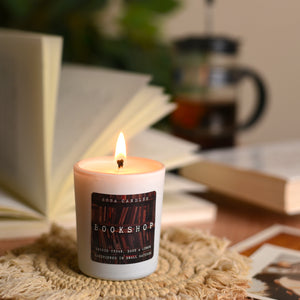
Scented candle No Puts scent into a normal room in fifteen to twenty minutes. A flame is not an air cleaner and I will not claim it is An evening already aired, when you want something immediate. Attended, and put out ₹379
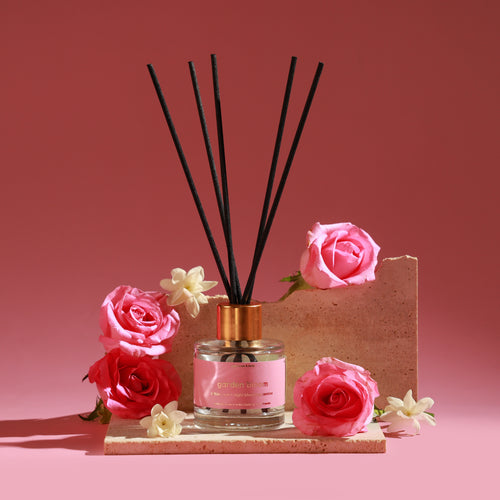
Reed diffuser No Holds one steady unplugged level for months, and needs 24–72 hours to reach it A hall or landing you want permanently characterful. Never for tonight from ₹749
Room or linen spray No Thirty minutes of covering, then nothing. SOSA does not make one for the home — the sprays in the range are car perfumes Not a solution to anything on this page, which is why it is not in the range
Shop this guide
For after the twenty minutes
The SOSA principle
Masking does not produce one smell. It produces two, and the second one tells everybody you were worried about the first.
The nose separates rather than blends. Which is why a room that smells of dinner is fine, and a room that smells of dinner underneath jasmine is not.

The order that works, and why it is also cheaper

Take the sequence first, with times attached, because the whole argument of this page collapses into one schedule. Extraction on before the pan is hot and left running for ten minutes after the hob goes off. Two openings on opposite or adjacent walls for twenty minutes, starting immediately. Windows shut. Machine on, three to six drops per tank, about twenty minutes to a steady level. Eat during the twenty minutes of airing rather than waiting for it to finish, and the whole method costs you no time at all — the flat is doing the work while you are at the table. If the smell survives that sequence, the problem is not in the air and no adjustment to the machine will touch it: it is in the fabric, in the film above the hob or in the clothes you cooked in, and the page on how long cooking smells actually last explains why that reservoir keeps refilling the air you just cleared. Two free additions that make a visible difference: shut the bedroom and wardrobe doors before you start rather than after, and take the clothes airer out of the room you are cooking in. Both are about keeping the absorbent things out of the release, and both are worth more than any product decision on this page.

Then the cost argument, which is the one that convinces people who were not going to be convinced by physics. A fragrance run against food is consumed at a rate that makes no sense. Six drops per tank on the high setting, from seven o'clock until the room finally seems acceptable at eleven, is four hours at nine to twelve hours per fill — you are refilling constantly, dosing at the top of the range, and at the end of it the room still smells of dinner because none of it was ever removed. Three drops on low for two hours into cleared air, on the 2H timer, is a fraction of the fragrance and a better result. Across a month of daily cooking that is the difference between a 15ml bottle at ₹299 lasting a few days and lasting several weeks, which is the sort of arithmetic that changes behaviour faster than any explanation of olfactory perception. The Sukoon at ₹1,899 gives 16–18 hours per fill on low at 30–50 ml/h against 9–12 on high, with a 2.4MHz cool-mist plate, a remote, auto shut-off, a BPA-free tank and steady, 2H and 4H timers, and three 15ml Hotel Collection scents of your choice included; buy it for the timers rather than for the coverage figure, because the timer is what enforces the sequence when you have stopped thinking about it. A Boond at ₹899 runs the same bottles at the same three to six drops per tank in a second room, since the dose is per tank rather than per litre.

Then the choice of scent, and the constraints. In a flat that cooks daily, choose a dry scent over a warm one, and the reason is register rather than strength. Residual food odour sits in a warm, fatty, roasted part of the perceptual space; a warm fragrance — amber, resin, creamy sandalwood — lands in the same neighbourhood and the two run together into something heavier than either. A dry composition built on cedar, vetiver and green leaf sits somewhere the food is not, so any trace still hanging about stays distinguishable rather than merging. That is the argument in the open-kitchen page in this group, and it applies in any flat where cooking happens most days. It also helps that nothing in the Hotel Collection is sweet and that black pepper is its only spice material — no cinnamon, clove, cardamom or saffron in the seven or in the alcohol-free reed line. On the constraints, plainly: the Hotel Collection is water-based and runs in the Sukoon, the Boond and the Megh only. It will not climb the sticks of a reed diffuser, which is a separate alcohol-free line, and it does not go into the waterless Vaayu at ₹11,999. Never substitute raw essential or carrier oils, which clog the 2.4MHz plate; rinse the tank when you change scent; a cool-mist machine adds 30–50 ml of water an hour, so it is the wrong device for a room you are drying out; and SOSA does not make a room or linen spray for the home. Expect to stop perceiving your own flat within a fortnight, and ask one honest guest rather than adding drops.

Nobody has ever walked into a home, smelled cooking, and thought less of the household. Plenty of people have walked in, smelled cooking under jasmine, and wondered what was being hidden.
— Sonal Sahani, SOSA

The SOSA edit

In the only order that works, which puts three free steps ahead of anything with a price on it. The last row is the product people go looking for when they want masking, and it is not in the range — for the reasons this whole page has been about.

The SOSA edit
Cooking smell and fragrance, in the correct order
Step What it is Why it is in this position Cost
1. Extract, then ventilate ★ Hood before and ten minutes after; two openings on opposite walls for twenty minutes, immediately These are the only steps that remove anything. Everything below adds, and adding to a loaded room gives you two smells ₹0
2. Deal with the reservoir Covers, throws and the clothes you cooked in through the wash; the film above the hob degreased monthly If the smell survives a proper airing it is not in the air, and no fragrance decision will reach it ₹0
3. Doors shut, airer moved Bedroom and wardrobe doors closed before you start; the clothes airer taken out of the room you cook in Keeps the most absorbent objects in the flat out of the release, which is cheaper than washing them afterwards ₹0
4. Sukoon on the 2H timer 500ml, 270–320 sq ft, 16–18 hours on low, steady/2H/4H timers, three 15ml scents included, twenty minutes to a steady level Started after the windows are shut. The timer is what enforces the sequence once you stop thinking about it ₹1,899
5. A dry scent rather than a warm one The 1 Hotels-inspired Forest Suite or the Ritz-Carlton-inspired Quiet Luxury, three to six drops per tank Dry materials sit in a different register from food, so any trace left stays separate instead of merging ₹299
Not in the range: a room or linen spray The sprays SOSA makes are car perfumes, formulated and sized for a car Stated rather than implied. A spray is a thirty-minute cover even where one exists, and covering is the thing this page has argued against
Honest notes for buyers: fragrance is the last step, never the first. It layers on air that is already clean and moving, and it will not remove a source — not damp, not a dry drain trap, not a loaded sofa, not a filter that needs washing. Deal with the cause, change the air, then scent the room. On timing: a candle puts scent into a room in fifteen to twenty minutes and a Sukoon reaches a steady level in about twenty, while a reed diffuser needs a day to three days before it is doing its job — the wrong buy for a deadline and the right buy for a room you want to hold one level for months. SOSA does not make a room or linen spray for the home; the sprays in the range are car perfumes. A cool-mist ultrasonic adds 30–50 ml of water an hour to the air, so it is the wrong machine for a room you are trying to dry out. The Hotel Collection is water-based and runs in the Sukoon, Boond and Megh only — not in reeds and not in the waterless Vaayu. Reed diffusers are a separate alcohol-free line with their own scents. Candles must be attended and put out. The Hotel Collection scents are SOSA's own interpretations inspired by the world's finest hotels; SOSA is an independent Indian fragrance house, not affiliated with or endorsed by any hotel brand. A portion of every order supports girl-child education through Nanhi Kali.
SOSA Sukoon
What the machine is genuinely for
SOSA Sukoon ₹1,899
A 500ml BPA-free tank for 270–320 sq ft, 16–18 hours on low at 30–50 ml/h against 9–12 on high, a 2.4MHz cool-mist plate, a remote, auto shut-off, steady, 2H and 4H timers and three 15ml Hotel Collection scents of your choice included. Its job is to give clean air a consistent character, which is a different job from removing something — and it is much cheaper done that way, because a scent run at six drops on high against dinner empties a 15ml bottle in days, while three drops on low into cleared air runs for weeks. Twenty minutes from cold to a steady level, and the 2H timer stops it without you.
SS
ISIPCA
Versailles
A note from Sonal

This is the email I answer most often, and the answer has never changed. No, it will not cover the cooking, and I would rather tell you that and lose the order than take ₹1,899 for a machine that is about to disappoint you in a way you will blame on the whole category. I have watched people try it properly, with good products, at high output, and the result is never a room that smells of one thing. It is a room that smells of two things and of somebody's anxiety about the first one.

What I will say for the machine is the thing that is actually true of it, which is smaller and more reliable. Put a scent into air that has already been cleared and it will give your home a character, hold it steadily, and cost you very little to run — three drops on low for two hours instead of six on high for four spent losing an argument. That is worth having and it is what I make. But it sits at the end of a sequence that begins with a fan and two windows, both of which are free, and any brand that tells you otherwise is asking you to buy the wrong thing at the wrong point in the evening.

Everything is made and supported from Pune, and a part of every order funds girl-child education through Nanhi Kali. You get a home that smells like somewhere you chose; a girl gets a classroom. That equation has always felt right to me.

Frequently asked questions

Will a diffuser cover a cooking smell?
No. Masking requires the covering odour to be perceptibly stronger than the one it covers for as long as that one lasts, which means a fragrance level nobody wants to sit in — and even then the nose separates two odours rather than blending them, so the room reads as though something is being hidden.
Why does a masked room smell worse than an unmasked one?
Because of what the impression communicates. A guest who smells cooking concludes that you cooked. A guest who smells cooking underneath a strong fragrance concludes that something is being covered up, which is a far less pleasant thing to have thought about somebody's home.
When should I switch the diffuser on, then?
After the extraction has run for ten minutes past the hob going off and the flat has had twenty minutes of cross-ventilation with two openings. Shut the windows, then start the machine — it takes about twenty minutes from cold to reach a steady level.
Does a scented candle work better than a diffuser against cooking smells?
Not against them, no. A candle reaches a room faster — fifteen to twenty minutes — which makes it good for an evening already aired, but a flame does not remove a cooking smell and I would not describe it as an air cleaner. Ventilation is what removes; both of these add.
Which scent should I use in a flat where I cook every day?
A dry one rather than a warm one. Cedar, vetiver and green leaf sit in a different register from the warm, fatty, roasted character of food, so any residual trace stays distinguishable instead of merging into something heavier. The 1 Hotels-inspired Forest Suite at ₹299 is the clearest example in the range.
The honest answer, and the useful one
It will not cover dinnerit will give clean air a character, which is better
Cook, extract, ventilate for twenty minutes, then scent. The Hotel Collection is ₹299 for 15ml, ₹999 for 100ml and ₹1,799 for 300ml at about ₹6 per millilitre, at three to six drops per tank. The Sukoon is ₹1,899 for 270–320 sq ft with steady, 2H and 4H timers, 16–18 hours per fill on low and three 15ml scents of your choice included; the Boond is ₹899. SOSA does not make a room or linen spray for the home. Free shipping above ₹499, and a portion of every order supports girl-child education through Nanhi Kali.
See the Sukoon · ₹1,899 See the seven scents · ₹299
Continue the read
More from SOSA
Editorial standards & sources
About this guide: Written by Sonal Sahani, ISIPCA Versailles-trained founder and perfumer at SOSA Home & Body, on why a diffuser cannot cover a cooking smell — the intensity a genuine mask would require, and the fact that the nose segregates two distinct odours rather than blending them, so a masked room reads as concealment — what a diffuser genuinely does instead, the sequence of extraction, ventilation and then scent, and why running a fragrance against food is also the most expensive way to use it.

Facts verified August 2026: Diagnostic facts used in this guide: a closed room accumulates what it cannot exchange, so cross-ventilation needs two openings rather than one; a drain's U-bend water seal evaporates in roughly two to four weeks of disuse and then admits sewer gas, which is corrected by pouring water down the drain; microbial growth in fabric and on surfaces accelerates above about 60% relative humidity, and Indian monsoon indoor humidity commonly runs 80–95%, which is the one situation where ventilating on a wet day can import moisture rather than remove it; an air-conditioner's cold, wet evaporator coil and filter grow biofilm that is blown into the room on start-up; textiles adsorb cooking aerosol and body oils and re-release them for weeks; and olfactory adaptation makes a constant household smell undetectable to its residents within about a fortnight while visitors still perceive it. Timings: a scented candle scents a normal room in roughly 15–20 minutes, a Sukoon ultrasonic diffuser reaches a steady level in about 20 minutes from cold, and a reed diffuser needs roughly 24–72 hours. SOSA products and prices: Sukoon 500ml ₹1,899 (270–320 sq ft, 16–18h on low, 9–12h high, 30–50 ml/h, 2.4MHz cool mist, remote, steady/2H/4H timers, BPA-free, auto shut-off, includes three 15ml Hotel Collection scents of your choice); Boond 300ml ₹899; Megh 6-litre ₹3,499; waterless Vaayu ₹11,999 (up to 1000m³); Aangan ₹25,999. Hotel Collection water-based fragrance 15ml ₹299, 100ml ₹999, 300ml ₹1,799, Pack of 7 at 15ml ₹1,799; dose 3–6 drops per tank. Reed diffusers (separate alcohol-free line): Morning Freshness from ₹749, Garden Bloom and Evening Calm from ₹799, Fresh Brew and Mountain Breeze from ₹849; 130ml from ₹1,249; duos from ₹1,498; 300ml refills ₹2,399. Scented candles: Bookshop 80g ₹379, Amber Rose 130g ₹599 and 220g ₹799, Smoked Oudh 130g ₹449, ceramic jar candles ₹949, Pure Calm wax melt set ₹854. Free shipping above ₹499. SOSA does not make a room or linen spray for the home. The Hotel Collection scents are SOSA's own interpretations; SOSA is not affiliated with or endorsed by any hotel brand. Prices subject to change — see the live product pages.
Back to blog