




Why the difference is real: standing, you breathe well-mixed room air. Seated, your nose is within a foot of large soft surfaces that are slowly releasing what they have adsorbed, and concentration falls off steeply with distance from a releasing surface.
The correction: heavier odour molecules do not sink to the floor in a normal room. Convection and diffusion mix a room's air far faster than gravity could sort it. This is proximity, not gravity.
What to do: walk the room low. Put your nose within a foot of each soft surface in turn. It costs nothing and it beats every product on this site.
2. Which means the smell has a location, and that is genuinely good news. A smell with no position is a building problem, a ventilation problem or a damp problem, and those are slow. A smell that appears when you sit is furniture, and furniture can be washed.
3. It is proximity rather than gravity, whatever you have read. Heavier odour molecules do not settle to the floor in a normal room — air is mixed by convection and diffusion far faster than gravitational sorting could ever manage. What you are smelling is a source that happens to be low, not a smell that has sunk.
4. So walk the room low before you buy anything. Nose within a foot of the seat cushions, the crease between seat and back, the rug, the floor beside the sofa, the underside of the coffee table. One of those will be noticeably heavier than the others. That is your answer, and it cost ₹0.
5. Then wash what is washable, exchange the air properly with two openings for twenty minutes, and only then think about fragrance. A scent added on top of a loaded sofa gives you two smells, and the one with six months behind it is not the one you chose.
A portion of every order supports girl-child education through Nanhi Kali.

What your nose is actually sampling at each height
The reason this observation gets dismissed is that people describe it as a feeling and it is not a feeling — it is a measurement, taken twice, in two different places. Your nose is a sampling instrument with a very small catchment. It reports what is in the few litres of air immediately in front of your face, and nothing else. Move it a metre and you have taken a different sample. Most household smell investigation goes wrong because people take one sample, standing, in the middle of the room, and then reason about the whole flat from it.
The survey, position by position
This is the walk I would do in your living room, in the order I would do it, with what a strong reading in each position actually means. Take the samples in this sequence rather than at random, because you want the least contaminated positions early and the obvious suspects late. Every row costs ₹0 and no SOSA product appears in the table, because none belongs in it.
| Position | How close | What a strong reading there means | What to do about it | Cost |
|---|---|---|---|---|
| Seat cushions and the crease behind them ★ | A hand's breadth, then a foot | The upholstery is the reservoir. This is the commonest result by a distance in a flat with a kitchen that breathes into the sitting room | Covers off and into the machine; upholstery head over the deck; pads outdoors for two hours a side | ₹0 |
| The rug or carpet, palm down first | Kneel, nose at the pile | A large, still, textile-covered surface holding whatever has been walked in, dropped or spilled — and in monsoon, holding moisture as well | Beat it outdoors, vacuum both faces, and give it a dry sunny morning. In July, dry it before anything else | ₹0 |
| The floor beside and behind the sofa | Nose at ankle height | Not the fabric at all. Something is under or behind the furniture — a spill, a pet bowl, a forgotten plate, or a floor drain in an adjacent room whose trap has dried out | Move the sofa out and look. Then a mug of water down every floor drain and unused basin in the flat | ₹0 |
| The underside of the coffee table and low shelving | Nose to the surface | Deposited film. Low horizontal surfaces near where people eat collect an oily layer that a dry cloth never removes | A degreasing wipe on the undersides and edges, not only the tops | ₹0 |
| The curtain hem and the bottom foot of the curtain | Nose to the fabric | Curtains, which are dealt with separately because they load from the window rather than from the room | Down and into the machine at the care-label temperature — see the curtain page before you wash a lined pair | ₹0 |
| Standing air, middle of the room, eyes shut | Arm's length from nothing | If this is the strongest reading of the six, it is not a soft-furnishing problem. Look at exchange, at humidity and at the AC instead | Two openings on opposite walls for twenty minutes, and the closed-room diagnosis next | ₹0 |
Sukoon · waist height or above₹1,899Shop → 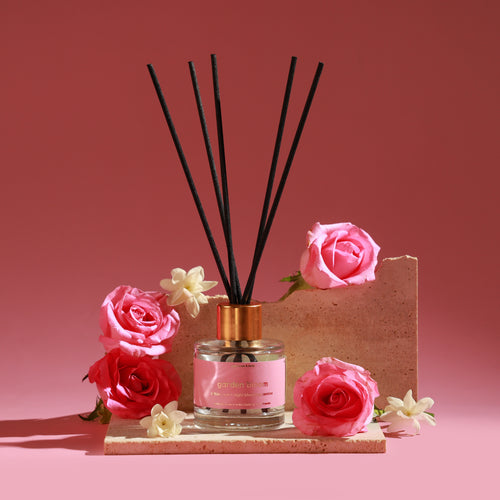 Reeds · on a console, not a low tablefrom ₹749Shop →
  Scents · four drops₹299Shop →
How to run it honestly, and what to do with the answer
Start with how to take the samples, because a badly run survey gives confident wrong answers. Do it with a cold nose. Come in from outside, or at least out of the room, and give yourself two or three minutes of different air first, because olfactory receptors adapt within minutes and a nose that has been sitting in the room for an hour has already discounted everything in it. Do it before you cook rather than after, and not while anything scented is running — switch off a diffuser and open a window for twenty minutes first, or you are measuring your own fragrance. Take one deliberate breath in each position rather than half a dozen quick ones; repeated sniffing at the same spot adapts you to that spot specifically and the reading fades under you. And move between positions steadily rather than lingering, since the comparison is the whole point and the comparison degrades the longer you take. If you can, get a second nose. A guest who has just walked in from outside receives the room at full strength, and asking them to do the same walk low is the single most reliable version of this test. They have no habituation to your flat and no investment in the answer. It is also worth doing the survey in the morning and again at nine in the evening, because the time axis frequently separates two candidates that look identical at four in the afternoon.
Then what to do with each result, and the useful thing about this diagnosis is that every answer it can produce has a free response. If the sofa reads strongest, the covers come off and go into the machine at the warmest temperature the care label allows, the frame gets the upholstery head and the crevice tool, and the loose pads go outdoors for two hours a side. If the rug reads strongest, it goes out to be beaten and then vacuumed on both faces, and in a monsoon month it needs drying before it needs anything else. If the floor beside the furniture reads strongest, move the furniture and look underneath, and while you are at it pour a mug of water down every floor drain, basin and unused shower in the flat — a U-bend seal evaporates in two to four weeks of disuse and then the drain vents into the room, which is the commonest cause of a low, sharp smell nobody can place. If the standing reading is the strongest of the six, the problem is exchange rather than fabric: two openings on opposite or adjacent walls for twenty minutes, since one window is ventilation and two is exchange, and the difference between them is not marginal. In every case, do the free thing and then repeat the survey a week later. A survey that reads differently afterwards has told you that you fixed the right thing, and that is worth more than any reassurance I could offer.
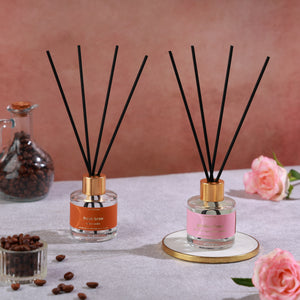
Then fragrance, which is the last step and never the first, and this page has one placement instruction that follows directly from its physics. A diffuser at floor level is scenting a rug. Cool mist falls rather than rises, the air near the floor is the least-mixed air in the room, and a machine standing on the ground releases into exactly the stagnant band this page has spent two thousand words asking you to investigate — so it deposits onto the rug and the bottom of the sofa, and the room above never receives the level you are paying for. Waist height or above, at the edge of the room rather than in a doorway, out of the direct path of a fan or an air-conditioning vent, and away from soft furnishings you cannot wash. The same applies to a reed diffuser from ₹749 in the alcohol-free line: it releases from the tops of the sticks, it needs 24 to 72 hours before it is doing its job, and it belongs on a console rather than on a low table beside the sofa. If you would rather have control of the hour, the Sukoon at ₹1,899 covers 270–320 sq ft, runs 16–18 hours per fill on low at 30–50 ml/h against 9–12 on high, has steady, 2H and 4H timers, a remote and auto shut-off, and arrives with three 15ml Hotel Collection scents of your choice; the Boond at ₹899 is the same idea at 300ml and the Megh at ₹3,499 is for a genuinely open-plan flat. Four drops in a living room, three in a small one, and the dose is per tank rather than per litre since you are scenting the mist and not the water. Two constraints: the Hotel Collection is water-based and runs in the Sukoon, Boond and Megh only, never in a reed and never in the waterless Vaayu at ₹11,999; and SOSA does not make a room or linen spray for the home, so there is nothing here to spray at the seated-height problem even if you wanted one. Finally, expect to stop smelling your own living room within about a fortnight, because a nose reports change and discards constants. The instinct that produces is to add drops. The correct response is to do the walk again, low, with a cold nose.
The SOSA edit
In order, and the order is the whole recommendation. The survey comes first because it decides which of the rows below you actually need, and four of the six cost nothing. The last row states plainly what SOSA does not make, since a page about a smell you can locate is a page where people expect to be sold something to spray at it.
| Step | What it is | Why it comes here in the order | Cost |
|---|---|---|---|
| 1. The survey, low to high ★ | Cold nose, one breath per position: cushions, crease, rug, floor beside the sofa, low table undersides, standing air | First, always. It costs ten minutes and it decides whether this is a fabric problem or a ventilation one | ₹0 |
| 2. Whatever the survey named | Covers into the machine, rug beaten and vacuumed both faces, furniture moved and looked under, pads given two hours of sun | Second. You are treating the one thing that read strongest rather than the whole room, which is why the survey came first | ₹0 |
| 3. Twenty minutes of real exchange, and a mug of water down every drain | Two openings on opposite or adjacent walls, not one window ajar; then the floor drains, basins and any unused shower | Third. It clears what you have disturbed, and the drain seal is the cheapest fix for a low smell nobody can place | ₹0 |
| 4. The survey again, a week later | The same six positions, same time of day, cold nose | Fourth, and almost nobody does it. It is how you learn whether you fixed the thing or merely tidied around it | ₹0 |
| 5. A reed diffuser or the Sukoon | Alcohol-free reeds from ₹749 holding one level for months, or a 500ml ultrasonic with steady/2H/4H timers and three 15ml scents included | Fifth. On a console or a sideboard, never on the floor, for the reason this entire page is about | from ₹749 / ₹1,899 |
| Not in the range: anything to spray at the seat | SOSA makes no room or linen spray for the home. The sprays in the range are car perfumes, formulated for about three cubic metres of moving air | Printed rather than implied, on the page where the reader has just located a smell and wants to attack it directly | — |
Versailles
I have been doing this walk in other people's flats for years and I still find it slightly comic that it works as well as it does. Somebody has spent six months convinced their building is damp, or that the neighbours cook something unusual, and the answer takes ninety seconds on their knees beside their own sofa. The reason it feels like a trick is that we are all trained to think of a room's smell as a property of the room, one number, evenly spread. It is not. It is a field with hills in it, and you find hills by walking rather than by standing still and thinking harder.
The part I insist on getting right is the physics, because the wrong explanation is everywhere and it sends people to the mop. Smells do not sink. Air mixes far too quickly for that, and anybody who tells you otherwise is repeating something they have not checked. What is true is duller and more useful: concentration is highest next to whatever is releasing, and at seated height you are next to several square metres of the most absorbent material in the room. Which also settles where the diffuser goes, since a machine on the floor is releasing into the same still band and its mist falls rather than rises. Waist height or above. That single sentence has saved more disappointed customers than anything else I say.
Everything is made and supported from Pune, and a part of every order funds girl-child education through Nanhi Kali. You get a home that smells like somewhere you chose; a girl gets a classroom. That equation has always felt right to me.
Frequently asked questions
- Why your sofa makes the whole living room smell closed — what the survey usually finds, in detail.
- Can fabric hold a smell for longer than the air does? — the reason a low reading persists after you have aired the room.
- My house smells and I cannot find the source — the same three axes applied to the whole flat.
- Why soft furnishings are the real reason your home smells — the pillar guide for this group.
- Brand: the SOSA founder story.
Facts verified August 2026: Diagnostic facts used in this guide: a closed room accumulates what it cannot exchange, so cross-ventilation needs two openings rather than one; a drain's U-bend water seal evaporates in roughly two to four weeks of disuse and then admits sewer gas, which is corrected by pouring water down the drain; microbial growth in fabric and on surfaces accelerates above about 60% relative humidity, and Indian monsoon indoor humidity commonly runs 80–95%, which is the one situation where ventilating on a wet day can import moisture rather than remove it; an air-conditioner's cold, wet evaporator coil and filter grow biofilm that is blown into the room on start-up; textiles adsorb cooking aerosol and body oils and re-release them for weeks; and olfactory adaptation makes a constant household smell undetectable to its residents within about a fortnight while visitors still perceive it. Timings: a scented candle scents a normal room in roughly 15–20 minutes, a Sukoon ultrasonic diffuser reaches a steady level in about 20 minutes from cold, and a reed diffuser needs roughly 24–72 hours. SOSA products and prices: Sukoon 500ml ₹1,899 (270–320 sq ft, 16–18h on low, 9–12h high, 30–50 ml/h, 2.4MHz cool mist, remote, steady/2H/4H timers, BPA-free, auto shut-off, includes three 15ml Hotel Collection scents of your choice); Boond 300ml ₹899; Megh 6-litre ₹3,499; waterless Vaayu ₹11,999 (up to 1000m³); Aangan ₹25,999. Hotel Collection water-based fragrance 15ml ₹299, 100ml ₹999, 300ml ₹1,799, Pack of 7 at 15ml ₹1,799; dose 3–6 drops per tank. Reed diffusers (separate alcohol-free line): Morning Freshness from ₹749, Garden Bloom and Evening Calm from ₹799, Fresh Brew and Mountain Breeze from ₹849; 130ml from ₹1,249; duos from ₹1,498; 300ml refills ₹2,399. Scented candles: Bookshop 80g ₹379, Amber Rose 130g ₹599 and 220g ₹799, Smoked Oudh 130g ₹449, ceramic jar candles ₹949, Pure Calm wax melt set ₹854. Free shipping above ₹499. SOSA does not make a room or linen spray for the home. The Hotel Collection scents are SOSA's own interpretations; SOSA is not affiliated with or endorsed by any hotel brand. Prices subject to change — see the live product pages.