
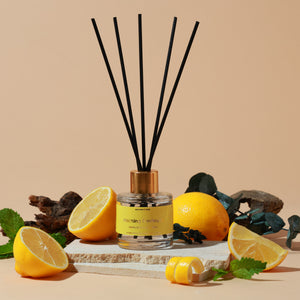

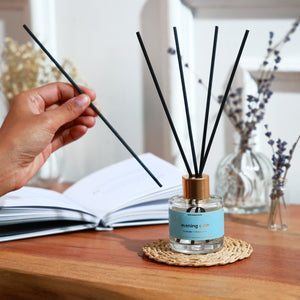
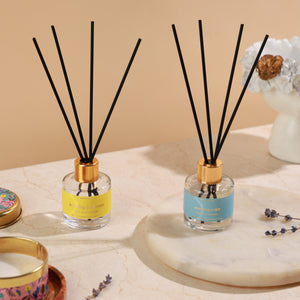

How it works: capillary action draws the oil up the fibre, and it evaporates off the exposed length into the air. It runs continuously and cannot be switched on or off.
What it asks of the recipient: stand it on a tray on a flat surface, out of direct sun and away from an AC vent, and turn the six reeds over once a week. That is all. Skipping a flip does not break it.
What to give: Garden Bloom ₹799 blind, Morning Freshness ₹749 for a kitchen-and-bathroom home, Evening Calm ₹799 for a small flat, the Day & Night duo ₹1,498 for two rooms.
2. The oil moves by itself. Capillary action pulls the oil up through the fibre, in the same way water climbs a paper towel, and it evaporates off the length of reed standing above the neck of the bottle. Nothing pushes it and nothing heats it. This is why it is quieter than a spray and steadier than a candle.
3. It cannot be switched on, which is the point. There is no on and no off. It works from the evening it is unwrapped until the oil is gone — 6–8 weeks for a 50ml bottle, 14–18 weeks for a 130ml — with no decision required from anyone in the house.
4. The upkeep is one action a week. Lift the six reeds out, turn them over, put them back — gloves are worth using, and the bottle should stand on a tray because the oil marks wood and stone. Skipping a week does not damage anything; the room simply gets quieter than it could be.
5. Passive is the whole argument in a house full of boxes. A flat in its first month has half its plug points behind cartons, nobody with the patience to build a new habit, and often a child or a cat wandering through rooms that have not been childproofed yet. A gift with no flame and no socket removes every one of those questions.
6. It is a consumable, and that is a feature. A gift with a stated end leaves nothing to store and no obligation to display. In a small flat where every permanent object has to be found a place, a bottle that finishes is a kindness rather than a compromise.
7. Be honest about the limits. A reed diffuser adds fragrance to a room. It does not clean air, remove odours or take away the paint smell in a new flat — that is ventilation and time. It is a low, constant background rather than a burst of scent on demand, and it will not fill a large open-plan space on its own.
Everything is composed and handmade in small batches in Pune, and a portion of every order supports girl-child education through Nanhi Kali.
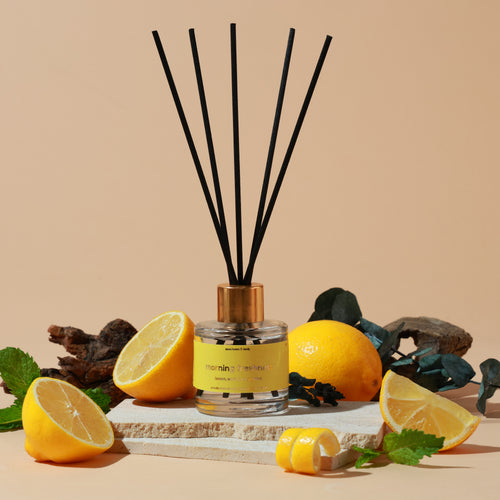
Part one — what it is, and what is actually happening in the bottle
I write this section for people who have never owned one, because I get the question often enough to know it is not obvious from a product photograph. The short version is that there is less going on than you expect, and the lack of machinery is the reason it suits a house that has just been moved into. Everything a reed diffuser does, it does by evaporation at room temperature. No heat, no pressure, no fan, no ultrasonic plate, no electricity of any kind.
 Evening Calm₹799 · 50mlCapillary action carries the oil up the fibre — the same effect that pulls water up a paper towel or a wick — and once it reaches the exposed length of reed above the bottle, it evaporates into the room at whatever rate the temperature and the passing air allow. That is the whole engine. It gives the format a characteristic shape over time that is worth knowing before you gift one: a brighter first two or three days while the dry reeds saturate, a settling over the next fortnight, and then a long steady plateau that holds until the oil is finished. The plateau is the product. If the recipient tells you it seemed stronger in the first week, nothing has gone wrong — that is the curve behaving exactly as designed, and it is why I would rather describe a diffuser as constant than as strong.
Part two — what each home-fragrance format asks of someone who moved last week
The honest way to compare these is not by how good they smell — all four can smell excellent — but by what each one requires from a household that is exhausted, half-unpacked and short of plug points. That is the axis a housewarming gift is actually judged on.
| Format | Needs a flame? | Needs a socket? | Needs them to remember something | If ignored for a month | Suits a flat full of boxes |
|---|---|---|---|---|---|
| Reed diffuser ★ from ₹749 | No | No | One weekly flip, and it is optional | Still working, just quieter than it could be | Yes — this is the format's whole case |
| Jar candle ₹379, Sandalwood ₹449 | Yes — every single time | No | To light it, to watch it, to put it out | Nothing at all has happened | Only where someone already lights candles |
| Wax melts ₹474 | Yes, or a burner they may not own | Depends on the burner | A burner, a tealight, and the melting itself | Unopened in a drawer | No — it needs equipment first |
| Boond ₹899 or Sukoon ₹1,899 | No | Yes — and a free plug point | Water, switching on, timers, wiping the plate | Empty and switched off | Only once the flat is set up |
| The honest caveat: a low demand is not the same as a better experience. A candle gives a household a flame, a pause and a small ritual, and for people who already light candles most evenings that ritual is the gift — a bottle cannot offer it and it would be dishonest to pretend otherwise. A machine gives them scent on demand and reaches a room a reed diffuser cannot. This table measures one thing only: how much of the recipient's attention the gift needs in the month when they have none to spare. | |||||
 Garden Bloom · the blind gift₹799Shop →
 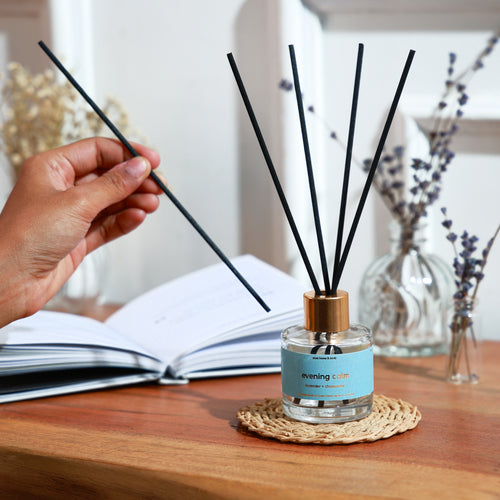 Evening Calm · the quietest₹799Shop →
 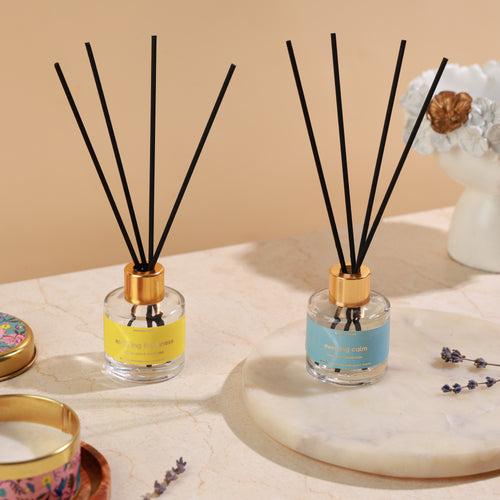 Day & Night duo · two rooms₹1,498Shop →
Part three — when a candle or a machine is the better gift
I am not going to argue that passive beats everything, because it does not. For a household that lights candles most evenings, a candle is the better gift and I would send one without hesitating. The flame is not a delivery mechanism, it is the point — a small deliberate act at the end of a day, a warmer light than a ceiling tube, and a scent that arrives because somebody chose it in that moment rather than because a bottle has been running since Tuesday. A jar candle at ₹379 gives roughly 15–18 hours and the Sandalwood jar at ₹449 is the one I would pick for a home that leans traditional. The question to ask yourself is genuinely simple: have you ever seen a lit candle in their house? If not, you are giving a jar.
The second case is size and control. A reed diffuser is a point source with no propulsion — it releases and waits for the room to distribute — so past roughly 250 to 300 square feet of connected open volume it stops being the right tool, and no amount of extra reeds fixes that. It is also constant by design: it cannot be turned up before guests arrive or off during a dinner. If what the household wants is scent on demand, or if the flat is one large open living-dining, a Sukoon at ₹1,899 is the honest answer — 270–320 sq ft, timers, and three 15ml Hotel Collection fragrances in the box. The Boond at ₹899 is the smaller version at around 150 sq ft. Both need a plug point and a person willing to fill them with water, which is why I would not send one into week one of a move — but as a gift for a flat that is already set up, a machine is not a step down from a bottle. Most homes end up running both, in different rooms.
And the boundary that is not negotiable. If anyone in the household has said they dislike scented things, or has told you they are sensitive to fragrance, do not send a diffuser — it runs continuously and cannot be put away for a fortnight without ending the gift. Similarly, a new flat smells of paint, polish, new joinery and sometimes damp, and fragrance does not remove any of that. Ventilation and time do: windows open, fans on, a few weeks. A diffuser put down in week one sits alongside the paint until the paint goes, and then it is the thing left in the room. Tell them that when you hand it over, and the gift gets judged in the right week.
Part four — the questions first-time givers actually ask
These are the ones that arrive in my inbox from people buying a diffuser for someone else, having never owned one. The answers are plain, and each has a consequence for whether it is the right gift.
| What people ask me | The plain answer | What it means for the gift |
|---|---|---|
| Does it need electricity? ★ | No. There is no plug, no battery and no switch anywhere on it | It works in a flat where the plug points are still behind cartons |
| Is there a flame? | No. Nothing burns and nothing gets warm | Safe to leave running in a home with children or pets in the room |
| Do they have to set it up? | Stand the reeds in the bottle and put it on a tray. Ten seconds | No instructions to read on a day when nobody is reading anything |
| How long does it last? | 6–8 weeks at 50ml, 14–18 weeks at 130ml, then it is finished | A stated end — no clutter, no obligation, nothing to store |
| What if they forget about it? | It carries on working. The weekly flip only affects how loud it is | The gift does not fail through neglect, which candles and machines do |
| Can I make it stronger for a bigger room? | Reed count is the volume control, and it shortens the bottle in proportion | Buy for the room they use, not the largest room in the flat |
| Does a bigger bottle smell stronger? | No — a 130ml at ₹1,299 lasts longer, it does not project further | Buy 130ml when you want the gift to outlast the season, not to fill more space |
Versailles
When I was training in Versailles, the thing that surprised me most about reed diffusers was how little engineering there is in them. You spend years learning to build a composition and then you hand it to a piece of fibre and gravity, and the room does the rest. I found that frustrating for about a year and then I understood it was the entire advantage. Nothing that has no moving parts can go wrong in someone else's house.
That is why it is the format I send to people who have just moved. I have been in enough half-unpacked flats to know what week one is like — the plug points are behind a wall of cartons, nobody has found the good scissors, and the last thing anyone needs is a gift that comes with a small learning curve. A bottle you stand on a shelf and forget is not a lesser gift than one that does something clever. It is a gift calibrated to the week it arrives in.
What I will not do is tell you it will be their favourite thing or that they will remember who gave it. Nobody selling you anything knows that. What I can tell you is what is in the box, what the oil does, how long it lasts and what it does not do — and that a household in the middle of a move will not have to think about it once. Everything is made in Pune, in small batches, and a part of every order funds a girl's classroom through Nanhi Kali.
Frequently asked questions
- Against the traditional gifts — five categories on duplication, storage, effort and shelf life.
- Gifts other than candles — the honest difference between a flame and a bottle.
- Instead of home decor and for someone who has everything — taste risk and the gaps a move creates.
- The unique housewarming gift guide — the complete argument for not bringing what everyone brings.
- Brand: the SOSA founder story.
SOSA range & prices used in this guide (verified from the live store, August 2026): Reed diffusers — alcohol-free, phthalate-free, paraben-free, IFRA-compliant compositions on a heat-stable coconut-derived (CCT) carrier, supplied in a refillable glass bottle with six fibre reeds; 50ml lasts 6–8 weeks, 130ml lasts 14–18 weeks. Morning Freshness 50ml ₹749 · 130ml ₹1,249; Garden Bloom 50ml ₹799 · 130ml ₹1,299; Evening Calm 50ml ₹799 · 130ml ₹1,299; Fresh Brew 50ml ₹849 · 130ml ₹1,349; Mountain Breeze 50ml ₹849 · 130ml ₹1,349. Duo sets: Day & Night ₹1,498, Fresh & Grounded ₹1,548, Warmth & Bloom ₹1,598 (2 × 50ml); ₹2,498–₹2,598 (2 × 130ml). Oil-only refills 300ml ₹2,399 · 500ml ₹3,499 (the glass vessel and reeds are not included). The least expensive SOSA reed diffuser is ₹749, so no reed diffuser exists below that price in any format. Below it SOSA sells scented candles from ₹379 (roughly 15–18 hours), a Sandalwood jar candle ₹449, wax melts ₹474, ceramic mugs ₹474, ribbed and face mugs ₹569, bubble and taper candles ₹474–₹569, a ceramic trinket dish ₹664 and candle duos ₹664 (roughly 30–36 hours). The store runs an automatic discount, so several prices display with a .05 tail (₹379.05, ₹474.05); whole rupees are quoted here. Machines: Boond 300ml ₹899 · Sukoon 500ml ₹1,899 · Megh 6L ₹3,499 · waterless Vaayu ₹11,999. The water-based Hotel Collection (15ml ₹299 · 100ml ₹999 · 300ml ₹1,799) is a fragrance for an ultrasonic machine and is not a standalone gift. SOSA does not sell a gift card, a gift hamper, a gift box or a curated reed gift set, and gift wrapping, gift notes, direct-to-recipient shipping and any bulk or corporate terms are unconfirmed — check at checkout or with SOSA rather than assuming them. Composed and handmade in small batches in Pune, India; tested through 45°C summer heat and 85% monsoon humidity. Free shipping above ₹499. A portion of every order supports girl-child education through Nanhi Kali. Prices subject to change — see the live product pages.