


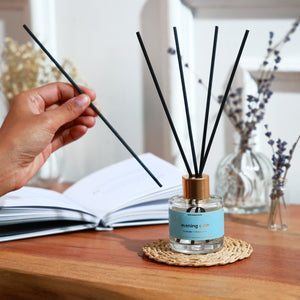
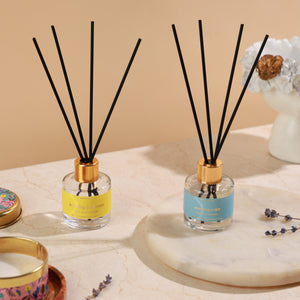

The one thing that makes a difference: stand the bottle on a small tray or a ceramic dish. If it ever does need to move, it moves as one object, and the surface underneath is protected either way.
Worst placements, in order: the floor · a low centre table that gets pushed aside for mopping · the front edge of a dining table · a windowsill.
The honest gap: SOSA makes no wall bracket, no fixed mount and no shelf accessory, and I would not want you waiting for one. This is a furniture decision, it costs nothing, and it is the highest-value change on this page.
2. Set it back from the edge, roughly a hand's width. Nearly every knock in a home happens in the outer few inches of a surface — a passing sleeve, a bag put down, a cloth run along the front lip. Move the bottle back and the risk mostly disappears.
3. Stand it on a tray or a ceramic dish. This is the whole accessory list. It protects the wood or stone from a drip, it catches anything that walks down the neck, and if the surface ever genuinely does need clearing, the bottle and reeds travel as one unit instead of being lifted by the neck at an angle.
4. Then check it against the air, not against the room. At or slightly below nose height, in the room's natural airflow path — near a doorway rather than sunk into a dead corner — but never in a direct draught, never on a windowsill, never under a running split AC and never within reach of a diya, an agarbatti or a candle. Fragrance oil is flammable and it belongs nowhere near an open flame.
5. Leave it there for a fortnight before you judge anything. A reed diffuser saturates its reeds over the first days and then settles into the composition as it was designed to sit. If you have been shifting it around, you have never actually seen what that position does. Give it two weeks in one place before you decide the scent is wrong.
Alcohol-free, phthalate-free, made in Pune. A portion of every order supports girl-child education through Nanhi Kali.
Three tests a placement has to pass before the scent matters at all
People ask this question as though it were about tidiness. It is really about consistency. A reed diffuser is the only fragrance product in the house with no controls at all — you cannot turn it up, down or off, so the only two dials you have are how many reeds are in it and where it stands. Of those two, position is the one that changes the answer most, and it is the one almost nobody sets deliberately. Run a candidate surface through these three tests and you will have your spot in about a minute.
 Evening Calm₹799Every Indian home has two categories of surface, and the difference between them is the whole of this page. There are surfaces that get cleared — a dining table, a kitchen counter, a low centre table that has to be pushed aside so the floor beneath it can be reached — and surfaces that get dusted around, which is a shelf, a bookcase ledge, a wall unit niche, the top of a chest of drawers, the back half of a sideboard. Put the bottle on the second kind and the question resolves itself without anyone having to remember anything. Nobody is at fault when a bottle standing in the middle of a dining table is moved; that is what dining tables are for.
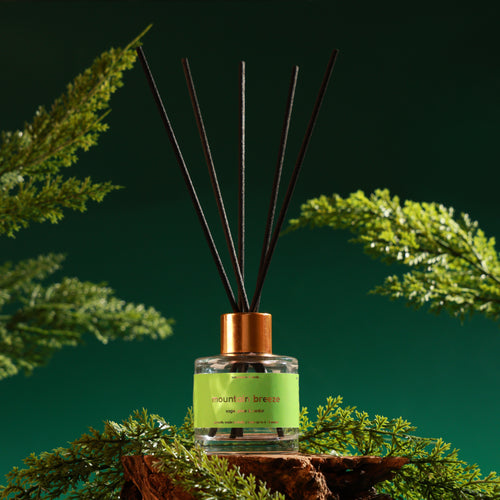
 Mountain Breeze₹849These are not the same thing and confusing them is the commonest placement error I see. Airflow is the slow, general movement of air through a room — the drift towards a doorway, the circulation a room has simply because it is connected to the rest of a flat. A reed diffuser needs that; a bottle in a sealed dead corner behind a cupboard will underperform badly. A draught is a fast, directional stream — an open window, a balcony door, a split AC blowing directly on it, a pedestal fan. That strips the lightest materials off the reeds and empties the bottle into somewhere you are not. Aim for a spot in the general drift and out of the line of anything that blows.
 Morning Freshness₹749A bottle with six reeds standing in it has a much larger footprint than the glass suggests — the reeds fan outward and the top of that fan is the part that gets caught. Set the bottle back roughly a hand's width from the front edge of whatever it stands on, and keep it clear of the swing of a door, a curtain and the reach of a small child. A tray underneath is worth more than it sounds: it means that on the rare day the surface genuinely does need clearing, the bottle is picked up flat with everything on it, rather than grabbed by the neck and tilted, which is exactly the movement that walks oil down the outside of the glass.
What actually goes wrong when a filled bottle is moved every day
Three separate things, and only one of them is the obvious one. The obvious one is spillage: a bottle carrying six saturated reeds has a high centre of gravity and no seal, and lifting it at an angle is enough to bring a film of oil onto the neck and shoulders of the glass. That film then transfers to the next surface it stands on. The ring people find on a wooden shelf is almost never a leak; it is the outside of the bottle, deposited by handling. A tray removes the whole problem and costs nothing.
The second is subtler and matters more. A reed diffuser needs continuity of position to be judged at all. Its output depends on the air passing the reeds, and the air passing the reeds depends on where the reeds are — a foot to the left, closer to a doorway, and the bottle projects further and empties sooner; a foot to the right, into an alcove, and it goes quiet. If the bottle is somewhere slightly different every day, none of those observations accumulate into anything, and you are left with the vague and demoralising sense that the fragrance is inconsistent. It is not. The position is.
The third is the one worth being honest about, because it saves money. Oil leaving a reed diffuser is never wasted in the sense of being thrown away — there is no reservoir the bottle holds back, and every millilitre eventually exits through the reeds into the room. The only genuine waste in this product is oil evaporating into a place nobody is standing, and that is a question of placement and airflow rather than a fault in the bottle. A diffuser parked temporarily on the floor while a room is cleaned, or nudged behind a curtain, or set down for the day on a windowsill in the sun, is spending itself somewhere you get no benefit from. Heat and moving air both accelerate evaporation, and a sunny sill supplies both.
Every surface in an ordinary Indian flat, ranked for a reed diffuser
The honest ranking, including the placements people most want to use and should not. Note that the two best surfaces in the list are usually free, already exist, and are being used for something less important.
| Surface | What happens to it during daily cleaning | How it performs | Verdict |
|---|---|---|---|
| Shelf or bookcase ledge ★ | Dusted around, never cleared | Good — usually at or near nose height, off the draught line | Best in the flat |
| Back corner of a sideboard or chest of drawers ★ | Dusted around; the front half is what gets used | Good — stable, protected, in the room's general drift | Best in a bedroom |
| Wall unit niche or TV unit ledge | Occasional dusting only | Good if it is not sunk into a dead alcove | Strong |
| Console table, set back from the edge | Wiped, but usually around objects | Good in a hall, provided it is off the door swing and out of the draught | Works with conditions |
| Kitchen counter | Cleared and wiped end to end, often twice a day | Also the hottest and greasiest surface in the flat | Avoid |
| Dining table | Cleared for every meal | Moved several times a day by definition | Avoid |
| Low centre table | Frequently pushed aside so the floor beneath can be reached | Below nose height and in the busiest traffic path in the room | Avoid |
| Windowsill | Wiped often; also the sunniest ledge in the room | Direct sun plus a draught — the fastest way to empty a bottle into the street | Worst |
| The floor | The one surface guaranteed to be cleaned daily | Far below nose height, in the mopping path, and easy to knock | Never |
Living room shelf · Morning Freshness₹749Shop → 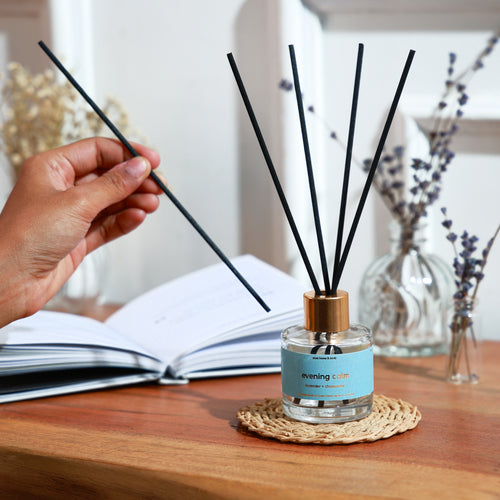 Bedroom chest · Evening Calm₹799Shop →
  Study bookcase · Mountain Breeze₹849Shop →
Once the spot is settled: size, reed count and the only handling it needs
With the position fixed, the two remaining decisions are small and both are reversible. Size follows room volume, not budget. A 50ml is built for anything up to roughly 150 sq ft — a bedroom, a study, a bathroom — and runs 6–8 weeks. A 130ml is for above that, so a living room or an open-plan end of a flat, and runs 14–18 weeks. Putting a 50ml on a shelf in a 300 sq ft living room and concluding that it is weak is one of the commonest misreadings there is; the bottle is performing exactly to specification in a room it was not built for.
Reed count is the volume dial and it is free. All six reeds gives full projection. Three gives a soft, near-bedside level and roughly doubles how long the bottle lasts. Two or three in a small bathroom can make a 50ml run close to three months. If the shelf you have chosen turns out to be nearer than you expected to where people sit, take reeds out before you consider a different scent — a fragrance that feels like too much is very often the right composition at the wrong concentration, and pulling half the reeds costs nothing and takes four seconds.
The only routine handling a well-placed bottle needs is flipping, and that is a three-to-five-day cadence for Morning Freshness and five-to-seven for Garden Bloom, not a daily one. Lift the reeds out, invert them, put them back dry end down. Do that on a fixed day of the week and you get a clear lift in projection without opening a new bottle. Do not wipe the reeds with a damp cloth — they are porous fibre and water in the channel is the one thing that genuinely does slow them down. Dust the glass and the shoulders of the neck instead; that is where a film collects and it is a ten-second job.
What to buy for a permanent spot — and what not to bother with
Because the answer to this particular question is largely free, the buying section is short and I would rather it were honest than long. If you already own a reed diffuser, the entire content of this page is: move it to a shelf, set it back from the edge, put a dish under it and leave it alone for a fortnight. If you are buying, the choice is the ordinary one of room size and register, and the last row of the table below is the thing we do not make.
| Buy | What it is | When it is the right answer | Price |
|---|---|---|---|
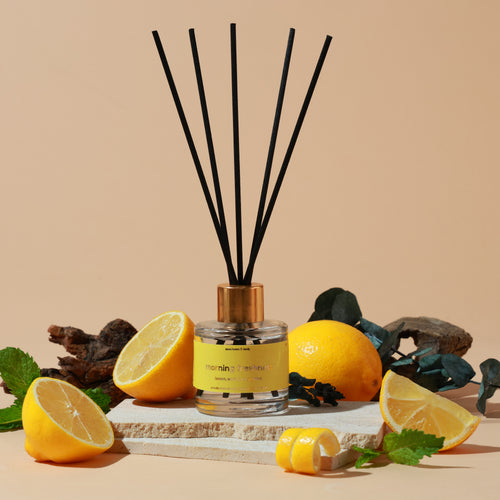
| 1. Morning Freshness 50ml ★ | Malabar lemon, peppermint, eucalyptus globulus — 9.0, bright | A shelf in a living room or hall in a home that is cleaned each morning; the register sits with cleaner residue rather than fighting it | ₹749 |
| 2. Evening Calm 50ml | Kashmir lavender, chamomile, soft musk — 8.9, the softest we make | The back corner of a chest of drawers in a bedroom, at three reeds | ₹799 |
| 3. Mountain Breeze 50ml | Himalayan pine, sage, Indian cedar — 9.4, deep woody | A bookcase ledge in a study, or any household that finds citrus too busy | ₹849 |
| 4. Any scent in 130ml | The same compositions in the larger bottle, 14–18 weeks | Only if the room is above about 150 sq ft. Below that it is over-specified | ₹1,249–₹1,349 |
| 5. Day & Night duo | Two 50ml bottles, bright and soft | If you are settling two permanent spots rather than one | ₹1,498 |
| No mount, no bracket, no stand: the honest gap | There is no wall fixing, no fixed base, no weighted holder and no shelf accessory in the SOSA range, and no plug-in or timed system either. A ₹0 ceramic dish you already own does the job a stand would | Said plainly rather than sold around | — |
Versailles
I have come to think that placement is the part of this product we under-explain, and questions like this one are the evidence. A perfumer spends months on an evaporation curve and then the bottle is put down in the middle of a dining table, where it will be moved four times before dinner. Nothing in the composition survives that well, because the composition was designed for a fixed point in a room's air.
The framing I would offer is that a reed diffuser is closer to a lamp than to a vase. You would not move a lamp every morning; you decided once where the light needed to fall and then the lamp stayed there. Fragrance is the same decision with a slower feedback loop. Choose the shelf, set the bottle back from the edge, put something under it, and then — this is the part that requires patience rather than money — leave it alone long enough to find out what that spot actually does.
And I would rather tell you plainly that we do not sell the thing you might reasonably expect us to sell here. There is no SOSA wall mount, no bracket, no weighted stand. A saucer from your own kitchen is genuinely the right answer, and a page that invented a product to fill this gap would have wasted your money and my credibility. Everything is composed in Pune, and a part of every order funds a girl's classroom through Nanhi Kali.
Frequently asked questions
- Why the fresh smell after mopping disappears within an hour — the one-hour decay, explained.
- Flip the reeds before or after cleaning? — after, and the reason is practical.
- Wonderful after mopping, stale by evening — the same mechanism from the other end of the day.
- The best fragrance after a morning cleaning routine — why citrus and green sit with cleaner residue.
- Can the diffuser stay out during dusting? — yes, with two small pieces of care.
- When the floors smell strongly of cleaning liquid — matching the register instead of competing with it.
- Holding the just-cleaned feeling until evening — reed diffuser or Sukoon, answered honestly.
- Clean, but it doesn't smell fresh — why those are two different jobs.
- The "just housekept" smell — the whole method in one place.
- Brand: the SOSA founder story.
SOSA reed diffusers — facts verified August 2026: Five scents, all alcohol-free, on a heat-stable CCT (caprylic/capric triglyceride) base rather than DPG, phthalate-free, paraben-free, IFRA-compliant, 0 ppm formaldehyde, six fibre reeds in a refillable glass bottle, composed and made in Pune, India. Morning Freshness (Malabar lemon · peppermint · eucalyptus globulus) 50ml ₹749 · 130ml ₹1,249 · 9.0 on the SOSA strength scale. Evening Calm (Kashmir lavender · chamomile · soft musk) 50ml ₹799 · 130ml ₹1,299 · 8.9, the softest in the range. Garden Bloom (British rose · night-blooming jasmine) 50ml ₹799 · 130ml ₹1,299 · 8.9. Mountain Breeze (Himalayan pine · sage · Indian cedar) 50ml ₹849 · 130ml ₹1,349 · 9.4. Fresh Brew (Coorg coffee · Kerala vanilla · caramel) 50ml ₹849 · 130ml ₹1,349 · 9.5, the deepest in the range. 50ml suits rooms up to about 150 sq ft and lasts 6–8 weeks; 130ml suits above that and lasts 14–18 weeks. Six reeds gives full projection, three gives a soft level and roughly doubles bottle life. Duos: Day & Night ₹1,498, Fresh & Grounded ₹1,548, Warmth & Bloom ₹1,598 (50ml × 2). Refills 300ml ₹2,399 · 500ml ₹3,499, which are oil only and not a first purchase. Machines: Boond ₹899, Sukoon ₹1,899, Megh ₹3,499. Climate-tested through 45°C heat soak and 85% relative humidity. SOSA sells no room spray, no air purifier, no odour eliminator, no plug-in and no wall mount or stand for reed diffusers; every SOSA spray is a car perfume. Reed oil and the water-based Hotel Collection are separate physical systems and are not interchangeable, and there is no hotel-inspired reed diffuser. This page makes no health, air-quality, allergy or antimicrobial claim. Free shipping above ₹499. A portion of every order supports girl-child education through Nanhi Kali. SOSA is an independent Indian fragrance house and is not affiliated with or endorsed by any hotel brand. Prices subject to change — see the live product pages.