Founder Diaries · Property Viewings · Sprays, Reeds & Professional Machines
By Sonal Sahani · ISIPCA Versailles 11 min read Updated September 2026
There are exactly three ways of getting fragrance into the air of a room, and the useful way to choose between them is by what each one physically does rather than by what each one costs. A reed evaporates. An ultrasonic machine breaks water into a mist and lets the mist carry fragrance with it. A nebuliser uses pressurised air to shear neat oil into particles small enough to stay suspended, with no water involved at all. Those are not three grades of the same product. They are three different processes with three different outputs, and the reason the answer for a large viewing is usually the third is not that it is the dearest — it is that the second one adds water to a property, and the first one cannot be told how big the property is.
Quick answers — read this first
Passive (reeds, from ₹749): capillary evaporation from a fixed exposed surface. No power, no noise, no control, output set by how much reed is showing. Excellent at small constant volumes.
Ultrasonic (Sukoon ₹1,899, Megh ₹3,499): a 2.4MHz plate breaks water into a cool mist that carries water-based fragrance. Cheap and effective in one room — and it adds 30 to 50 millilitres of water an hour to the air.
Nebulising (Vaayu ₹11,999, Aangan ₹25,999): pressurised air atomises undiluted oil into a dry particle mist. No water, no heat, no residue, output set by a rate you choose, coverage up to 1000 m³ and 3,000 m³ respectively.
The short answer
Short answer: a nebulising diffuser, for a large property viewing.
Not because it is the most expensive of the three, but because it is the only one of the three whose output is a rate you set rather than a consequence of the format, and the only one that introduces nothing wet into a closed flat. The
Vaayu at ₹11,999 covers up to 1000 m³, roughly 2,000 to 3,000 sq ft.
The pick, by property: a furnished, occupied, single-room space is an ultrasonic job and the
Sukoon at ₹1,899 is the better buy there; a large, empty, stone-floored or monsoon-season property is a nebulising job and the
Vaayu at ₹11,999 is the machine; a small enclosed room shown over months, with nobody to switch anything on, is still a
reed diffuser from ₹749 and I would not replace one.
Shop: the
Vaayu at ₹11,999 — waterless, up to 1000 m³, 400ml for about 75 days, app and 1h/4h/8h/24h timers, under 38 dB, 0.9 kg, key-lock — and the
Aangan at ₹25,999 for up to 3,000 m³. The
Sukoon is ₹1,899 with three 15ml scents included, the
Boond ₹899 and the
Megh ₹3,499. Reed diffusers from ₹749. Free shipping above ₹499.
Straight answer
Which type of diffuser works better than passive reeds for a large property viewing?
1. A nebulising diffuser, and the reason is mechanical rather than commercial. Pressurised air atomises undiluted fragrance oil into a dry particle mist. There is no water to carry it and no heat to alter it, the particles are fine enough to stay suspended across a large volume, and the output is a rate you set rather than whatever the format happens to give you.
2. The Vaayu at ₹11,999 is the residential size of that machine. Up to 1000 m³, which is roughly 2,000 to 3,000 sq ft, with a 400ml tank running about 75 days, Bluetooth and 1h/4h/8h/24h timers, under 38 dB, auto-stop, key-lock and 0.9 kg. The
Aangan at ₹25,999 is the same process at up to 3,000 m³ for a sales gallery or a clubhouse.
3. An ultrasonic machine is a different process and it is the better buy in a smaller space. A 2.4MHz plate vibrates water into a cool mist that carries the fragrance with it. The
Sukoon at ₹1,899 covers 270 to 320 sq ft, runs 16 to 18 hours on low and includes three 15ml scents. In a furnished, occupied room it is the sensible purchase and the Vaayu would be overkill.
4. The reason not to put an ultrasonic in a large empty property is water, not performance. It consumes 30 to 50 millilitres an hour and every one of those millilitres ends up in the air of the flat. In a closed, unoccupied property, in monsoon, or anywhere you would rather be drying out, that is the wrong direction of travel.
5. And passive still wins one category outright. A reed from ₹749 needs no power, makes no sound, cannot be tampered with and never needs switching on. In a small enclosed room in a listing shown over months, that specification beats both machines, and this page is not going to pretend otherwise.
A portion of every order supports girl-child education through Nanhi Kali.
TL;DR: three processes, not three price points: reeds evaporate passively from a fixed surface, ultrasonics break water into a mist that carries fragrance and add 30–50 ml of water an hour, and nebulisers atomise neat oil with pressurised air into a dry mist at a rate you set. The property decides which — ultrasonic for a furnished room, nebulising for volume and vacancy, reeds for small enclosed spaces shown for months.

The machine I would buy for one furnished room, and would not buy for a vacant flat
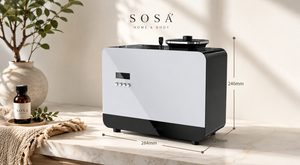
SOSA Sukoon · 500ml ultrasonic ₹1,899
A 2.4MHz plate vibrating water into a cool mist that carries three to six drops of water-based fragrance with it. 500ml tank, 270–320 sq ft, 16–18 hours on low, steady, 2H and 4H timers, auto shut-off, and three 15ml
Hotel Collection scents of your choice included.
It is genuinely good value and it is the correct purchase for a furnished, occupied, single-room space. It also puts 30 to 50 millilitres of water an hour into the air, which is the one thing you must not do in a closed, empty, stone-floored property or in anything during monsoon. That is not a criticism of the machine. It is a description of what an ultrasonic diffuser is.
Three processes, described properly
Most comparisons of diffuser types are really price comparisons wearing a technical hat, and they mislead in a specific way: they imply that the expensive machine is the cheap one with more of something. It is not. A nebuliser is not a strong ultrasonic and an ultrasonic is not a powered reed. The three are as different from each other as a kettle, a pressure cooker and a bowl of water left on a windowsill. Once you know what each is doing to the fragrance and to the air, the buying decision makes itself, and — this is the part worth staying for — it makes itself differently for different properties on your own books.
1
PASSIVE
Capillary evaporation, no power, and an output the format decides
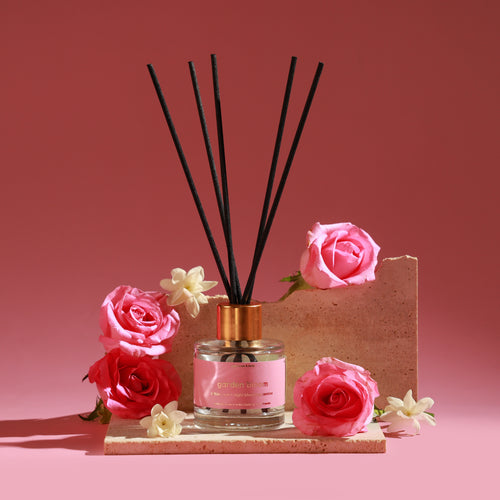
A reed diffuser is the oldest of the three and the only one with no moving part in it. Fragrance climbs the porous sticks by capillary action, spreads across the exposed length, and evaporates from that surface into whatever air happens to be passing. Everything about its behaviour follows from that sentence. The output is governed by exposed surface area, by temperature and by air movement, which means the bottle is quietly at the mercy of the room: a warm flat with the windows open empties it in a fraction of the time a cool sealed one does. It cannot be adjusted, because there is nothing to adjust — you can put fewer sticks in, which lowers the output permanently, and that is the whole of the control panel. It needs 24 to 72 hours to climb the full length of the reeds and reach its working level. Now the virtues, which are real and which this cluster keeps insisting on: it requires no power, produces no sound, has nothing to switch on, nothing to switch off and nothing to be blamed for, and it will hold its level in a small enclosed volume for months without a human being involved. In a guest bathroom, a powder room, a wardrobe lobby or a small entrance hall — the volumes where a fixed small output is exactly right — it is not merely acceptable, it is the correct object, and putting a machine in one of those rooms would be silly. The line from ₹749 is alcohol-free, so the liquid climbs the reed rather than flashing off the surface, which is why it lasts as long as it does. The limitation is the one you already know: a fixed source has no knowledge of the volume it is standing in, and eight hundred cubic metres is a great deal of volume to be ignorant of.
2
ULTRASONIC
A 2.4MHz plate, a cool water mist — and 30 to 50 ml of water an hour
The second process is the one most Indian homes already own.
A ceramic plate vibrating at about 2.4 million cycles a second sits under a tank of water. The vibration breaks the water surface into droplets so small they leave as a visible cool mist, and the few drops of water-based fragrance you added to the tank leave with them. Note what is actually being diffused: water, carrying fragrance. The machine is a humidifier that has been given a job on the side, which is why the dose is three to six drops per tank rather than per litre — you are scenting the mist, not the water, and a bigger tank buys hours rather than intensity. This is a genuinely good design at what it was built for. The
Sukoon at ₹1,899 handles 270 to 320 sq ft, runs 16 to 18 hours a fill on low, has steady, 2H and 4H timers, auto shut-off and a remote, and includes three 15ml
Hotel Collection scents of your choice; the
Boond at ₹899 does a smaller room and the
Megh at ₹3,499 holds six litres for an open-plan space.
For a furnished, occupied one-room space this is the machine I would buy, and I would not spend six times as much to do the same job worse. The constraint is the water, and it is arithmetic rather than opinion: at 30 to 50 millilitres an hour, a machine running a six-hour Saturday has put roughly a quarter of a litre of water into the air of the property. In an occupied, air-conditioned, furnished flat that disappears without consequence. In a closed, empty, marble-floored apartment, in a monsoon week, or in any property you are trying to dry out, it is the wrong direction and no fragrance is worth it. That single fact is what sorts the second process from the third.
3
NEBULISING
Pressurised air, neat oil, a dry mist, and a rate you choose
The third process removes the carrier entirely.
A stream of pressurised air is passed across a tube drawing undiluted fragrance oil, and the shearing force breaks that oil into particles fine enough to remain suspended in air rather than falling out of it. Nothing is diluted, nothing is heated, and nothing wet enters the room. Three consequences follow and each of them matters to a realtor specifically. First, the output is dry and residue-free, which is why it can run for hours in a flat with marble floors, polished veneer and a lacquered console without leaving a film for somebody to notice with a fingertip. Second, because the fragrance is neat rather than a few drops in half a litre of water, a very small quantity of oil covers a very large volume — which is how a 400ml tank runs for roughly 75 days and how one machine reaches 1000 m³. Third, and most usefully, the output is a rate.
Intensity on the Vaayu is a setting, so the identical machine runs a 900 m³ villa at one level and a 300 m³ apartment at another, and the number is chosen against the property in front of you rather than against a label written by somebody who has never seen it. The rest of the specification exists for the same reader: 1h, 4h, 8h and 24h timers with Bluetooth app control, so the flat has arrived at its level before you park; under 38 dB, which matters more in an empty property than in a furnished one because there is nothing to absorb sound; a key-lock so nobody adjusts it while you are showing the bedrooms; auto-stop; 0.9 kg and 165 × 80.5 × 215 mm; CE, RoHS and SGS certification; four hotel-inspired scents supplied. At ₹11,999 for the Vaayu and ₹25,999 for the
Aangan at up to 3,000 m³, it is the dearest of the three processes, and in a small furnished room it would also be the wrong one.
The sentence I would want you to take away from all three: you are not choosing a price bracket. You are choosing whether the fragrance travels on nothing, on water, or on air — and the property, not the budget, answers that.
The mechanism table
The three processes side by side on what each physically does rather than on what each costs, with the property each one is right for in the fourth column. The rows are ordered by suitability for a large viewing, which is the question in the title, and the ordering would change for a small furnished room — which is the point the table is making as much as the specifications are.
Three processes, not three price points
What each diffusion method physically does, and which property it suits
| Method |
The mechanism |
What it puts into the air |
The property it is right for |
Price |
| Nebulising · Vaayu ★ |
Pressurised air shears undiluted oil into suspendable particles. No water, no heat |
A dry, residue-free particle mist at a rate you set. Nothing lands on stone or veneer |
Large, empty, stone-floored, humid or vacant. Up to 1000 m³. The viewing machine |
₹11,999 |
|
Nebulising · Aangan |
The same process at commercial scale, HVAC-connected or standalone |
The same dry output distributed by the building's own air handling, under 42 dB |
Sales galleries, clubhouses, very large villas. Up to 3,000 m³ — not a 2,000 sq ft flat |
₹25,999 |
|
Ultrasonic · Sukoon |
A 2.4MHz plate breaks water into droplets; water-based fragrance leaves with the mist |
A cool visible water mist — and 30–50 ml of water an hour into the property |
Furnished, occupied, one room of 270–320 sq ft. Genuinely the better buy there |
₹1,899 |
|
Ultrasonic · Megh |
The same plate under a six-litre reservoir, for hours rather than intensity |
The same water mist, for longer. Dose stays 3–6 drops per tank, not per litre |
An open-plan occupied space where humidity is not a concern. Still water-based |
₹3,499 |
|
Passive · reed diffusers |
Capillary action up porous sticks, then evaporation from the exposed surface |
Vapour only, at whatever rate the surface area, temperature and airflow produce |
Small enclosed volumes — bathrooms, powder rooms, halls — in a listing shown for months |
from ₹749 |
| Not in the range: a room spray |
SOSA does not make one for the home; the sprays we make are car perfumes |
A single dose with no continuing source, wherever it is bought |
Printed rather than implied, so you can weigh the comparison above knowing what we sell |
— |
Shop this guide
One of each process, in three products
The SOSA principle
A nebuliser is not a strong ultrasonic and an ultrasonic is not a powered reed. They are three different physical processes — and the property decides which one, not the budget.
Fragrance travels on nothing in a reed, on water in an ultrasonic, and on air in a nebuliser. Only the last of those is safe to run for hours in a closed, empty, stone-floored flat.
How the property picks, and what each one costs to run
Start by describing the property rather than the budget, in four facts, and the machine falls out of the description. Is it occupied or empty; is it one room or a whole floor; is it dry or is it monsoon; and will anybody be there to switch something on. A furnished, occupied two-bedroom flat where the owner is living and the air conditioning runs is an ultrasonic property: the Sukoon at ₹1,899 on a 2H timer in the sitting room, three to six drops of a Hotel Collection scent per tank, with the water it adds disappearing into a space that is being lived in and ventilated. Buying a nebuliser for that flat is spending ₹11,999 to do a ₹1,899 job less conveniently, and I would say so. An empty 3,000 sq ft apartment with marble floors, closed for a fortnight, shown on a wet Saturday in July is the opposite property in every one of the four facts, and it is a nebulising job. Nothing wet should go into it; the volume is roughly 840 cubic metres against the 270 to 320 sq ft an ultrasonic is rated for; there is no furniture to hold or soften anything; and nobody is there in the morning to start a machine, which is what the timers and the Bluetooth are for. A small enclosed room in a listing that has been on your books since spring, meanwhile, is still a reed property, and there is a version of this decision where you own all three and use each where it belongs — which is what most of the agents I talk to end up doing after a year.
Then the running cost, which is where the three processes stop resembling each other completely. A reed is a consumable: the bottle empties, and in a large airy flat it empties faster than the box implies, so the cost recurs at ₹749 to ₹849 a bottle per room per replacement cycle, with 130ml from ₹1,249 and 300ml refills at ₹2,399 for a property you keep supplied. An ultrasonic is nearly free to run and cheap to scent — three to six drops per tank means a 15ml Hotel Collection bottle at ₹299 lasts a long time, the 300ml 300ml refill is ₹1,799 at about ₹6 a millilitre, and the Pack of 7 at 15ml is ₹1,799 against ₹2,093 singly — but you are also refilling a tank with water every day or two, which in somebody else's flat means being there. A nebuliser reverses that arrangement: the oil is the expensive part and the attendance is nearly zero. A 400ml tank runs about 75 days, which for most listings is longer than the listing, and the machine draws 5 watts on a 12V adapter, so the electricity is not worth calculating. One compatibility fact that catches people out and belongs here rather than in a footnote: the water-based Hotel Collection bottles are for the ultrasonic machines only. The Vaayu and the Aangan take their own undiluted oil and arrive with four hotel-inspired scents; never put a water-based bottle into a nebuliser, and never put raw essential or carrier oil into an ultrasonic, which will clog the misting plate.
Then the part that is true of all three and matters more than any of them. The process only becomes relevant after the property has been prepared, and the preparation is free. A flat that has been shut for a fortnight needs its windows opened on opposite walls the day before, every drain trap flushed until the seal is holding, the air conditioning run for an hour if it is hot, and a walk through with the front door closed behind you to notice what is actually there. Do that and a modest amount of fragrance reads as a property in good order. Skip it and no machine of any process will produce that result, because you will simply be running two smells at once. And the boundary this whole cluster is built on: if what the flat smells of has a cause — damp, a leak, a blocked trap, smoke damage, something under a floor — then none of the three processes is the answer and choosing between them is a mistake in itself. That smell is a material fact about the property. Find it, fix it, or disclose it. Scent a listing that is genuinely sound, keep the register quiet — the Ritz-Carlton-inspired Quiet Luxury is white tea, bergamot and cedar for a reason, and the buyer should walk out able to describe the flat and unable to describe the smell — and treat the whole exercise as presentation, alongside the photography and the lighting, rather than as persuasion.
Fragrance travels on nothing in a reed, on water in an ultrasonic, and on air in a nebuliser. The property tells you which of those three it can afford to have in it.
— Sonal Sahani, SOSA
The SOSA edit
In buying order for an agent choosing a diffusion method rather than a product. Two of the five rows send you to something under ₹2,000, because for two very common kinds of listing those are the right answers and a page that recommended the machine for every property would not be worth reading.
The SOSA edit
Choosing a diffusion method for a property you are showing
| Buy |
The process |
The property it belongs in |
Price |
| 1. Vaayu ★ |
Cold-air nebulisation — pressurised air, undiluted oil, dry residue-free output, no water |
Large, empty, stone-floored or humid. Up to 1000 m³, timers and app, 0.9 kg, key-lock, ≈75 days a fill |
₹11,999 |
| 2. Sukoon
|
Ultrasonic — a 2.4MHz plate breaking water into a cool mist that carries the fragrance |
One furnished occupied room of 270–320 sq ft. Three 15ml scents included. Not for a closed or damp flat |
₹1,899 |
| 3. Reed diffusers
|
Passive capillary evaporation from a fixed exposed surface, unpowered and silent |
Bathrooms, powder rooms and halls in a listing shown for months. 24–72 hours to establish |
from ₹749 |
| 4. Megh
|
The same ultrasonic process under a six-litre reservoir — hours rather than intensity |
An open-plan occupied space where added humidity is genuinely not a concern |
₹3,499 |
| 5. Aangan
|
Nebulisation at commercial scale, HVAC-connected or standalone, under 42 dB |
Sales galleries, clubhouses and villas above 1000 m³. Overkill in an apartment, and I would say so |
₹25,999 |
| Not in the range: a home room spray |
A single dose with no continuing source; the SOSA sprays are car perfumes |
Stated so that the comparison above can be weighed knowing exactly what we do and do not sell |
— |
Honest notes for buyers: fragrance is the last step in preparing a property, never the first, and it must never be used to cover a defect. Damp, a leak, drains, smoke or anything structural is a material fact about a property: find it, fix it or disclose it. Scent a listing that is genuinely sound. On the machines: the
Vaayu at ₹11,999 is waterless cold-air nebulisation — no water, no heat and no dampness — covering up to 1000m³ or roughly 2,000–3,000 sq ft, with a 400ml tank lasting about 75 days, Bluetooth app control, 1h/4h/8h/24h timers, under-38dB running, auto-stop and a key-lock, at 0.9 kg and smaller than a shoebox, so one machine can serve a whole portfolio. The
Aangan at ₹25,999 covers up to 3,000m³ for sales galleries and clubhouses. The ultrasonic
Sukoon,
Boond and
Megh are water-based and add 30–50 ml of water an hour to the air, which makes them the wrong choice for a closed or humid vacant property. A
reed diffuser needs 24–72 hours to establish, so it suits a listing shown over months rather than a viewing tomorrow. A candle must be attended and put out, which rules it out of an unoccupied property. SOSA does not make a room spray for the home; the sprays in the range are car perfumes. The Hotel Collection scents are SOSA's own interpretations inspired by the world's finest hotels; SOSA is an independent Indian fragrance house, not affiliated with or endorsed by any hotel brand. A portion of every order supports girl-child education through Nanhi Kali.
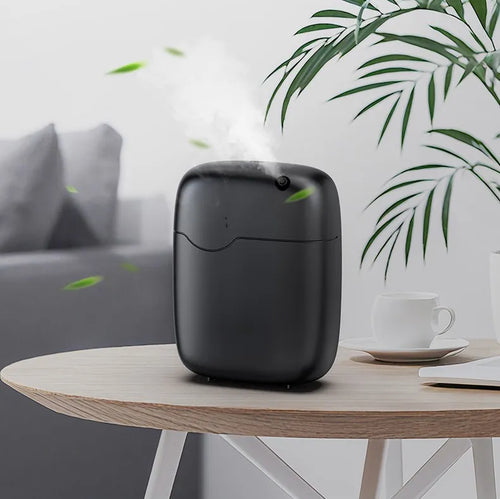
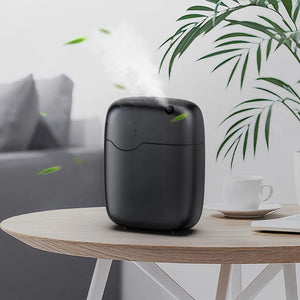
Pressurised air, undiluted oil, and no water anywhere in the process
SOSA Vaayu · cold-air nebulisation ₹11,999
A nebuliser takes neat fragrance oil and shears it into particles small enough to stay suspended, using pressurised air and nothing else. No water is added, no heat is applied, and because there is no carrier to land, the output is dry — which is what makes it safe on marble, on polished veneer and on a wooden floor somebody is about to buy. The rate is a number you set rather than a consequence of how much reed you have exposed, so the same machine runs a 900 m³ villa hard and a 300 m³ apartment gently. Up to 1000 m³, 400ml for about 75 days, under 38 dB, CE, RoHS and SGS certified.
A note from Sonal
I am wary of technology pages, because they are usually written to make the expensive item sound inevitable, and the honest version of this one does not. Two of the three processes on this page are cheaper than the third and each of them is the right answer for a kind of property that a great many agents have on their books right now. If your listings are furnished, occupied and one room at a time, an ultrasonic machine at ₹1,899 is not a compromise. It is the correct instrument, and the water it adds is irrelevant in a flat somebody is living in with the air conditioning on.
Where I do think the argument is genuinely one-sided is the empty flat, and it is a physical argument rather than a commercial one. A cool-mist machine works by putting water into a room. If the room is closed, unoccupied, stone-floored and being shown in a wet month, you have chosen a device whose primary output is the thing you least want more of. That is the reason I would send a realtor towards a nebuliser and it is the only reason I need. Everything else — the timers, the key-lock, the 0.9 kg, the 75 days — is convenience, and convenience is worth paying for once but not worth choosing a process for. Choose the process for what it puts into the air, and then enjoy the timers.
Everything is made and supported from Pune, and a part of every order funds girl-child education through Nanhi Kali. You get a space that smells like somewhere considered; a girl gets a classroom. That equation has always felt right to me.
Frequently asked questions
What is the difference between an ultrasonic and a nebulising diffuser?
The carrier. An ultrasonic vibrates water into a cool mist that carries a few drops of water-based fragrance with it, adding 30 to 50 ml of water an hour to the room. A nebuliser uses pressurised air to atomise undiluted oil into a dry mist with no water and no heat, so nothing wet enters the property.
Is a nebulising diffuser always better than an ultrasonic one?
No. In a furnished, occupied single room the
Sukoon at ₹1,899 is the better purchase and the water is harmless there. The nebuliser wins where the property is large, empty, stone-floored or humid, and where you need an output rate set against a volume rather than fixed by the format.
Why can't reed diffusers just be scaled up for a large flat?
Because their output is governed by exposed surface area rather than by the room. Adding bottles adds small fixed sources rather than raising a level, each still needs 24 to 72 hours to establish, and none of them can be turned up for a busy Saturday. Reeds remain the right answer for small enclosed volumes.
Can I use the Hotel Collection bottles in the Vaayu?
No. The
Hotel Collection is water-based and belongs in the ultrasonic machines — the
Sukoon,
Boond and
Megh — at three to six drops per tank. The
Vaayu and
Aangan take their own undiluted oil, and the Vaayu arrives with four hotel-inspired scents.
Which diffuser type is quietest in an empty property?
The nebuliser, at under 38 dB for the
Vaayu and under 42 dB for the
Aangan. This matters more than it sounds: an unfurnished flat has no soft furnishing to absorb sound, so a machine that is unnoticed in a carpeted room can be audible in an empty one. A reed, of course, is silent.
Three processes, one property
On nothing, on water, or on air — and the flat decides which it can have
The Vaayu is ₹11,999 for waterless cold-air nebulisation up to 1000 m³, with a 400ml tank lasting about 75 days, Bluetooth app and 1h/4h/8h/24h timers, under 38 dB, auto-stop, key-lock, 0.9 kg and four hotel-inspired scents included; the Aangan is ₹25,999 for up to 3,000 m³. The ultrasonic Sukoon is ₹1,899 with three 15ml scents, the Boond ₹899 and the Megh ₹3,499, all water-based at 30–50 ml an hour. Reed diffusers from ₹749. Free shipping above ₹499, and a portion of every order supports girl-child education through Nanhi Kali.
See the Vaayu · ₹11,999 See the Sukoon · ₹1,899
Continue the read
More from SOSA
Editorial standards & sources
About this guide: Written by Sonal Sahani, ISIPCA Versailles-trained founder and perfumer at SOSA Home & Body, on the three physical processes available for scenting a property — passive capillary evaporation, ultrasonic water-mist diffusion at 2.4MHz, and cold-air nebulisation of undiluted oil — what each puts into the air, why an ultrasonic is the better purchase for a furnished occupied room, and why the water it adds makes it the wrong machine in a closed, empty or humid property.
Facts verified August 2026: Product facts used in this guide. SOSA Vaayu ₹11,999: waterless cold-air nebulising diffuser, atomises undiluted fragrance oil to a dry residue-free nano-mist, coverage up to 1000m³ (approximately 2,000–3,000 sq ft), 400ml refillable tank lasting up to about 75 days per fill, Bluetooth app plus onboard control, 1h/4h/8h/24h timer scheduling, adjustable intensity, under 38 dB, DC 12V/1A at 5W, 165 × 80.5 × 215 mm and 0.9 kg, freestanding or wall/HVAC mounted, auto-stop and key-lock, CE, RoHS and SGS certified, supplied with four hotel-inspired fragrances. SOSA Aangan ₹25,999: HVAC-connected or standalone commercial nebulising diffuser, coverage up to 3,000m³ (roughly 8,000–10,000 sq ft), 800ml reservoir, metal body, programmable schedules, under 42 dB. Ultrasonic machines are water-based and consume 30–50 ml of water an hour: Sukoon ₹1,899 (500ml, 270–320 sq ft, 16–18 hours on low, 3–6 drops per tank, steady/2H/4H timers, three 15ml Hotel Collection scents included), Boond ₹899 (300ml), Megh ₹3,499 (6 litres). Hotel Collection water-based fragrance 15ml ₹299, 100ml ₹999, 300ml ₹1,799, Pack of 7 at 15ml ₹1,799 against ₹2,093 bought singly; the Vaayu and Aangan take their own undiluted oil rather than these water-based bottles. Reed diffusers (separate alcohol-free line) from ₹749, requiring 24–72 hours to reach their working level. Scented candles from ₹379, scenting a room in roughly 15–20 minutes but requiring attendance. Free shipping above ₹499. Timings: a nebulising diffuser reaches a working level within minutes and a stated viewing level well inside two hours. This guide makes no claim that fragrance affects a property's price, offer level or time on market; it is presentation, in the same category as photography, styling and lighting. Fragrance must never be used to conceal a material defect. SOSA is not affiliated with or endorsed by any hotel brand. Prices subject to change — see the live product pages.