
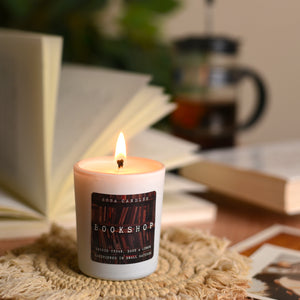



Why: it emits 30–50 ml of water an hour. Over an evening that is most of a litre, and in a room at 80–95% relative humidity that water leaves the air onto the coldest surfaces — walls, window glass, and the nearest fabric.
When it is fine: dry-season rooms, air-conditioned rooms being actively dehumidified, and anything comfortably under 60% RH. Check the number rather than the feeling; a hygrometer is about ₹300.
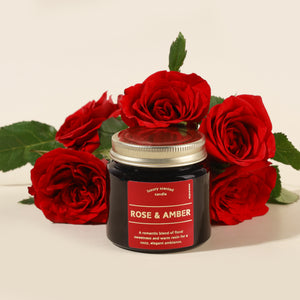
Instead, for now: a candle from ₹379 or an alcohol-free reed diffuser from ₹749. Neither adds any water to the room.
2. In a damp room that water has nowhere to go. Air holds a finite amount of vapour at a given temperature, and at 80 to 95 per cent relative humidity it is already close to that limit. What you add beyond it does not disappear — it leaves the air again at the coldest surface it can find, which is the external wall, the window glass, and whatever soft furnishing is nearest.
3. So you are feeding the condition that is producing the smell. The musty note in a damp room is the metabolic by-product of microbial growth, and that growth is limited by available moisture. Adding moisture is the one intervention guaranteed to help it along.
4. It is not a permanent no, and I will not pretend it is. In a dry-season room, in an air-conditioned room whose compressor is pulling water out faster than the diffuser puts it in, or in any space measurably under 60 per cent relative humidity, a cool mist is fine. It is a seasonal instruction, not a prohibition.
5. Check the number, not the feeling. People judge humidity by how warm they are and get it wrong in both directions. A small digital hygrometer costs about ₹300, tells you in ten seconds whether tonight is a diffuser night, and is the most useful thing anybody reading this page can buy.
6. Until the number is down, use a format with no water in it. A Bookshop candle at ₹379 is fifteen to twenty minutes from lighting to a scented room, and an alcohol-free reed diffuser from ₹749 holds a level for months without a socket. Both add nothing to the moisture load.
A portion of every order supports girl-child education through Nanhi Kali.

What the machine actually is
The confusion behind this question is a naming problem, and it is not the reader's fault. A cool-mist ultrasonic diffuser and a cool-mist ultrasonic humidifier are the same machine with different words on the box. Both hold water in a tank. Both sit that water on a ceramic plate vibrating at 2.4 million cycles a second. Both use those vibrations to throw a fine suspension of water droplets off the surface, and both push that suspension out of a nozzle with a small fan. The only difference is that in one of them you have added three to six drops of a water-based fragrance to the tank. The scent is a passenger travelling on a vehicle made entirely of water, and once you see the machine that way the answer to this page's question stops being a matter of taste.
Now the part that matters more than the number. Air can only hold so much water vapour at a given temperature, and relative humidity is simply how close to that ceiling you are. A bedroom of about eighty cubic metres — a normal 12 by 12 with a standard ceiling — holds somewhere near two litres of water as vapour when it is warm and sitting at eighty-five per cent. That is the whole capacity of the room, and it is already eighty-five per cent used. Into that you are proposing to introduce another half litre. It does not fit, and physics does not negotiate: the surplus leaves the air again at the first surface cool enough to take it. That surface is the external wall, the window glass, the tiled skirting, the back of the wardrobe and the curtain hanging against the cold pane. The water does not vanish because you cannot see it. It relocates onto the exact materials whose dampness you were trying to cover up.
And now the room has two smells rather than one, which is the specific failure this entire cluster exists to prevent. A nose is exceptionally good at separating simultaneous odours; it does not blend them into an average. It receives the damp note and it receives the fragrance, and it draws the obvious conclusion — that somebody in this house is aware of a problem and is attempting to paper over it. That is a worse impression than the damp on its own, because damp is weather and concealment is a decision. The reader who wrote to me about her Bandra flat put it perfectly: she said the room had stopped smelling musty and started smelling like a lift in a building with a problem. I could not improve on that.
So the honest instruction is seasonal rather than absolute: buy the machine, and start it in October. A Sukoon at ₹1,899 does not expire over a monsoon, and the three 15ml Hotel Collection scents that come with it do not either. What I object to is buying it in July in order to solve a July problem, because that is the one month of the year it cannot.
Every fragrance format, ranked by how much water it puts into the room
The single column that decides this page is the third one. Everything else — how fast a format works, how long it lasts, what it costs — is a normal shopping consideration, and in a damp room it is subordinate to whether the thing you are about to switch on is adding to the problem. Two of the five formats here add nothing measurable at all, and those two are the cheapest things this house makes.
| Format | Water added to the room | How fast it works | Right for a damp room? | Price |
|---|---|---|---|---|
| Scented candle ★ | None of any practical consequence — combustion vapour is a fraction of a gram a minute | 15–20 minutes from lighting | Yes. The warm plume also moves the air above it rather than letting it settle | ₹379–₹949 |
| Alcohol-free reed diffuser | None. Capillary action up a rattan stick, evaporating oil rather than water | 24–72 hours to establish, then months at one level | Yes, provided you can wait three days for it. No socket and nothing to remember | from ₹749 |
| Wax melt | None. A warmer holds the wax below its smoke point and the fragrance leaves the melt | 20–30 minutes | Yes. Same logic as a candle, with a lower and steadier heat and no flame to watch | ₹854 |
| Waterless nebulising diffuser | None. It atomises undiluted oil with air pressure and uses no water at any stage | Minutes, and it covers up to 1000m³ | Technically yes, and at ₹11,999 it is a commercial machine rather than an answer to a damp bedroom | ₹11,999 |
| Cool-mist ultrasonic | 30–50 ml every hour — most of a litre across a long evening, all of it into your room | About 20 minutes to a steady level from cold | No. Not above 60% RH. Excellent below it, which is most of the year | ₹899–₹3,499 |
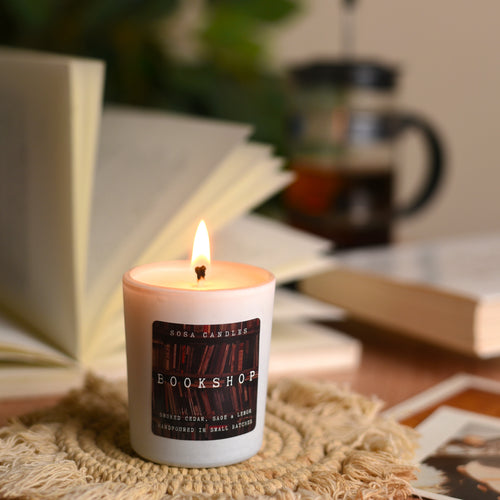 Candle · no water added₹379Shop →
 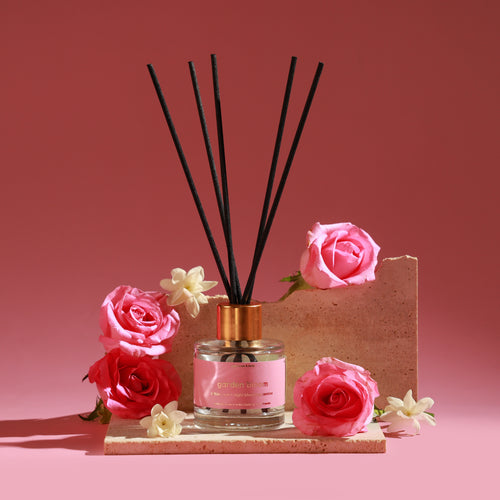 Reeds · no water eitherfrom ₹749Shop → Sukoon · under 60% only₹1,899Shop →
The number to check, and what to do while you are under it
Buy the hygrometer first, and buy it from anywhere. A small digital temperature-and-humidity display costs somewhere around ₹300, needs one AAA cell, and converts this entire question from a judgement call into a reading. I recommend it on a fragrance website with no commercial interest in it whatsoever, and I recommend it because human beings are genuinely poor at estimating humidity — we perceive it through skin temperature and comfort, which means a cool damp room feels fine and a warm dry one feels oppressive, and both readings are the wrong way round. Put the unit in the room that smells, at about chest height, away from the window and away from any vent, and leave it for a day before you take it seriously. Then use three bands. Under 50 per cent, run whatever you like: the Sukoon at ₹1,899 over 270 to 320 sq ft, or the Boond at ₹899 for a bedroom, at three to six drops of Hotel Collection per tank — the dose is per tank rather than per litre, since you are scenting the mist and not the water. Between 50 and 60, use the 2H timer rather than steady, so the room reaches a level and then stops receiving water for the rest of the night. Over 60, the machine stays off and the candle comes out. In an air-conditioned room, take the reading with the AC running rather than before you switch it on, because that is the condition the diffuser will actually be working in and the number can be twenty points apart.
Then the placement rules, which change in a humid room and are worth stating separately from the usual advice. Never put a cool-mist machine within a metre of an external wall, a window, a wardrobe, a bookshelf or a bed, because cool mist falls rather than rises and it lands on whatever is beneath and beside it. A diffuser sitting on a bedside table is misting the mattress; one on a bookshelf is misting the books, which is the single worst place in a flat to add water to. Waist height or above, in open air, at the middle of the room rather than at its cold edge. If you can see a visible plume settling onto a surface, you have already found where tonight's water is going. And do the drying work first in either case: air the room at the driest part of the day, get the ceiling fan moving so nothing stands still against a cold surface, put a mug of water down any floor drain that has been unused for a fortnight, and wash whatever is washable. Those four cost nothing, and if the reading drops below sixty as a result, you have both solved the smell and earned the right to use the machine.
Then the constraints, and the principle underneath the whole page. The Hotel Collection is water-based and runs in the Sukoon, the Boond and the Megh only. It does not go into a reed diffuser, which is a separate alcohol-free line with its own scents, and it does not go into the waterless Vaayu at ₹11,999, which takes its own undiluted oil. Never put raw essential or carrier oils into an ultrasonic — they clog the 2.4MHz plate — and rinse the tank when you change scent. SOSA does not make a room spray or a linen spray for the home; the sprays in the range are car perfumes, and I mention it here because a spray is the product most people reach for next when they have been told not to use a diffuser. And the principle: the reason to publish this page at all is that a fragrance company which will not tell you when its own machine is the wrong purchase is not worth listening to when it says one is the right one. I would rather sell you a ₹379 candle in July and a ₹1,899 diffuser in October than the diffuser twice and your good opinion once.
The SOSA edit
In the order I would actually spend, which begins with something we do not sell and ends with a machine I am asking you to postpone rather than skip. The last row is in the table on purpose; leaving it out would be the dishonest version of this page.
| Buy | What it is | Why it comes here in the order | Price |
|---|---|---|---|
| 1. A digital hygrometer ★ | A ₹300 display of temperature and relative humidity, from anywhere. Not a SOSA product | First, because every other decision on this page depends on one number and you cannot feel it accurately | ~₹300 |
| 2. Bookshop candle or Amber Rose | 80g for roughly 15–18 hours at ₹379; 130g for 25–30 hours at ₹599 and 220g for 40–50 at ₹799 | The no-moisture answer that works tonight. Fifteen to twenty minutes from match to scented room, attended and put out | ₹379 / ₹599 |
| 3. An alcohol-free reed | Morning Freshness ₹749, Garden Bloom and Evening Calm ₹799, Fresh Brew and Mountain Breeze ₹849 | For a level held for months with no socket and no water. Give it 24–72 hours, slower still in high humidity | from ₹749 |
| 4. Pure Calm wax melt set | Wax melted gently in a warmer, releasing fragrance with no flame and no water | If you want the candle logic without a flame in a room where the windows are shut against the rain | ₹854 |
| 5. Sukoon or Boond — in October | 500ml for 270–320 sq ft with steady/2H/4H timers and three 15ml scents included, or 300ml for a bedroom | Once the hygrometer reads under 60. A genuinely good machine bought in the right month rather than the wrong one | ₹1,899 / ₹899 |
| Not while the reading is over 60: any cool-mist diffuser | The Sukoon, Boond and Megh all emit 30–50 ml of water an hour by design | Printed rather than implied. This is the one page in the range where our own machine is the wrong recommendation | — |
Versailles
This is the page I get asked about most often by people who work in this industry, and the question is always some version of why I would put it on the website at all. The answer is that the alternative is worse for us, not just for the customer. Somebody buys a Sukoon in July because a fragrance company let them, runs it in a flat at ninety per cent, and by the second week has a room that smells damp and floral and a machine they now associate with a bad decision. They do not write to ask whether the season was wrong. They conclude that the product does not work, and they are never coming back. A returned diffuser costs me ₹1,899. A customer who thinks we are not serious costs me considerably more than that.
The part I would like to leave you with is the one about October, because it is the difference between a refusal and a rejection. Nothing on this page says an ultrasonic diffuser is a bad object. It says it is a machine with a specification, and that specification includes putting thirty to fifty millilitres of water an hour into whatever room it is standing in. For seven or eight months of the Indian year that is unremarkable and occasionally a small kindness. For the other four it is the wrong direction. Buy the hygrometer, watch the number come down as the season turns, and switch the machine on the week it goes under sixty. Until then a candle is ₹379 and it starts working in twenty minutes, which is not a consolation prize. It is simply the right tool for a wet month.
Everything is made and supported from Pune, and a part of every order funds girl-child education through Nanhi Kali. You get a home that smells like somewhere you chose; a girl gets a classroom. That equation has always felt right to me.
Frequently asked questions
- What humidity level makes a house start smelling musty — the bands, and where 60 per cent comes from.
- How to dry out a flat without buying a dehumidifier — the seven free steps that get the number down.
- Why books and paper smell stronger in monsoon — the worst possible place to put a cool mist.
- Why your home smells damp, and why fragrance is the very last step — the pillar guide for this group.
- Brand: the SOSA founder story.
Facts verified August 2026: Diagnostic facts used in this guide: a closed room accumulates what it cannot exchange, so cross-ventilation needs two openings rather than one; a drain's U-bend water seal evaporates in roughly two to four weeks of disuse and then admits sewer gas, which is corrected by pouring water down the drain; microbial growth in fabric and on surfaces accelerates above about 60% relative humidity, and Indian monsoon indoor humidity commonly runs 80–95%, which is the one situation where ventilating on a wet day can import moisture rather than remove it; an air-conditioner's cold, wet evaporator coil and filter grow biofilm that is blown into the room on start-up; textiles adsorb cooking aerosol and body oils and re-release them for weeks; and olfactory adaptation makes a constant household smell undetectable to its residents within about a fortnight while visitors still perceive it. Timings: a scented candle scents a normal room in roughly 15–20 minutes, a Sukoon ultrasonic diffuser reaches a steady level in about 20 minutes from cold, and a reed diffuser needs roughly 24–72 hours. SOSA products and prices: Sukoon 500ml ₹1,899 (270–320 sq ft, 16–18h on low, 9–12h high, 30–50 ml/h, 2.4MHz cool mist, remote, steady/2H/4H timers, BPA-free, auto shut-off, includes three 15ml Hotel Collection scents of your choice); Boond 300ml ₹899; Megh 6-litre ₹3,499; waterless Vaayu ₹11,999 (up to 1000m³); Aangan ₹25,999. Hotel Collection water-based fragrance 15ml ₹299, 100ml ₹999, 300ml ₹1,799, Pack of 7 at 15ml ₹1,799; dose 3–6 drops per tank. Reed diffusers (separate alcohol-free line): Morning Freshness from ₹749, Garden Bloom and Evening Calm from ₹799, Fresh Brew and Mountain Breeze from ₹849; 130ml from ₹1,249; duos from ₹1,498; 300ml refills ₹2,399. Scented candles: Bookshop 80g ₹379, Amber Rose 130g ₹599 and 220g ₹799, Smoked Oudh 130g ₹449, ceramic jar candles ₹949, Pure Calm wax melt set ₹854. Free shipping above ₹499. SOSA does not make a room or linen spray for the home. The Hotel Collection scents are SOSA's own interpretations; SOSA is not affiliated with or endorsed by any hotel brand. Prices subject to change — see the live product pages.