



The mechanism: oil climbs the reeds by capillary action and leaves the exposed end by evaporation, which is driven by temperature and airflow. Occupancy has nothing to do with it, so the oil is spent whether you are there or not.
The case for: a reed needs 24 to 72 hours to reach its level. One left standing has already done that before you open the door — nothing else in the range can be at equilibrium at the moment you arrive.
The case against: in a closed, unventilated flat it accumulates rather than dispersing, so you can walk into one thick note sitting on a stale base. Fewer reeds is the fix.
Longer than three weeks: cap it and put it away.
2. Understand why the money is spent either way. Oil climbs the reeds by capillary action and leaves the exposed end by evaporation, and evaporation depends on temperature and on air moving across the surface. It does not depend on anybody being in the room. A capped bottle in a cupboard saves you the fortnight; a bottle left out with the reeds in does not, whether you are in Goa or in the next room.
3. Move it out of direct sunlight and off a west-facing sill before you go. A locked flat runs hot in Indian summer, and a bottle in a patch of afternoon sun in that flat empties appreciably faster than the same bottle two metres away on an interior shelf. This is the single largest variable you control.
4. What you get for the money is arrival. A reed needs 24 to 72 hours to reach its proper level. One that has been standing while you were away has already done that, so it is the only thing in this range capable of being at equilibrium at the exact moment you open the front door.
5. What can go wrong is accumulation, and it is real. In a shut, unventilated flat the scent builds instead of dispersing, and walking into one thick note sitting on a stale base is worse than walking into either separately. Fewer reeds is the whole fix.
6. Longer than about three weeks, cap it and put it away. Past that point the arrival is too far off to be worth the oil, and the accumulation risk stops being theoretical.
A portion of every order supports girl-child education through Nanhi Kali.
What actually makes a reed empty
The question is usually asked as though the diffuser were doing something for you when you are there and wasting itself when you are not, and the physics does not work that way at all. A reed diffuser is a passive evaporator. Oil travels up the porous reed by capillary action, reaches the exposed section above the neck of the bottle, and leaves it into the air at a rate set by three things: the surface area of reed exposed, the temperature of the room, and how much air is moving across it. You are not on that list. Nor is the door being locked, nor whether anybody is smelling the result. Once that is clear, the decision stops being about waste and becomes a straightforward question of what you would like to buy with money that is going to be spent regardless.
The case for and the case against, side by side
Both arguments in one place, by length of trip, because the answer genuinely changes with the number of days rather than staying constant. The third column is the number of reeds I would leave standing and the fourth is the reasoning. Nothing in this table saves you any oil — the oil goes either way — so the table is about what you receive in exchange for it.
| How long you are away | Leave it out? | Reeds standing | Why | What it costs in oil |
|---|---|---|---|---|
| Two weeks ★ | Yes | Two or three | The reed has already done its 24–72 hours when you open the door, which nothing else in the range can manage. Halved reeds keep it from climbing in a shut flat | About ₹115 of a ₹749 bottle |
| A long weekend, three or four days | Yes, unchanged | All of them | Too short for accumulation to matter and too short to be worth touching. Leave the flat exactly as it is | About ₹25–₹35 |
| One week | Yes | Three or four | The same argument as a fortnight with less at stake. Move it off the sill and leave the rest alone | About ₹58 |
| Three weeks | Borderline — your call | Two | The arrival is still worth something but the accumulation risk in a shut flat is now real. If the flat is hot, cap it instead | About ₹175 |
| A month or more | No — cap it | None | Past about three weeks the oil buys an arrival too far away to justify it. Cap the bottle, remove the reeds, cupboard | Nothing, once capped |
| Any length, in a hot closed flat in summer | Yes, but move it first | Two | Temperature is the largest variable you control. Off the sill, out of the afternoon sun, onto an interior shelf | Up to double the winter rate |
Fewer reeds, out of the sun, and when to cap it instead
Start with the reeds themselves, because that is the control and people do not use it. Take the surplus reeds out on the morning you leave, wipe them with a tissue, and stand them dry in a glass somewhere they will not be knocked over. Two or three left standing in a 50ml bottle is the number I would use for a fortnight in a one or two-bedroom flat, and two if the flat runs hot or the bottle is in a small hall where there is nowhere for anything to go. Put the removed reeds back the evening you return and the output recovers over the following day; they will not perform exactly as new ones do, because a reed that has wicked and then dried carries some residue in its pores, but the difference is modest and it is a great deal better than either running the full set into an empty flat or buying replacement reeds. Then move the bottle, which is a bigger lever than the reeds and takes ten seconds. Off any windowsill, out of any afternoon sun, off the top of a fridge or a television or anything else that produces its own heat, and away from an air conditioner outlet or a window left ajar. An interior shelf in the hall is close to ideal: it is warm but not hot, still but not sealed, and it is the first place the scent needs to be present when you walk in. And do not flip the reeds on your way out. Flipping moves saturated surface into the air deliberately and produces a burst, which is a good thing an hour before guests arrive and precisely the wrong thing on day one of fourteen.
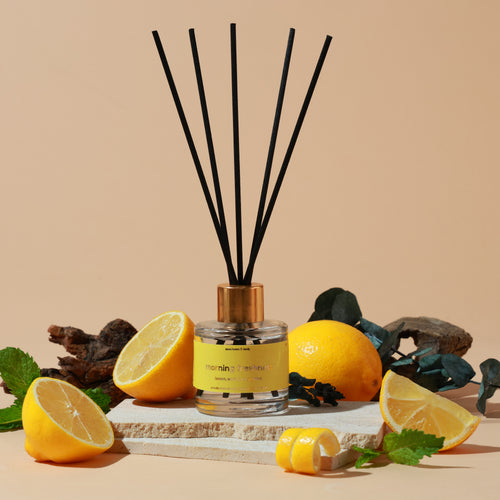
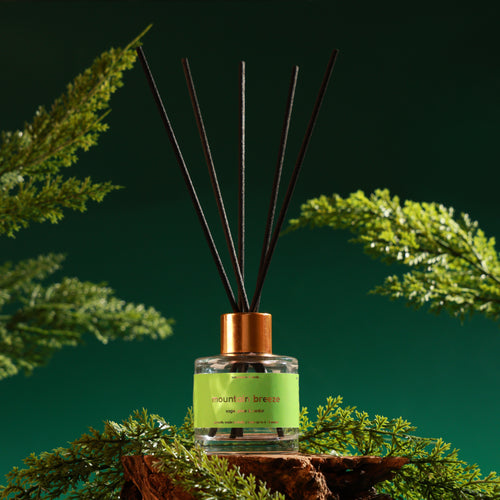
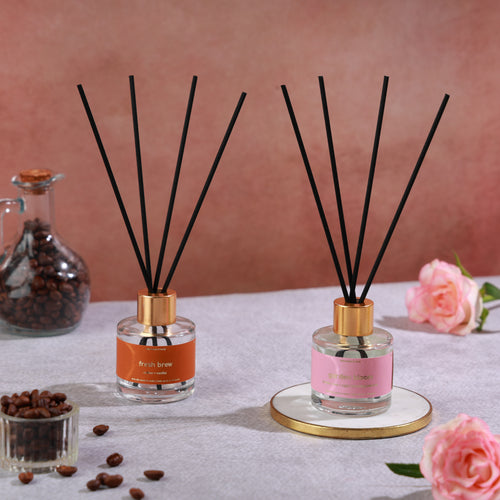
Then the note, which matters more for a bottle left running in an empty flat than for one you live beside. Choose for how it behaves when it has accumulated, not for how it smells when you sniff the bottle. A clean, bright composition that has been building quietly for two weeks reads as present and slightly strong; a warm, heavy one in the same situation reads as thick and enclosed, and thick is the word people use when they have decided against a product. Morning Freshness at ₹749 — Malabar lemon, peppermint and eucalyptus — is the most forgiving bottle in the reed line for this job, because everything in it is structurally light and because a citrus-mint note is the closest thing in fragrance to the impression of a window having been open. Mountain Breeze at ₹849 — Himalayan pine, sage and cedar — is the dry alternative if you find lemon obvious, and it holds its shape unusually well at higher concentration. Evening Calm at ₹799 and Fresh Brew at ₹849 are both lovely and both the wrong choice here, because lavender and coffee are exactly the registers that turn heavy on accumulation. The 130ml sizes from ₹1,249 change nothing about the rate, since the rate is set at the reeds rather than in the bottle; they simply mean you refill less often, and 300ml reed refills at ₹2,399 are the sensible restock once you know which bottle you actually keep buying.
Then the boundary, the alternatives and one thing this page will not claim. Over about three weeks, cap it. Take the reeds out, put the stopper back in, and stand the bottle in a cupboard — the oil keeps perfectly well and you have simply paused the meter. The reason for the boundary is that the value of the whole exercise is concentrated in a single moment, the moment you open the door, and past three weeks you are paying an increasing amount for a fixed reward while the accumulation risk in an unventilated flat rises at the same time. If your trips are regularly longer than that, or regularly more frequent than a reed can sensibly absorb, the format is arguably wrong for you rather than the settings, and the comparison worth reading is the reed against the Sukoon for coming home from a trip, where a machine that spends nothing at all when it is off changes the arithmetic completely. And the thing this page will not claim: a reed left standing does not solve a flat that smells closed. It gives you a settled flat rather than a shut one, which is a genuine and pleasant difference, but if a drain trap has dried out or the washing machine gasket has gone sour then what you will walk into is a reed on top of that, which is worse than the reed alone. The free work still has to happen — windows on opposite walls, a mug of water down every drain — and it is set out properly in the first-hour page for this group. Fragrance is the finish, on this page as on every other one.
The SOSA edit
What I would actually do on the morning of a two-week trip, in order, and none of the first three costs anything. The last row is the claim I am not going to make for the product, printed rather than left to be discovered on the doormat.
| Do this | What it is | Why it comes here | Cost |
|---|---|---|---|
| 1. Reeds down to two or three ★ | Pull the surplus out, wipe them, stand them dry in a glass, replace them on your return | First. The reed count is the only output control a reed has, and halving it roughly halves the rate | Free |
| 2. Move the bottle off the sill | Onto an interior shelf in the hall, out of afternoon sun, away from anything that produces heat | Second, and the biggest single variable. A hot closed flat can run at close to double the winter rate | Free |
| 3. Do not flip the reeds | Flipping moves saturated surface into the air and produces a deliberate burst | Third. A burst on day one of fourteen is the exact opposite of what an empty flat wants | Free |
| 4. Morning Freshness or Mountain Breeze | Malabar lemon, peppermint and eucalyptus at ₹749, or Himalayan pine, sage and cedar at ₹849 | Choose for how it behaves accumulated rather than how it smells in the bottle. Clean reads as present; warm reads as thick | ₹749 / ₹849 |
| 5. 300ml reed refill or 130ml | ₹2,399 for 300ml, or 130ml bottles from ₹1,249 — the same rate, refilled less often | Once you know which bottle you keep going back to. The rate is set at the reeds, never in the bottle | from ₹1,249 |
| What it will not do: rescue a flat that smells closed | A reed on top of a dried-out drain trap or a sour washing machine gasket is worse than the reed alone | Said here rather than found on the doormat. The free work still has to happen when you get in | — |
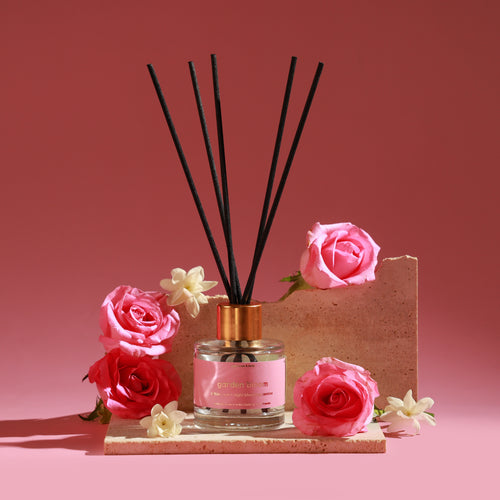
Versailles
I get asked this most often in April and May, and the version of the question people ask is not quite the one they mean. They ask whether leaving it out is wasteful, and what they actually want to know is whether capping it would save them anything. The answer to the second is yes, and the answer to the first depends entirely on what you think an arrival is worth. A reed is a passive evaporator. It responds to heat and to moving air and to nothing else, and it has no way of knowing that the flat is empty. So the fortnight of oil is a fortnight of oil. The only decision in front of you is whether it evaporates into a room that will greet you properly or into the inside of a cupboard.
For two weeks I leave mine out, and I take reeds out until three are standing, and I move it off the sill because Pune in May does things to a closed flat that people do not believe until they measure it. What I am buying is not fourteen days of fragrance. It is about ten seconds of it — the ten seconds after the door opens, when a flat either feels like somewhere you live or like somewhere that has been shut. That is a small purchase and I am comfortable saying it is a small purchase. Over three weeks I cap it, because past that point I am paying a rising price for a reward that has not got any bigger, and because a bottle running unchecked into a sealed flat for a month is how people end up walking into a room that smells of one thing far too much. Fewer reeds, off the sill, and a limit. That is the whole of it.
Everything is made and supported from Pune, and a part of every order funds girl-child education through Nanhi Kali. You get a home that smells like somewhere you chose; a girl gets a classroom. That equation has always felt right to me.
Frequently asked questions
- Is leaving a reed diffuser out while I'm travelling just wasting it — the same question answered with arithmetic instead.
- Should frequent travellers use reed diffusers differently — the settings, for people who do this monthly.
- I came home after a two-week holiday and my flat smells closed — the free work a reed cannot do for you.
- Reed diffuser or Sukoon for coming home from a trip — the two formats on this one job.
- Brand: the SOSA founder story.
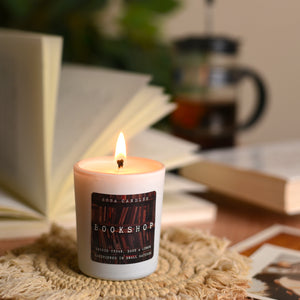
Facts verified August 2026: Timings in this guide: a scented candle puts noticeable fragrance into a normal room in roughly 15–20 minutes; a Sukoon ultrasonic diffuser reaches a steady level in about 20 minutes from cold; a reed diffuser needs roughly 24–72 hours for the oil to travel the reeds and the room to settle, so it is not a same-day solution. SOSA products and prices: Sukoon 500ml ultrasonic diffuser ₹1,899 (270–320 sq ft, 16–18h on low, 9–12h high, 30–50 ml/h, 2.4MHz cool mist, 7-colour LED, remote, steady/2H/4H timers, BPA-free, auto shut-off, includes three 15ml Hotel Collection scents of your choice); Boond 300ml ₹899; Megh 6-litre ₹3,499; waterless Vaayu ₹11,999 (up to 1000m³); Aangan ₹25,999; Meenar ₹38,500. Hotel Collection water-based fragrance 15ml ₹299, 100ml ₹999, 300ml ₹1,799, Pack of 7 at 15ml ₹1,799 / 100ml ₹5,999 / 300ml ₹10,799; dose 3–6 drops per tank. Reed diffusers (separate alcohol-free line): Morning Freshness from ₹749, Garden Bloom and Evening Calm from ₹799, Fresh Brew and Mountain Breeze from ₹849; 130ml from ₹1,249; duos from ₹1,498; 300ml refills ₹2,399. Scented candles: Bookshop 80g ₹379 (~15–18 hours), Bookshop + Cozy Corner ₹664 (~30–36 hours), Amber Rose 130g ₹599 (~25–30 hours) and 220g ₹799 (~40–50 hours), ceramic jar candles ₹949, Pure Calm wax melt set ₹854. Free shipping above ₹499. SOSA does not make a room or linen spray for the home — the sprays in the range are car perfumes. The Hotel Collection scents are SOSA's own interpretations; SOSA is not affiliated with or endorsed by any hotel brand. Prices subject to change — see the live product pages.