



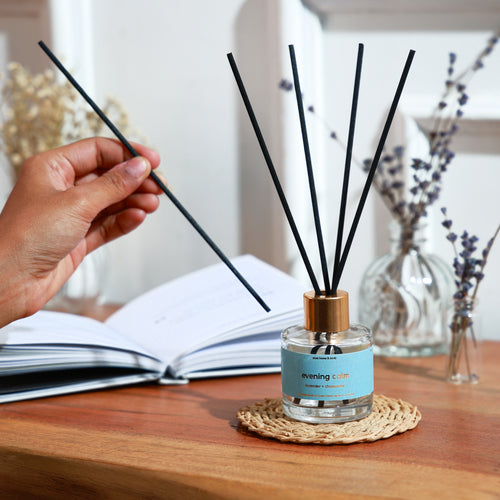
The real exception: a bedroom with a door that shuts. Then the second bottle is justified by weight rather than variety — a room you sleep in wants something quieter. Evening Calm at ₹799 is Himalayan lavender and chamomile, and it is the argument.
The money: a reed duo is ₹1,498 against ₹1,548 to ₹1,598 for the same two bought singly — a saving of ₹50 to ₹100. And the honest alternative: one reed plus one Sukoon covers more ground than two reeds ever will.
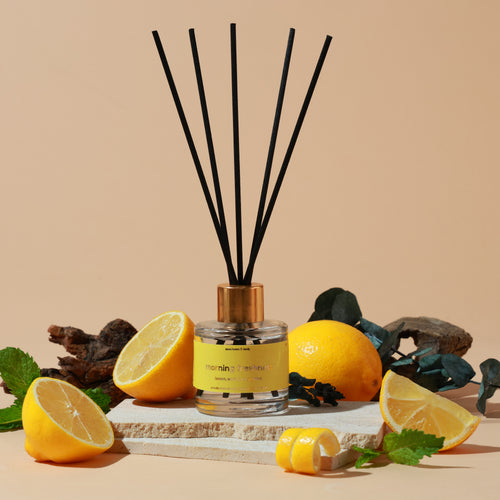
2. If the door stays open, buy one reed and put it in the living area. One scent, running everywhere, is what reads as deliberate. Morning Freshness from ₹749 or Mountain Breeze from ₹849 will carry a 1BHK on their own. Spending ₹1,548 on two bottles to achieve a worse result is a genuinely common outcome.
3. If the door does shut, a second bottle is justified — but for weight, not variety. You are unconscious in that room for seven or eight hours a night, and a scent chosen to be interesting is the wrong tool for a room whose job is to stop being interesting. Evening Calm at ₹799 — Himalayan lavender and chamomile — is quieter than anything you would put in a living room, which is the point of it.
4. Keep the two in the same broad family if you can. Two fresh scents at different volumes read as one home with a quiet end. A citrus in one room and a coffee-and-vanilla in the next read as two different flats sharing a wall, and the doorway announces it every time.
5. Buy the pair together if you are buying two. A duo is ₹1,498 against ₹1,548 for a ₹749 and a ₹799 bought separately, or ₹1,598 for two ₹799 bottles — ₹50 to ₹100 saved, and both bottles arrive on the same day, which matters because a reed needs 24 to 72 hours before it is doing its job.
A portion of every order supports girl-child education through Nanhi Kali.
What actually happens where two scents meet
Almost everybody imagines a two-scent home as two rooms, each smelling of its own thing. That is not what the building does with them. Fragrance molecules move with air, air moves through openings, and a bedroom door is an opening — so what you get is not two scents but three: the first one, the second one, and a shifting mixture of both occupying the doorway and a metre either side of it. That third one is the one you pass through most often, and it is the one nobody chose. In a 1BHK or a compact 2BHK the mixing zone can easily be a fifth of the floor area. This is the single reason the two-scent plan disappoints people who have spent properly on it, and it is worth understanding before you spend rather than after.
One bottle, two bottles, or one bottle and a machine
The four arrangements a new two-room home can realistically take, with what each actually costs and what it actually does. The prices are for 50ml reeds, which last months; 130ml versions run from ₹1,249 and duos at 130ml from ₹2,498. Every reed on this table needs 24 to 72 hours before it is doing its job, so none of these is a same-day answer.
| Arrangement | Cost | What it gives you | Right when |
|---|---|---|---|
| One reed, living area ★ | ₹749–₹849 | A single scent that carries the whole flat and reads as a property of the building rather than as decoration | The bedroom door stays open, which is most new flats. The default, and the cheapest correct answer |
| A reed duo, one per room | ₹1,498 (vs ₹1,548–₹1,598 singly) | Two rooms held at fixed levels, plus a mixing zone in the doorway if the door is ever open | The bedroom door genuinely shuts at night, and you want the same family at two different weights |
| One reed + one Sukoon | ₹2,648 | A permanent background in one room and a timed, adjustable, switchable scent in the other, with three 15ml scents included | You want control in the bedroom — on at bedtime, off by the 2H timer, nothing running while you are out |
| One reed + one Boond | ₹1,648 | The same idea at 300ml rather than 500ml — same three-to-six-drop dose, fewer hours per fill | The second room is small and the budget is closer to ₹1,500 than ₹2,500 |
| Two reeds, different families | ₹1,548–₹1,698 | Two unrelated scents and a doorway that announces the change twenty times a day | Rarely. This is the arrangement people regret, and the one most often bought |
| Nothing in the bedroom at all | ₹749–₹849 total | One scent, drifting in whenever the door is open, at a level lower than the living room's | A completely respectable answer, and the one I use in my own flat's spare room |
 Morning Freshness · shared space₹749Shop → Evening Calm · behind the door₹799Shop →
  Sukoon · the controllable second zone₹1,899Shop →
Same family, lower volume — how to run a two-room flat
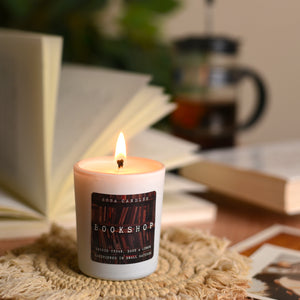
Start with reed count, because it is the control most people do not realise they have. A reed diffuser's output is set almost entirely by how many sticks you put in and how often you flip them, and a 50ml bottle supplied with eight or ten reeds is not obliged to run all of them. In a living area of 150 to 200 sq ft, all the reeds is usually right. In a bedroom, start with half — four or five — and add one at a time over the following week if the room feels blank. This is how you achieve the same-family, lower-volume arrangement without buying a different scent at all: the identical bottle, running at half strength behind a door, is a genuinely elegant solution and it costs nothing. Flipping the reeds refreshes the output sharply for a day or two, so do it in the living room when people are coming and leave the bedroom alone. And give the thing time. A reed needs 24 to 72 hours from opening before the oil has travelled the sticks and the room has reached equilibrium, which means a reed is the wrong purchase if somebody is arriving tomorrow and exactly the right purchase for a home you are setting up to live in for two years. If you need a room to smell different tonight, that is a Bookshop candle at ₹379 in fifteen to twenty minutes, or a Sukoon at ₹1,899 in about twenty from cold. It is not a reed, and I would rather say so than sell you one.
Then placement in a two-room flat, which is subtler than in a one-room one. The living-room reed should sit away from the bedroom door rather than near it, which is the opposite of what people do. The instinct is to put it in the middle so it reaches both rooms; the effect is to concentrate the mixing zone exactly where you walk. Put it on the far side of the living area — a console, a shelf, the end of a sideboard — and let it fill that room properly instead. The bedroom bottle, if you have one, goes on a chest of drawers or a shelf rather than the bedside table: a metre or so of extra distance makes a measurable difference to how much of it reaches your face while you sleep, and it also puts it out of reach of an arm reaching for a phone in the dark. Keep both out of direct sun and away from a fan or an air-conditioning vent, which strip the light top notes and leave the heavy base standing alone. Reed oil marks polished wood and painted finishes, so a saucer, a coaster or a small tray under each bottle is not fussiness — it is the difference between a deposit returned and a deposit argued about. In a rental that is worth more than the price of the diffuser.
Then the honest limits, and the principle. Two reeds do not double the scent in a flat; they double the number of decisions you have made and add a boundary you have to walk through. If your real reason for wanting two is that you would like variety, the better answer is a machine rather than a second reed, because a machine lets you change your mind: the Hotel Collection is ₹299 for 15ml, water-based, three to six drops per tank, and swapping scents takes a rinse of the tank and thirty seconds. A reed commits you for months. On the practical constraints: never put Hotel Collection oil into a reed diffuser — the reeds are a separate alcohol-free line with their own five scents, formulated to travel up a stick rather than to be misted — and never put reed oil or any raw essential or carrier oil into an ultrasonic, where it clogs the 2.4MHz plate. SOSA does not make a room spray for the home; the sprays in the range are formulated and sized for a car, so spraying a bedroom every evening is not an arrangement I can sell you even if you wanted it. And the principle: a home that smells of one thing reads as considered, and a home that smells of three reads as products. The restraint is the luxury, which is an unfashionable thing for somebody who sells bottles to say and is nonetheless true.
The SOSA edit
In buying order for somebody setting up a new home and deciding between one bottle and two. The first row is what most people should buy; the second is the only honest reason to add a second bottle; and the last row is the arrangement I would talk you out of.
| Buy | What it is | When it earns its place | Price |
|---|---|---|---|
| 1. Morning Freshness or Mountain Breeze ★ | Malabar lemon, peppermint and eucalyptus, or Himalayan pine, sage and cedar — 50ml, alcohol-free | First and often only. One scent in the living area, carrying the whole flat. Allow 24 to 72 hours to reach its level | ₹749 / ₹849 |
| 2. Evening Calm | Himalayan lavender and chamomile — the quietest of the five reed scents | Only if the bedroom door genuinely shuts. Run four or five reeds rather than all of them, on a chest of drawers rather than the bedside table | ₹799 |
| 3. A reed duo | Two bottles together from ₹1,498, against ₹1,548–₹1,598 for the same pair singly | If you have decided on two, buy them as a pair — ₹50 to ₹100 saved, and both rooms settle over the same 72 hours | from ₹1,498 |
| 4. Sukoon instead of the second reed | 500ml, 270–320 sq ft, steady/2H/4H timers, three 15ml Hotel Collection scents of your choice included | When what you want in the second room is control rather than another fixed level. ₹897 of fragrance in the box | ₹1,899 |
| 5. 300ml reed refill | Refills the bottle you already own rather than replacing it | Months later, once you know the scent has survived. Reeds should be replaced at refill time; the old ones are saturated | ₹2,399 |
| Not this: two reeds in unrelated families | A citrus in one room and a coffee-and-vanilla in the next, ₹1,548–₹1,698 | The commonest regret in this category. The doorway mixes them and announces the change every time you cross it | — |
Versailles
I get asked this question most often by people who have just signed their first proper lease, and there is usually an unspoken second question behind it, which is whether having only one scent means they have not done it properly. They have it backwards. Buying one scent and running it everywhere is the more sophisticated choice, and it is what every hotel you have ever admired the smell of actually does. The corridor and the room are the same composition; only the intensity changes. Nobody experiences that as monotony. They experience it as coherence, and they usually cannot say why.
Where I do change my mind is a bedroom with a door that shuts, and the reason is not decorative. You spend more hours in that room than in any other and almost all of them unconscious, so the right scent for it is one that asks nothing of you. Lavender and chamomile at half the reed count, on a chest of drawers across the room rather than beside your head, is a different sort of decision from buying a second bottle because the first one felt insufficient. If you are choosing between spending ₹1,498 on two reeds and ₹1,899 on a machine that comes with three scents, I would take the machine most days, and I say that knowing perfectly well which of the two is the smaller order.
Everything is made and supported from Pune, and a part of every order funds girl-child education through Nanhi Kali. You get a home that smells like somewhere you chose; a girl gets a classroom. That equation has always felt right to me.
Frequently asked questions
- What fragrance should I choose as the signature scent of my first apartment — how to pick the one bottle properly.
- My new rental is small and has an open kitchen — where should the reed go — placement, with the reasons.
- I have only ₹1,000 left after moving — is a reed diffuser worth it — the honest value case.
- The best home fragrance purchase in your first week — the ranked list, and what not to buy yet.
- Brand: the SOSA founder story.
Facts verified August 2026: Timings in this guide: a scented candle puts noticeable fragrance into a normal room in roughly 15–20 minutes; a Sukoon ultrasonic diffuser reaches a steady level in about 20 minutes from cold; a reed diffuser needs roughly 24–72 hours for the oil to travel the reeds and the room to settle, so it is not a same-day solution. SOSA products and prices: Sukoon 500ml ultrasonic diffuser ₹1,899 (270–320 sq ft, 16–18h on low, 9–12h high, 30–50 ml/h, 2.4MHz cool mist, 7-colour LED, remote, steady/2H/4H timers, BPA-free, auto shut-off, includes three 15ml Hotel Collection scents of your choice); Boond 300ml ₹899; Megh 6-litre ₹3,499; waterless Vaayu ₹11,999 (up to 1000m³); Aangan ₹25,999; Meenar ₹38,500. Hotel Collection water-based fragrance 15ml ₹299, 100ml ₹999, 300ml ₹1,799, Pack of 7 at 15ml ₹1,799 / 100ml ₹5,999 / 300ml ₹10,799; dose 3–6 drops per tank. Reed diffusers (separate alcohol-free line): Morning Freshness from ₹749, Garden Bloom and Evening Calm from ₹799, Fresh Brew and Mountain Breeze from ₹849; 130ml from ₹1,249; duos from ₹1,498; 300ml refills ₹2,399. Scented candles: Bookshop 80g ₹379 (~15–18 hours), Bookshop + Cozy Corner ₹664 (~30–36 hours), Amber Rose 130g ₹599 (~25–30 hours) and 220g ₹799 (~40–50 hours), ceramic jar candles ₹949, Pure Calm wax melt set ₹854. Free shipping above ₹499. SOSA does not make a room or linen spray for the home — the sprays in the range are car perfumes. The Hotel Collection scents are SOSA's own interpretations; SOSA is not affiliated with or endorsed by any hotel brand. Prices subject to change — see the live product pages.