


The four things to fix first, in order: flush the suction lines at the end of every session and empty the trap on a named schedule · local exhaust at the chair for monomer and eugenol · ventilate the compressor and suction-motor cupboard · empty the plaster trap under the model bench.
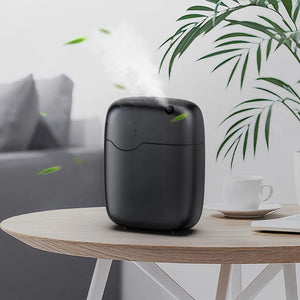
Then the waiting area, and only the waiting area: it is a public room with chairs in it, so it takes the same light scent as the main lobby, usually from the Vaayu at ₹11,999 that is already holding the floor. A 1,400 sq ft dental wing has roughly 117 cubic metres of scented volume left once the closed doors come out of the sum.
2. Flush the suction lines and empty the trap before you do anything else. If your dental corridor is acceptable at nine in the morning and unpleasant at four in the afternoon, that is the evacuation system and it is almost never anything else. End-of-session flushing with the manufacturer's line cleaner, and a named person emptying the trap on a written schedule. It costs a rota rather than money.
3. Put local exhaust where the chemistry is released. Methyl methacrylate monomer from acrylic work and eugenol from temporary cements are chairside and intermittent. A chairside extraction arm over the working field is the proper answer; a ceiling extract that genuinely pulls, plus a door that is actually shut, is the workable one.
4. Then look at the two rooms nobody inspects: the compressor cupboard and the model bench. An oil-lubricated compressor sharing an unventilated cupboard with a mop and a bucket is at positive pressure to the corridor every time it cycles. A plaster trap under the model sink that is never emptied is a wet sludge trap in a room with no extract.
5. The operatories, the sterilisation room and the dental X-ray cubicle are fragrance-free. Treatment and procedure rooms, sterile stores and imaging rooms are all on the list of places a diffuser does not belong in, and a dental wing contains one of each. That list is longer than the list of places it does belong, on purpose.
6. The dental waiting bay is ordinary, and that is the whole commercial answer. It is a public room with chairs in it. Same fragrance as the lobby, same intensity, same schedule — and in most polyclinics it is a bay of the shared hall rather than a separate room, which means the Vaayu at ₹11,999 already covering the floor reaches it and there is nothing further to buy.
A portion of every order supports girl-child education through Nanhi Kali.
The five dental smells, and where each one actually lives
Dentistry is the one speciality inside a general polyclinic where a patient in the waiting area can sometimes name the smell coming out of the department, and that single fact changes how the whole wing has to be handled. Everywhere else in your building the clinical smells are broadly anonymous — alcohol, floor cleaner, warm plastic. In a dental wing they are clove, solvent and something the patient associates directly with pain. Which means a dental odour is never a background; it is a specific thing arriving from a specific place, and the only useful response is to find the place. There are five of them and only one is in the operatory.
Extraction or fragrance: what each dental odour actually needs
Every recognised source in a dental wing, what it physically is, what the correct answer is, and whether fragrance has any business in that location at all. Five of the six rows say no, which is the honest shape of this department. The one row that says yes is the row that costs you nothing extra, because the volume is already covered.
| Where it comes from | What it physically is | The correct answer | Fragrance here? | Cost |
|---|---|---|---|---|
| 1. The suction line and trap ★ | Wet evacuation carrying saliva, blood, irrigation fluid and debris to a trap that fills through the day | End-of-session flushing with the manufacturer's line cleaner; a named person emptying the trap on a written schedule | No. A corridor that is fine at nine and not at four is telling you this | ₹0 and a rota |
| 2. The chair, during acrylic and endodontic work | Methyl methacrylate monomer, eugenol cements and sealers, and cut dentine when a bur runs short of coolant | Chairside local exhaust over the working field, or a ceiling extract that genuinely pulls with the door shut | No. Operatories are treatment rooms and stay fragrance-free | Extraction |
| 3. The compressor and suction-motor cupboard | Warm oil from an oil-lubricated compressor, plus damp from the mop and bucket stored next to it | A ventilation grille, a dry floor, and the cleaning kit moved to a different room | No. It goes to positive pressure every time the motor cycles | A grille and a rule |
| 4. The model and plaster bench | Gypsum dust, alginate, and a plaster trap under the sink that nobody has opened in a year | A local extract over the bench, and the trap added to the same schedule as the suction | No | Extraction |
| 5. The dental waiting bay | People, upholstery, occupancy and whatever the air changes are doing at four in the afternoon | Ventilation and seating first, then the same light scent as the rest of the floor at the same setting | Yes — it is an ordinary public room | Usually already covered |
| 6. Sterilisation room and dental X-ray cubicle | Autoclave steam, chemical indicators, and a lead-lined room with the door closed | Room extract and a door that shuts. Nothing added to the air in either | No. Sterile stores and imaging rooms are fragrance-free | — |
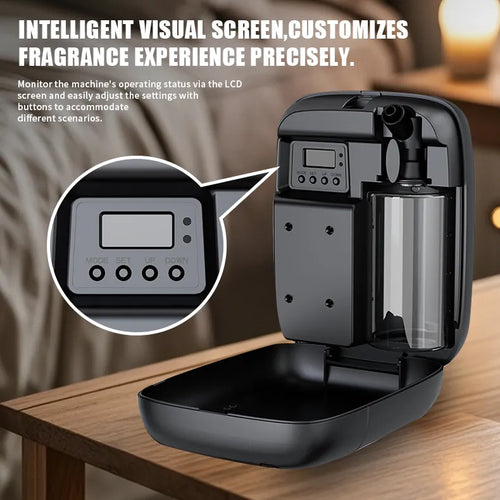
The waiting bay, the corridor, and the machine that already reaches them
Start with the boundary, because in a dental wing the boundary is doing most of the work. The line between the scented part of this department and the unscented part is a door, and the whole design question is whether that door is ever actually shut. In practice it is the single most reliable failure I find in Indian dental wings: the operatory door is propped open with a stool because the split air-conditioning unit is in the corridor and the room gets warm, and from that moment every one of the chairside arguments on this page collapses. Fix the cooling in the operatory and the door will shut itself. Then fit a door closer, because a closer removes the decision from a nurse carrying a tray. Once the doors close reliably you have two separate volumes — a clinical one that receives nothing and a public one that receives the same light scent as your lobby — and you can hold both at once from a single machine standing in the corridor. Placement follows the same rules as anywhere else in a clinic: three or four metres inside the bay rather than at a threshold, above waist height because a cold-air mist falls rather than rises, at the edge of the seating rather than in the walking line, and out of the direct throw of an air-conditioning vent, which strips the light top off a composition and leaves the heavy end standing on its own. The Vaayu wall or HVAC mount earns its fitting cost in a dental bay for a reason that has nothing to do with performance: it puts the unit above the reach of a bored eight-year-old waiting for an orthodontic adjustment, and the key-lock handles anyone taller.
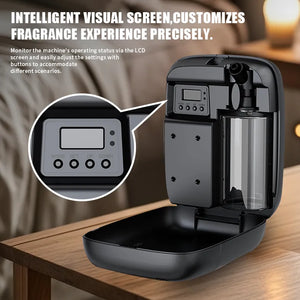
Then the setting and the hours, which in dentistry are a slightly different shape from the rest of your building. A dental department runs on longer appointments than a general outpatient clinic — forty minutes, an hour, sometimes two for an endodontic session — which means the bay empties and refills in slower waves rather than the steady churn a general waiting hall sees. That matters for exactly one reason: the temptation to adjust. A bay that is empty at eleven and full at noon looks like a room that needs a different setting at each hour, and it is not. The level gets set once, in the first week, by walking in cold each morning before the department fills, and then it is locked and left. Nobody raises it because the bay got busy, because busy is an occupancy and air-change problem and adding fragrance to it makes the room worse rather than better — the peak-hours question has its own page. The Vaayu carries 1h, 4h, 8h and 24h onboard timers plus Bluetooth app scheduling, so a dental wing that runs from nine to seven gets a schedule that starts at half past eight and stops with the last appointment, and the 24h setting stays unused because a clinic is not a building that never closes. A 400ml tank holds about seventy-five days at those hours, which is four refill visits a year per unit and a line whoever owns refilling and maintenance can put into a rota without thinking about it.
Then the things that will go wrong in month three, and the limits of the products themselves. The first is nose-blindness among your own dental staff, and it is worse in this department than anywhere else in the building, because dental nurses spend their day in a room with a genuinely strong chemical smell in it. A person who has spent four hours next to eugenol and acrylic cannot judge what the waiting bay smells like at half past two, and they are precisely the person most likely to say the level should go up. Ask a supplier's engineer, a courier, a visiting orthodontist — anybody who walks in cold twice a month — and ask them to be accurate rather than polite. The second is that a source smell will come back: a trap is missed over a festival weekend, a locum forgets the end-of-session flush, a compressor cupboard door gets blocked by a delivery. The correct response is never to raise the fragrance, because covering a smell whose cause you have not found deletes the signal that told you a task had slipped. Find it and fix it. On the products themselves, plainly: the Vaayu at ₹11,999 is waterless and runs its own undiluted oil rather than the water-based Hotel Collection bottles, and it ships with four hotel-inspired fragrances. The ultrasonic Sukoon at ₹1,899, Boond at ₹899 and Megh at ₹3,499 hold standing water and put 30–50 ml of it into the air every hour, which makes them honest for the dental department's own office, with a named person on the tank, and wrong for a public bay. An alcohol-free reed diffuser from ₹749 needs 24 to 72 hours to establish and is barely noticed past about a metre. Candles have no place in a healthcare building at all, because an open flame is a fire-safety and insurance matter rather than a fragrance one. And SOSA does not make a room spray, so a morning spray in the dental corridor is not a product we can sell you even if you wanted it.
The SOSA edit
In the order I would actually spend, for a clinic owner with a dental wing that smells. The first three rows are not fragrance at all and the most important item on the list is one I do not sell, which is printed in the last row rather than left for you to work out.
| Do this | What it is | When it earns its place | Cost |
|---|---|---|---|
| 1. Flush the lines, empty the trap ★ | End-of-session flushing with the manufacturer's cleaner; a named person and a written schedule for the trap | First, always. This is the cause in the large majority of dental wings that smell in the afternoon | ₹0 and a rota |
| 2. Local exhaust at the chair | A chairside extraction arm over the working field, or a ceiling extract that holds a tissue at the grille | Second. Monomer and eugenol are released at a known point and are caught there or not at all | Contractor |
| 3. The compressor cupboard and the plaster trap | A ventilation grille, a dry floor, the mop moved out, and the plaster trap on the suction's schedule | Third. Two rooms nobody inspects, both of which vent into the corridor | Small works |
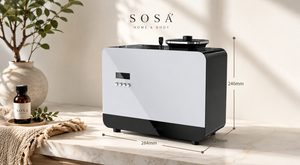
| 4. Vaayu for the floor's public volume | Waterless, up to 1000 m³, 400ml lasting about 75 days, app and 1h/4h/8h/24h timers, under 38 dB, key-lock, auto-stop | Only if the floor has no machine yet. If it has one, the dental bay is already inside its coverage | ₹11,999 |
| 5. The scent: the lightest of the seven | Westin-inspired White Tea Serenity — white tea, aloe and cedar, at the same setting as the rest of the floor | With the machine. A patient should not be able to name it, only to say nothing smelled unpleasant | from ₹299 |
| Not sold here: dental local exhaust | Chairside extraction arms, suction line cleaner and bench extracts come from your dental equipment supplier | The most important item on this list is one SOSA does not make, and pretending otherwise would be useless to you | — |

Versailles
The first dental wing I was called into was in Nagpur, and the centre head opened the conversation by asking me for something strong enough to deal with the corridor. I asked what time of day the corridor was a problem and he said afternoons, which more or less ended my usefulness as a perfumer within ninety seconds of arriving. It was the suction. Two chairs, one trap, an end-of-session flush that had quietly become an end-of-week flush after a nurse left, and a service duct running the length of the department. Nobody had done anything wrong on purpose. A task had simply fallen off a list and the building had been reporting it faithfully every afternoon for four months.
What I told him then is what this page says at more length. A dental department produces smells that have addresses, and a smell with an address is a maintenance instruction rather than a fragrance brief. Get the extraction right at the chair, get the lines and the traps onto somebody's name, put a grille in the compressor cupboard, and the department stops arguing with itself. Then the waiting bay is just a room with chairs in it, and it can have exactly what the lobby has and nothing more interesting than that. We fitted no machine in that clinic at all, because the one already standing in their reception was reaching the dental bay perfectly well. I would rather sell nothing and be believed the next time.
Everything is made and supported from Pune, and a part of every order funds girl-child education through Nanhi Kali. You get a space that smells like somewhere looked after; a girl gets a classroom. That equation has always felt right to me.
Frequently asked questions
- Which departments in a multi-speciality clinic should be scented and which should not? — the zone map the whole cluster hangs off.
- How should a physiotherapy department inside a polyclinic handle odour? — the other department with a plant room problem.
- Which areas of a medical centre should always be left fragrance-free? — the full list, and the reason for each.
- What should a multi-speciality clinic fix before it spends anything on fragrance? — the free work, in order.
- Brand: the SOSA founder story.
Facts verified August 2026: Product facts used in this guide. SOSA Vaayu ₹11,999: waterless cold-air nebulising diffuser, atomises undiluted fragrance oil to a dry residue-free nano-mist with no water reservoir, coverage up to 1000m³ (approximately 2,000–3,000 sq ft), 400ml refillable tank lasting up to about 75 days per fill, Bluetooth app plus onboard control, 1h/4h/8h/24h timer scheduling, adjustable intensity, under 38 dB, DC 12V/1A at 5W, 165 × 80.5 × 215 mm and 0.9 kg, freestanding or wall or HVAC mounted, auto-stop and key-lock, CE, RoHS and SGS certified, supplied with four hotel-inspired fragrances. SOSA Aangan ₹25,999: HVAC-connected or standalone commercial nebulising diffuser, coverage up to 3,000m³ (roughly 8,000–10,000 sq ft), 800ml reservoir, metal body, programmable schedules, under 42 dB. Ultrasonic machines are water-based, hold standing water and consume 30–50 ml of water an hour: Sukoon ₹1,899 (500ml, 270–320 sq ft, 16–18 hours on low, 3–6 drops per tank, steady/2H/4H timers, three 15ml Hotel Collection scents included), Boond ₹899 (300ml), Megh ₹3,499 (6 litres). Hotel Collection water-based fragrance 15ml ₹299, 100ml ₹999, 300ml ₹1,799, Pack of 7 at 15ml ₹1,799 against ₹2,093 bought singly; the Vaayu and Aangan take their own undiluted oil rather than these water-based bottles. Alcohol-free reed diffusers from ₹749, requiring 24–72 hours to reach their working level. Free shipping above ₹499. Coverage arithmetic: cubic metres equal floor area in square feet divided by 10.76 and multiplied by ceiling height in metres, counting only the volumes that are actually scented. This guide makes no medical, therapeutic or clinical claim of any kind for fragrance: a diffuser does not purify, disinfect or clean air, and does not treat, calm or affect any patient or condition. Fragrance is housekeeping and presentation. Clinical areas should be left fragrance-free, and a persistent odour should be traced to its source and corrected rather than covered. SOSA is not affiliated with or endorsed by any hotel brand. Prices subject to change — see the live product pages.