


Then test properly: leave the room for fifteen minutes and walk back in, and ask somebody who does not live there. You adapt to your own home within minutes; a visitor is a better instrument than you are.
If you still want a machine: Sukoon at ₹1,899 — 500ml, 270–320 sq ft, 16–18 hours on low, three 15ml Hotel Collection scents included. Very often the correct bedroom answer, and it should never be skipped on the way to something dearer.
About Safar ₹3,999: it is named and sold as a car and travel diffuser, SOSA publishes no room-coverage figure for it, its timer runs only 1, 2 or 3 hours and it needs recharging. It is the waterless mechanism at personal scale, not a set-and-forget room machine.
The honest gap: between Safar ₹3,999 and Vaayu ₹11,999 there is no mid-sized waterless bedroom nebuliser. Nothing here is “a Vaayu for one room”.
2. Understand what you are actually observing, because it is not a fault. A reed diffuser is a point source. Concentration is highest at the bottle and falls away with distance, smoothly — but perception compresses that smooth gradient, so you experience it as a corner with an edge rather than as a slope. A reed produces a fragrant zone, not a fragranced room. That is the design. It is also why the thing is silent, needs no power and never has to be switched on.
3. If a machine is genuinely the answer, start at Sukoon ₹1,899, not at Safar. A 500ml tank, 270–320 sq ft of coverage, 16–18 hours on the low setting, and three 15ml Hotel Collection scents in the box so it arrives ready to run. Its rating is the one in our range that matches an ordinary Indian bedroom. The honest costs: the oil is diluted in water, the mist adds humidity, the tank needs filling, and in a hard-water city it can leave a fine white mineral dust nearby.
4. Safar ₹3,999 is a different purchase, and here is what it says on the box. It is named and sold as a car perfume diffuser, and SOSA's own page names the car, the handbag, the desk, the bedside and the hotel room. So a small personal room is within its brief — but SOSA has published no square-foot or cubic-metre coverage figure for it and I will not invent one. What it is: waterless cold diffusion of undiluted oil, a 20ml bottle, a 2000 mAh Type-C battery, fully cordless, up to 10 hours continuous or around 30 intermittent per charge, three speeds, a 1/2/3-hour auto-off timer, 6.9 cm tall. What it is not: set-and-forget. The timer stops after at most three hours and the battery needs recharging.
5. And keep the reed, whatever else you decide. It is silent. It needs no power, no water, no filling and no charging. There is nothing to remember. It works in a power cut. It costs roughly ₹13–₹15 a day for a 50ml bottle running six to eight weeks. It is an object rather than an appliance, and it never breaks. Most rooms that end up right end up with both.
Alcohol-free, phthalate-free, IFRA-compliant, composed in Pune. Free shipping above ₹499, and a portion of every order supports girl-child education through Nanhi Kali.
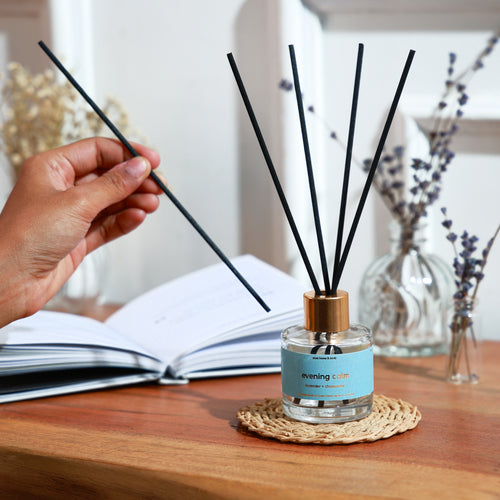
The six free fixes, in the order I would actually run them
Run these as a sequence rather than all at once, because if you change six variables together you will never know which one mattered, and you will not know what to do when you move house. Give each about two days. The whole exercise takes a week and costs nothing, and it settles this question for a great many people who arrived here expecting to be sold a machine.
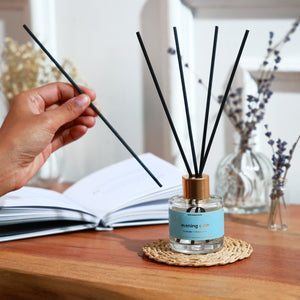
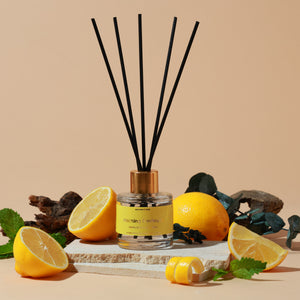
 Morning Freshness₹749Reed count is the only genuine dose control a passive diffuser has, and it is the one people most often leave at the factory setting. Put all six in and give it two days to saturate. It will empty faster — that is the honest trade, and it is why three reeds roughly double the life. Then, and this matters more than any change of scent, halve the distance between the bottle and where you are. Concentration falls away steeply from a point source, so moving a bottle from a far console to the table beside your chair does more than any amount of shopping. If the reader's answer is “but I want it across the room, not beside me”, that is a legitimate requirement and it is precisely the one a passive device cannot meet — hold that thought until the ladder further down.
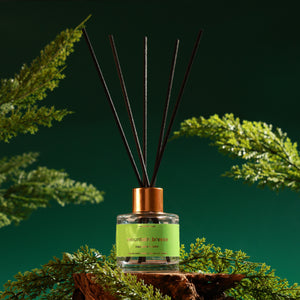
 Mountain Breeze₹849Put the bottle at or just below the height of your nose when you are sitting, on a surface — not on the floor, where you will never meet it, and not on a high shelf, where the same is true for a different reason. Then think about air. A windowsill or an open balcony door is the worst placement in the house, because air that leaves the room takes the fragrance with it; the bottle is not weaker, the room is being flushed. Directly in the blast of a running split AC is the other placement to avoid outright, because it strips the reeds and throws everything at one wall. But do not overcorrect into a dead corner behind a wardrobe, where nothing moves at all. You want the bottle standing in the room's circulation, not in its exhaust.
 Garden Bloom₹799Containment is half the equation and it costs nothing: a closed door stops the room's air being continuously diluted by the rest of the flat. And then the single best free instruction in this cluster. Turn the ceiling fan on to its lowest setting in a closed room. A reed has no fan and moves no air; a fan is the transport the bottle structurally lacks, and it converts a fragrant corner into something much nearer a fragranced room without you spending a rupee. Not directly under the blades at full speed, which simply scours the reeds. Low, in a closed room, for the hours you are in it. The one honest cost is that faster air over the reeds means faster evaporation, so the bottle will finish sooner — and you should be told that and left to choose, rather than have the tip withheld so that a machine looks better.
Why the bottle cannot do this on its own, however good the oil is
Here is the mechanism in the fewest words I can manage, because once you have it the rest of this page becomes obvious. Emission is how much fragrance leaves the source. Transport is how far it gets. A reed diffuser is excellent at the first and supplies none of the second. Oil climbs six fibre reeds by capillary action and evaporates from their surface at whatever rate temperature, humidity and airflow permit — no energy goes in, and no air is moved. From the reeds outward, the fragrance can travel only two ways: by molecular diffusion, which is orders of magnitude too slow to usefully cross several metres of a bedroom, and by whatever air the room itself happens to be moving. That second mechanism does nearly all of the work in any real home, and it is not under the bottle's control at all.
The consequence governs every purchase decision in this family, so it is worth stating flatly: you cannot fix a transport problem by increasing emission. More reeds raise emission. A bigger bottle raises duration and nothing else. A deeper, stronger-smelling oil raises emission. A second diffuser on the far wall raises emission in a second place, producing two concentration peaks with a valley between them — two hills, not a plateau. All four of those are reasonable things to try, all four are sold to people in this exact situation, and all four disappoint in precisely the same way, because none of them adds a single unit of transport. That is not a criticism of any of them. It is the reason a fan works and a bigger bottle does not.
There is one more thing worth knowing before you spend, because it explains a great deal of what people describe as fading. Receptors adapt to a constant stimulus within minutes. The molecules keep arriving; your brain stops forwarding the report. So a person can sit in a properly scented room and honestly say they smell nothing, while a guest walks in and immediately remarks on it. Before deciding your room is under-fragranced, leave it for a quarter of an hour and come back, and ask somebody who does not live there. It is genuinely common for the answer to arrive at that point rather than at the checkout.
Every option in the range, side by side, for one room that smells only near the bottle
The whole ladder, including the two products I would talk you out of. A comparison that lists only the things that fit your search is an advertisement rather than a comparison, so our own range's clearest trap is in the table as well.
| Option | Mechanism | What it adds | The honest catch | Price |
|---|---|---|---|---|
| The six free fixes ★ | Placement, dose and the room's own air | Real transport from the ceiling fan, and containment from the door | The fan shortens bottle life; the door has to actually be shut | Free |
| Reed 50ml | Passive capillary — six fibre reeds, no power | A permanent fragrant zone, silent, ~₹13–₹15 a day, up to ~150 sq ft | No transport whatsoever, and no control — it cannot be turned up or timed | ₹749–₹849 |
| Boond | Ultrasonic water mist, 300ml | Moved air and on-demand output up to ~150 sq ft, ~6 hours, USB, night light | Short runtime, small tank, water-diluted oil | ₹899 |
| Sukoon ★ | Ultrasonic water mist, 500ml | 270–320 sq ft, 16–18h on low, three 15ml Hotel Collection scents included | Diluted oil, adds humidity, needs filling, possible white dust in hard water | ₹1,899 |
| Megh | Ultrasonic water mist, six-litre tank | Around 100 hours of runtime from a single fill | Only ~215 sq ft — less coverage than the ₹1,899 Sukoon. A runtime and humidity machine, never a coverage upgrade | ₹3,499 |
| Safar | Waterless cold diffusion of undiluted oil | Dry mist, no water, no dilution, no humidity, no dust; cordless, three speeds, 20ml bottle | Named and sold as a car and travel diffuser; no published room-coverage figure; timer only 1/2/3h; needs recharging | ₹3,999 |
| Vaayu | Waterless cold-air nebulising, 1000 m³ | 2,000–3,000 sq ft, 400ml tank up to ~90 days, app and schedule, under 38 dB | The wrong purchase for one bedroom — nine-tenths of it idle in 120 sq ft | ₹11,999 |
 Room-sized · Sukoon₹1,899Shop → The zone · Evening Calm₹799Shop →
  Machine oils · Hotel Collection₹299Shop →
If you do buy a machine, the fragrance will probably change — and the reed keeps doing what it does
This is the disappointment I most want to prevent, because it arrives after the money has gone. Changing mechanism may mean changing scent. The three systems take three incompatible kinds of oil. Reed oil sits on a heat-stable CCT carrier engineered to climb fibre and evaporate slowly over weeks, and it cannot go into an ultrasonic machine. The water-based Hotel Collection oils are made for ultrasonic machines and cannot go into reeds — there is no hotel-inspired reed diffuser and there never has been. Safar takes pure fragrance oil and will clog on anything thick, sticky or water-based. So if the reason you are reading this is that you love one particular SOSA reed and want that smell across the room, the instruction is to add rather than to replace: keep the bottle where it is doing its work beautifully, and let a machine handle transport in its own fragrance.
And be fair to the object you already own, because it does several things no machine on this page does. It is silent — not quiet, silent. It needs no power and no water. There is nothing to fill, nothing to charge and nothing to remember on a Sunday evening. It goes on working through a power cut, which in most Indian cities is not a hypothetical. It runs at roughly ₹13–₹15 a day for a 50ml bottle over six to eight weeks. It is an object rather than an appliance: it sits on a console looking like something you chose, not something you installed. And it never breaks. Every machine has a tank or a battery, a plug or a charging port, and a failure mode; a glass bottle with six fibre reeds in it has none of those. For a great many readers the right conclusion is not to replace the reed at all, but to keep it exactly where it is and put the free fixes to work around it.
What I would buy, in order — and the gap in our own range
In the order I would actually spend, for a room that smells lovely at the bottle and ordinary three metres away. The last row is the honest gap, and if you skim only one line of this table, make it that one.
| Step | What it is | When it is the right answer | Price |
|---|---|---|---|
| 1. The six free fixes ★ | Six reeds not three · halve the distance · nose height · out of the draught · door closed · ceiling fan on low | Always, and for a week before anything else. A large share of readers stop here, and the fan is the one that usually settles it | Free |
| 2. Reed 130ml, or a second scent for a second room | More duration, and a different register elsewhere in the flat | If the bottle is running out rather than falling short — volume is duration, never coverage | ₹1,249–₹1,349 |
| 3. Sukoon ★ | 270–320 sq ft, 16–18h on low, three 15ml Hotel Collection scents included | The first genuine coverage upgrade, and very often the correct bedroom answer | ₹1,899 |
| 4. Safar | Waterless cold diffusion of undiluted oil, cordless, three speeds, 1/2/3h timer, 6.9 cm | When you want the dry waterless mechanism close to you, and can live with recharging and a short timer. Named and sold as a car and travel diffuser, with no published room-coverage figure | ₹3,999 |
| 5. Vaayu | 1000 m³ nebuliser, 2,000–3,000 sq ft, 400ml tank, app and schedule | Only when the brief grows: a whole floor, an open-plan living-dining, a large home or villa, a clinic, a salon, a showroom or a reception. Not one bedroom | ₹11,999 |
| The honest gap | Between Safar and Vaayu there is no mid-sized waterless bedroom nebuliser. Nothing in this range is “a Vaayu for one room” | Said plainly rather than answered by pointing you at the nearest expensive object | — |
Versailles
When somebody writes to say the fragrance is beautiful near the bottle and absent from the bed, they usually apologise for complaining. There is nothing to apologise for, and it is not really a complaint — the first half of that sentence is the compliment that makes the second half worth answering. You like what we made. You want more of it in more of the room. That is a completely reasonable thing to want and it has an answer, but the answer is not always a purchase, which is an awkward thing for a founder to write on her own website and the reason I would rather write it than not.
So I have put the free fixes at the top of this page instead of burying them under the products, and I would ask you to give them a proper week. The ceiling fan on low, in a closed room, is the one that surprises people. It shortens the life of the bottle and I have said so; you can decide whether that trade is worth it, but you cannot decide about a fix you were never told existed.
If you get to the end of the week and the room still is not what you want, then Sukoon at ₹1,899 before Safar at ₹3,999, and Safar knowing exactly what it is: our car and travel diffuser, with no room-coverage figure published, a timer that stops after at most three hours, and a battery to charge. Between it and Vaayu we make nothing bedroom-sized and waterless, and I would rather name that gap than sell around it. Everything is composed in Pune, and part of every order funds a girl's classroom through Nanhi Kali.
Frequently asked questions
- I like the fragrance but want much more projection — why the word “switch” is the trap.
- Reed diffuser vs Safar across a bedroom — scored head to head, with the reed's rows conceded.
- I don't want to keep buying more reed diffusers — consumption and coverage are two different complaints.
- High projection in one personal room — Safar before a larger machine?
- Safar vs Vaayu for one weak room — why the larger machine is the wrong shape.
- Do I need Vaayu for one smaller space? — no, and what Vaayu is genuinely for.
- When Safar beats hunting for the strongest reed — why that product cannot exist.
- When to move from passive to active — a decision rule that works even if you buy nothing.
- Reed, Safar or Vaayu — choose by the experience you want, not the product you searched for.
- Brand: the SOSA founder story.
SOSA products — facts verified August 2026: Reed diffusers in 50ml and 130ml only — Morning Freshness ₹749 / ₹1,249, Evening Calm ₹799 / ₹1,299, Garden Bloom ₹799 / ₹1,299, Mountain Breeze ₹849 / ₹1,349, Fresh Brew ₹849 / ₹1,349; 50ml suits rooms up to ~150 sq ft and lasts 6–8 weeks, 130ml suits above 150 sq ft and lasts 14–18 weeks; six fibre reeds in a refillable glass bottle on a heat-stable CCT carrier; alcohol-free, phthalate-free, paraben-free, IFRA-compliant, 0 ppm formaldehyde; roughly ₹13–₹15 a day; climate-tested at 45°C and 85% RH; composed in Pune. Refills 300ml ₹2,399 and 500ml ₹3,499, oil only. Machines: Boond ₹899 (300ml, ≤~150 sq ft, ~6h, USB, night light); Sukoon ₹1,899 (500ml, 270–320 sq ft, 16–18h on low, three 15ml Hotel Collection scents included); Megh ₹3,499 (six-litre tank, ~100h runtime, ~215 sq ft — a runtime and humidity machine, never a coverage upgrade); Safar ₹3,999 (waterless cold diffusion of undiluted oil, 20ml bottle, 2000 mAh Type-C battery, fully cordless, up to 10h continuous or ~30h intermittent, three speeds, 1/2/3-hour auto-off timer, 6.9 cm — named and sold as a car and travel diffuser, with no published room-coverage figure); Vaayu ₹11,999 (waterless cold-air nebuliser rated to 1000 m³, roughly 2,000–3,000 sq ft, 400ml tank up to ~90 days, Bluetooth app and onboard buttons, 1h/4h/8h/24h windows, adjustable intensity, key-lock, under 38 dB, 5W, CE, RoHS, SGS). Hotel Collection oils are water-based and ultrasonic-only: 15ml ₹299, 100ml ₹999, 300ml ₹1,799, pack of seven ₹1,799. Reed oil, Hotel Collection oil and Safar's pure fragrance oil are not interchangeable in any direction, and there is no hotel-inspired reed diffuser. No oil-consumption rate has been published for any SOSA machine, so no machine running cost is computed on this page. Free shipping above ₹499. A portion of every order supports girl-child education through Nanhi Kali. SOSA is an independent Indian fragrance house; the Hotel Collection is SOSA's own interpretation inspired by the world's finest hotels, and SOSA is not affiliated with or endorsed by any hotel brand. Prices subject to change — see the live product pages.