



2. Space the clothes so air reaches both faces of every garment. Drying time is the whole variable. A shirt that dries in a few hours never develops the note; the same shirt crowded against three others for two days does.
3. Put a fan on the rack, not on the ceiling. Air moving across wet fabric is the single most effective free thing in this article, and a ceiling fan two metres above the rack is not doing it.
4. Deal with the textiles that are already holding it — the towel that never quite dries, the clothes folded away slightly damp, the curtain that touches the rack.
The honest gap: SOSA makes no dehumidifier, no air purifier and no odour eliminator, and there is no fragrance in my range or anybody else’s that removes a damp smell. Fragrance is the last twenty per cent of this problem and it only works once the first eighty is done.
2. Space the garments so both faces of each one are exposed. This is the fix people underestimate most. The musty note is not produced by water in the air; it is produced on fabric that stays wet for a long time. Halving the drying time by giving each garment room is worth more than any product on this page, and it costs nothing but a second rack or a wider spacing.
3. Move air across the clothes. A pedestal or table fan pointed at the rack does something a ceiling fan cannot, because a ceiling fan pushes air down onto the top of the rack and across the floor, not through the gaps between the garments. Air moving over wet fabric is what carries the water away; still air simply sits and saturates.
4. Clear the fabric that has already absorbed the note. Towels, the pile of worn clothes in the corner, curtains that touch the rack, anything folded into a cupboard while still slightly damp. Textiles are a reservoir, and a room can smell of damp for days after the last wash has come off the rack because the smell is now in things that are not the laundry.
5. Then, and only then, fragrance — at a low dose. Three reeds rather than six, in the airflow path near the doorway rather than tucked in a corner, and a bright register rather than a sweet one. Morning Freshness at ₹749 for 50ml.
Alcohol-free, phthalate-free, paraben-free, IFRA-compliant, 0 ppm formaldehyde, six fibre reeds in a refillable glass bottle, composed in Pune. Free shipping above ₹499, and a portion of every order supports girl-child education through Nanhi Kali.

What is actually happening in that room
A load of washing comes off the machine holding a great deal of water, and every millilitre of it has to go somewhere. Indoors, there is only one place for it to go: into the air of the room, and then into everything porous in that room. Clothes drying indoors release several litres of water into the air over the course of a day, and in a bedroom you have chosen the worst possible container for it — a small volume, a door that is shut all night, windows that in monsoon are shut against the rain, and a great deal of absorbent material already in there in the form of a mattress, a wardrobe, curtains and bedding.
The smell itself is a second-order effect and this is the part almost nobody is told. Water vapour has no odour. What produces the characteristic musty note is that fabric which stays wet for a long time supports microbial growth, and the by-products of that growth are what your nose is reporting. That single fact reorganises the whole problem, because it tells you the variable that matters is not humidity in the abstract — it is how long any individual garment stays wet. A shirt that dries in four hours does not develop the note. The same shirt, crowded into the middle of a rack in a still room, takes two days and does. Same flat, same rain, entirely different outcome, and the difference was spacing and a fan.
This is why I am not going to sell you anything in the first half of this article. There is no fragrance, from us or from anyone, that reverses that chemistry. Adding a pleasant odour to an unpleasant one gives you both at once, and in this particular case the combination is unusually bad, because damp is already a low, heavy, close-smelling thing and most home fragrances that people reach for when a room smells bad are sweet ones. Sweet over damp is the single most common mistake in this entire cluster of questions, and the result has a name in my inbox: people write and describe it as their room smelling “perfumed and still wrong”. The sequence is source, then airflow, then fragrance, and it does not work in any other order.
What each intervention actually changes
Below is the honest hierarchy, and I have put cost in the last column deliberately, because the ranking and the price run in opposite directions. The things that matter most here cost nothing, and the thing I sell sits at the bottom of the list doing a job that is real but is not the job you came looking for.
| Intervention | What it changes physically | Effect on the musty note | Effort | Cost |
|---|---|---|---|---|
| 1. Dry the clothes in another room | Removes the water source from the least ventilated space in the flat | The largest single change available to most households | One decision, then habit | Free |
| 2. Space the garments properly | Exposes both faces of each item so drying time falls sharply | Direct — the note develops as a function of how long fabric stays wet | Two minutes per load | Free, or one more rack |
| 3. Fan across the rack | Replaces the saturated layer of air sitting against the fabric | Large, and it compounds with spacing | Switch on, leave running | Free if you own a fan |
| 4. Clear and air the textiles | Empties the secondary reservoir — towels, curtains, folded clothes, bedding | Explains why a room stays musty after the laundry has gone | One afternoon, then upkeep | Free |
| 5. Fragrance, at a low dose | Adds a pleasant odour alongside whatever is left. It removes nothing | None on the damp itself. Real on how the finished room reads | Flip reeds every 3–5 days | From ₹749 |
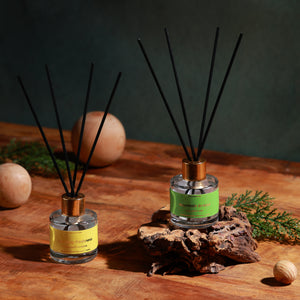
Bright · Morning Freshness₹749Shop →  Dry green · Mountain Breeze₹849Shop →
 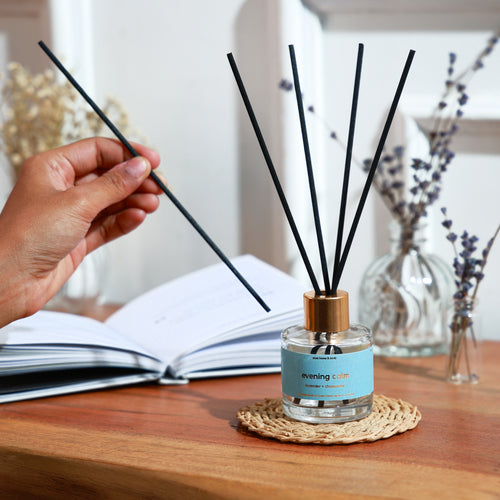 Soft · Evening Calm₹799Shop →
The textiles you are not thinking about
Here is the question I get in the second message, after somebody has moved the rack and is still unhappy: the clothes are gone, so why does the room still smell? The answer is that the laundry was never the only wet fabric in there. A bedroom in a monsoon month contains a mattress, bedding, curtains, a rug, a wardrobe full of cotton, and quite often a towel that has been hanging on a chair since Tuesday. All of those are absorbent, all of them have been sitting in air that was carrying the water from the rack, and several of them are slow to give it back. The room becomes a reservoir, and a reservoir keeps releasing after the tap is closed.
The practical version is unglamorous and it works. Wash and properly dry the towels rather than re-hanging them. Take the curtains down for a day if they have been near the rack. Do not fold anything into a cupboard while it is even slightly damp, because a closed wardrobe is a small, still, unventilated box and it is the single most reliable way to give a whole shelf of clothes the same note. Open the wardrobe doors for a few hours when the room is otherwise being aired. And on any day the rain genuinely stops, open everything and let the flat exchange its air properly, because ten honest minutes of cross-ventilation does more than a week of a shut room with something pleasant in it.
One more thing about your own nose, because it changes how you should judge all of this. Olfactory receptors adapt to a constant stimulus within minutes — the signal keeps arriving and the brain stops reporting it because nothing about it has changed. So you are the worst available judge of your own bedroom, and you will systematically underrate a problem you live with and overrate a change you have just made. Leave the flat for fifteen minutes and walk back in without thinking about it. That first breath is the only honest measurement you have, and it is free.
Only now: what fragrance is actually for here
Assume the rack has moved, the clothes are spaced, a fan runs across them and the towels have been dealt with. The room is now neutral, which is a great deal better than where you started and is still not what you asked for. Neutral is the ground on which a fragrance can build something, and building something is the entire job of a diffuser. In a monsoon bedroom it does one thing particularly well: it gives a room a consistent character through a fortnight when the windows have been shut and the flat has had no chance to smell of the outside world at all.
Two adjustments for the season. Use fewer reeds than you would in a dry month — three rather than six in a bedroom, which also roughly doubles how long the bottle lasts. And move the bottle into the room’s natural airflow path, near the doorway rather than in a far corner, because saturated air carries fragrance molecules less readily and projection genuinely does shorten in a wet month. That is the one season where placement is worth more than dose, and adding reeds to compensate mostly buys you a faster-emptying bottle rather than a stronger room.
On register: bright rather than sweet. A citrus sits in a completely different part of the spectrum from a damp organic note, so the two read as separate things and the citrus reads as clean. Anything sweet sits close enough to blend with it, and blended is precisely what you are trying to avoid. And one flat prohibition that has nothing to do with smell: no candle in a room where laundry is drying. Fragrance oil is flammable, a drying rack is a stand full of fabric, and an open flame near hanging cloth in an unattended room is not advice I will give at any price.
What to do, in order — and what I would talk you out of
The complete sequence with prices where prices exist, which is only at the very bottom. The last row is the part of this problem SOSA does not answer, said plainly rather than gestured at, because a fragrance house pretending to sell a solution to humidity is not worth anybody’s time.
| Step | What it is | Why it comes here in the order | Cost |
|---|---|---|---|
| 1. Move the drying out of the bedroom | Bathroom with an exhaust, covered balcony, utility area, or the room that stays open all day | Removes a continuous water source from the least ventilated room in the flat | Free |
| 2. Space the clothes | Both faces of every garment exposed; towels and denim separated from the rest | Drying time is the variable the musty note actually depends on | Free |
| 3. Fan across the rack | A pedestal or table fan pointed through the garments, not a ceiling fan above them | Moving air removes the saturated layer sitting against wet fabric | Free |
| 4. Clear the textile reservoir | Towels, curtains, bedding, and nothing folded away even slightly damp | Explains why the room stays musty after the laundry has gone | Free |
| 5. Morning Freshness 50ml ★ | Malabar lemon, peppermint, eucalyptus — three reeds, in the airflow path near the doorway | Gives a dry, aired room a character of its own through a shut-in fortnight | ₹749 |
| The honest gap: there is no product for the damp itself | SOSA makes no dehumidifier, no air purifier, no odour eliminator and no room spray — every SOSA spray is a car perfume. And no candle belongs in a room where laundry is drying, because fragrance oil is flammable and a rack is a stand full of fabric | Said plainly. Airflow is the answer to airflow | — |
Versailles
I have written a lot of pages for this website and this is the one I most wanted to get right, because the search behind it is somebody standing in their own bedroom at eleven at night with a rack of wet clothes in the corner, wondering whether ₹749 will make it stop. It will not, and I would rather lose the sale than have you find that out yourself in a fortnight.
The thing that changed how I answer this was realising the note is about time rather than about humidity. Once you know it comes from fabric staying wet too long, the whole problem becomes tractable, because you can shorten drying time with a fan and a bit of spacing in a way you can never dehumidify a flat in July. I have watched people put in a second rack, split the load, aim a table fan through it, and describe the difference as if something structural had changed in the building.
Then, in the dry room that follows, a diffuser is a lovely thing and does something genuinely useful: it gives you a consistent smell of your own through the weeks when the flat cannot smell of the outside. Three reeds, near the doorway, Morning Freshness if you like a bright register. If somebody tells you the order can run the other way, they are selling and not explaining. Everything is composed in Pune, and a portion of every order funds a girl’s classroom through Nanhi Kali.
Frequently asked questions
- Drying indoors in a Mumbai monsoon — the full sequence for a living room.
- Laundry in the spare bedroom — the worst case, and what to do about it.
- Why the house smells damp — the mechanism on its own, in full.
- Fresh without being too perfumed — the dose question around a drying rack.
- A 1BHK with no choice — practical sequencing when there is nowhere else.
- Best fresh fragrance for a Mumbai flat — why citrus longevity is the whole argument.
- Reed diffuser or Sukoon in monsoon — why a machine that adds water is the wrong answer here.
- Citrus, green or floral over damp — the scored comparison.
- A small flat through weeks of rain — the complete method in one place.
- Brand: the SOSA founder story.
SOSA reed diffusers — facts verified August 2026: Five scents, all alcohol-free, on a heat-stable CCT (caprylic/capric triglyceride) base, phthalate-free, paraben-free, IFRA-compliant, 0 ppm formaldehyde, six fibre reeds in a refillable glass bottle, composed and made in Pune, India. Morning Freshness (Malabar lemon · peppermint · eucalyptus globulus) 50ml ₹749 · 130ml ₹1,249 · 9.0 on the SOSA strength scale. Evening Calm (Kashmir lavender · chamomile · soft musk) 50ml ₹799 · 130ml ₹1,299 · 8.9, the softest in the range. Garden Bloom (British rose · night-blooming jasmine) 50ml ₹799 · 130ml ₹1,299 · 8.9. Mountain Breeze (Himalayan pine · sage · Indian cedar) 50ml ₹849 · 130ml ₹1,349 · 9.4. Fresh Brew (Coorg coffee · Kerala vanilla · caramel) 50ml ₹849 · 130ml ₹1,349 · 9.5, the deepest in the range. Longevity 6–8 weeks on 50ml and 14–18 weeks on 130ml; six reeds gives full projection and three gives a soft level at roughly double the life. Refills 300ml ₹2,399 · 500ml ₹3,499, oil only. Climate-tested through 45°C heat and 85% RH monsoon humidity. SOSA makes no room spray, air purifier, dehumidifier or odour eliminator; every SOSA spray is a car perfume. Reed diffuser oil and the water-based Hotel Collection are separate systems and are not interchangeable, and there is no hotel-inspired reed diffuser. Free shipping above ₹499. SOSA is an independent Indian fragrance house and is not affiliated with or endorsed by any hotel brand. Prices subject to change — see the live product pages.