


Slightly inside instead. One to two metres in, along the walk your guests actually take, in moving air but not in a draught. Never under a running split AC — that strips the top notes within days and leaves you wondering where the fragrance went.
Mechanism first: a hall is a small volume, and passive capillary diffusion is genuinely enough for it. A 130ml reed with all six fibre reeds is the right tool and it looks like an object rather than an appliance, which on an entry console matters.
When it is not enough: if guests walk straight into an open-plan living-dining rather than a hall, a reed will give you a fragrant zone rather than a fragranced room. That is when Sukoon ₹1,899 — ultrasonic water mist, a published 270–320 sq ft — becomes a real purchase rather than an upgrade.
The honest gap: Safar ₹3,999 is waterless and undiluted but is named and sold as a car and travel diffuser with no published room coverage; Vaayu ₹11,999 is rated to 2,000–3,000 sq ft and is absurd for a hallway. Nothing sits between them.
2. Put it one to two metres inside, along the line they walk. Not at the destination — the sofa is where they stop noticing, because by then they have been in your air for a minute. Somewhere on the walk, at roughly waist to chest height on a console or a shelf, in air that is already moving gently through the house. You are trying to place a fragrant zone across the path rather than at either end of it.
3. Out of the draught, and never under a running split AC. Air moving fast past a reed does not project it, it removes it — and a split unit blowing directly onto a bottle will strip the lightest, most volatile materials within days and leave you with the base, which is the commonest cause of “it smelled lovely for a week”. Gentle circulation carries fragrance. A blast carries it out of the room.
4. In a hall, use the reed and all six of its reeds. Passive capillary diffusion is not a compromise here, it is the correct mechanism: a hall is a small volume, your guest passes close to the source, and the reed brings things no machine on this page can — silence, no power, no water, no charging, nothing to remember, refillable glass, about ₹13–₹15 a day, and the look of an object rather than an appliance. On an entry console that last point is not vanity; it is the reason people accept having it there at all.
5. Only upgrade if guests walk straight into a large open room. Then the physics genuinely changes: a reed will produce a fragrant zone and the room will remain a room. Sukoon at ₹1,899 is the honest purchase — ultrasonic water mist moves air and covers a published 270–320 sq ft — run for an hour before people are due, at the cost of water, dilution, added humidity and a tank to fill.
Free shipping above ₹499, and a portion of every order supports girl-child education through Nanhi Kali.
Three placements, scored properly
People choose a spot for a diffuser the way they choose a spot for a vase, which is to say by sightline. The bottle goes where it looks best, and where it looks best is nearly always the console immediately inside the front door — the one piece of furniture in the house designed to be seen first. Airflow and sightline are not the same variable, and where they disagree, airflow wins. Here are the three candidates, in the order most homes get them wrong.
 Evening Calm₹799A doorway is the least stable air in a home. It opens several times a day and each opening exchanges that pocket of air with the corridor, the stairwell or the street, so the concentration there is wiped and has to climb again — and on a high floor, where wind speed is greater and a balcony or landing door makes for a far more aggressive exchange, it is wiped harder. Meanwhile the bottle in that turbulence loses oil faster than the same bottle two metres away. And the impression it delivers is wrong: your guest meets it at arm’s length, so it registers as a strong smell near a table rather than as a home that smells good.
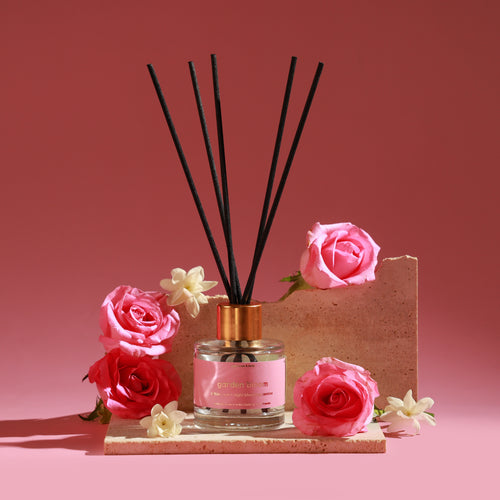
 Garden Bloom₹799This is the answer, and it is free. Far enough in that the door’s air exchange does not reach it, close enough that your guest is inside the fragrant zone before they have taken their shoes off. Height matters more than people expect: a bottle at chest or waist level on a console puts the evaporating surface roughly where a nose is, whereas the same bottle on the floor beside a shoe rack is doing its work at ankle height and competing with the worst-smelling object in most Indian entrances. Keep it out of a dead corner — air that does not move takes the fragrance nowhere — and out of direct sun on a windowsill, which heats the oil and shortens the bottle.
 Sukoon₹1,899A bottle beside the sofa is serving people who have already been breathing your air for sixty seconds and have begun to adapt to it. It is a perfectly good placement for the evening; it is the wrong placement for the question you asked. If your front door opens directly into a large living-dining, you have both problems at once — there is no hall to use, and the volume is beyond what a passive source can hold at a level. That is the one configuration where I would put a machine at the entry end: Sukoon ₹1,899 covers a published 270–320 sq ft, runs 16–18 hours on low, and can be switched on an hour before people arrive.
Why a doorway is the hardest place in a home to put anything
Every other room in a flat has reasonably settled air: it circulates on convection, it turns over slowly, and a source placed in it builds a concentration that stays broadly where you put it. An entrance has none of that stability by design — it exists to be opened. Each opening is a small, violent air exchange between two bodies of air at different temperatures and pressures, and the pocket immediately inside the door is the part that gets replaced. So a source on the threshold is in a permanent cycle of being stripped and rebuilding, and rebuilding is exactly what a passive capillary device is slowest at, because it has no reserve to release quickly and no fan to push with.
Height and floor level make more difference than most people would guess. Wind speed rises with height, so a twentieth-floor landing or a balcony door is a far more aggressive exchange than a second-floor entrance in a low block; nothing about the diffuser changes, the air simply turns over more often. The same logic explains why a lobby-facing flat behaves differently from one off an enclosed corridor. None of this is fixed by a stronger fragrance. All of it is fixed by moving the bottle two metres and letting the air that reaches it be air that is circulating rather than air that is being replaced.
There is a second reason not to sit a diffuser at the door, and it is aesthetic rather than physical. A fragrance with an obvious, findable source reads as something added; a fragrance with no locatable source reads as belonging to the building. That is a large part of why a hotel feels the way it does — the scent is introduced into moving air rather than released from an object on a table, so there is no gradient to walk up and nothing to identify. You cannot reproduce that exactly at home, and you should not try to hide the bottle in a cupboard, where it will do nothing. But moving it off the console by the door and slightly out of the immediate sightline gets you a surprising amount of the same effect for nothing.
| Placement | What the air does there | What the guest experiences | Effect on the bottle | Verdict |
|---|---|---|---|---|
| 1–2 m inside, chest height, out of the draught ★ | Gentle circulation, no direct exchange with outside | Walks into a fragrant zone at nose height while still in the hall | Full stated life — 14–18 weeks on a 130ml | The answer for almost every home |
| On the console immediately beside the door | Repeatedly replaced every time the door opens | A close-range burst, then a gap while it rebuilds | Empties noticeably faster in the turbulence | The obvious choice and the wrong one |
| On the floor by the shoe rack | Still air at ankle level | Very little — and competing with shoes | Slow, uneven evaporation | Avoid |
| In a dead corner of the hall | Almost no air movement at all | A fragrant pocket nobody walks through | Long life, no projection | The commonest reason a reed “feels weak” |
| Directly under a running split AC | High-velocity air across the reeds | Strong for days, then oddly flat | Top notes stripped early; the base is all that is left | Never |
| Beside the sofa | Settled room air | Excellent for the evening, too late for the arrival | Full stated life | Right bottle, wrong question |
The hall · Garden Bloom₹799Shop → 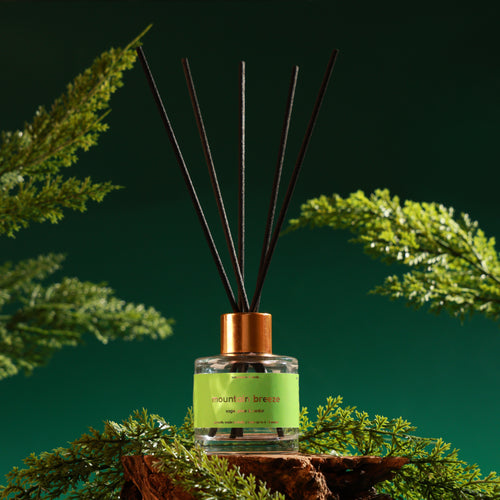 If florals are out · Mountain Breeze₹849Shop →
  Open-plan entry · Sukoon₹1,899Shop →
When a reed is genuinely enough, and when it honestly is not
I want to be precise here rather than loyal, because the reed is our own best-selling product and it would be easy to overstate it. For a hall, a reed is not a budget option — it is the correct tool. The volume is small, your guest passes within a metre or two of the source, the encounter is brief, and nothing about the situation calls for moved air. On top of that a reed brings a list no machine here can match: it is silent, needs no power, no water, no charging and no schedule, it never has to be switched on, it costs about ₹13–₹15 a day, and it sits on a console looking like an object rather than an appliance. In an entrance, where everything is on show, that last point genuinely decides whether the thing stays where it should be.
Where it stops being enough is a matter of volume rather than quality. A 50ml is specified for rooms up to about 150 sq ft and a 130ml above that, so if your front door opens onto a 300 sq ft living-dining, a 50ml is performing to specification while reading as weak — and the fix there is the larger bottle, not a different scent. Beyond that, more reeds will not rescue it: six reeds is full projection, and adding output does not change the transport mechanism, which moves no air at all. That is the structural ceiling, and it is why the next step is a different physics rather than a bigger bottle.
The next step, when it is warranted, is Sukoon at ₹1,899: ultrasonic water mist, a piezo plate vibrating an oil-and-water mixture into a visible cool mist that moves air and covers a published 270–320 sq ft from a 500ml tank, 16–18 hours on low, with three 15ml Hotel Collection scents in the box. If water is ruled out — a humid coastal flat, or a room you simply do not want more moisture in — Safar at ₹3,999 is waterless cold-air nebulising, the hotel mechanism at personal scale, with undiluted oil, three speeds and a 1, 2 or 3-hour auto-off; it is named and sold as a car and travel diffuser, its own product page lists car, handbag, desk, bedside and hotel room among its uses, and SOSA publishes no room-coverage figure for it, so I will not tell you it fills a hallway. And the gap in our own range belongs on this page too: between Safar and Vaayu at ₹11,999 there is no mid-sized waterless machine, and Vaayu, rated to 2,000–3,000 sq ft, is not a hallway product under any reading.
What to buy for the first thirty seconds, in order
The placement change first, because it fixes a majority of the people who write to me about this and it costs nothing at all. Then the right bottle for the volume of your entrance. A machine appears fourth, not first, and only for one specific layout. The last row is what I would actively steer you away from, including one product of our own that reads like an upgrade and is not.
| Step | What it is | When it is the right answer | Price |
|---|---|---|---|
| 1. Move the bottle two metres inside, to chest height, out of the draught ★ | Off the threshold, along the walk guests take, in gently circulating air — never under a running split AC and never in a dead corner | Always first. It is free, it takes a minute, and it fixes more of these questions than any purchase does | ₹0 |
| 2. A 130ml reed, all six reeds ★ | Passive capillary, six fibre reeds, refillable glass, 14–18 weeks, flipped every 3–5 days. Silent, unpowered, nothing to remember, and it looks like an object rather than an appliance | For a hall or an entry room. This is not a compromise here — it is the correct mechanism for a small volume and a brief encounter | ₹1,249–₹1,349 |
| 3. The same scent at 50ml further in | Three reeds, deliberately softer, roughly double the life per bottle | So the home reads as one identity at two levels rather than as separate products meeting in a corridor | ₹749–₹849 |
| 4. Sukoon | Ultrasonic water mist, 270–320 sq ft published, 16–18 hours on low, three 15ml Hotel Collection scents included | Only when the front door opens onto a large or open-plan living-dining. Accept water, dilution, added humidity and filling a tank | ₹1,899 |
| 5. Safar, if water is out | Waterless cold-air nebulising of undiluted oil, 3 speeds, 1/2/3-hour auto-off, 2000 mAh Type-C, 20ml, 6.9 cm | Humid flats and rooms you want no extra moisture in. Named and sold as a car and travel diffuser, no published room coverage, needs recharging | ₹3,999 |
| The honest gap, and what not to buy | Megh ₹3,499 covers about 215 sq ft — less than the ₹1,899 Sukoon — and is never a coverage upgrade. Vaayu ₹11,999 is rated to 2,000–3,000 sq ft and is not a hallway product. And SOSA makes no mid-sized waterless machine between Safar and Vaayu | Said plainly, because on this question the two most expensive options in the range are both the wrong purchase | — |
Versailles
When somebody tells me their diffuser is not doing enough at the door, the first question I ask is not which scent it is. It is how far from the door is it, and is anything blowing on it. Nine times out of ten the bottle is on the console you see as you come in, which is where it looks right, and which is the one square metre of the flat where the air is replaced several times a day. Moving it two metres and away from the air conditioner has fixed more of these than any product I have ever recommended, and it costs nothing, which is why it goes at the top of the page rather than the bottom.
The other thing I would say is about believing your guests over yourself. You cannot audit your own entrance — you have been walking through it all day, and receptors stop reporting a stimulus that does not change. If a friend has ever said something and you could smell nothing, that is not a coincidence and it is not politeness. It means the thing is working for everyone but its owner, which is the normal and expected outcome. If you want to hear it yourself, leave for fifteen minutes and come back in, and judge it on the walk-in only.
And I will defend the reed here, because this is one of the places it is genuinely the best answer rather than the cheap one. An entrance is small, the encounter is brief, and there is nothing about it that needs a fan, a tank or a battery. What it does need is something you are happy to look at every day, that never has to be switched on, that makes no noise, and that will still be working on a Sunday morning without anyone having thought about it since March. That is a reed, at about ₹13 to ₹15 a day. Everything is composed in Pune, and part of every order funds a girl’s classroom through Nanhi Kali.
Frequently asked questions
- How hotels do it in seconds — threshold concentration, scheduling and consistency.
- The “wow, your home smells amazing” effect — one scent, one entry room, ventilate before.
- An arrival moment at the bedroom door — why closing a door is the cheapest tool you own.
- Nice once you sit inside, but no immediate impact — the concentration gradient explained.
- Reed, spray or active diffusion — the first sixty seconds versus the evening.
- A signature scent at your own door — and the honest limitation of scenting for yourself.
- Why a lobby lands and your own home does not — adaptation, in full.
- Arrival effect or background scent — two setups mostly in tension.
- Stronger fragrance or better diffusion — the family pillar.
- Brand: the SOSA founder story.
Facts verified August 2026: Passive capillary — SOSA reed diffusers, five scents, 50ml ₹749–₹849 for rooms up to ~150 sq ft lasting 6–8 weeks, 130ml ₹1,249–₹1,349 above 150 sq ft lasting 14–18 weeks, six fibre reeds included (six for full projection, three for a soft bedside level and roughly double the life), flipped every 3–5 days, about ₹13–₹15 a day, heat-stable CCT carrier rather than DPG, alcohol-free, phthalate-free, paraben-free, IFRA-compliant, 0 ppm formaldehyde, refillable glass, tested at 45°C and 85% RH, composed in Pune; duos ₹1,498–₹1,598 for 50ml × 2; refills 300ml ₹2,399 and 500ml ₹3,499, oil only and never a first purchase. Ultrasonic water mist — Boond ₹899 (300ml, up to ~150 sq ft, ~6 hours, USB, night light), Sukoon ₹1,899 (500ml, 270–320 sq ft, 16–18 hours on low, three 15ml Hotel Collection scents included), Megh ₹3,499 (6L tank, ~100 hours, ~215 sq ft — less than Sukoon, and never a coverage upgrade). Waterless cold-air nebulising — Safar ₹3,999 (20ml bottle, 2000 mAh Type-C, up to 10 hours continuous or around 30 hours intermittent per charge, 3 speeds, 1/2/3-hour auto-off, 6.9 cm, named and sold as a car and travel diffuser with bedside and hotel room among its stated uses, no published room-coverage figure) and Vaayu ₹11,999 (up to 1000 m³ or roughly 2,000–3,000 sq ft, 400ml tank lasting up to about 90+ days, Bluetooth app plus onboard buttons, 1h/4h/8h/24h run windows, choice of days, adjustable intensity, key-lock, under 38 dB, freestanding or wall/HVAC mount, 5W, CE, RoHS, SGS). Between Safar and Vaayu there is no mid-sized waterless bedroom nebuliser in the SOSA range. Hotel Collection oils are water-based and ultrasonic-only — 15ml ₹299 (a refill), 100ml ₹999, 300ml ₹1,799, pack of 7 ₹1,799 — and cannot be used in reed diffusers, nor reed oil in ultrasonic machines; there is no hotel-inspired reed diffuser. SOSA sells no room spray or home spray; every SOSA spray is a car perfume. No health, air-quality, allergy or antimicrobial claims are made, no claim is made that fragrance improves sleep, mood or concentration, and fragrance does not remove a smell: source, ventilation, then fragrance. Free shipping above ₹499. A portion of every order supports girl-child education through Nanhi Kali. SOSA is an independent Indian fragrance house; the Hotel Collection scents referenced here are SOSA’s own interpretations inspired by the world’s finest hotels, and SOSA is not affiliated with, endorsed by or a supplier to any hotel brand. Prices subject to change — see the live product pages.