




The word "cloud" is the clue. A room-filling, even body of fragrance is an active-diffusion outcome — it requires air being pushed. No arrangement of passive bottles produces it, at any count or any price.
Your door bottle is also in the worst spot in the room. A doorway is the most turbulent point in a home: every opening flushes it, and it is the furthest point from where you sleep. Move it slightly inside the room, out of the draught.
Free first, and it may be enough: bring the bottles closer to where you actually are, nose height on a surface, six reeds each (three if one is at your elbow), close the door — and turn the ceiling fan on low, which is the one free change that genuinely fills the valley, because a fan supplies transport.
If you want the cloud: Sukoon ₹1,899 covers 270–320 sq ft and is very often the right bedroom answer. Between Safar ₹3,999 — named and sold as a car and travel diffuser — and Vaayu ₹11,999 at 1000 m³, roughly 2,000–3,000 sq ft, SOSA has no mid-sized waterless bedroom nebuliser.
2. Move the door bottle, because it is in the worst position in the room. An entrance is the most turbulent point in a home — every time the door swings, the air there is displaced and whatever has accumulated is pushed out into the corridor. It is also the furthest point from your bed, which is where you actually want to smell this. Bring it a metre or two inside the room, onto a surface, out of the swing of the door and out of the draught, but not into a dead corner behind furniture where nothing circulates at all. That change alone often restores more than people expect.
3. Bring both bottles closer to where you are, and get the height right. Distance is the strongest lever you have and it costs nothing. In practice that means both bottles within a metre or two of where you sit or sleep, at or slightly below nose height on a surface — not on the floor, where the fragrance has to rise through the coolest air in the room, and not on a high shelf above the layer you breathe. If a bottle is now within arm's reach, drop it to three reeds rather than six: three is a soft bedside level and roughly doubles the life.
4. Then fill the valley with the one free thing that can — a ceiling fan on low. This is the most useful sentence on the page. A fan is precisely the transport your two bottles do not have. On the lowest setting in a closed room, it takes the two warm columns sitting above your two bottles and folds them through the whole volume, and the valley between the hills stops being a valley. It will shorten both bottles, because faster air across the reeds means faster evaporation, and you should make that trade with your eyes open. Close the door as well; containment costs nothing and it is half the equation.
5. If you still want a cloud rather than two zones, buy the mechanism. Sukoon at ₹1,899 covers 270–320 sq ft and runs 16–18 hours on low, and it is very often the correct bedroom answer. Keep at least one reed — it is silent, needs no power, has nothing to fill or charge, works in a power cut and never breaks.
Alcohol-free, phthalate-free, made in Pune. A portion of every order supports girl-child education through Nanhi Kali.
Walk your own room, door to bed and back — the shape is your own evidence
Do this tonight, slowly, and you will never need to be told about gradients again. It takes about twenty seconds and it is the most convincing demonstration in this whole subject, because it happens in your bedroom rather than in a diagram.
 Garden Bloom₹799Stand beside the door bottle and it is unmistakable. Take two steps into the room and it is noticeably less. Two more and it is nearly gone. That fall is smooth in reality — concentration declines steadily with distance — but perception compresses it, so what you experience is not a gentle slope but a zone with an edge. This is also the placement I would change first, whatever else you decide. A doorway is the most turbulent point in a home: each swing of the door displaces the air there, and the fragrance that has been accumulating goes into the corridor rather than into your bedroom. Slightly inside the room, on a surface, out of the swing, is a better place for the same bottle.
 Sukoon₹1,899Keep walking and somewhere around the centre of the floor you reach the quietest air in the bedroom. This is the part people find counter-intuitive, because it is the point equidistant from two working diffusers — and that is exactly why. The midpoint is the farthest point from both bottles at once. Each gradient has decayed to its weakest by the time it arrives there, and there is nothing to add them up: molecular diffusion is far too slow to carry fragrance across metres of a room usefully, and neither bottle moves air. Two weak edges meeting do not make a strong middle. They make a valley, and it sits precisely where you stand when you are crossing the room.
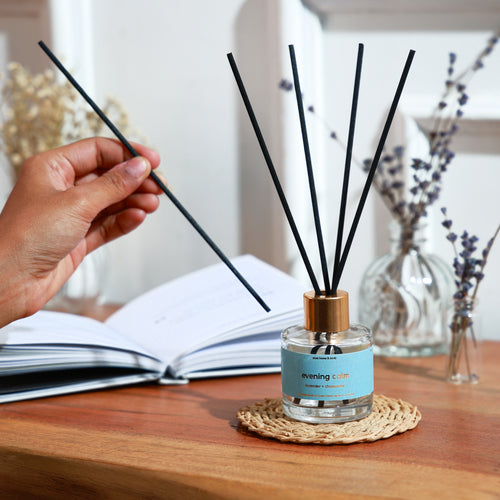
 Evening Calm₹799As you approach the bed it comes back, and by the time you are sitting down it is present again. That is the second hill, and this bottle is doing the more useful job of the two, because at night you are inside its zone for hours rather than passing through. Which is the whole shape of your room in one walk: high, low, high — never level. Two things follow. First, a third bottle would give you high, low, high, low, high, which is more fragrance and no more evenness. Second, at close range you are over-dosed rather than under-dosed: at arm's length three reeds is the correct setting, six is a bottle standing across a room, and three roughly doubles the life.
When two reeds genuinely is the right setup — because sometimes it is
I do not want to leave you thinking two bottles is always a mistake, because it is not, and your instinct in placing them at opposite ends was a reasonable one. Two passive sources are genuinely correct in four situations. The first is a long or L-shaped room that is really used at both ends — a bedroom with a desk at one end and a bed at the other, where you spend hours at each and never much care about the middle. The second is two rooms that function as one volume, such as a bedroom opening onto a dressing area, where a single source cannot serve both. The third is when you actively want different scents in different zones, which is a legitimate and rather sophisticated way to use fragrance at home. And the fourth is simply a budget that is short of a machine, where two bottles at ₹749–₹849 do more good than waiting.
What two sources cannot do is produce evenness across one open volume, and that is what your question is asking for. It is worth being precise about why, because the reason is not that the bottles are too small. It is that you cannot fix a transport problem by increasing emission. More reeds, a bigger bottle, a deeper composition and a second diffuser all raise the amount of fragrance entering the room. None of them adds a single mechanism for moving that fragrance from where it is to where it is not. Every one of those four purchases disappoints in the same characteristic way, and the disappointment is not a coincidence — it is the same missing term showing up four times.
There is a related trap worth naming while we are here, because it catches people who reason exactly as you have. Bottle volume is a duration specification, not a coverage specification. If two bottles do not fill the room, two larger bottles will not either; they will simply take longer to run out while failing in exactly the same shape. The starkest illustration is inside our own range: Megh at ₹3,499 has a six-litre tank and around a hundred hours of runtime, and covers only about 215 sq ft — less than the ₹1,899 Sukoon with its 270–320. Six litres against half a litre, and the smaller machine covers more ground. Tank size is runtime; it is never reach.
Two reeds against one machine, scored honestly
What each arrangement actually wins, including the rows where your current setup beats the machine outright, because a comparison that only lists the machine's advantages is an advertisement. The last row is the one thing neither arrangement of reeds can ever deliver.
| What you care about | Two reed diffusers | One machine | Honest verdict |
|---|---|---|---|
| Evenness across the room | Two hills with a valley between them | A single body of fragrance you are inside | Machine, decisively. This is the whole question |
| Silence | Absolutely silent, always | Audible, even when quiet | Reeds |
| Running without power | Works in a power cut, no socket, nothing to charge | Needs power or charging, and switching on | Reeds |
| Maintenance | Flip every 3–5 days. Nothing to fill, clean or remember | Filling, cleaning, timers, and a lifespan | Reeds |
| Different scents in different zones | Easily — one register at the desk, another at the bed | One scent at a time per machine | Reeds |
| Cost over time | Two bottles at roughly ₹13–₹15 a day each, indefinitely | Once, plus oil. SOSA publishes no oil-consumption rate, so I will not compute a running cost | Depends how long you keep buying |
| The cloud you asked for | Not available at any bottle count. It is not what the mechanism does | This is exactly what moved air produces | Machine, and only a machine |
Beside the bed · Evening Calm₹799Shop →  Fills the valley · Sukoon₹1,899Shop →
  Keep the reed running₹2,399Shop →
What a cloud actually is — and the honest way to get one
The word you used is precise and I want to honour it rather than talk you out of it. A cloud is a body of fragrance distributed through a volume, rather than a source you can locate. It is the reason a good hotel corridor smells the same at every point along its length and you can never find the device responsible — there often is not one in the room to find, because the scent has been introduced into moving air rather than released from an object on a table. There is no gradient to walk up and no source to stand next to. That is a completely different experience from a reed diffuser, and it is produced by a completely different mechanism.
Two mechanisms do it. Ultrasonic water mist vibrates a mixture of water and fragrance into a visible cool mist and pushes it out on a plume — a genuine step up in reach, with real trade-offs: the oil is diluted in water, the output adds humidity, and hard water can leave a fine white mineral dust nearby. Sukoon at ₹1,899 is the one I recommend most often for a bedroom and it should never be skipped on the way to something dearer: 500ml, 270–320 sq ft, 16–18 hours on low, three 15ml Hotel Collection scents included. Boond at ₹899 is the smaller version — 300ml, up to about 150 sq ft, around six hours, USB, night light. Waterless cold diffusion is the other route: pressurised air shatters undiluted oil into a dry micro-mist, no water, no dilution, no heat, no added humidity, no dust. Safar ₹3,999 is that mechanism at personal scale, and it is named and sold as a car and travel perfume diffuser — SOSA's own page also lists a handbag, a desk, a bedside and a hotel room, so personal use is fair, but no room coverage figure has been published for it and I will not invent one. 20ml bottle, 2000 mAh Type-C, cordless, up to ten hours continuous or around thirty intermittent, three speeds, a one, two or three-hour auto-off timer, 6.9 cm. It is not set-and-forget.
Two things to know before you switch. First, changing mechanism may mean changing scent: reed oil cannot go into an ultrasonic machine, the water-based Hotel Collection cannot go into reeds, and Safar takes pure fragrance oil. Three mechanisms, three liquids, no crossing in any direction. Second, Vaayu at ₹11,999 is the wrong purchase for one bedroom — it is rated to 1000 m³, roughly 2,000–3,000 sq ft, and in a single room nine-tenths of it is wasted; it earns its price on a whole floor or an open-plan home. Which leaves the gap I would rather name than dodge: between Safar and Vaayu, SOSA has no mid-sized waterless bedroom nebuliser. Nothing in our range is a Vaayu for one room.
What I would buy, in order, given that you already own two
You are further along than most readers here, because you have already spent twice and learned something concrete from it. So this list starts with rearranging what you own and ends with the parts of our own range I would keep you away from. From the third row down, what you are buying is transport, control and evenness rather than a better smell.
| Step | What it is | When it is the right answer | Price |
|---|---|---|---|
| 1. Rearrange what you own, and put the fan on low ★ | Move the door bottle a metre or two inside and out of the draught; bring both to within a metre of where you sit or sleep, at nose height on a surface; three reeds on anything at arm's length; door shut; ceiling fan on low | First, always, and it costs nothing. The fan is the only free thing that fills the valley, because it is the transport neither bottle has. It shortens both bottles — make that trade knowingly | ₹0 |
| 2. Keep the bed bottle running | 300ml refill, roughly six 50ml fills, for the glass and six fibre reeds you already own. Oil only | Once you have decided the bedside reed keeps its place. Never a first purchase for anyone who does not own the bottle — it is the item most often bought by mistake | ₹2,399 |
| 3. Boond | Ultrasonic, 300ml, up to about 150 sq ft, roughly six hours, USB, night light. Runs the water-based Hotel Collection | The cheapest honest way to have moved air in a bedroom, and the cheapest way to find out whether a cloud is really what you want. Adds humidity, needs filling | ₹899 |
| 4. Sukoon | Ultrasonic, 500ml, 270–320 sq ft, 16–18 hours on low, three 15ml Hotel Collection scents included | Very often the correct bedroom answer and never to be skipped on the way to something dearer. Water-diluted, adds humidity, can leave white mineral dust in a hard-water city | ₹1,899 |
| 5. Safar, with the disclosure attached | Waterless cold diffusion of undiluted oil, 20ml, cordless, 2000 mAh Type-C, three speeds, 1 / 2 / 3-hour timer, 6.9 cm. Named and sold as a car and travel perfume diffuser | When you want undiluted oil, no water and no added humidity at personal scale. Not set-and-forget — the timer runs in hours and it needs recharging. No room coverage figure is published and I will not invent one. Never buy it in multiples | ₹3,999 |
| What I would not buy: a third reed or Vaayu — and the gap between them | A third bottle makes a third hill. Vaayu ₹11,999 is rated to 1000 m³, roughly 2,000–3,000 sq ft. Megh ₹3,499 has a six-litre tank and covers only about 215 sq ft | Neither answers your question. A third bottle adds emission you already have; Vaayu is nine-tenths wasted in one bedroom. And between Safar and Vaayu there is no mid-sized waterless bedroom machine in this range — nothing here is a Vaayu for one room | — |
Versailles
Placing two diffusers at opposite ends of a room is not a naive thing to do. It is what anybody would do who had been told that a diffuser scents a room — if one scents a room, two should scent it more thoroughly, and the arithmetic feels sound right up until you walk between them. The flaw is not in your reasoning. It is in the premise you were handed, which is that a passive bottle scents a room at all. It scents a zone, beautifully, and two of them scent two zones.
I would also gently point out that you may be a poorer judge of your own bedroom than you think, and it is worth ruling that out before spending. Receptors adapt to a constant stimulus within minutes — the molecules keep arriving and the brain stops forwarding the report — so somebody sitting in a properly scented room can honestly say they smell nothing. Sensitivity also varies a great deal between people, and you are adapted to your own home in a way no visitor is. If guests remark on your bedroom from the doorway while you cannot detect anything from the bed, it is working for everyone except you. Leave for fifteen minutes, walk back in, and ask somebody who does not live there.
And whatever you do next, keep at least one reed. Not out of loyalty to something we sell, but because the two kinds of object fail in opposite directions and that is useful in a home. A machine gives you a room and asks for power, water, filling and a switch, and it has a lifespan. A reed gives you a zone and asks for nothing at all — it is silent, there is nothing to charge or remember, it carries on through a power cut, it costs roughly ₹13–₹15 a day, and it never breaks. Put the machine in the middle where the valley is and leave the reed beside the bed where the hill already works. Everything is composed in Pune, and a part of every order funds a girl's classroom through Nanhi Kali.
Frequently asked questions
- Amazing near the bottle, nothing from the bed in 120 sq ft — the free fixes, then the ladder.
- 10 × 12, all the reeds, flipped regularly — you have done everything right, and here is what that proves.
- Perfect in the bathroom, invisible in the bedroom — the experiment that proves your oil is fine.
- Larger bottles, same walk-past result — duration is not coverage.
- A strong oil that will not travel — what carries across to a machine and what does not.
- Every part of the bedroom, not the whole flat — three options, weighed honestly.
- 150 sq ft with a ceiling fan and a balcony — you may need to buy nothing at all.
- A second reed, or active diffusion? — the arithmetic, done properly.
- Passive device, active expectation — the pillar, and the close of the whole subject.
- Brand: the SOSA founder story.
SOSA facts verified August 2026: Reed diffusers are supplied in 50ml and 130ml only — 50ml suits rooms up to about 150 sq ft and lasts 6–8 weeks, 130ml suits rooms above 150 sq ft and lasts 14–18 weeks, at roughly ₹13–₹15 a day. Six reeds is full projection; three is a soft bedside level and roughly doubles the life; flip the reeds every 3–5 days. Morning Freshness ₹749 / ₹1,249 · Evening Calm ₹799 / ₹1,299 · Garden Bloom ₹799 / ₹1,299 · Mountain Breeze ₹849 / ₹1,349 · Fresh Brew ₹849 / ₹1,349. Strength scale, perceived intensity rather than quality: Evening Calm 8.9 softest, Garden Bloom 8.9, Morning Freshness 9.0, Mountain Breeze 9.4, Fresh Brew 9.5 deepest. Six fibre reeds rather than rattan, heat-stable CCT carrier rather than DPG, alcohol-free, phthalate-free, paraben-free, IFRA-compliant, 0 ppm formaldehyde, refillable glass bottle, tested at 45°C and 85% RH, composed in Pune. Refills 300ml ₹2,399 and 500ml ₹3,499, oil only and never a first purchase. Machines: Boond ₹899 (300ml, up to about 150 sq ft, ~6h, USB, night light) · Sukoon ₹1,899 (500ml, 270–320 sq ft, 16–18h on low, three 15ml Hotel Collection scents included) · Megh ₹3,499 (6L, ~100h runtime but only ~215 sq ft, never a coverage upgrade) · Safar ₹3,999, a waterless cold-diffusion device named and sold as a car and travel perfume diffuser, with a 20ml bottle, a 2000 mAh Type-C battery giving up to 10 hours continuous or around 30 intermittent, three speeds, a 1 / 2 / 3-hour auto-off timer and a height of 6.9 cm · Vaayu ₹11,999, a waterless cold-air nebuliser rated to 1000 m³, roughly 2,000–3,000 sq ft, with a 400ml tank and app control, and the wrong purchase for one bedroom. Between Safar and Vaayu there is no mid-sized waterless bedroom nebuliser in this range. Hotel Collection oils are water-based and ultrasonic-only: 15ml ₹299, 100ml ₹999, 300ml ₹1,799, pack of seven ₹1,799. Reed oil, the water-based Hotel Collection and pure fragrance oil are not interchangeable across these mechanisms in any direction. No health, air-quality, allergy, sleep or mood claims are made anywhere on this page. Free shipping above ₹499. SOSA is an independent Indian fragrance house; the Hotel Collection is SOSA's own interpretation inspired by the world's finest hotels and SOSA is not affiliated with or endorsed by any hotel brand. Prices subject to change — see the live product pages.