Founder Diaries · Clinics & Medical Centres · Shared Waiting Areas
By Sonal Sahani · ISIPCA Versailles 11 min read Updated September 2026
Almost every question I am sent about a shared waiting area is a question about which scent, and almost every answer turns out to be a question about which wall.
A waiting hall in a multi-speciality clinic is one volume of air with a bank of seats in the middle of it and a row of fragrance-free clinical doors along one edge, and the whole job is to put a working level over the first of those and nothing at all over the second. That is a siting problem before it is a fragrance problem. This page is about the three coordinates that decide it — how far in, how high, and where the air is already going — and about the distance at which the curve has to be dead. The machine itself is the
Vaayu at ₹11,999, and it is the least interesting decision on the page.
Quick answers — read this first
One machine, one hall. A shared waiting area is a single volume of air. Site one unit for the whole of it rather than one per department, and put the effort into where it stands.
The three coordinates: three to four metres inside the entrance and at the edge of the seating bank rather than in it · above head height, because a cold-air mist falls rather than rises · out of the direct throw of a supply grille and never upstream of the consultation corridor.
Where it has to die: stand in the open doorway of the nearest consultation or sample-collection room with the machine running. If you can read anything there, move the machine before you turn it down. Those rooms are fragrance-free and that is not a concession.
Before any of it: a persistent smell in a public hall is information about a dry drain trap, a dressing bin or an air-conditioning drain pan. Find it and fix it rather than covering it.
The short answer
Short answer: one machine for the whole hall, sited three to four metres inside the entrance, at the edge of the seating bank rather than among the chairs, above head height, out of the direct throw of an air-conditioning grille, and on the side of the room furthest from the consultation doors. Run it low, from thirty minutes before the first appointment, and never adjust it because the hall got busy.
The pick: the
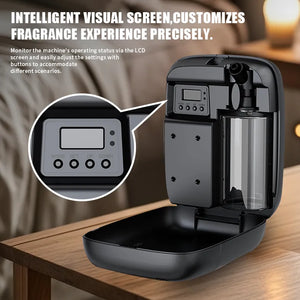
Vaayu at ₹11,999 — waterless, up to 1000 m³, key-locked, under 38 dB, with 1h/4h/8h/24h timers and app scheduling. The
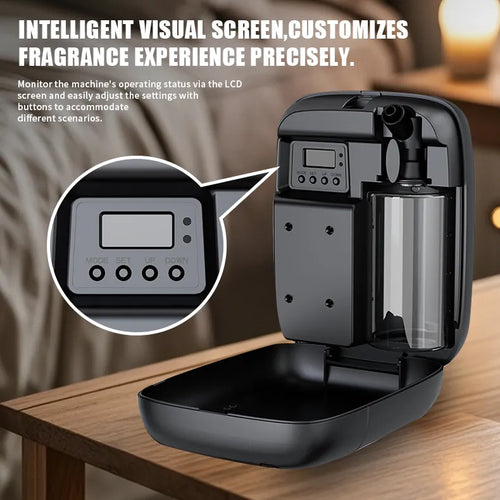
Vaayu wall or duct mount is worth the fitting cost in a public hall because it puts the unit out of reach. The Westin-inspired
White Tea Serenity is the lightest of the seven scents and the default for a medical building.
Shop: the
Vaayu ₹11,999 (up to 1000 m³ or roughly 2,000–3,000 sq ft, 400ml tank lasting about seventy-five days, Bluetooth app, auto-stop, key-lock, four hotel-inspired scents supplied) and the
Aangan ₹25,999 for an atrium or a whole-floor HVAC tie-in. Ultrasonic
Sukoon ₹1,899 and
Boond ₹899 are water-based and belong in a single administrative cabin. Alcohol-free
reed diffuser from ₹749. Free shipping above ₹499.
Straight answer
Where should the diffuser actually go in a shared multi-speciality waiting area, and how far should it carry?
1. Before anything is sited, confirm the hall is not telling you something. If the space smells of anything in particular at half past four on a Wednesday, that smell has a source — a drain trap that has dried out in a toilet nobody uses, a dressing bin past its collection time, a soiled-linen trolley taking the public route because the service lift is down, biofilm in an air-conditioning drain pan. A smell in a medical facility is information. Find it and fix it rather than covering it, because covering it removes the signal that told housekeeping something was wrong.
2. Then buy one machine for the hall, not one per department. A shared waiting area is a single volume of air. Six signboards on the wall do not make six rooms, and
two fragrances in one volume average into a third nobody chose.
3. Site it three to four metres inside the entrance, at the edge of the seating bank. Not at the door, where an air curtain and a sliding panel throw everything you release straight back outside. Not in the middle of the chairs, where one unlucky patient sits in the highest concentration in the building for forty minutes.
4. Put it above head height and out of the airflow. A cold-air mist falls rather than rises, so a unit on the floor is scenting a skirting board. Keep it off the direct throw line of a supply grille, which strips the light top off a composition and leaves the heavy end standing on its own.
5. Then check where it dies, and check it from the doorway that matters. Walk to the open door of the nearest consultation cabin or sample-collection room while the machine is running and breathe. If there is anything there at all, move the machine further from that wall. Do not simply turn it down: turning it down shrinks the whole field, including the part over the chairs that you actually wanted.
6. Then set it once and leave it. Low, from thirty minutes before the first appointment, stopping with the last one. The
Vaayu at ₹11,999 holds up to 1000 m³ with app scheduling, a key-lock and under-38 dB running. Nobody turns it up at noon because the hall filled. Busy is a ventilation and occupancy question and
it has its own page.
A portion of every order supports girl-child education through Nanhi Kali.
TL;DR: one machine for the whole hall, sited three to four metres inside the entrance at the edge of the seating bank, above head height, out of the throw of an air-conditioning grille and on the far side of the room from the consultation doors. Check the curve from the doorway of the nearest fragrance-free room: if you can read anything there, move the machine rather than turning it down. The
Vaayu at ₹11,999, low, from T-30m.
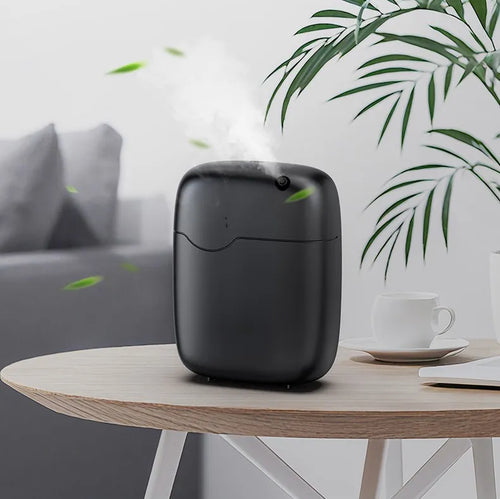
A machine bought for where it can stand, not only for what it covers
SOSA Vaayu · waterless ₹11,999
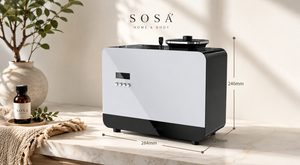
0.9 kg and 165 × 80.5 × 215 mm, freestanding, wall-mounted or tied into a supply duct, running on DC 12V at 5W. In a shared waiting hall the specification I actually shop for is the mounting choice and the key-lock, because siting is the decision and everything else follows it. A machine that has to sit on a console table sits where the furniture is; a machine that can go on a wall at two and a half metres goes where the air is going, out of reach of a bored ten-year-old and out of the sightline of a queue. Coverage up to 1000 m³ from a 400ml tank lasting about seventy-five days, 1h/4h/8h/24h timers with Bluetooth scheduling, auto-stop, under 38 dB, CE, RoHS and SGS certified, supplied with four hotel-inspired fragrances.
Siting is the decision; the scent is the easy part
I have walked a fair number of shared waiting halls with a clinic owner, and the conversation nearly always opens at the wrong end. The owner has a shortlist of fragrances and a budget, and what they do not yet have is a plan of where the machine stands. Which is backwards, because in a room of this shape the scent determines what the hall smells of and the position determines who smells it — and in a multi-speciality clinic, who smells it is the part a medical director will ask about. A shared waiting area is almost never a simple rectangle. It is a bank of forty-odd chairs, a registration counter at one end, a token screen, a corridor mouth leading to six or eight consultation cabins, a sample-collection room that is usually the nearest door to the seats because that is where the queue is, and somewhere in the middle of all that, a supply grille moving several hundred cubic metres of air an hour in a direction nobody has ever plotted.
1
THE THREE COORDINATES
How far in, how high, and where the air is already going
Start with distance from the entrance, because it is the coordinate people get wrong most confidently.
The instinct is to put the machine at the door, and the door is the worst position in the building. An entrance is a pressure boundary: a sliding panel cycling every ninety seconds, an air curtain in most Indian clinics, a security desk, and on a Monday morning a queue holding it open. Anything released there leaves, so the operator raises the intensity to compensate, and the first thing a patient meets on the mat becomes a wall of fragrance. Three to four metres in is far enough to be inside the room's own air and close enough that the arrival is scented at all.
Then height, which is a physics point rather than a taste one: a cold-air nano-mist is heavier than the air it enters and it falls. A machine on a low table is scenting people's shins and a machine on the floor is scenting a skirting board, which is why the
Vaayu wall or duct mount earns its fitting cost twice over — it puts the output above the seated head line so the field descends through the room, and it puts the unit out of reach of everybody in a hall you did not choose the occupants of. The key-lock handles anybody tall enough to reach it anyway.
Then the third coordinate, which is the one nobody checks: where the air is already going. Find the supply grilles and the return grille, hold a tissue up to each, and watch. A machine sitting in the direct throw of a supply diffuser has its output thrown across the room in one direction at fan speed, which strips the light end of the composition off and delivers the heavy end somewhere you did not plan. A machine sitting under the return grille is scenting the inside of a duct. Neither of those is a fragrance problem and neither is fixed by changing the bottle.
The five-minute survey I would do before ordering anything: walk the hall with a tissue at nine in the morning, mark every supply and return grille on a printed floor plan, mark the doors that open into it, and mark the two clinical doors nearest the chairs. That sheet of paper decides the position.
2
THE DOOR LINE
The distance at which the curve has to be dead already
Now the part that makes this a clinic page rather than a hotel one.
Every shared waiting hall in a multi-speciality clinic has a line across it, and on the far side of that line the fragrance has to be gone. It is the line where the public room becomes clinical property. Consultation and examination cabins, treatment and procedure rooms, dressing rooms, the sample-collection room, the laboratory, dispensing, sterile stores, imaging, oncology day-care and paediatric clinical areas are fragrance-free, doors shut, and that list is longer than the list of rooms you are allowed to scent on purpose. The reasons are worth keeping in your head while you site a machine rather than looking them up afterwards: a clinician is trained to notice what a room and a patient smell of, and a patient may need to describe a symptom that involves smell; people faint and feel sick in a sample-collection room and adding anything to that air is a poor idea; a laboratory or a sterile store is a contamination conversation nobody wants to have with their own quality lead.
So the test is not a nose test in the middle of the hall. It is a nose test in the doorway of the nearest clinical room, done by somebody who has just walked in from outside. Your own staff cannot do it, because a nose reports change and discards constants and everybody in the building stops being able to smell it within a fortnight. Ask a courier, an equipment engineer, a visiting consultant, and ask them to be accurate rather than polite. If anything registers in that doorway, the machine moves. If the geometry means it cannot move far enough — a long thin hall with cabins down one entire side is a genuinely difficult plan — then the honest answer is a lighter composition and a lower intensity accepted as a permanent limit, and
keeping fragrance out of clinical zones is a page of its own.
3
THE SEAT NOBODY WANTS
Why the machine goes at the edge of the seating and not in it
The last coordinate is social rather than physical.
In any bank of chairs there is a seat closest to the machine, and whoever sits in it receives a concentration nobody designed for, for as long as their wait lasts. In a shared hall that wait can be fifty minutes. Somebody who is sensitive to fragrance, somebody who is pregnant and nauseous, somebody who has arrived unwell — these are not edge cases in a multi-speciality clinic, they are your Tuesday, and the design decision that protects them costs nothing at the siting stage and is almost impossible to retrofit once the unit is mounted. Put the machine at the edge of the seating field rather than inside it: against the wall behind the back row, above the head line, two and a half to three metres from the nearest chair.
What you are building is a gradient, not a spot. The hall should be uniformly and faintly scented across the whole seating area, with no chair noticeably warmer than another, and nothing at all at the clinical end. A patient who can point at the source has been sited badly, regardless of what the source contains. And if somebody asks for the area to be fragrance-free altogether because they react to smells, that request is honoured without argument and without a discussion about how gentle the composition is —
which areas should always be left alone covers the standing list, and a patient request extends it.
Six places to put it in a shared waiting hall, ranked
The positions I am actually offered when I walk a clinic, with what happens at each one and the verdict. The ranking assumes a single machine for a single volume, which is the correct starting point for almost every shared waiting area in an Indian polyclinic. Only the top row is a recommendation; the rest are here because each of them has been proposed to me in the last two years.
Siting a single machine
Where it goes in a shared waiting hall, and what happens if it does not
| Position |
What actually happens there |
Verdict |
Fix |
| 1. Edge of the seating bank, 3–4 m in, above head height ★ |
The field descends evenly across the chairs and has run out long before the corridor mouth |
The pick, in almost every plan |
Wall mount, key-lock, one setting |
| 2. Mounted into the public-zone supply duct |
The air-handling unit distributes it evenly at fan speed, which is either excellent or uncontrollable depending on the zoning |
Good only if the public zone is a separate duct from the clinical one |
Ask the HVAC contractor which rooms share the branch |
| 3. On the reception counter |
Convenient, visible, at hand height, in the busiest turbulence in the building and directly on the staff who sit there all day |
Poor. Reception is not a shelf |
Move it behind the counter line and raise it |
| 4. At the entrance, near the air curtain |
Most of the output leaves through the door, so somebody raises the intensity and the threshold becomes a wall |
Wrong, and it costs you fragrance |
Three to four metres further in |
| 5. In the mouth of the consultation corridor |
The heaviest concentration in the hall lands on the doors that should receive none, usually because that is where the token counter is |
Wrong, and it is the common mistake |
Opposite wall, and re-test from the doorway |
| 6. On the floor beside a sofa |
A cold-air mist falls, so the output pools at ankle level and reaches one seat strongly and the rest not at all |
Wrong twice over, and reachable by children |
Above the seated head line, out of reach |
Shop this guide
The shared-hall setup, in three products
The SOSA principle
A shared waiting hall is one volume with two halves — a seating field that should be faintly and evenly scented, and a clinical edge that should be reading nothing at all.
Which makes the useful question not what the fragrance is, but where its curve falls to zero. That is set by position and by the weight of the composition, and almost never by the intensity dial.
Distance, height and the setting you never change
Start with the numbers I would actually write on a siting sheet, because vague advice about placement is how machines end up on reception counters. Three to four metres inside the entrance line. Two and a half to three metres from the nearest chair. Two to two and a half metres off the floor, which in practice means mounted rather than stood. At least a metre and a half clear of the nearest supply grille, and never directly under the return. Those five figures cover ninety per cent of shared waiting halls, and the sixth figure is the one the room gives you rather than the one you choose: the distance from the machine at which the field should be unreadable, which has to be less than the distance from the machine to the first clinical door. If it is not, the plan is wrong and no bottle fixes it. The Vaayu helps here for an unglamorous reason — it is 0.9 kg and 165 × 80.5 × 215 mm, so a wall bracket at two and a half metres is a genuine option rather than a structural conversation, and the Vaayu duct mount exists for the halls where the ceiling is the only sensible place left. Under 38 dB matters at that height too, because a machine mounted above a quiet waiting area at half past eight in the morning is audible in a way a machine behind a counter is not, and in most polyclinics the wall it is on has a consultation cabin on the other side of it.
Then the two adjustments a hall will ask for in its first fortnight, and the one it will ask for and should not get. The first legitimate adjustment is position, and you should expect to move the unit once. A room's air does not behave the way a floor plan suggests, and the honest way to find out is to run it for a week and test the doorway of the nearest clinical room each morning with somebody who has come in from outside. The second legitimate adjustment is the composition: if the hall is large and the field is dying before it reaches the far chairs, the answer is the Ritz-Carlton-inspired Quiet Luxury — white tea, bergamot and cedar, a step more present than the Westin-inspired — rather than more of the lighter one. A heavier composition at a lower intensity covers further with a flatter curve than a lighter one worked hard, which is the single most useful thing I know about sizing a scent to a room. The adjustment a hall will ask for and should never get is upward, at noon, because the queue doubled. A room that has filled with people is a room whose air change has been outpaced by its occupancy. Adding fragrance to it makes the air busier rather than better, and the person asking is usually the person who has been in the building since eight and can no longer smell any of it. Set the intensity once during the first week, by walking in cold each morning before the hall fills, then lock it and write the number into the standard operating procedure.
Then the hours, the limits on the products, and the boundary this whole page sits inside. The machine runs the opening hours and stops. The Vaayu has 1h, 4h, 8h and 24h onboard timers plus Bluetooth scheduling, so an eight-to-eight clinic sets a schedule that starts at 7:30 and ends with the last appointment; the 24h setting exists for buildings that genuinely never close and a polyclinic is not one of them. On the products themselves: the Vaayu is waterless and takes its own undiluted oil rather than the water-based Hotel Collection bottles, and it arrives with four hotel-inspired fragrances. The ultrasonic Sukoon at ₹1,899, Boond at ₹899 and Megh at ₹3,499 hold standing water and add 30–50 ml of it to the air every hour, which makes them right for one administrative cabin with a named person emptying and drying the tank daily and wrong for a public hall. An alcohol-free reed diffuser from ₹749 takes 24 to 72 hours to establish and is barely noticed past about a metre, so it belongs in a small lobby or an office. Candles are not appropriate in a healthcare facility at all, because an open flame is a fire-safety and insurance matter rather than a fragrance one, and SOSA does not make a room spray. And the boundary: none of this does anything to a patient. A diffuser is not an air purifier, it does not clean or disinfect anything, and it has no clinical effect of any kind. What good siting buys is a public hall that smells of nothing in particular and a clinical edge that smells of nothing at all. That is housekeeping and presentation, and in a building this busy it is worth doing properly.
Turning the dial down shrinks the whole field, including the part you wanted. If the fragrance is reaching a consultation door, move the machine — do not quieten it.
— Sonal Sahani, SOSA
The SOSA edit
In the order I would spend, for a clinic owner siting one machine in a shared waiting hall. The first two rows cost nothing at all, which is the honest shape of this list, and the last row prints the product we do not make rather than leaving you to discover it after a purchase order has gone out.
The SOSA edit
Siting a shared waiting area, in spending order
| Buy |
What it is |
When it earns its place |
Cost |
| 1. A floor plan with the grilles marked ★ |
Supply and return grilles, the doors that open into the hall, and the two clinical doors nearest the chairs |
First, and before any order. A tissue and a printed plan decide the position better than any specification sheet |
₹0 |
| 2. Water down every drain trap |
Every toilet, every unused sink, every floor drain in a store room off the hall |
Before anything is sited. Four weeks without use is enough for a water seal to evaporate and a drain to vent into a public corridor |
₹0 |
| 3. Vaayu for the whole hall |
Waterless, up to 1000 m³, 400ml lasting about 75 days, app and 1h/4h/8h/24h timers, under 38 dB, key-lock, auto-stop |
Once the hall is genuinely clean. One unit for one volume, low, from T-30m, stopping at close |
₹11,999 |
| 4. Vaayu wall or duct mount |
The same machine fixed at two to two and a half metres rather than stood on furniture |
In any public hall. It puts the output above the seated head line and the unit out of reach |
Fitting only |
| 5. The scent, chosen for where it stops |
Westin-inspired White Tea Serenity as the default; the Ritz-Carlton-inspired Quiet Luxury a step more present for a large hall |
With the machine. A patient should not be able to tell you what it is, only that nothing smelled unpleasant |
from ₹299 |
| Not made by SOSA: a room spray |
The sprays in the SOSA range are car perfumes, formulated and sized for about three cubic metres of moving air |
Never in a hall this size. A morning spray is a twenty-minute product that has gone before the ten o'clock queue arrives |
— |
Honest notes for buyers: fragrance in a medical facility is housekeeping and presentation, never treatment. Nothing on this page claims that a fragrance reduces anxiety, aids recovery, improves sleep, cleans or disinfects air, or has any clinical effect whatsoever, because it does not and a diffuser is not an air purifier. Scenting belongs to the entrance, reception, shared waiting areas, inter-departmental corridors and administrative rooms. Consultation and examination rooms, treatment and procedure rooms, day-care surgery, dressing rooms, blood- and sample-collection rooms, laboratories, pharmacy dispensing, sterile stores, imaging rooms, oncology day-care and paediatric clinical areas should be left fragrance-free. A persistent smell is information about a dry drain trap, a bin, a soiled-linen route or an air-conditioning drain pan: find it and fix it rather than covering it. On the machines: the
Vaayu at ₹11,999 is waterless cold-air nebulisation with no standing water tank, covering up to 1000m³ or roughly 2,000–3,000 sq ft, with a 400ml tank lasting about 75 days, Bluetooth app control, 1h/4h/8h/24h timers, under-38dB running, auto-stop and a key-lock for public areas. The
Aangan at ₹25,999 covers up to 3,000m³ and connects to HVAC for a whole floor or an atrium. The ultrasonic
Sukoon,
Boond and
Megh are water-based, hold standing water and add 30–50 ml of water an hour to the air, which makes them suitable for a single administrative cabin with a named person emptying and drying the tank daily, and unsuitable for public clinical property. An alcohol-free
reed diffuser needs 24–72 hours to establish and suits a small lobby rather than a large waiting hall. Candles are not appropriate in a healthcare facility because an open flame is a fire-safety matter. SOSA does not make a room spray. The Hotel Collection scents are SOSA's own interpretations inspired by the world's finest hotels; SOSA is an independent Indian fragrance house, not affiliated with or endorsed by any hotel brand. A portion of every order supports girl-child education through Nanhi Kali.

Chosen for where it stops rather than for what it is
Westin-inspired · White Tea Serenity ₹299 / 15ml
White tea, aloe and cedar — the lightest of the seven and the default for a medical building.
In a waiting hall the useful property of a light composition is not that it is pleasant. It is that it falls off quickly with distance, which means the edge of the scented zone lands somewhere you can choose rather than somewhere you discover. A heavier, more persistent scent set to the same audible level at the seating bank is still legible thirty feet further on, at the mouth of the consultation corridor, where it has no business being. Light is a siting tool. The Ritz-Carlton-inspired
Quiet Luxury is a step more present if your hall is genuinely large. The water-based 15ml bottles run in the ultrasonic machines; the
Vaayu takes its own undiluted oil.
A note from Sonal
The most instructive thirty minutes I have spent in a clinic was in a polyclinic off FC Road in Pune, where the centre head had already bought a machine and wanted to know why patients kept mentioning it. It was sitting on a plant stand beside the token counter, which sounds harmless until you notice that the token counter was at the mouth of the corridor with eight consultation cabins on it. The busiest part of the hall, the lowest ceiling, a return grille directly overhead, and every doctor on that corridor getting a version of the fragrance in their doorway every time it opened. Two of them had complained. The scent was not the problem and the intensity was not the problem. The plant stand was the problem.
We moved it to the far wall behind the back row of chairs, at about two and a half metres, on a bracket that cost less than a thousand rupees, and turned it back up rather than down. The hall read better than it ever had, the corridor read of nothing, and the whole intervention was a change of wall. I think about that room whenever somebody sends me a shortlist of fragrances for a waiting area, because the shortlist is almost never where the answer is. A shared hall has a shape, an airflow and a clinical edge, and the honest work is to find the one position that respects all three. Then you pick the lightest bottle you own, set it once, and stop touching it.
Everything is made and supported from Pune, and a part of every order funds girl-child education through Nanhi Kali. You get a space that smells like somewhere looked after; a girl gets a classroom. That equation has always felt right to me.
Frequently asked questions
Where exactly should a diffuser be placed in a shared clinic waiting area?
Three to four metres inside the entrance, at the edge of the seating bank rather than among the chairs, two to two and a half metres off the floor, at least a metre and a half clear of the nearest supply grille, and on the side of the hall furthest from the consultation corridor. The
Vaayu wall or duct mount is worth the fitting cost because it puts the unit above the seated head line and out of reach.
How far should the fragrance carry in a waiting hall?
Far enough to cover the whole seating field evenly, and no further. The working test is to stand in the open doorway of the nearest consultation or sample-collection room while the machine runs. If anything registers there, move the machine rather than turning it down, because turning it down shrinks the part of the field over the chairs as well.
Do I need one machine per department in a shared waiting area?
No. A shared waiting area is a single volume of air and six signboards do not make six rooms. One unit sited properly covers it, and
two compositions in one volume produce a third nobody chose. The
Vaayu at ₹11,999 holds up to 1000 m³, which is more than most shared halls contain once the fragrance-free rooms come out of the sum.
Our waiting area smells faintly of the toilets by the afternoon. Should we site the machine nearer that end?
No. That is a source and almost always a dry drain trap or an extract fan that has stopped, and a fragrance put on top of it removes the signal that told housekeeping something was wrong. Run water down every trap, check the fan is actually turning, and
fix what needs fixing before you spend anything.
Can the machine go into the air-conditioning duct instead?
Yes, if the public zone is on a separate branch from the clinical rooms. Ask the HVAC contractor which rooms share the duct before you commit, because a shared branch delivers fragrance into consultation cabins and those are fragrance-free.
Whether one machine covers a whole clinic goes into the zoning in more detail.
One hall, one machine, one wall
The scent is the easy part — the wall is the decision
The Vaayu is ₹11,999: waterless cold-air nebulisation with no standing water tank, up to 1000 m³ or roughly 2,000–3,000 sq ft, a 400ml tank lasting about seventy-five days, Bluetooth app control with 1h/4h/8h/24h timers, under 38 dB, auto-stop and a key-lock for public areas, 0.9 kg and 165 × 80.5 × 215 mm, freestanding, wall or HVAC mounted, supplied with four hotel-inspired fragrances. The Aangan is ₹25,999 for an atrium or a whole-floor tie-in. Free shipping above ₹499, and a portion of every order supports girl-child education through Nanhi Kali.
See the Vaayu · ₹11,999 Wall and HVAC mounting
Continue the read
More from SOSA
Editorial standards & sources
About this guide: Written by Sonal Sahani, ISIPCA Versailles-trained founder and perfumer at SOSA Home & Body, on siting a single scent machine in a shared multi-speciality waiting hall: the three coordinates that decide the position, the distance from the consultation doors at which the fragrance curve must already have fallen to nothing, why the machine belongs at the edge of the seating rather than inside it, and the free housekeeping work that comes before any purchase.
Facts verified August 2026: Product facts used in this guide. SOSA Vaayu ₹11,999: waterless cold-air nebulising diffuser, atomises undiluted fragrance oil to a dry residue-free nano-mist with no water reservoir, coverage up to 1000m³ (approximately 2,000–3,000 sq ft), 400ml refillable tank lasting up to about 75 days per fill, Bluetooth app plus onboard control, 1h/4h/8h/24h timer scheduling, adjustable intensity, under 38 dB, DC 12V/1A at 5W, 165 × 80.5 × 215 mm and 0.9 kg, freestanding or wall or HVAC mounted, auto-stop and key-lock, CE, RoHS and SGS certified, supplied with four hotel-inspired fragrances. SOSA Aangan ₹25,999: HVAC-connected or standalone commercial nebulising diffuser, coverage up to 3,000m³ (roughly 8,000–10,000 sq ft), 800ml reservoir, metal body, programmable schedules, under 42 dB. Ultrasonic machines are water-based, hold standing water and consume 30–50 ml of water an hour: Sukoon ₹1,899 (500ml, 270–320 sq ft, 16–18 hours on low, 3–6 drops per tank, steady/2H/4H timers, three 15ml Hotel Collection scents included), Boond ₹899 (300ml), Megh ₹3,499 (6 litres). Hotel Collection water-based fragrance 15ml ₹299, 100ml ₹999, 300ml ₹1,799, Pack of 7 at 15ml ₹1,799 against ₹2,093 bought singly; the Vaayu and Aangan take their own undiluted oil rather than these water-based bottles. Alcohol-free reed diffusers from ₹749, requiring 24–72 hours to reach their working level. Free shipping above ₹499. Coverage arithmetic: cubic metres equal floor area in square feet divided by 10.76 and multiplied by ceiling height in metres, counting only the volumes that are actually scented. This guide makes no medical, therapeutic or clinical claim of any kind for fragrance: a diffuser does not purify, disinfect or clean air, and does not treat, calm or affect any patient or condition. Fragrance is housekeeping and presentation. Clinical areas should be left fragrance-free, and a persistent odour should be traced to its source and corrected rather than covered. SOSA is not affiliated with or endorsed by any hotel brand. Prices subject to change — see the live product pages.


 Wall mount · out of reach₹11,999Shop →