




What shortens it: high reed counts, a hot dry room, heavy sweet compositions, and above all a monsoon. A set that would have run comfortably to the far end of the interval will often be visibly tired after eight weeks of 85% humidity.
What lengthens it: four reeds instead of six, a cool sealed bedroom, and a lighter composition such as Evening Calm. A quiet bedroom set can go past the usual interval without complaint.
Against oil: a set of reeds will carry one 50ml fill easily, a second usually, and a third rarely. If you are on your third fill through the same reeds, change them before you buy more oil.
2. The easiest schedule is to tie reeds to bottles. A 130ml runs 14–18 weeks, which sits neatly inside the reed interval. Finish the bottle, start a new one, and the six fresh reeds arrive with it. Nothing to remember and nothing extra to buy.
3. On 50ml bottles, count fills instead. A 50ml runs 6–8 weeks. One set of reeds will carry the first fill beautifully and the second perfectly well. By the third you are usually pushing it, and that is the point at which fresh oil starts to disappoint.
4. Shorten the interval for reed count. Nine reeds in a 50ml empties it in roughly five weeks rather than eight, and the fibre ages in proportion. If you have run a festive month at nine or ten reeds, treat those reeds as older than the calendar says.
5. Shorten it again for a monsoon. Eighty-five per cent humidity is the single harshest thing an Indian home does to a reed. Our reeds are fibre rather than rattan precisely because rattan's pores swell and clog at those levels, but even fibre comes out of a monsoon tired. September is the month to check.
6. Lengthen it for a quiet bedroom. Four reeds, a cool sealed room and a soft composition such as Evening Calm will run past the usual interval without complaint. Let the flip test decide rather than the diary.
Composed and handmade in small batches in Pune, and a portion of every order supports girl-child education through Nanhi Kali.
Part one — the three things that set the clock
Ask when to change reeds and you are really asking how fast fibre silts up, because that is the only process going on. Oil climbs, evaporates, and leaves its heaviest fraction behind inside the channels. Nothing about that is time-dependent in itself. What varies is how much oil goes through, how hot and wet the air is while it happens, and how heavy the composition's residue is. Those three factors between them explain every difference I have seen between one customer's reeds lasting half a year and another's being obviously finished in ten weeks, and none of them is a fault in the product.
 Garden Bloom₹799 · 8.9/10Heat raises evaporation off the exposed length, which raises throughput, which ages the fibre. A 45°C Nagpur May does in six weeks what a Bengaluru winter does in twelve. Humidity does something different and worse: water in the air competes for the same channels the oil is trying to climb, and porous natural material swells. This is exactly why every SOSA bottle ships with fibre reeds rather than rattan — rattan's natural pores clog readily at the 85% humidity a Mumbai or Kochi monsoon produces, which is why so many imported diffusers stall in their second month here. Fibre holds its rate through it. It does not come out unchanged, though, and a post-monsoon check is the single most useful one in the year.
Part two — reed life by how you actually run the bottle
Here is the interval as a table rather than a rule. These are working figures from our own testing and customer correspondence rather than laboratory measurements, and the right-hand column matters most: whatever the row says, the warning sign is what should actually trigger the change.
| How you run it | Reeds in the bottle | Oil it gets through | Refresh reeds | The sign that comes first |
|---|---|---|---|---|
| 130ml living room, year-round ★ | Six · the calibrated count | One 130ml, 14–18 weeks | With each new bottle | Fragrance goes base-heavy near the end |
| 50ml living room, refilled | Six | Two to three 50ml fills | Every second or third fill | A flip stops giving you the evening back |
| Cool sealed bedroom | Four · deliberately gentle | Slowly — beyond the stated window | Later than the usual interval | Wet line creeping down over a month |
| Festive month at high count | Nine to ten | A 50ml in roughly four to five weeks | Sooner — treat them as older than the diary says | Reeds dark to the tip within weeks |
| Through a full monsoon | Any count | Whatever the season allowed | Check in September regardless | A gritty crust forming at the neck |
| Hot dry summer room, no AC | Six | Faster than the stated window | Sooner, because throughput is up | Reed tips dry while the bottle drops fast |
| The honest caveat: every one of these intervals ends at the same awkward place — SOSA does not sell replacement reeds as a separate product. The refill is oil only, by design, and I am not going to pretend otherwise on a page about reed lifespan. Your two workable routes are a fresh bottle, which arrives with six new fibre reeds and new oil, or plain unscented reeds from a craft or packaging supplier. If you go the second route, look for fibre rather than rattan for the humidity reason above, and buy unscented — a pre-fragranced reed will fight whatever you pour through it. | ||||
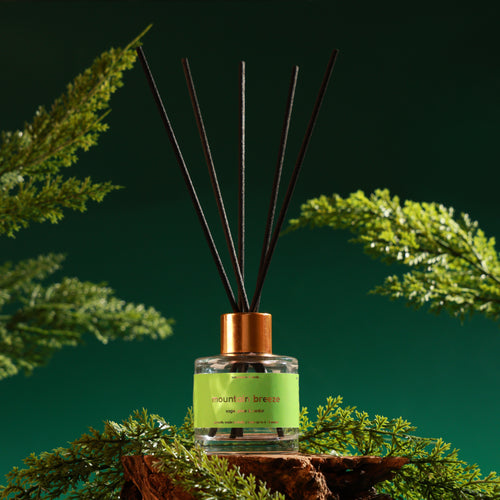
Mountain Breeze 130ml · 14–18 weeks₹1,349Shop →  Morning Freshness · lightest on fibrefrom ₹749Shop →
 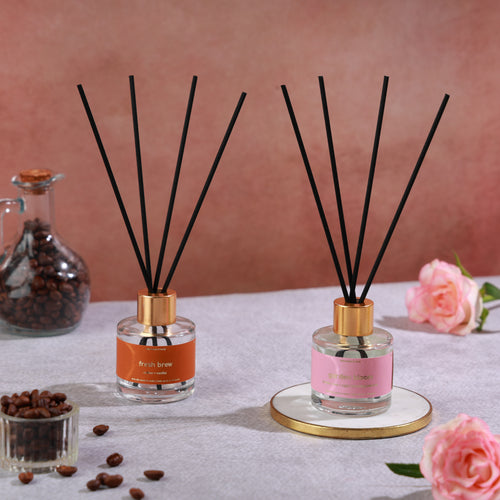 Oil refill · for the fills between₹2,399Shop →
Part three — the reed's season, and how to build it into a year
India gives a reed diffuser three distinct climates a year and each does something different to the fibre. The summer is a throughput season: heat lifts evaporation off the exposed length, the bottle drops faster than the stated window, and reeds age quickly because a lot of oil goes through them in a short time. The monsoon is a resistance season — throughput falls because the air is already saturated and evaporation slows, yet the reeds come out in worse condition than they went in, because humidity is doing its own work on the channels. Then the cool months are the kind ones: steady evaporation, low residue accumulation, and a set of reeds that will hold its rate for a long time. That is the shape of the year, and it is why a single flat number was never going to be an honest answer.
The practical version is a two-check calendar. Check one, September. When the monsoon breaks, lift a reed from every bottle in the house and run the wet-line and flip tests. This is the check that catches the most tired reeds, and if you only ever do one, do this one. Check two, whenever a bottle empties. A 130ml finishing at 14–18 weeks lands you almost exactly on the interval, so the decision makes itself: new bottle, new reeds, no thinking required. On 50ml bottles the arithmetic is looser — two fills at 6–8 weeks each puts you at roughly three to four months, which is the sensible point to start fresh rather than pour a third fill through the same fibre.
One more piece of scheduling that saves money. A 300ml refill at ₹2,399 covers roughly 8–11 months of a vessel's oil, which means a single refill spans two or three reed generations. Buying the refill does not put you on a reed schedule; it puts you on an oil schedule, and the two are different lengths. That mismatch is the origin of almost every disappointed refill email I receive — someone reaches month nine of a refill, pours the last of it through reeds that have been in the glass since the previous winter, and concludes the oil has gone off. It has not. At roughly ₹7–8 per millilitre against ₹15–17 for a fresh 50ml, the refill remains the cheapest oil we sell; it simply needs fibre that can still carry it. Plan a fresh bottle somewhere in the middle of every refill, keep the old glass for a second room, and both schedules stay honest.
Part four — the reed year, month by month
Here is the whole thing as a calendar. Timings are indicative for a typical Indian city and shift by a few weeks north to south, but the sequence holds everywhere.
| Season | What it does to a reed | Reed action | Oil action |
|---|---|---|---|
| Monsoon · June to September ★ | Humidity competes for the channels; fibre survives it, rattan does not | Leave alone during; check every bottle when it breaks | Bottle drops slowly — do not read that as a fault |
| Post-monsoon · September | The tiredest point of the year for a set of reeds | The one check to keep if you keep only one | Good moment to start a fresh 130ml |
| Festive · October to November | High reed counts age fibre fast for a few weeks | Start the season on fresh reeds, not tired ones | Expect a 50ml at nine reeds to go in about five weeks |
| Cool months · December to February | The kindest season — low throughput, low residue | A set will hold its rate right through | Cold thickens oil slightly; the climb is slower and that is normal |
| Summer · March to May | Heat lifts evaporation; a lot of oil passes through quickly | Expect to reach the interval sooner than the calendar suggests | Keep out of direct sun, or the bottle empties weeks early |
| Any month you host | Nine or ten reeds for a weekend, then back to six | Keep the extra reeds standing in a glass, not lying on wood | Negligible on oil for two days; noticeable if it becomes a habit |
Versailles
When we were writing the care card that goes in the box, there was a long argument about whether to put a number on reed replacement. A number is easier to read and easier to obey. The trouble is that any number I could have printed would have been wrong for most of the country, because a four-reed bedroom in Shimla and a ten-reed drawing room in Chennai are not on the same clock, and pretending otherwise would have had half our customers throwing away perfectly good reeds and the other half persevering with dead ones.
So the card says every few months, and this page says what moves it. If that feels like a dodge, use the September check. One morning after the monsoon breaks, lift a reed from every bottle in the house. It takes ten minutes and it catches almost everything.
I would also rather you knew the gap than discovered it at checkout: we do not sell reeds on their own. It is on the list of things I would like to fix, and until it is fixed the honest answers are a new bottle or a craft supplier. Everything is composed and handmade in Pune, and a part of every order funds a girl's classroom through Nanhi Kali.
Frequently asked questions
- How do you know when reeds need replacing? — the five signs, in the order they appear.
- Can reed diffuser sticks become clogged? — the humidity mechanism in full.
- Should you use new reeds when refilling? — where the oil and reed schedules collide.
- The complete reed replacement guide and why can't I smell my reed diffuser?
- Brand: the SOSA founder story.
SOSA reed diffuser range & prices (verified August 2026): alcohol-free, phthalate-free, paraben-free and IFRA-compliant compositions on a heat-stable coconut-derived (CCT) carrier, low-VOC, supplied in a refillable glass bottle with six fibre reeds; 50ml lasts 6–8 weeks and 130ml lasts 14–18 weeks. Morning Freshness (Malabar lemon · peppermint · Nilgiri eucalyptus) 50ml ₹749 · 130ml ₹1,249 · 9.0/10; Garden Bloom (British rose · night-blooming jasmine) 50ml ₹799 · 130ml ₹1,299 · 8.9/10; Evening Calm (Kashmir lavender · chamomile) 50ml ₹799 · 130ml ₹1,299 · 8.9/10; Fresh Brew (Coorg coffee · Kerala vanilla) 50ml ₹849 · 130ml ₹1,349 · 9.5/10; Mountain Breeze (Himalayan pine · sage · Indian cedar) 50ml ₹849 · 130ml ₹1,349 · 9.4/10. Reed diffuser refills are oil only — you reuse your own vessel and reeds: 300ml ₹2,399 (roughly 8–11 months) · 500ml ₹3,499 (roughly 14–18 months), about ₹7–8 per ml against ₹15–17 per ml for a 50ml bottle. Duo sets ₹1,498–₹1,598 for 2 × 50ml and ₹2,498–₹2,598 for 2 × 130ml. Strength figures are positions on SOSA’s own internal strength scale, not an industry standard. Replacement reeds are not sold as a separate SKU; SOSA guidance is to refresh reeds every few months. The reed line is separate from the water-based Hotel Collection for ultrasonic machines (15ml ₹299 · 100ml ₹999 · 300ml ₹1,799) and the two are not interchangeable. Diffusers: Boond 300ml ₹899 · Sukoon 500ml ₹1,899 · Megh 6L ₹3,499 · waterless Vaayu ₹11,999. Composed and handmade in small batches in Pune, India; tested through 45°C summer heat and 85% monsoon humidity. Free shipping above ₹499. A portion of every order supports girl-child education through Nanhi Kali. Prices subject to change — see the live product pages.