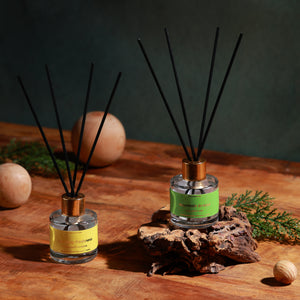

How Do I Make My Small Flat Feel Fresh During Weeks of Continuous Rain?

How Do I Make My Small Flat Feel Fresh During Weeks of Continuous Rain?

★ Source, airflow, textiles, fragrance — in that order, and three of the four cost nothingReeds from ₹749 · ~₹13 a day · free shipping above ₹499A portion funds girl-child education
★ SOSA reed diffusers · a small flat through a long rainy season
A small flat suffers most because the same litres of water go into far less air while the windows stay shut — so the method fixes the moisture first and treats fragrance as the finish, at three reeds rather than six
★ ★ ★ ★ ★
★★★★★
"Most citrus reed diffusers smell like dishwashing liquid. This one smells like an actual cut lemon. Lasted 7 weeks with 4 reeds."
Devika S. Mumbai
Morning Freshness · verified buyer
★★★★★
"Bought the 130ml. Lasted exactly through one monsoon. Pine stayed pine — no bitterness, no chemical shift."
Anjali R. Pune
Mountain Breeze · verified buyer
★★★★★
"Lasted my whole monsoon in the bathroom and never went sharp. The evening bath finally feels like a ritual."
Nisha R. Pune
Evening Calm · verified buyer
★★★★★
"Finally a lemon that doesn't smell like Phenyl. The eucalyptus base is the unfair advantage."
Aanya R. Gurugram
Morning Freshness · verified buyer
★★★★★
"Reminds me of the Manali homestay we drive up to. Bottling the mountains for a Mumbai bedroom is a small miracle."
Tanmay S. Mumbai
Mountain Breeze · verified buyer
★★★★★
"I was worried it would be too strong at night. It's the opposite — soft and gentle, just there in the background."
Meera D. Delhi
Evening Calm · verified buyer
★★★★★
"Most citrus reed diffusers smell like dishwashing liquid. This one smells like an actual cut lemon. Lasted 7 weeks with 4 reeds."
Devika S. Mumbai
Morning Freshness · verified buyer
★★★★★
"Bought the 130ml. Lasted exactly through one monsoon. Pine stayed pine — no bitterness, no chemical shift."
Anjali R. Pune
Mountain Breeze · verified buyer
★★★★★
"Lasted my whole monsoon in the bathroom and never went sharp. The evening bath finally feels like a ritual."
Nisha R. Pune
Evening Calm · verified buyer
★★★★★
"Finally a lemon that doesn't smell like Phenyl. The eucalyptus base is the unfair advantage."
Aanya R. Gurugram
Morning Freshness · verified buyer
★★★★★
"Reminds me of the Manali homestay we drive up to. Bottling the mountains for a Mumbai bedroom is a small miracle."
Tanmay S. Mumbai
Mountain Breeze · verified buyer
★★★★★
"I was worried it would be too strong at night. It's the opposite — soft and gentle, just there in the background."
Meera D. Delhi
Evening Calm · verified buyer
Alcohol-free · phthalate-free · paraben-free · IFRA-compliant · 0 ppm formaldehyde 50ml suits up to ~150 sq ft and runs 6–8 weeks · three reeds roughly doubles that SOSA makes no dehumidifier or air purifier · composed in Pune · free shipping above ₹499


Founder Diaries · Real Indian Homes · Indoor Laundry & Monsoon
By Sonal Sahani · ISIPCA Versailles 13 min read Updated August 2026
This is the page that gathers the whole method, so it is the longest and the one I would send to somebody who has read nothing else. There are four stages and they run in a fixed order: moisture source first, airflow second, textiles third, fragrance last and at a low dose. Three of the four cost nothing. The reason a small flat suffers most is not that it is small in a general sense — it is that a small flat has fewer cubic metres of air to absorb the same several litres of water a load of washing releases, while a rainy month simultaneously shuts the windows and keeps everybody indoors. Three variables move against you at once, and the method below addresses them in the order they actually matter.
The method, in order — read this first
Stage 1 · the source. Where the water comes from and where it dries. Space the garments, split heavy items out, and keep the drying out of the room you sleep in.

Stage 2 · the airflow. A fan across the rack rather than a ceiling fan above it, internal doors open so the flat shares one air volume, and ten honest minutes of cross-ventilation on any day the rain pauses.

Stage 3 · the textiles. Towels, curtains, bedding, rugs and cupboards are the reservoir. They keep releasing after the rack is empty, and nothing goes into a cupboard even slightly damp.

Stage 4 · the fragrance, at a low dose. Three reeds rather than six, in the room’s natural airflow path near a doorway. Morning Freshness ₹749, roughly ₹13 a day.

The honest gap: stages one to three are the answer. Stage four is the finish. SOSA makes no dehumidifier, no air purifier and no odour eliminator, and no fragrance from anyone removes a damp smell — it sits alongside it.
The short answer
Short answer: treat it as four stages in a fixed order — source, airflow, textiles, fragrance. A small flat feels worse than a large one through a wet month because the same volume of water from the washing is going into a much smaller volume of air, and because the windows that would normally carry it away are shut against the rain. Fix the water and the air, deal with the fabric that has already absorbed it, and then add fragrance at a deliberately low dose.
The thing most people get wrong: they start at stage four. Fragrance is an addition and never a subtraction, so a pleasant smell laid over damp gives you both at once and the mixture is worse than either. It is also the stage that costs money, which is why starting there feels like doing something and produces the least. Three of the four stages are free.
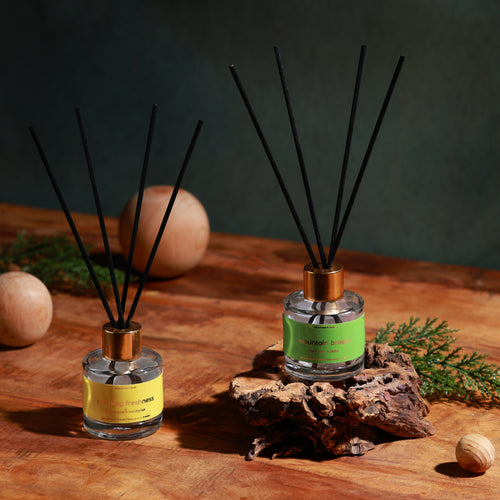
Shop, when you get to stage four: Morning Freshness 50ml ₹749 for a room up to about 150 sq ft (6–8 weeks, roughly ₹13 a day) or 130ml ₹1,249 above that (14–18 weeks). Mountain Breeze ₹849 is the dry green alternative. Six fibre reeds in a refillable glass bottle. Free shipping above ₹499.
Straight answer
How do I keep a small flat feeling fresh through weeks of continuous rain?
1. Control the water before anything else. Drying clothes release several litres of water into the flat over a day, and the musty note comes from fabric that stays wet too long rather than from the humidity itself. So the useful moves are the ones that shorten drying time: space the garments so air reaches both faces, split the towels and denim out from the rest, and never choose a closed bedroom as the drying room.

2. Then move the air, deliberately. A pedestal or table fan pointed through the rack does what a ceiling fan two metres above it cannot. Leave internal doors open so the flat behaves as one air volume rather than five small still ones. And on any day the rain genuinely pauses, open everything for ten minutes — ten honest minutes of cross-ventilation is worth more than a week of a shut flat with something pleasant in it.

3. Deal with the textiles, because they are the reservoir. A room can keep smelling damp for days after the rack is empty, because the towels, curtains, bedding, rugs and the cotton in the cupboards have all taken up moisture and give it back slowly. Wash and properly dry the towels, air the curtains, open the wardrobe while the room is being aired, and put nothing away even slightly damp.

4. Only now, fragrance — and turn the dose down, not up. Three reeds rather than six, which is a soft level and roughly doubles the life of the bottle. Place it in the room’s natural airflow path, near a doorway rather than in a corner, because saturated air carries fragrance less readily and placement beats dose in this season. Morning Freshness ₹749, at roughly ₹13 a day.

5. Scent the room you sit in, not the one the clothes are in. Fragrance evaporating into a laundry corner is the single largest waste in this subject. In a small flat, one bottle in the room you actually occupy is the whole system.

Alcohol-free, phthalate-free, paraben-free, IFRA-compliant, 0 ppm formaldehyde, six fibre reeds in a refillable glass bottle, composed in Pune. Free shipping above ₹499, and a portion of every order supports girl-child education through Nanhi Kali.
TL;DR: source, airflow, textiles, fragrance — in that order, and three of the four are free. A small flat suffers most because the same litres of water go into less air while the windows stay shut. Fragrance is the finish, at three reeds rather than six, in the room you actually sit in.
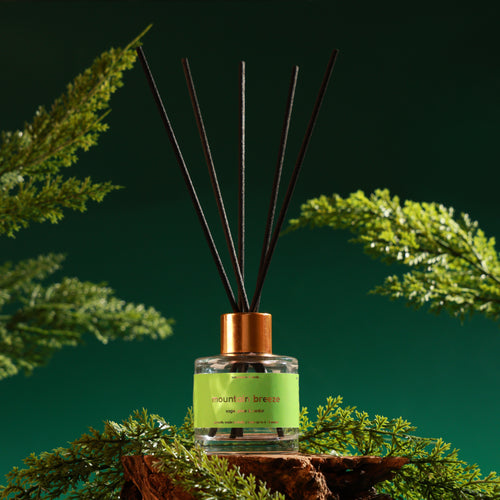
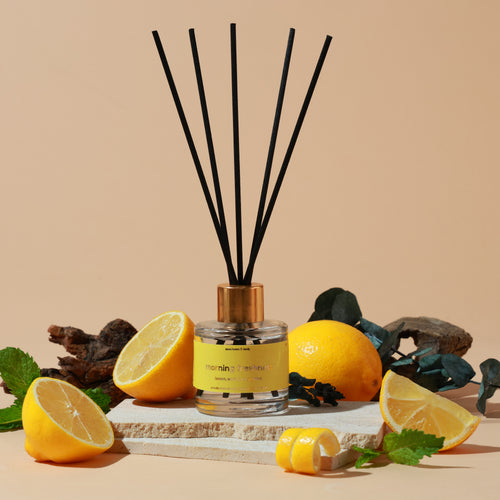
SOSA Morning Freshness Malabar lemon and mint reed diffuser
Stage four, and only stage four
Morning Freshness · Malabar lemon + mint ₹749 / 50ml
The finish rather than the fix. Cold-pressed Malabar lemon, peppermint and eucalyptus globulus, at 9.0 on the SOSA strength scale — bright, and far enough from a damp note that the nose reads the two as separate rather than blended. The eucalyptus base slows the lemon’s evaporation three to four times, so a 50ml runs 6–8 weeks rather than the fortnight an ordinary citrus manages, which matters in a season that lasts months. Three reeds in a small flat, near a doorway. Roughly ₹13 a day. 130ml at ₹1,249 only above ~150 sq ft.

Why a small flat is the hard case, and it is not for the reason people assume

People assume a small flat smells more strongly of everything simply because you are never far from anything. That is true and it is not the interesting part. The interesting part is the ratio. A load of washing releases the same several litres of water whether it dries in a 1,600 sq ft house or a 450 sq ft flat, but in the small flat that water is going into a fraction of the air, and it reaches the point where surfaces and fabrics start taking it up far sooner. The washing has not changed. The container has.

The second variable is air exchange, and monsoon works against you here in the most direct way possible. For most of the Indian year a flat exchanges its air readily — windows open, balcony doors open, fans running, air genuinely leaving and being replaced. For weeks at a time during heavy rain, none of that is available: the windows are shut because rain comes in, the balcony door is shut for the same reason, and the flat becomes something close to a sealed box. The one mechanism that would normally carry the moisture away is switched off in exactly the weeks you most need it.

The third is occupancy, and it is the one nobody counts. In a month of continuous rain a household is indoors more, for longer and less predictable stretches. Every person in a room adds to the load in small ways, cooking happens more, the flat is simply used more, and there is nobody arriving from outside with an unadapted nose to tell you what it actually smells like. That last part matters: olfactory receptors adapt to a constant stimulus within minutes, and after four days indoors you are thoroughly adapted to your own flat. Leave for fifteen minutes and walk back in without thinking about it. That first breath is the only honest reading available, and it is the measurement I would take before and after every stage below.

1
STAGE ONE · THE SOURCE
Where the water enters, and how long the fabric stays wet
Everything starts here because the note itself starts here: slow-drying fabric supports the microbial growth that produces the characteristic musty smell, so the variable that matters is drying time rather than humidity in the abstract. Space the garments so air reaches both faces of each one; a crowded rack dries only on its outer surface and the middle sits in a pocket of saturated air of its own making. Split the heavy items out — towels and denim hold the most water and dry last, and one wet towel in the middle of a rack slows everything around it. Choose the drying room deliberately: a bathroom with a working exhaust, a covered balcony, a utility corner, or whichever room stays open and occupied. Never the room you sleep in with the door shut for eight hours. And spin the load properly before it comes out of the machine; less water in means less water out.
Test: if individual clothes smell faintly wrong coming off the rack, the drying time is too long. That is a stage one problem and no later stage fixes it.
2
STAGE TWO · THE AIR
Replace what the shut windows used to do
Moving air carries water away from wet surfaces; still air sits against them and saturates. In a rainy fortnight your windows cannot do that job, so a fan has to. A pedestal or table fan aimed horizontally through the rack is doing something a ceiling fan is not, because a ceiling fan pushes a column of air down onto the top of the rack and out along the floor, missing the gaps where the drying happens. Beyond the rack, treat the flat as one volume rather than several: leave the internal doors open so air can circulate between rooms, and run the fans in the rooms you are in. Corners, alcoves and the spaces behind furniture are where air goes to stop, which is exactly why damp is always worst there. And take every pause in the rain seriously — ten minutes with two openings on opposite sides of the flat produces a genuine exchange of air, which is more than any device in my range does.
Test: stand in the doorway of each room. If you cannot feel any movement anywhere in the flat, nothing is leaving.
3
STAGE THREE · THE TEXTILES
The reservoir that keeps releasing after the rack is empty
This is the stage that explains the complaint I hear most: the clothes are gone and it still smells. Every absorbent thing in a small flat has been sitting in air that was carrying the water — mattress, bedding, curtains, rugs, upholstery, the cotton in the cupboards, the doormat, the towel on the back of a chair — and all of them give it back slowly. So the room stays musty after the tap has been closed. The work is unglamorous and it is finite: wash and fully dry the towels rather than re-hanging them, take down and air the curtains nearest the rack, open the wardrobe doors for a few hours while the room is being aired, put nothing away even slightly damp, and get the rugs and cushions into whatever daylight and moving air you can find. A closed cupboard is a small, still, unventilated box, and it is the most reliable way to give an entire shelf of clothes the same note.
Test: open a cupboard that has been shut for two days and smell the first breath out of it. That tells you whether stage three is done.

The method in one table

The four stages side by side, with what each one controls and what it costs. I have added a column for what each stage does not do, because the mistakes in this subject are almost all misattributions — people expect stage four to do stage one’s work and then conclude that home fragrance is a con.

The complete method
Four stages for a small flat through weeks of continuous rain
Stage What it controls What to do What it will not do Cost
1 · Source How much water enters, and how long fabric stays wet Space the garments, split out towels and denim, spin properly, choose the drying room deliberately Nothing here helps the fabric already holding the note Free
2 · Airflow Whether the moisture leaves or accumulates Fan through the rack, internal doors open, ten minutes of cross-ventilation whenever the rain pauses Will not shorten drying time on a crowded rack — stage one has to be done first Free
3 · Textiles The secondary reservoir that keeps releasing Towels washed and dried, curtains aired, cupboards opened, nothing put away damp Will not stop the problem recurring if the rack is still crowded in a shut room Free
4 · Fragrance What the room smells of once it is dry and aired Three reeds, in the airflow path near a doorway, in the room you occupy Removes nothing. Over damp it produces scented damp, which is worse than either From ₹749
Stage four, when you get there
The bright answer, the dry green one, and the pairing for two rooms
The SOSA principle
Three of the four stages cost nothing, and they are the three that matter. The one that costs money is the one that does the least work.
Which is an awkward sentence for a fragrance house to publish and the reason this page is worth reading. A reader who is told the truth about the laundry can believe the recommendation about the diffuser.

Stage four, and why the dose goes down rather than up

Almost everybody’s instinct in a wet month is to push harder — more reeds, a bigger bottle, something stronger. It is the wrong direction on both of the grounds that matter. The first is perception: any composition read at too high a concentration flattens into a single sweet or sharp impression, and a flattened fragrance is far more likely to merge with a damp note than a legible one is. Three reeds rather than six gives a soft, layered level and roughly doubles how long the bottle lasts. Six reeds in a small flat is over-dosed in any season, and in this one it is the fastest way to produce a room that reads as heavily perfumed on top of something else.

The second is physics, and it is the single most useful thing to know about home fragrance in monsoon. Saturated air carries fragrance molecules less readily, so projection shortens and the scent hangs closer to the bottle. That is why it seems weaker in July than in February, and nothing is wrong with the bottle. Adding reeds does not solve it — it mostly buys you a faster-emptying bottle and a slightly louder metre. What solves it is placement: move the diffuser into the room’s natural airflow path, near a doorway, at the mouth of a corridor, in the line the fan is pushing, rather than tucking it into a corner or onto a shelf behind furniture. This is the one season where moving the bottle two metres does more than changing anything about it.

The rest is arithmetic and restraint. A 50ml suits a room up to about 150 sq ft and runs 6–8 weeks — roughly ₹13 a day for Morning Freshness or Garden Bloom, and about ₹15 for Mountain Breeze, Evening Calm or Fresh Brew. A 130ml is for above that and runs 14–18 weeks, and in a genuinely small flat it is over-specified: the honest recommendation there is the 50ml with fewer reeds, not the larger bottle. In a small flat, one bottle in the room you actually sit in is the whole system, and the room where the clothes are drying should be getting airflow rather than fragrance. Two final constraints: keep any diffuser away from open flame, and never a candle in a room where laundry is drying, because fragrance oil is flammable and a drying rack is a stand covered in hanging fabric.

The rain is not the problem and the flat is not the problem. A crowded rack in a still room is the problem, and it is solved with a fan and thirty centimetres of spacing.
— Sonal Sahani, SOSA

What to buy, in order — and what does not exist

Stages one to three have no shopping list, which is why they are absent from this table. What follows is stage four in the order I would spend it in a small flat, with the honest gap at the bottom stated in full rather than gestured at.

The small-flat monsoon edit
Stage four in buying order, and everything this range does not do
Buy What it is When it is the right answer Price
1. Morning Freshness 50ml Bright citrus on a eucalyptus base, six fibre reeds, ~₹13 a day, 6–8 weeks The one bottle for a small flat. Three reeds, in the room you sit in, near a doorway ₹749
2. Mountain Breeze 50ml Pine, sage and cedar — dry and resinous rather than bright If citrus reads as sharp, or for a bedroom or study you want settled rather than woken ₹849
3. Evening Calm 50ml Lavender and chamomile at 8.9, the softest thing we make A bedside where you want the room quiet. Accept that a wet month can swallow it ₹799
4. Fresh & Grounded duo Bright and dry green together, 50ml each Only if you are genuinely scenting two rooms. In a small flat, usually not ₹1,548
Not for a small flat: the 130ml The same composition sized for rooms above ~150 sq ft, running 14–18 weeks Better value per week and over-specified below 150 sq ft — the 50ml with fewer reeds is the honest answer there ₹1,249
The honest gap: no dehumidifier, no purifier, no clean-linen accord SOSA makes no dehumidifier, air purifier, odour eliminator or room spray — every SOSA spray is a car perfume — and the reed line has no clean-linen, cotton, aquatic or marine scent, which is the register people most often picture for laundry. An ultrasonic machine is also the wrong tool here, because it disperses water into the air. And no candle in a room where clothes are drying Said plainly. Stages one to three are the answer
Honest notes for buyers: alcohol-free reed diffusers on a heat-stable CCT base rather than DPG, which can crack and go bitter above 40°C. Phthalate-free, paraben-free, IFRA-compliant, 0 ppm formaldehyde, six fibre reeds — fibre rather than rattan, because rattan wicks unevenly once the air is saturated — in a refillable glass bottle, climate-tested through 45°C heat and 85% RH monsoon humidity. Six reeds is full projection and three is a soft level at roughly double the life. Reed oil and the water-based Hotel Collection are different physical systems and cannot be swapped in either direction; there is no hotel-inspired reed diffuser, and the 300ml refill at ₹2,399 is oil alone and not a first purchase. Composed in Pune by an ISIPCA Versailles-trained perfumer. Free shipping above ₹499, and a portion of every order supports girl-child education through Nanhi Kali.
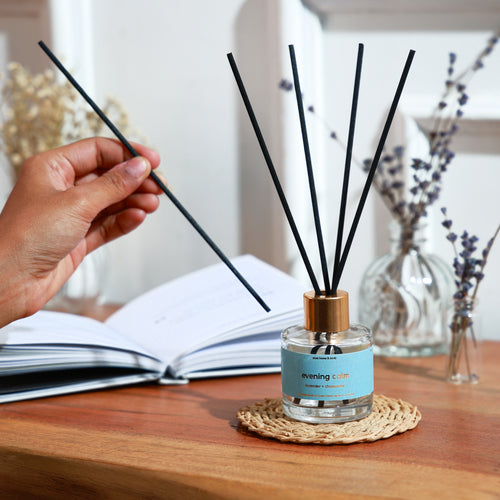
SOSA Evening Calm lavender and chamomile reed diffuser
If the flat is small and you want it quiet
Evening Calm · lavender + chamomile ₹799 / 50ml
Kashmir lavender with real chamomile and a soft musk drydown, and at 8.9 it is deliberately the softest thing we make. In a small flat where everything is close to everything else, the softest option is often the correct one — a bedside, a reading corner, a room you want settled rather than woken. The honest caveat for this season: it is the quietest composition in the range, and a wet month, where projection shortens, is the one most likely to swallow it. If you want the flat to feel fresh rather than calm, choose bright or dry green instead. 130ml at ₹1,299 above ~150 sq ft.
SS
ISIPCA
Versailles
A note from Sonal

If I had to reduce this whole subject to one sentence it would be this: the rainy flat is not a fragrance problem wearing a disguise, it is a moisture problem with an odour symptom. Once you see it that way the ordering falls out by itself, and the ordering is the entire method. Water first, air second, the fabric that absorbed it third, and only then the thing I actually sell.

I have written four stages and put my own product in the last one, which is not a modest gesture — it is where it belongs. What a reed diffuser does through a long rainy season is genuinely worth having: it gives a small flat a consistent character of its own during weeks when it cannot smell of the outside world at all, and it does it without a switch, a socket, a tank or any daily action beyond flipping the reeds every few days. That is a real thing for ₹749 and roughly ₹13 a day to do. It is simply not the same thing as drying the flat.

The adjustment I would most like you to take from this page is the one that costs nothing: three reeds instead of six, and the bottle moved into the airflow path near a doorway rather than tucked into a corner. In a humid month those two changes do more than any change of scent, because the season has already shortened your projection and over-dosing to compensate simply flattens the composition into one note. Restraint is the cheapest luxury signal there is. Everything is composed in Pune, and a portion of every order funds a girl’s classroom through Nanhi Kali.

Frequently asked questions

How do I make a small flat feel fresh through weeks of continuous rain?
In four stages, in order. Control the source — space the drying clothes, split out the towels and denim, and keep the rack out of the room you sleep in. Move the air — a fan through the rack, internal doors open, ten minutes of cross-ventilation whenever the rain pauses. Deal with the textiles that have already absorbed moisture. Then add fragrance at a low dose: Morning Freshness ₹749 with three reeds, in the room you occupy, near a doorway. Three of the four stages are free.
Why does a small flat feel worse in monsoon than a big house?
Because the same load of washing releases the same several litres of water into a much smaller volume of air, so surfaces and fabrics start taking it up far sooner. Two other things happen at once: the windows that would normally exchange the flat’s air are shut against the rain, and the household is indoors for longer stretches. The washing has not changed — the container has, and the one mechanism that would clear it is unavailable in exactly those weeks.
Should I use a bigger bottle or more reeds because the fragrance seems weaker?
Neither, in a small flat. Saturated air carries fragrance molecules less readily, so projection shortens and the scent hangs closer to the bottle — that is the season, not the product. The fix is placement: move the diffuser into the room’s natural airflow path, near a doorway rather than into a corner. Use three reeds rather than six, which gives a softer, more legible level and roughly doubles the life of the bottle. A 130ml in a room under about 150 sq ft is over-specified.
Should I put a diffuser in the room where the clothes dry?
No. That room needs airflow, not fragrance, and a diffuser running into a room nobody sits in is the largest single waste in this subject. Scent the room you actually occupy. And nothing with a flame belongs there at all — fragrance oil is flammable and a drying rack is a stand covered in hanging fabric, so a candle near indoor laundry is not something we would ever recommend, at any price.
What does a reed diffuser actually cost me over a monsoon?
Roughly ₹13 a day for a 50ml Morning Freshness or Garden Bloom, and about ₹15 a day for Mountain Breeze, Fresh Brew or Evening Calm, with a 50ml running 6–8 weeks. Using three reeds instead of six roughly halves the rate and doubles the life, so a single bottle can cover a long rainy stretch. Stating it per day is fairer than the sticker price, because a ₹749 bottle that runs for two months is a different purchase from a ₹749 object — and free shipping starts at ₹499, which matters more than people expect when comparing it to a cheaper item.
Indoor laundry & monsoon — the complete method
Source, airflow, textiles, fragrance. Three of the four are free, and the fourth is the finish, not the fix
Morning Freshness ₹749 for 50ml at three reeds, in the airflow path of the room you sit in — 6–8 weeks at roughly ₹13 a day, or ₹1,249 for the 130ml at 14–18 weeks above ~150 sq ft. Mountain Breeze ₹849 for a dry green register. Alcohol-free, phthalate-free, paraben-free, IFRA-compliant, 0 ppm formaldehyde, six fibre reeds in a refillable glass bottle, composed in Pune. SOSA makes no dehumidifier and no air purifier, and no fragrance removes a damp smell. Free shipping above ₹499, and a portion of every order supports girl-child education through Nanhi Kali.
Shop Morning Freshness ₹749 → Mountain Breeze ₹849
Continue the read
The whole indoor-laundry and monsoon family
Editorial standards & sources
About this guide: Written by Sonal Sahani, ISIPCA Versailles-trained founder and perfumer at SOSA Home & Body, as the complete method for a small Indian flat through a long rainy season, in the order the four stages actually matter. This guide states plainly that fragrance does not remove an odour and that the correct sequence is source, then ventilation, then fragrance; it also states that an ultrasonic cool-mist diffuser disperses water into the room as part of its normal operation. It contains no health, air-quality, allergy, antimicrobial or building-remediation claims and makes none. Where a mechanism cannot be quantified from published SOSA data it is described qualitatively rather than with an invented figure. Longevity and cost-per-day figures assume ordinary Indian household use and vary with room size, ventilation and reed count. Review quotations are from verified SOSA buyers.

SOSA products — facts verified August 2026: Five reed scents, all alcohol-free, on a heat-stable CCT (caprylic/capric triglyceride) base, phthalate-free, paraben-free, IFRA-compliant, 0 ppm formaldehyde, six fibre reeds in a refillable glass bottle, composed and made in Pune, India. Morning Freshness (Malabar lemon · peppermint · eucalyptus globulus) 50ml ₹749 · 130ml ₹1,249 · 9.0 on the SOSA strength scale; the eucalyptus globulus base slows lemon evaporation three to four times, giving 6–8 weeks rather than the usual ten-to-fourteen-day citrus fade. Evening Calm (Kashmir lavender · chamomile · soft musk) 50ml ₹799 · 130ml ₹1,299 · 8.9, the softest in the range. Garden Bloom (British rose · night-blooming jasmine) 50ml ₹799 · 130ml ₹1,299 · 8.9. Mountain Breeze (Himalayan pine · sage · Indian cedar) 50ml ₹849 · 130ml ₹1,349 · 9.4. Fresh Brew (Coorg coffee · Kerala vanilla · caramel) 50ml ₹849 · 130ml ₹1,349 · 9.5, the deepest in the range. 50ml suits rooms up to approximately 150 sq ft and 130ml above that; longevity 6–8 weeks and 14–18 weeks respectively; six reeds gives full projection and three gives a soft level at roughly double the life; approximately ₹13 a day for Morning Freshness or Garden Bloom 50ml and ₹15 a day for Mountain Breeze, Fresh Brew or Evening Calm 50ml. Duos: Day & Night ₹1,498, Fresh & Grounded ₹1,548, Warmth & Bloom ₹1,598 (50ml × 2). Refills 300ml ₹2,399 · 500ml ₹3,499, oil only. Machines: Boond ₹899, Sukoon ₹1,899 (500ml, 270–320 sq ft, 16–18 hours on low), Megh ₹3,499 (six litres, around 100 hours of runtime, approximately 215 sq ft — a runtime and humidity machine, never a coverage upgrade). Climate-tested through 45°C heat and 85% RH monsoon humidity. The reed line contains no oud, sandalwood, vetiver, amber, aquatic, marine or clean-linen accord. SOSA makes no room spray, air purifier, dehumidifier or odour eliminator; every SOSA spray is a car perfume. Reed diffuser oil and the water-based Hotel Collection are separate systems and are not interchangeable, and there is no hotel-inspired reed diffuser. Free shipping above ₹499. SOSA is an independent Indian fragrance house and is not affiliated with or endorsed by any hotel brand. Prices subject to change — see the live product pages.
Back to blog