


The method: spend a week noticing where people actually walk — front door to kitchen, bedrooms to bathroom, sofa to balcony. Those are your carrying lines. Put the bottle beside one, at waist to chest height.
How long to judge: forty-eight hours, and ask someone who has been out. Your own nose adapts to a constant within minutes and adapts hardest at home.
What it costs: nothing. It is the only strength lever that is free, instant and completely reversible, which is why it should always be tried before a new bottle.
2. Spend a week drawing the map before you move anything. Notice, without changing your habits, where the household walks: door to kitchen, bedroom to bathroom, sofa to balcony. Every home has three or four such lines and a great deal of floor nobody crosses, and most diffusers are standing in the second kind of place.
3. Height matters as much as position. Waist to chest, roughly console height. On the floor the fragrance sits under the furniture; above eye level it drifts along the ceiling and you cannot reach the reeds to flip them.
4. A route is not a draught. Gentle incidental air is what you want. Directly under a split AC, in front of a fan or on a windowsill, the reeds are stripped, the room smells of little, and the bottle empties weeks early.
5. Give it forty-eight hours and borrow someone else's nose. You stop registering a constant within minutes, and you adapt hardest at home. Ask a guest, or judge it yourself on the way in from outside.
6. If two routes matter, use two bottles. Output per bottle is fixed, so the only honest way to raise the total in a home is another source — two 50ml on two routes beat one 130ml in the middle.
Composed and handmade in small batches in Pune, and a portion of every order supports girl-child education through Nanhi Kali.

Part one — who actually moves the air in your home
Ask most people what circulates air in a flat and they will say the fan, the air conditioner, or the open window. In practice, on an ordinary weekday, the largest and most useful mover of air in an occupied home is the household itself. A person walking through a doorway drags a body-sized parcel of air behind them and pushes another one ahead; a door swinging open exchanges the air in the gap; a chair pulled out, a curtain brushed past — each does more mixing at the scale of a room than a closed room's own convection ever will. This is why the same bottle can seem transformed by a two-metre move.
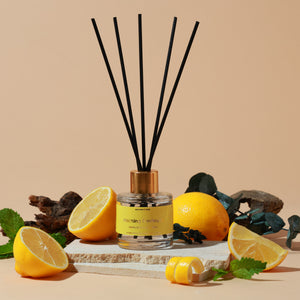
 Morning Freshness₹749 · 9.0/10For one week, change nothing and simply notice. Where do you go when you come in — drop keys on a console, or carry straight through to the kitchen? Which door does everybody use, and which one is decorative? What is the path from the bedrooms to the bathroom at seven in the morning? Almost every Indian home turns out to have three or four heavily walked lines and a lot of square footage nobody crosses at all. Sketch them on the back of an envelope; the picture is usually a surprise, because we furnish rooms for how they look from the doorway and then live in them along quite different lines. The bottle belongs where two lines cross — the mouth of a passage, the corner where the entry meets the living room.
Part two — the traffic map, zone by zone
Here is the map as I would draw it for a typical Indian two- or three-bedroom flat, ranked by how much carrying work the air in each zone does. The traffic figures are my own working impressions from customer correspondence and my own home rather than measurements — the ranking and the reasons are the point, and they hold whatever the exact numbers.
| Zone | Passes in a busy hour | What the air does there | Verdict for a bottle |
|---|---|---|---|
| Entrance console, just inside the door ★ | Very high | Exchanged wholesale every time the door swings; stirred by everyone arriving and leaving | The single best position in most homes |
| Mouth of the passage to the bedrooms | High | Two-way traffic morning and night; the passage acts as a duct into the sleeping rooms | Excellent, and it feeds three rooms at once |
| Sideboard beside the living-room doorway | High | Constant crossing between seating, dining and kitchen | Best position within a living room |
| Dining sideboard or serving counter | Medium | Busy in bursts — meals, tea, guests — and quiet in between | Good, particularly for an evening scent |
| Bedside table | Low but close | Very little air movement, but you are lying a foot away from it for eight hours | Works because of proximity, not throw |
| Centre of a coffee table | Low | People sit around it rather than walk through it; a low, sheltered pocket of still air | Looks right, performs poorly |
| Corner shelf, alcove or display cabinet | Almost none | Air stands still; fragrance pools within a foot of the glass and stays there | The commonest wrong answer |
| Windowsill or directly under the AC | Constant, but wrong | A hard one-way draught that strips the reeds and carries everything out of the room | Actively harmful — weak room and a short bottle |
| The honest caveat: this ranking assumes an occupied home on an ordinary day. A flat where everybody is out from nine to seven has almost no traffic at all during those hours, and no amount of repositioning changes that — what changes it is where you stand the bottle relative to the routes that do get walked, morning and evening. And if a position is genuinely impossible for domestic reasons — a toddler, a cat, a landlord's polished sideboard — the second-best spot you will actually live with beats the best spot you will not. | |||
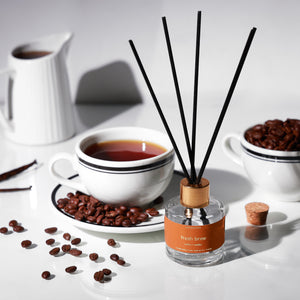
Garden Bloom · entrywayfrom ₹799Shop → 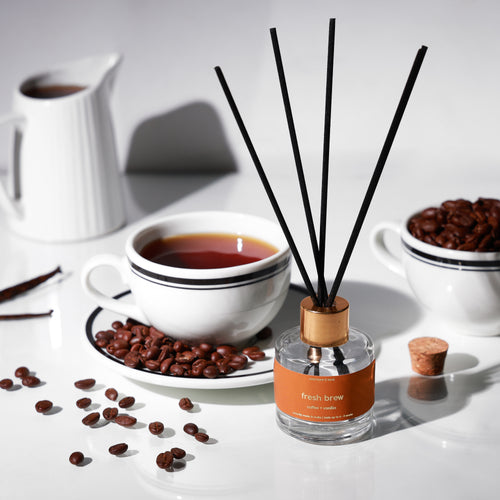 Fresh Brew · living roomsfrom ₹849Shop →
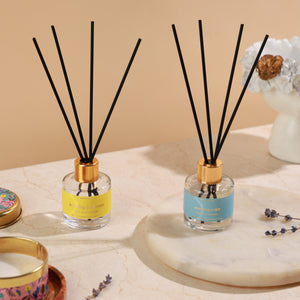
 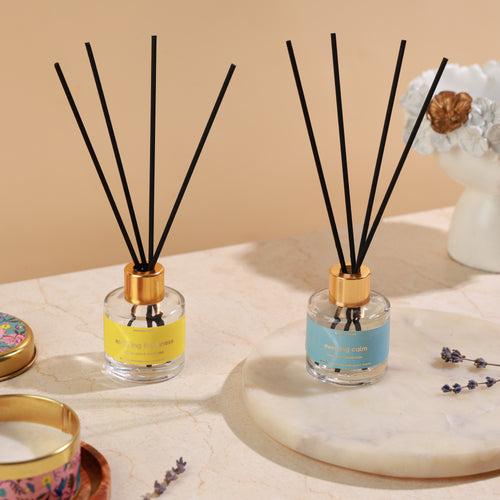 Day & Night duo · two routes₹1,498Shop →
Part three — running the move as a trial, not a guess
The reason people conclude that moving a diffuser "does nothing" is almost always the way they test it. They shift the bottle, lean over it, decide it smells the same, and shift it back within the hour. That test cannot work. Your nose stops reporting a constant within a few minutes and adapts hardest in your own home, and a relocated bottle needs time for the room's air to reach a new equilibrium anyway. So run it properly: move the bottle, flip all six reeds while your hands are on it, note the day, and leave it alone for forty-eight hours. Then judge it on the way in from outside. That first breath in the doorway, before adaptation catches up, is the only honest reading your own nose will give you.
Better still, borrow a nose. A guest, a delivery, a family member coming home from work — anyone who has been breathing other air for half an hour is a better instrument than you are. I have lost count of the messages that begin "I could not smell it at all, but everyone who visits comments on it"; that is not a paradox, it is the expected result of living with a constant. One tidy way to run it: move the bottle on a Friday, say nothing to anybody, and see whether the comment arrives on its own.
Two more practical notes on relocating. First, stand the bottle on a tray wherever it ends up — reed oil marks wood and stone, and a busy route is precisely where a sleeve or a bag will eventually catch the glass. Keep it out of reach of children and pets while you are at it. Second, if your map shows two busy lines a long way apart, do not try to solve it by shuttling one bottle back and forth; that simply leaves each end unscented half the time. Two 50ml bottles at ₹749–₹849 each, or a Day & Night duo at ₹1,498, will out-perform any single bottle in any position. If the two routes meet, choose scents that share a note — Mountain Breeze and Morning Freshness meet on green eucalyptus — or the junction will smell like a seam.
Part four — which bottle goes on which route
Once the map is drawn, the fragrance follows from what each route is for. An entrance is a first impression; a bedroom passage carries into rooms where people sleep; a kitchen doorway has to hold its own against food. Here is how I would allocate the range across a flat.
| The route | Stand the bottle | Fragrance I would choose | Why this one | From |
|---|---|---|---|---|
| Front door to living room ★ | Entrance console, waist height, tray under it | Garden Bloom | Rounded and hotel-like — a greeting rather than a statement | ₹799 |
| Living room to dining | Sideboard beside the doorway, clear of the seating | Fresh Brew | The fullest presence in the range at 9.5, and it suits a room people eat in | ₹849 |
| Passage to the bedrooms | Console or shelf at the mouth of the passage | Mountain Breeze | Deep and dry at 9.4 with no sweetness carried into sleeping rooms | ₹849 |
| Bathroom and morning route | Shelf away from the shower spray, chest height | Morning Freshness | Cold and sharp — it reads clearly in a small humid room | ₹749 |
| Bedside, where there is no route at all | Bedside table, back from the pillow | Evening Calm | Deliberately the softest thing we make; proximity does the work here | ₹799 |
| Two busy routes at opposite ends | One bottle on each — do not shuttle a single one | Day & Night duo | More sources is the only way to raise the total output of a home | ₹1,498 |
| No usable route anywhere in the room | Nothing to move it to — this is the honest failure case | Sukoon ultrasonic | A machine makes its own airflow; reeds borrow the room's | ₹1,899 |
Versailles
When we were testing the first reed compositions I kept a bottle on a beautiful carved shelf in the corner of my own living room in Pune, and for three weeks I quietly worried that the formula was underdosed. Then a plumber came to fix something in the passage, and I moved the bottle to the hall table to get it out of his way. By that evening the flat smelled like the thing I had actually composed. Nothing about the oil had changed. Two metres and a doorway had changed.
That is a humbling story for a perfumer to tell, and I tell it often, because it is the commonest thing standing between a customer and the fragrance they paid for. We can raise volatility and push a composition harder, and every one of those choices has a cost by week six. Moving the glass has no cost at all.
So before you write to us about strength, please give the traffic map a week. If it does not work, write anyway; I would far rather help you move a bottle or tell you honestly that your room needs a machine than sell you a second one that will stand in the same still corner. Everything is composed and handmade in small batches in Pune, and a part of every order funds a girl's classroom through Nanhi Kali.
Frequently asked questions
- The best placement for scent throw — every surface in a home, ranked with reasons.
- How to increase scent throw and stronger without wasting fragrance — distance, and the four wastes.
- How to make a reed diffuser smell stronger — the four currencies, ranked by cost.
- The complete guide to stronger performance and why can't I smell my reed diffuser?
- Brand: the SOSA founder story.
SOSA reed diffuser range & prices (verified August 2026): alcohol-free, phthalate-free, paraben-free and IFRA-compliant compositions on a heat-stable coconut-derived (CCT) carrier, low-VOC, supplied in a refillable glass bottle with six fibre reeds; 50ml lasts 6–8 weeks and 130ml lasts 14–18 weeks. Morning Freshness (Malabar lemon · peppermint · Nilgiri eucalyptus) 50ml ₹749 · 130ml ₹1,249 · 9.0/10; Garden Bloom (British rose · night-blooming jasmine) 50ml ₹799 · 130ml ₹1,299 · 8.9/10; Evening Calm (Kashmir lavender · chamomile) 50ml ₹799 · 130ml ₹1,299 · 8.9/10; Fresh Brew (Coorg coffee · Kerala vanilla) 50ml ₹849 · 130ml ₹1,349 · 9.5/10; Mountain Breeze (Himalayan pine · sage · Indian cedar) 50ml ₹849 · 130ml ₹1,349 · 9.4/10. Reed diffuser refills are oil only — you reuse your own vessel and reeds: 300ml ₹2,399 (roughly 8–11 months) · 500ml ₹3,499 (roughly 14–18 months), about ₹7–8 per ml against ₹15–17 per ml for a 50ml bottle. Duo sets ₹1,498–₹1,598 for 2 × 50ml and ₹2,498–₹2,598 for 2 × 130ml. Strength figures are positions on SOSA’s own internal strength scale, not an industry standard. Replacement reeds are not sold as a separate SKU; SOSA guidance is to refresh reeds every few months. The reed line is separate from the water-based Hotel Collection for ultrasonic machines (15ml ₹299 · 100ml ₹999 · 300ml ₹1,799) and the two are not interchangeable. Diffusers: Boond 300ml ₹899 · Sukoon 500ml ₹1,899 · Megh 6L ₹3,499 · waterless Vaayu ₹11,999. Composed and handmade in small batches in Pune, India; tested through 45°C summer heat and 85% monsoon humidity. Free shipping above ₹499. A portion of every order supports girl-child education through Nanhi Kali. Prices subject to change — see the live product pages.