
The free ladder: fifteen-minute doorway test → flip all six reeds → move and raise the bottle → close the room for an hour → add reeds. Only then buy.
The four levers that actually change strength: reed count, airflow, the composition, and the number of sources. Bottle size is not one of them — 130ml buys 14–18 weeks against 6–8 and projects the same at six reeds.
The ceiling, stated honestly: past roughly 250–300 sq ft of connected open volume, or when you want scent on demand, reeds are the wrong tool and a Sukoon at ₹1,899 is the answer.
2. Flip all six reeds, weekly, with gloves. Over weeks the exposed end accumulates the heavy end of the composition and delivery stalls. Flipping restores the designed rate. It is a repair, not a raise, and most people who ask for a raise actually needed the repair.
3. Move it onto a walked route and raise it. Console or sideboard beside a doorway, waist to chest height, an arm's length of clear air around the reeds, a couple of metres from any AC vent or fan, out of direct sun. Air in a home is stirred mostly by people walking through it.
4. Close the room for an hour and come back in. This tells you what the bottle can do when the volume it is scenting is bounded. If a closed room reads well and an open one does not, the problem is volume, not the bottle.
5. Then, and only then, add reeds. Six is the count each composition is dosed for. Nine gives a fuller room and roughly five weeks instead of eight on a 50ml; ten gives four to five. It is free, reversible in ten seconds, and paid for in weeks.
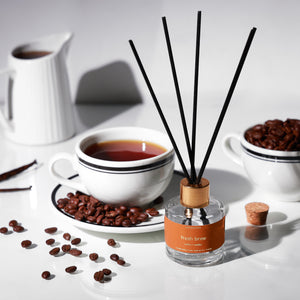
6. Buy strength in the composition, not the bottle size. Fresh Brew at 9.5 and Mountain Breeze at 9.4 are our loudest; Evening Calm at 8.9 is the softest and is meant to be. A 130ml lasts 14–18 weeks against 6–8 and projects the same.
7. For a large space, add sources rather than volume. Output per bottle is fixed. Two 50ml at opposite ends of an open living-dining beat one 130ml in the middle, every time.
8. Know when to stop. Past roughly 250–300 sq ft of connected open volume, or when what you want is scent on demand, the format is the limit. A Sukoon at ₹1,899 covers 270–320 sq ft with timers. Most homes end up running both.
Composed and handmade in small batches in Pune, and a portion of every order supports girl-child education through Nanhi Kali.
Part one — which question you actually have
"Not strong enough" arrives in my inbox several times a week and it is never one complaint. It is three, and they have three different answers, two of which are free. Separating them takes about two minutes and saves most people a purchase. The first is a presence problem — the room is scented but you are not registering it. The second is a throw problem — the fragrance is real near the bottle and absent where you sit. The third is a format problem — you want a room to smell strongly at a chosen moment, which is not something a passive diffuser can do at all. Read the three cards below and decide which one you have before you read anything else on this page.
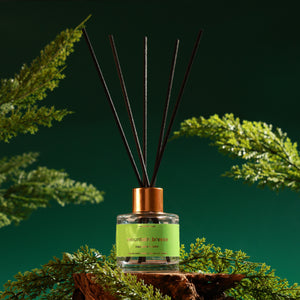
 Mountain Breeze₹849 · 9.4/10Throw is distance, and distance is a property of the room's air rather than of the bottle. A reed diffuser releases and waits; something has to carry what it releases. In an alcove, a closed cabinet or behind a sofa the fragrance pools within a foot of the glass. Airflow has two opposite failure modes and both read as weakness — dead air distributes nothing, and a hard draught from a split AC, a fan or an open window strips the reeds, empties the bottle weeks early and still leaves the room smelling of very little. The correct condition is gentle incidental traffic: beside a doorway or walkway, waist-to-chest height, clear space around the reeds, out of direct sun. Fixing this is free and it is the highest-return change most people can make.
Part two — the free ladder, ranked by return
Everything on this rung list costs nothing and is reversible. Work down it in order and stop as soon as the room is right; there is no prize for reaching the bottom. The gains described are our own working guidance from in-house testing and customer correspondence rather than measurements, and they assume a 50ml bottle with its standard six fibre reeds in an ordinary Indian room.
| Rung | What it corrects | Time it takes | Typical gain | What it means if this rung fails |
|---|---|---|---|---|
| 1. The fifteen-minute doorway test ★ | Tells you whether anything is wrong at all | 15 minutes | None — it is a diagnosis, and often the whole answer | The room really is under-scented; continue down the ladder |
| 2. Flip all six reeds | A stalled delivery rate from heavy residue at the exposed end | 2 minutes, then weekly | Returns the bottle to its designed rate within a few hours | Delivery was not the problem — look at the room next |
| 3. Run the wet-line test | Tells you whether the reeds are saturated, stalled or spent | 1 minute | None — it points you at the right rung | High and dark means flip; barely above the oil means refresh reeds |
| 4. Move it onto a walked route | Dead air, or a draught doing the opposite | 1 minute, judged over 48 hours | Frequently the single largest free change | Distribution was fine; the issue is volume or composition |
| 5. Raise it and clear the space around it | Low, enclosed or fabric-crowded placement | 1 minute | Noticeable when moving up from a coffee table to a console | You are already at a good surface — go on |
| 6. Close the room for an hour | Tells you whether the space is simply too large | 1 hour | None directly — it bounds the problem | If a closed room reads well and an open one does not, it is volume |
| 7. Add two to four reeds | A genuine output shortfall, once everything above is right | 10 seconds, reversible | Audibly fuller room — nine reeds is a real step up from six | Not free: nine reeds ≈ 5 weeks rather than 8 on a 50ml |
| The honest caveat: the last rung is the only one that costs you something, and it costs you roughly in proportion — reed count is the true volume control and it is paid for in weeks, not rupees. Rungs one to six genuinely cost nothing, which is why they come first and why I would rather you worked through all six and bought nothing at all than skipped to a purchase. If the ladder is exhausted and the room is still short, the problem is real, and Part three is the order in which to spend on it. | ||||
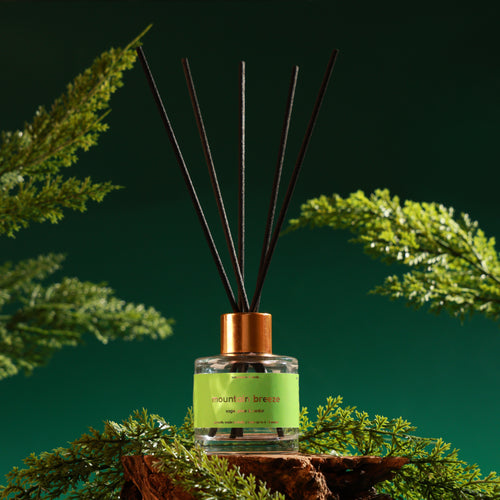 Mountain Breeze · 9.4/10from ₹849Shop →
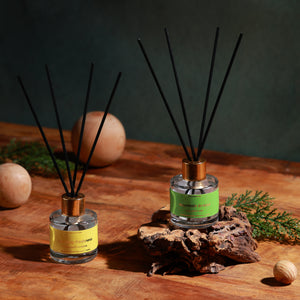
 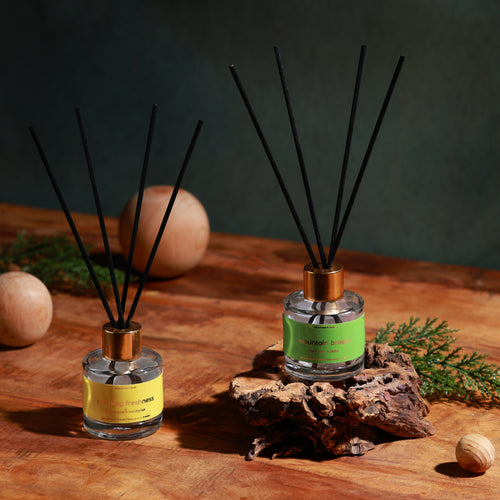 Fresh & Grounded duo₹1,548Shop →
 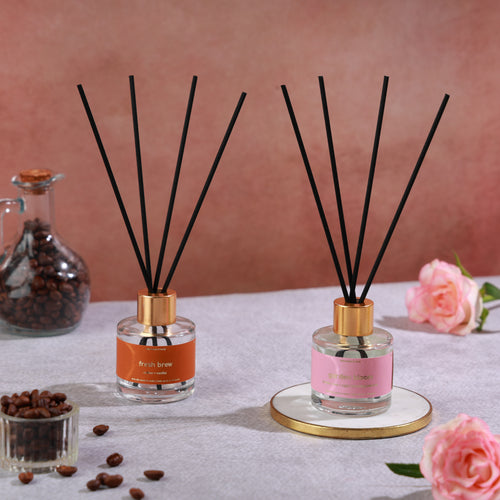 Oil refill · 300ml₹2,399Shop →
Part three — the paid levers, in buying order
Assume the ladder is exhausted: reeds flipped, bottle on a good surface in moving air, room bounded, nine reeds in the neck, and the space still reads quieter than you want. Now the spending starts, and the order matters because the levers are not interchangeable. The first purchase is always a composition, never a size. Strength lives in what the oil is made of: Fresh Brew sits at 9.5 and Mountain Breeze at 9.4 on our internal scale at six reeds, against 8.9 for Garden Bloom and Evening Calm. Those are positions on our own scale rather than an industry standard or a concentration, and they describe projection, not quality — but the gap between 8.9 and 9.5 is real in a room, and running a sleep fragrance in a hosting space is the most common mismatch we see. Moving up the scale costs ₹849 and changes the ceiling itself.
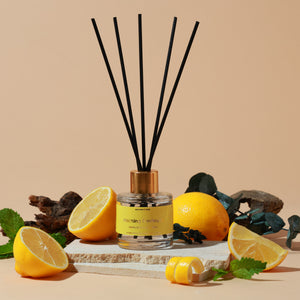
The second purchase is a second source, and it is the one people resist because it feels like defeat. It is not. Output per bottle is fixed at a given reed count, so the only honest way to raise the total fragrance in a home is another bottle. Two 50ml at opposite ends of an open living-dining will beat a single 130ml standing in the middle, every time, because a reed diffuser is a point source with no propulsion. Where two compositions will share a connected space, choose two that meet on a note or you will smell the seam: Mountain Breeze and Morning Freshness meet on green eucalyptus, which is what the Fresh & Grounded duo at ₹1,548 is; Fresh Brew and Garden Bloom meet on warmth and a soft musk, which is Warmth & Bloom at ₹1,598.
The third purchase is not a strength purchase at all; it is a running-cost one, and it matters most to the people who reach the end of this list. If you have concluded that your home wants two bottles at nine reeds, you have roughly doubled your consumption, and the sensible response is the oil-only refill: 300ml at ₹2,399 for about eight to eleven months, or 500ml at ₹3,499 for fourteen to eighteen, which works out at roughly ₹7–8 per millilitre against ₹15–17 for a fresh 50ml bottle — up to about 55 per cent less. You reuse your own glass vessel and your own reeds. Reeds are not sold separately, which is a genuine gap in our range and one I would rather name than paper over; the guidance is to refresh them every few months, and never to pour a new refill through reeds that stopped wicking during the monsoon. To refill: take the reeds out, pour to the neck, put them back, and flip once so both ends are coated. And the purchase that is never a strength lever, however it is marketed anywhere in this category: a bigger bottle. 130ml buys 14–18 weeks against 6–8 and projects the same at six reeds. Size buys duration.
Part four — settings room by room
The same bottle behaves differently in a 90 sq ft bedroom and a 300 sq ft living-dining, and the settings below are where I would start in each. Reed counts are the whole point of this table: they are the only true volume control, they are free, and they are reversible in ten seconds. Week figures are for a 50ml and are working guidance, not a specification — a hot month, a draught or a high reed count all move them.
| Room | Reeds to start at | Composition | Where to stand it | Expected weeks on a 50ml |
|---|---|---|---|---|
| Open living-dining ★ | Six each, in two bottles at opposite ends | Fresh Brew 9.5 and Garden Bloom 8.9 | Sideboards beside the two doorways, not the centre | 6–8 each |
| Living room, single room, up to about 200 sq ft | Six, nine when hosting | Fresh Brew 9.5 | Sideboard by the doorway, waist to chest height | 6–8 at six reeds, nearer 5 at nine |
| Entryway or hall | Six | Garden Bloom 8.9 | Console just inside the door, on a tray | 6–8 |
| Bedroom | Four to six | Evening Calm 8.9 | Dressing table or bedside, back from the pillow | 8 or more at four reeds |
| Home office or study | Six | Mountain Breeze 9.4 | Shelf at chest height behind the desk, clear of a fan | 6–8 |
| Bathroom | Six | Morning Freshness 9.0 | Open shelf away from the shower spray | 6–8, less in a hot dry month |
| Kitchen | Six to eight | Morning Freshness or Fresh Brew | Far end of the counter, never near the hob | 5–7 at eight reeds |
| Nursery or fragrance-sensitive room | Three to four | Evening Calm 8.9 | High shelf, well out of reach of children and pets | Comfortably beyond 8 |
| Anything past 250–300 sq ft of connected volume | Reeds are not the answer here | Sukoon ₹1,899, or two reed bottles | Central, with the machine's own airflow doing the work | 16–18 hrs on low per fill |
| The honest caveat: these are starting points, not prescriptions, and the two variables that will move them most are things I cannot see from here — your ceiling height and your ventilation. Also note the staging trick, which costs almost nothing: run six reeds through an ordinary week and add three on a Friday afternoon before people arrive, then remove them on Sunday. That buys hosting strength for two days at a very small cost in weeks, and it is what I do at home. Keep spare reeds standing in a small glass, never lying on furniture. | ||||
Part five — season, adaptation and the shape of the curve
Two bottles of the same composition can behave quite differently in July and December, and neither is faulty. Heat thins the oil, so it climbs the fibre and evaporates faster; a hot room genuinely receives more fragrance while also being the room in which warm, rounded accords blend into the background and read as less noticeable. That produces one of the most common messages we get — it is emptying faster and I can smell it less — where both halves are true at once and the answer is neither a bigger bottle nor a complaint. Humidity does the same trick from the other direction: in 85 per cent monsoon air, cold sharp compositions such as Morning Freshness at 9.0 cut through and can out-read a 9.5, while in dry winter air the woods and roasted notes hold their architecture and gain. Buy for the air you live in as much as for the number.
The curve matters just as much as the season. Every reed diffuser has three phases: a spike over days one to three, when dry reeds are saturating and the volatile top notes are leaving all at once; a settle across the first fortnight; and then a plateau that holds until the oil is gone. The plateau is the product. The spike is an artefact of the reeds filling, and measuring week six against day two is how a perfectly normal bottle gets described as having faded. If you want a single sentence to hold onto: a reed diffuser is designed to be a constant, deliberately low background, and the thing that feels like decline is usually the arrival of the level it was built to hold.
Behind that flat plateau is a formulation choice worth stating openly, because it is the reason our week one is less dramatic than some. Phthalate solvents push fragrance hard off a reed and win the first week convincingly; they also degrade in heat and can turn acrid by around week six, which is the arc familiar to anyone who has bought a cheap plug-in. SOSA is phthalate-free, alcohol-free, paraben-free and low-VOC on a heat-stable coconut-derived CCT base, and the trade is a smaller opening for a longer, flatter, more reliable plateau that survives 45°C heat and 85% humidity. Six fibre reeds rather than rattan is part of the same reasoning — rattan's natural pores clog readily in Indian humidity, which is why so many imported diffusers stop wicking in week two. None of this makes a bottle louder. It makes the loudness it does have last the whole bottle.
Part six — the ceiling, and the SOSA edit
Everything above has a limit, and I would rather draw it than let you find it by spending. Below is the whole decision as a purchase table: what each thing genuinely buys, what it does not buy however it is described, and what it costs. Read the middle column carefully — it is the one that saves money.
| The purchase | What it genuinely buys | What it does not buy | Price | Lasts |
|---|---|---|---|---|
| Fresh Brew or Mountain Breeze 50ml ★ | A higher ceiling — 9.5 and 9.4 against 8.9 | A change of room size; a point source is still a point source | ₹849 | 6–8 weeks |
| The same composition in 130ml | Duration, and a better price per week | Any additional loudness at all, at six reeds | ₹1,249–₹1,349 | 14–18 weeks |
| A second 50ml bottle for the far end of the room | A genuine rise in the home's total output | Coherence, unless the two share a note | From ₹749 | 6–8 weeks |
| A duo set — two matched compositions | Two sources chosen to meet on a shared note | Coverage of a space beyond the reed ceiling | ₹1,498–₹1,598 / 2 × 50ml | 6–8 weeks each |
| 300ml oil refill | Roughly ₹7–8 per ml against ₹15–17 — up to about 55% less | Reeds. The refill is oil only; reeds are not sold separately | ₹2,399 | 8–11 months |
| 500ml oil refill | The lowest running cost we offer | Anything to do with strength | ₹3,499 | 14–18 months |
| Boond ultrasonic 300ml | On-demand scent in a small room, about 150 sq ft | Compatibility with reed oil — it takes water-based Hotel Collection | ₹899 | ~6 hrs a fill |
| Sukoon ultrasonic 500ml | 270–320 sq ft, remote, steady/2H/4H timers, three 15ml scents in the box | The quiet constancy of a reed bottle — it is a different job | ₹1,899 | 16–18 hrs on low |
| Megh 6L | Runtime — about 100 hours — and humidity | Coverage. At roughly 215 sq ft it is not a coverage upgrade on a Sukoon | ₹3,499 | ~100 hrs |
Versailles
I have written nine guides around this one, and if I could only keep a single paragraph of all of them it would be this. A reed diffuser is a constant, passive, deliberately low background, and almost every complaint about strength is a collision between that design and an expectation borrowed from a spray, a plug-in or a machine. The design is not a compromise I settled for. It is the point: something that holds a room at a considered level for two months without a switch, a plug or a decision.
Which is why the ladder in Part two runs the way it does. Six free rungs before a paid one is not modesty, it is accuracy — the free rungs are where the problem usually is. I am aware that a page telling people to flip their reeds and move a bottle is a strange thing for a business to publish. It has also produced more loyal customers than any campaign we have run, because being told the truth about a ₹849 object is unusual enough to be memorable.
Where the format genuinely runs out, I will say so and point you at a machine, and where we have nothing for you — no oud, no musk-forward composition, nothing aquatic, no reeds sold separately — I will say that too. Everything is composed and handmade in small batches in Pune, tested through 45°C heat and 85% monsoon humidity, and a part of every order funds a girl's classroom through Nanhi Kali.
Frequently asked questions
- How to make a reed diffuser smell stronger and how to increase scent throw — the four currencies, and why throw belongs to the room.
- Does adding more reeds make it stronger? and how many reeds for stronger fragrance? — diminishing returns, and staging.
- Should I flip the reeds to make it stronger? and does moving it improve throw? — restoration, and the traffic map.
- Stronger without wasting fragrance and the best placement for strong throw — the four wastes, and the surface hierarchy.
- Which SOSA fragrances have the most presence, plus why can't I smell my reed diffuser? and the full strength guide.
- Brand: the SOSA founder story.
SOSA reed diffuser range & prices (verified August 2026): alcohol-free, phthalate-free, paraben-free and IFRA-compliant compositions on a heat-stable coconut-derived (CCT) carrier, low-VOC, supplied in a refillable glass bottle with six fibre reeds; 50ml lasts 6–8 weeks and 130ml lasts 14–18 weeks. Morning Freshness (Malabar lemon · peppermint · Nilgiri eucalyptus) 50ml ₹749 · 130ml ₹1,249 · 9.0/10; Garden Bloom (British rose · night-blooming jasmine) 50ml ₹799 · 130ml ₹1,299 · 8.9/10; Evening Calm (Kashmir lavender · chamomile) 50ml ₹799 · 130ml ₹1,299 · 8.9/10; Fresh Brew (Coorg coffee · Kerala vanilla) 50ml ₹849 · 130ml ₹1,349 · 9.5/10; Mountain Breeze (Himalayan pine · sage · Indian cedar) 50ml ₹849 · 130ml ₹1,349 · 9.4/10. Reed diffuser refills are oil only — you reuse your own vessel and reeds: 300ml ₹2,399 (roughly 8–11 months) · 500ml ₹3,499 (roughly 14–18 months), about ₹7–8 per ml against ₹15–17 per ml for a 50ml bottle. Duo sets ₹1,498–₹1,598 for 2 × 50ml and ₹2,498–₹2,598 for 2 × 130ml. Strength figures are positions on SOSA’s own internal strength scale, not an industry standard. Replacement reeds are not sold as a separate SKU; SOSA guidance is to refresh reeds every few months. The reed line is separate from the water-based Hotel Collection for ultrasonic machines (15ml ₹299 · 100ml ₹999 · 300ml ₹1,799) and the two are not interchangeable. Diffusers: Boond 300ml ₹899 · Sukoon 500ml ₹1,899 · Megh 6L ₹3,499 · waterless Vaayu ₹11,999. Composed and handmade in small batches in Pune, India; tested through 45°C summer heat and 85% monsoon humidity. Free shipping above ₹499. A portion of every order supports girl-child education through Nanhi Kali. Prices subject to change — see the live product pages.