




Why the order matters: steps one to five remove; step six adds. Adding to a loaded room gives you two smells rather than one.
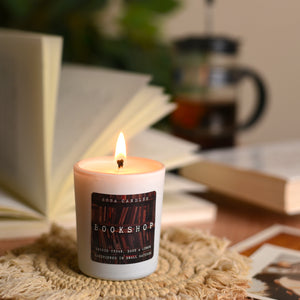
Cost: steps one to five are free. Step six starts at ₹299 for 15ml or ₹379 for a candle.
2. Contain. Bedroom and wardrobe doors shut before you start rather than after. A door is the only total control anybody has over a domestic smell, and a wardrobe is a small unventilated room full of fabric.
3. Ventilate. Two openings on opposite or adjacent walls, twenty minutes, immediately after the hob goes off. One window is ventilation and two is exchange, and the timing matters more than the duration.
4. Deal with the reservoir. Cooking aerosol lands on fabric and re-releases for weeks, which is why the smell survives everything above. Covers and throws monthly, curtains two to four times a year, the clothes you cooked in into the wash.
5. Clean the surfaces nobody cleans. Above eye level, the hood filters, and the wall and tiles beside the hob. Mesh and baffle filters soaked monthly; a carbon cartridge replaced every six to twelve months, because it cannot be washed.
6. Only then fragrance, and only as character on clean air. Three to six drops per tank from ₹299, started once the windows are shut. It will not remove anything, and on a properly cleared flat it does not need to.
A portion of every order supports girl-child education through Nanhi Kali.

Part one — the six steps, and why the order is fixed
Nine articles come before this one and between them they cover the physics, the chemistry, the equipment and the individual disasters. This page is the method they add up to, and the single most important thing about it is the sequence. Steps one to five remove something. Step six adds something. Every failed attempt at this problem that I have ever been asked about consisted of doing step six first and hoping. An addition to a loaded room does not cancel what is already there; it accompanies it. So the order below is not a preference or a piece of editorial tidiness — it is the difference between a flat that smells of your home and a flat that smells of dinner with something else in it.
Part two — one cooking evening, hour by hour
The same evening twice: the way it usually goes, and the way it goes when the six steps are running. Nothing in the corrected column takes extra time, because the flat does most of it while you are at the table. The only paid item appears at 8:20, after everything free has already happened.
| Time | The usual evening | The corrected evening | Cost |
|---|---|---|---|
| 6:45 · before the pan ★ | Nothing. The kitchen is a kitchen and the flat is open | Hood on high; bedroom and wardrobe doors shut; clothes airer moved out; one window a hand's width open on the far side for make-up air | ₹0 |
| 7:00–7:35 · cooking | Hood switched on when the smell becomes noticeable, usually on medium | Hood already running on high; lids on anything simmering; the tadka pan on a back burner | ₹0 |
| 7:35 · hob off | Hood switched off with the burner. Windows still shut | Hood left running for ten minutes while the pan, the oil film and the canopy finish releasing | ₹0 |
| 7:45–8:05 · eating | Doors opened, dinner carried through the flat, everything shut | Two openings on opposite or adjacent walls, twenty minutes of genuine cross-draught, while you eat | ₹0 |
| 8:05 · after | The flat smells of dinner, so something fragranced goes on at full output against it | Windows shut. Hob surround and hood underside wiped while still warm, which takes ninety seconds | ₹0 |
| 8:20 · the room | Two strong smells, and a growing suspicion that the fragrance was a waste of money | Diffuser on, three to six drops per tank, low setting, 2H timer — a steady level in about twenty minutes | ₹299 + machine |
| 10:30 · bedtime | Cooking still perceptible in the sitting room, and on the bedlinen through an open door | The flat smells of what you chose it to smell of, and the bedroom smells of nothing at all | ₹0 |
| Weekly and monthly | Filters untouched; curtains unwashed since they went up; the wall above the hob never wiped | Covers and throws monthly; filters soaked monthly; wall and canopy degreased monthly; curtains two to four times a year; carbon cartridge every 6–12 months | ₹0 plus a cartridge |

Part three — the maintenance schedule, and where fragrance sits
Put the whole thing on a calendar, because this is a problem that returns quietly rather than suddenly. Every cooking session: hood on high before the pan is hot and for ten minutes after; a window open somewhere distant for make-up air; bedroom and wardrobe doors shut; lids where a lid will do; two openings for twenty minutes immediately afterwards. Weekly: bedlinen, kitchen cloths and the clothes you cooked in; the bin liner changed and the bin itself wiped, because a bin is usually dirtier than what is in it, and the fridge's vegetable drawer and door seal checked. Monthly: cushion covers and throws through the machine; the hood's mesh, cassette or baffle filter soaked in near-boiling water with three or four spoons of washing soda for twenty to thirty minutes, brushed, rinsed and refitted completely dry; and a warm degreaser run top-down over the wall and tiles beside the hob, the underside of the canopy, the cupboard doors at head height and the top of the fridge. Fortnightly: the sofa vacuumed with an upholstery head, seams and under the back cushions included. Twice a year, or quarterly near an open kitchen: the curtains. Every six to twelve months: the activated carbon cartridge, if you own a recirculating hood — it is a specific part for your model rather than a generic pad, and it cannot be washed, sunned or baked back into service. Nothing on that list is difficult and none of it costs anything except the cartridge, and together they are worth more than every product on this website.
Then the machine and the dose, which is the shortest section on the page because by now the work is done. The Sukoon at ₹1,899 is the sensible default: a 500ml BPA-free tank rated for 270–320 sq ft, 16–18 hours per fill on low at 30–50 ml/h against 9–12 on high, a 2.4MHz cool-mist plate, a remote, auto shut-off and steady, 2H and 4H timers, with three 15ml Hotel Collection scents of your choice included. Buy it for the timers, because the timer is what keeps the sequence intact on the evenings you have stopped thinking about any of this. A Boond at ₹899 covers a bedroom or a study and takes exactly the same three to six drops per tank, since the dose is per tank rather than per litre — you are scenting the mist and not the water — and a Megh at ₹3,499 with six litres is the honest machine for a genuinely open volume. Three drops in a normal room and four in a large or open one; more drops do not make a scent better, they simply raise the floor of the room. On placement: waist height or above, at the edge of the room rather than in a doorway, out of the path of a fan or an air-conditioning vent, and as far from the hob as a plug allows — cool mist falls rather than rises, so a machine on the floor is scenting a rug. If it has to be tonight and you own nothing, the Bookshop candle at ₹379 puts scent into a room in fifteen to twenty minutes and must be attended and put out; a reed diffuser from ₹749 needs twenty-four to seventy-two hours to establish, which makes it the wrong purchase for a deadline and the right one for a hall you want holding one level for months.
Then the choice of scent, the adaptation and the constraints, and then this guide is finished. In a home where cooking happens most days, choose a dry composition over a warm one. Residual food odour occupies a warm, fatty, roasted part of the perceptual space, so a warm fragrance lands in the same neighbourhood and the two thicken each other, while cedar, vetiver and green leaf sit somewhere food does not and stay legible beside it — which is the argument in the open-kitchen page and applies in any flat with a hob in daily use. It helps that nothing in the Hotel Collection is sweet and that black pepper is the only spice material in the seven: there is no cinnamon, clove, cardamom or saffron in the collection or in the alcohol-free reed line, which in a country where those are food before they are fragrance is a decision rather than an oversight. Expect to stop smelling your own home within about a fortnight — receptors adapt, the constant disappears, and the instinct that produces is to add drops while every visitor still receives the level you set; one honest guest, asked to be truthful rather than polite, is the correct instrument. On the constraints: the Hotel Collection is water-based and runs in the Sukoon, the Boond and the Megh only. It will not climb the sticks of a reed diffuser, which is a separate alcohol-free line with its own scents, and it does not go into the waterless Vaayu at ₹11,999. Never substitute raw essential or carrier oils, which clog the 2.4MHz plate; rinse the tank when you change scent; a cool-mist machine adds 30–50 ml of water an hour, which is worth knowing in a kitchen already humid from cooking; and SOSA does not make a room or linen spray for the home. The principle the whole cluster runs on: fragrance is a finishing layer on air that is already clean and moving. It is step six, it is worth having at step six, and it is worth nothing at all at step one.
Part four — the complete edit
The whole method in buying order, which for most readers means doing five things that cost nothing and then spending ₹299. The last row states what the range does not contain, because a guide that lists only what is in stock is an advertisement rather than a method.
| Step | What it is | What it does | Cost |
|---|---|---|---|
| 1. Capture at source ★ | Hood on high before the pan is hot and for ten minutes after; a window open somewhere distant for make-up air; ducted rather than recirculating | The only step that acts before the smell reaches the rest of the flat, and the only device in the home that removes air | ₹0 to run |
| 2. Contain | Bedroom and wardrobe doors shut before you start; the clothes airer moved out of the cooking room | A shut door is the only total control anybody has over a domestic smell, and it has to be shut in advance | ₹0 |
| 3. Ventilate | Two openings on opposite or adjacent walls, twenty minutes, immediately after the hob goes off | Exchanges the flat's air before the load has had time to deposit. One window is ventilation; two is exchange | ₹0 |
| 4. Deal with the reservoir | Covers and throws monthly, curtains two to four times a year, cooking clothes into the wash, upholstery vacuumed fortnightly, sun where possible | Removes the deposit that re-releases for weeks and keeps re-loading the air you have just cleared | ₹0 |
| 5. Clean above eye level and the filters | Wall and tiles beside the hob, hood underside, cupboard doors at head height; filters soaked monthly; carbon cartridge every 6–12 months | Removes the invisible film that turns rancid with age, and keeps step one working rather than quietly declining | ₹0 plus a cartridge |
| 6. Hotel Collection 15ml on a Sukoon | Three to six drops per tank, dry rather than warm, started once the windows are shut; 500ml machine with steady/2H/4H timers and three scents included | Gives clean, moving air a consistent character. It removes nothing, and after steps one to five it does not need to | ₹299 / ₹1,899 |
| Not in the range: a room or linen spray | The sprays SOSA makes are car perfumes, formulated and sized for a car | Printed rather than implied. A spray is a thirty-minute cover, which is shorter than any timescale on this page | — |
Versailles
I have written nine pages on this subject and they all end in the same place, so it seemed worth putting the whole thing on one page in the order it actually happens. The reason cooking smell defeats people is not that Indian food is difficult. It is that the six things that fix it are usually attempted in reverse, starting with the only one that costs money. Somebody buys a diffuser, runs it during dinner, gets a room that smells of two things, and decides the category is nonsense. I would have decided the same in their position.
So here is the version I would give a friend. Switch the extraction on before the pan and leave it on ten minutes after. Shut the bedroom door before you start. Open two windows for twenty minutes while you eat. Wash the curtains, the covers and the kurta you cooked in. Wipe the wall above the hob and soak the filter once a month. Then, on genuinely clean air, put something dry and quiet into the room and let it run for two hours on a timer. Five of those six are free and the sixth costs ₹299, and in that order it works in every flat I have ever tried it in — including small ones, including open-plan ones, and including mine, where a tadka happens most evenings and always will.
Everything is made and supported from Pune, and a part of every order funds girl-child education through Nanhi Kali. You get a home that smells like somewhere you chose; a girl gets a classroom. That equation has always felt right to me.
Frequently asked questions
- Why a 1BHK smells of food despite a chimney, whether a chimney removes cooking smells at all and why an open kitchen fills the whole flat — the three pages on capture and layout.
- Why the cooking smell reaches the bedroom and why the kitchen still smells of oil after cleaning — the air paths, and the invisible film above eye level.
- Why the house smells of fish for two days and how long Indian cooking smells actually stay — the chemistry of the worst case, and real durations for every other one.
- Why the house smells of tadka hours later and whether a diffuser will cover a cooking smell — the thirty-second release, and the honest answer about masking.
- Brand: the SOSA founder story.
Facts verified August 2026: Diagnostic facts used in this guide: a closed room accumulates what it cannot exchange, so cross-ventilation needs two openings rather than one; a drain's U-bend water seal evaporates in roughly two to four weeks of disuse and then admits sewer gas, which is corrected by pouring water down the drain; microbial growth in fabric and on surfaces accelerates above about 60% relative humidity, and Indian monsoon indoor humidity commonly runs 80–95%, which is the one situation where ventilating on a wet day can import moisture rather than remove it; an air-conditioner's cold, wet evaporator coil and filter grow biofilm that is blown into the room on start-up; textiles adsorb cooking aerosol and body oils and re-release them for weeks; and olfactory adaptation makes a constant household smell undetectable to its residents within about a fortnight while visitors still perceive it. Timings: a scented candle scents a normal room in roughly 15–20 minutes, a Sukoon ultrasonic diffuser reaches a steady level in about 20 minutes from cold, and a reed diffuser needs roughly 24–72 hours. SOSA products and prices: Sukoon 500ml ₹1,899 (270–320 sq ft, 16–18h on low, 9–12h high, 30–50 ml/h, 2.4MHz cool mist, remote, steady/2H/4H timers, BPA-free, auto shut-off, includes three 15ml Hotel Collection scents of your choice); Boond 300ml ₹899; Megh 6-litre ₹3,499; waterless Vaayu ₹11,999 (up to 1000m³); Aangan ₹25,999. Hotel Collection water-based fragrance 15ml ₹299, 100ml ₹999, 300ml ₹1,799, Pack of 7 at 15ml ₹1,799; dose 3–6 drops per tank. Reed diffusers (separate alcohol-free line): Morning Freshness from ₹749, Garden Bloom and Evening Calm from ₹799, Fresh Brew and Mountain Breeze from ₹849; 130ml from ₹1,249; duos from ₹1,498; 300ml refills ₹2,399. Scented candles: Bookshop 80g ₹379, Amber Rose 130g ₹599 and 220g ₹799, Smoked Oudh 130g ₹449, ceramic jar candles ₹949, Pure Calm wax melt set ₹854. Free shipping above ₹499. SOSA does not make a room or linen spray for the home. The Hotel Collection scents are SOSA's own interpretations; SOSA is not affiliated with or endorsed by any hotel brand. Prices subject to change — see the live product pages.