




2. A retail store has almost no live product aroma competing with fragrance; a café has one constantly. Clothing, homeware, electronics and most retail stock produce no meaningful volatile aroma of their own, which is exactly why entrance and floor scenting is standard retail practice — there's nothing there for it to compete with.
3. Hotel-style whole-volume distribution assumes there's nothing in that air worth protecting; a café's dining air is the opposite case. Piping a fragrance evenly across a hotel's public floor works precisely because no part of that air is being actively smelled and judged as a product someone paid for.
4. Retail's 'scent the entrance to draw people in' habit doesn't survive contact with a café's layout. An entrance that opens straight onto the dining room is the dining room by another name, whatever a retail consultant would recommend for a shopfront selling shoes or stationery.
5. The parts of a café that genuinely resemble a hotel corridor or a retail floor are narrow: washrooms, a separated entrance, and merchandise. Those are the only zones where hospitality- or retail-style continuous, scheduled fragrance transfers cleanly, and together they're a smaller share of most café floor plates than either vertical assumes.
Vaayu's zoned scheduling is genuinely hotel-grade equipment, but only the washroom, a separated entrance and any retail counter in a café are the rooms where that grade of hospitality logic actually applies.
Why the same equipment behaves so differently across three businesses
Hotels sell an experience across a large, mostly food-neutral public volume — lobby, corridor, lift lobby, the walk to a room. Ambient fragrance there is pure atmosphere layered onto air that has nothing else in it to evaluate. A guest isn't smelling anything else they specifically paid for in that air, so a signature scent can be freely and continuously dosed across a large footprint through the building's own HVAC without competing with anything. Even where a hotel's restaurant sits off the same lobby, the fragrance schedule is usually zoned away from it for exactly the reason this cluster keeps returning to — a kitchen, once it's cooking, becomes its own evaluation zone even inside a hospitality building.
Retail stores sit in a similar position, for a different reason. Garments, electronics, homeware and books produce close to no volatile aroma of their own, so scenting the entrance and the floor adds a signal rather than competing with one already there. This is exactly why the standard retail playbook is scent-forward at the door and moderate across the shop floor — there is nothing being sold that the fragrance could clash with.
A café is a different category entirely. Coffee's aroma is live, complex and volatile, produced continuously at the counter, and it is the thing the customer is actively evaluating with their nose in real time — while ordering, while waiting, while drinking. Transplant hotel or retail placement logic wholesale into that room and the result isn't added ambience; it's a second, uninvited aroma sharing the same air as the one the customer already paid to experience. That's the whole difference in one sentence: a hotel or a retail floor scents air that has nothing else in it, and a café's dining room never has that luxury.
The three decisions that follow once you stop treating a café like either
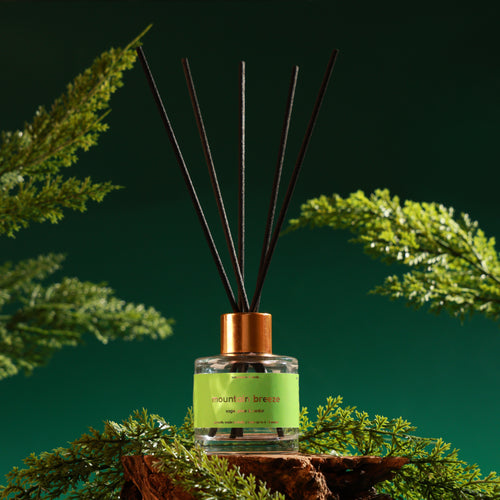
 Mountain Breeze₹849Walk your own floor plan and mark, honestly, which rooms have a live product aroma to protect — dining, counter, bar — and which don't — washroom, a genuinely separated entrance, retail. Hospitality and retail logic only applies to the second group.
Café, hotel and retail, placed side by side
The comparison makes the difference concrete: two of these rows have no product aroma to protect, and one of them very much does.
| Vertical or zone | Live product aroma present? | Typical ambient-fragrance approach | Why that approach works there |
| Hotel lobby and corridors | No — nothing served or evaluated in that specific air | Continuous, scheduled, often whole-volume via HVAC | Nothing in the air competes with the fragrance, so it reads purely as a signature |
| Retail sales floor | No — most stock has no meaningful volatile aroma of its own | Scent-forward entrance, moderate level across the floor | Nothing being sold has a smell worth protecting |
| Café dining room, counter, bar, seating | Yes — coffee's aroma is the product, made live | None — this is the one placement hospitality and retail logic should never reach | Any added fragrance would share the same air the product is being evaluated in |
| Café washroom, separated entrance, retail counter | No — no coffee aroma present in these specific rooms | Continuous, low, scheduled — genuinely hotel- or retail-style | These are the only café zones that actually resemble a hotel corridor or a retail floor |
| Two of these four rows have nothing in the air to protect from fragrance; the other two depend entirely on whether that's true where you're standing — get that distinction right before buying anything. | |||
Mountain Breeze · washroom register₹849Shop →  Sukoon · a separated entrance, self-contained₹1,899Shop →
  Vaayu · zoned across several qualifying rooms₹11,999Shop →
What actually transfers from hospitality and retail, and what doesn't
Never let a café's dining room, counter, bar or seating inherit hospitality's whole-volume approach or retail's floor-level dosing. This is the one placement decision where borrowing either industry's playbook does real damage, because both assume an absence of product aroma that a café's dining room simply does not have, and never will while coffee is being made in it.
Sometimes a genuinely separated entrance can run on something close to retail's own logic — continuous, moderate, welcoming — but only where a real air boundary exists, such as a second door or a distinct arrival volume. An entrance that is simply the front of the dining room inherits the dining room's rule, not the shopfront's, whatever it's called on the floor plan. A quick test that works on most site visits: stand in the proposed entrance zone, close whatever door exists, and check whether the coffee smell is still detectable a minute later — if it is, the boundary isn't real yet.
Usually the washroom and any retail or merchandise section can run close to true hotel-corridor logic — continuous, scheduled, unbothered by rush or quiet hours — because neither room has a coffee aroma of its own to protect. That is exactly the condition hospitality and retail scenting was designed around in the first place, and it's why those two rooms are the genuine opportunity in a café rather than an afterthought.
What to buy, in the zones where the comparison actually holds
Every recommendation below sits only in the rows of the table above that have nothing to protect.
| Route | Premises | Why | What it costs |
| Reed diffuser, Mountain Breeze, washroom | Under 300 sq ft, one washroom | A steady register with no product aroma nearby to interfere with, much like a hotel corridor | ₹749–₹849 |
| Sukoon ultrasonic, separated entrance | 300–750 sq ft, a genuinely separated arrival zone | Continuous, timed output close to a boutique retail entrance's own logic | ₹1,899 |
| Vaayu, wall or HVAC-mounted, per zone | 750 sq ft and above, several qualifying zones | Zoned scheduling genuinely comparable to hotel-corridor distribution, confined to the right rooms | ₹11,999 |
| Vaayu, freestanding, retail or merchandise counter | Any café with packaged goods sold apart from service | Runs on retail-floor logic because nothing volatile is being sold in that air | ₹11,999 |
| Aangan, HVAC-integrated, non-dining zones | Above roughly 3,000 sq ft, multiple qualifying zones | Distributes through ducting the way a hotel's own fragrance system would, kept to the right rooms | ₹25,999 |
Clients who've come from a hospitality background arrive with a specific instinct: they want the 'hotel treatment' — one signature scent, dosed generously, running through the whole space. I understand exactly where it comes from, and I still have to slow the conversation down and ask which rooms in their café actually have nothing else to compete with.
Clients arriving from a retail background ask for the opposite instinct just as reflexively: scent the entrance, draw people in, the way a boutique does. I ask a single question back — is that entrance actually separated air, with a door that closes, or is it simply the front of the dining room wearing a different name on the floor plan.
Whichever industry a client's instincts come from, I end up asking the same question either way: what does this specific room already smell of, on its own, before we add anything to it. The answer, not the industry the idea arrived from, is what decides whether fragrance belongs there. It's a slower way to start a conversation than most equipment brochures allow for, but it's the only version of the conversation that ends with the right room getting the right equipment.
Questions about borrowing hospitality and retail scenting logic
- Which areas of a café should be fragranced — and which shouldn't? — the room-by-room map this comparison sets up.
- Should a coffee shop use ambient fragrance at all? — the foundational question this post assumes an answer to.
- Should a specialty coffee shop have a signature fragrance? — the sharpest version of the product-aroma argument.
- What should a premium café smell like? — where this cluster starts.
- Brand: the SOSA founder story.
SOSA products & prices (verified September 2026): Reed diffusers 50ml ₹749–₹849 (to 150 sq ft, 6–8 weeks at six reeds) · 130ml ₹1,249–₹1,349 (above 150 sq ft, 14–18 weeks) · reed refill 300ml ₹2,399. Ultrasonic: Boond ₹899 (~150 sq ft) · Sukoon ₹1,899 (270–320 sq ft, ships with three 15ml Hotel Collection fragrances) · Megh ₹3,499 (6L tank, ~100 hrs runtime, ~215 sq ft — a runtime machine, not a coverage upgrade). Waterless cold-air: Safar ₹3,999 (no published coverage figure) · Vaayu ₹11,999 (up to 1000 m³, roughly 2,000–3,000 sq ft; 400ml tank lasting about 90+ days; app and onboard control, 1h/4h/8h/24h run windows, adjustable intensity, key-lock, under 38 dB, freestanding or wall/HVAC mount, 5W, CE/RoHS/SGS) · Aangan ₹25,999 (8,000–10,000 sq ft). Hotel Collection water-based fragrance 15ml ₹299 · 100ml ₹999 · 300ml ₹1,799 is for ultrasonic machines; reed oil and Hotel Collection are not interchangeable. Reed diffusers are alcohol-free, phthalate-free, paraben-free, IFRA-compliant and low VOC, handmade in small batches in Pune. Every purchase funds a girl's education through Nanhi Kali. Prices and availability subject to change — see the live product pages.