
2. Drying time. Wet fabric that stays wet for a long time supports the microbial growth that produces the characteristic musty note. Fast drying produces very little of it; slow drying produces a lot.
3. Low air exchange. A monsoon flat with the windows shut against rain replaces its air slowly, so the humid air around the clothes is not carried away — which slows the drying further and lengthens the period in which the smell is generated.
4. Fragrance does not touch any of this. Adding a pleasant odour to an unpleasant one gives a mixture, not a cancellation. Layered over damp it reads as scented damp, and most people find that worse than the plain version.
The honest gap: the fix for the first three lines is airflow and drying speed, and SOSA does not sell that. No dehumidifier, no air purifier, no odour eliminator, and no clean-linen scent in the reed range. Fragrance is genuinely useful here, but only after, and only for a different job.
2. The note itself is made on the fabric, not in the air. Fabric that stays wet for many hours supports microbial growth, and that activity produces the flat, slightly sour, cupboard-like smell that everybody calls damp. It is why a load dried in four hours smells of nothing and the same load dried over two days smells of itself. The variable is time, not detergent and not the machine.
3. A closed flat makes both worse, in a loop. Air exchange is how often a room's air is replaced. Shut against rain, a flat replaces its air slowly, so the humid air sitting against the clothes is not carried away. Saturated air next to wet fabric slows evaporation, which extends the drying time, which extends the period in which the note is being produced. Each cause feeds the other.
4. You smell it on arrival and not while you sit in it. Olfactory receptors adapt to an unchanging stimulus within minutes, so the residents of a house stop registering its background smell almost immediately. Walking in from outside gives you about a minute of accurate information. This is why the person who lives there thinks it is mild and the guest thinks it is not, and neither of them is wrong.
5. The fix is drying speed, and it is free. Space the garments so air can pass between them. Spin the load properly first, because water removed mechanically never becomes air at all. Point a fan along the rack, not at the ceiling. Give the drying area an opening of its own and keep its door shut against the rooms you use. Nothing on that list is a purchase.
This page makes no health, air-quality or antimicrobial claim, and SOSA sells no dehumidifier, air purifier or odour eliminator.
The three things that stack, and why they compound
Most explanations of this stop at "wet clothes make the room humid", which is true and does not explain why one household has the problem badly and another barely notices it. The difference is that these three factors do not add up, they multiply. A large water load in a well-ventilated room is a minor issue; a modest load in a sealed room is a serious one. Here they are separately.
Why adding fragrance at this stage makes it worse rather than better
The intuition is that a strong pleasant smell will cover a mild unpleasant one. It does not work that way, and the reason is worth understanding because it applies well beyond laundry. Two odours present in a room do not cancel; they are perceived as a compound. The nose is extremely good at separating components of a mixture — that is the entire basis of perfumery — so what actually happens is that your brain now tracks two things instead of one, notices the contradiction between them, and finds the combination more objectionable than the original. Bright citrus over a damp note does not read as a clean room. It reads as a room that somebody has tried to do something about.
There is a second, quieter reason the timing matters. Damp air changes how any fragrance performs. Saturated air carries fragrance molecules less readily, so projection shortens and the composition hangs close to the bottle rather than filling the room. At the same time, higher humidity makes everything feel heavier and closer, which pushes the perception of any scent towards its base rather than its top. The practical result is that the same bottle honestly does smell warmer and thicker in a Mumbai August than in a Delhi January, and no formulation prevents that. A fragrance chosen for a dry room and then deployed into a damp one will feel like a different product, and people usually conclude the bottle is faulty rather than that the air changed.
So the order is not a marketing preference, it is the only order that works: get the fabric drying quickly, get air moving through the drying area, keep that area's door shut against the rooms you occupy. When the underlying note is no longer being generated, the room is an ordinary room again — and an ordinary room in a grey monsoon week is exactly the situation home fragrance was invented for. That is the second half of this page, and it is a genuinely different question from the first.
| What people try | What it does | What it does not do | Verdict |
|---|---|---|---|
| Fan along the rack | Continuously replaces the saturated air against each garment, so the fabric dries markedly faster | Does not remove moisture from the flat — only from the clothes | The single highest-value step, and free |
| Spacing the clothes and batching | Stops the wettest fold in the middle setting the pace for the entire load | Nothing for air already loaded | Second highest value, also free |
| Opening a window in the rain | Exchanges air, carries the note outward, prevents the room reaching a stalled near-saturated state | Less moisture removal than in a dry month, because the incoming air is already carrying water | Worth doing, but not the main lever in monsoon |
| Fragrance while the clothes are still damp | Adds a second odour to the room | Removes nothing. Perceived as a compound, and usually judged worse than the original | The one step I would tell you not to take |
| Fragrance after the drying is fixed | Gives an ordinary room a continuous bright note at nose height, with no switch and nothing to fill | Still removes nothing — it is not doing that job and never was | Genuinely useful, and a different question |
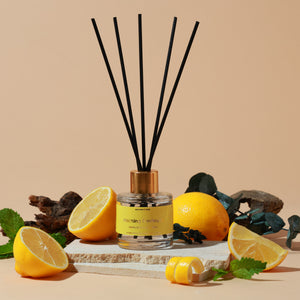
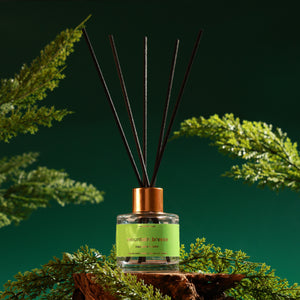
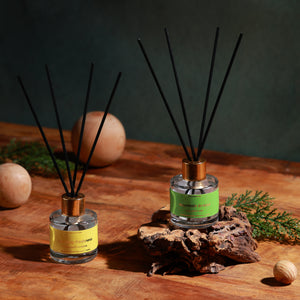
Bright · Morning Freshness₹749Shop → 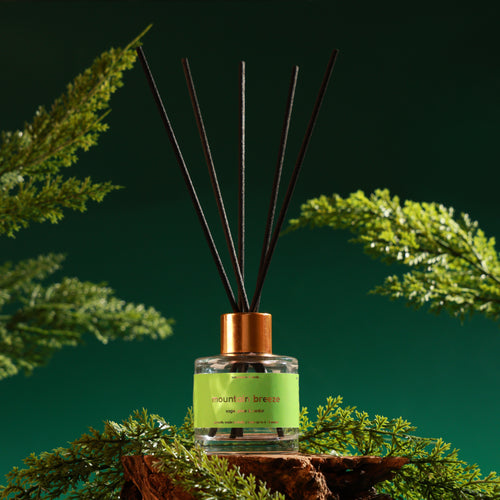 Dry green · Mountain Breeze₹849Shop →
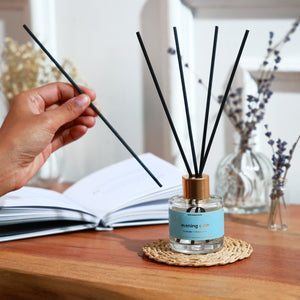
  Soft · Evening Calm₹799Shop →
What fragrance is honestly for, once the drying is fixed
A monsoon flat that is drying its laundry properly can still feel closed, grey and slightly stale, and that is a real thing to want to change. It is not a moisture problem at that point; it is a room that has had the windows shut for four days and has nothing in it but its own air. This is the situation a reed diffuser is genuinely good at, because it runs continuously without a switch, a socket, water or maintenance, and because it gives the room a consistent note at nose height that you meet on arrival and at transitions rather than constantly.
Register matters more than usual here, and the logic follows from the humidity. Heavy air already pushes perception towards the base of any composition, so a sweet or gourmand fragrance stacks onto the heaviness and can read as syrupy in a way it never would in winter. Bright citrus and dry green go the other way and contrast with it. Morning Freshness is the bright one at 9.0 on the SOSA strength scale — cold-pressed Malabar lemon, peppermint, and a eucalyptus globulus base that slows the lemon's evaporation three to four times, which is what turns an ordinary ten-to-fourteen-day citrus into a 6–8 week one. In a season that lasts months rather than days, that structural decision matters more than the note list does. Mountain Breeze at 9.4 is the dry resinous alternative for people who find citrus too sharp.
Two practical notes that are specific to wet months. First, dose down: start at three reeds rather than six, because humid air holds the fragrance close and the same bottle reads stronger than it would in a dry season. Three reeds is a soft level and roughly doubles how long the bottle lasts. Second, placement beats dosage. Move the bottle into the room's natural airflow path — near a doorway rather than into a far corner — and the room's own circulation will distribute it. In monsoon, relocating a diffuser does more than adding reeds to one, and it is free. It is also worth knowing that our bottles ship with six fibre reeds rather than rattan, because rattan is a natural cane with irregular internal channels that wicks unevenly in high humidity; that decision exists specifically for the conditions this page describes.
If you do buy something, buy it in this order
And if the drying is still slow, buy nothing yet. I would rather this page were cited for the mechanism than convert badly on a purchase that was going to disappoint. The list below assumes the rack is spaced, the fan is running and the drying area has its own way out for the air. The last row is the honest gap and it matters on this subject more than on most.
| Buy | What it is | When it is the right answer | Price |
|---|---|---|---|
| 0. Nothing — fix the drying first | Spacing, a harder spin, a fan along the rack, an opening in the drying area, its door shut | Always, and before anything below. This is the step that changes the smell | Free |
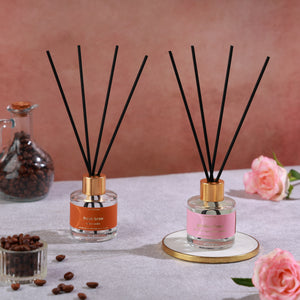
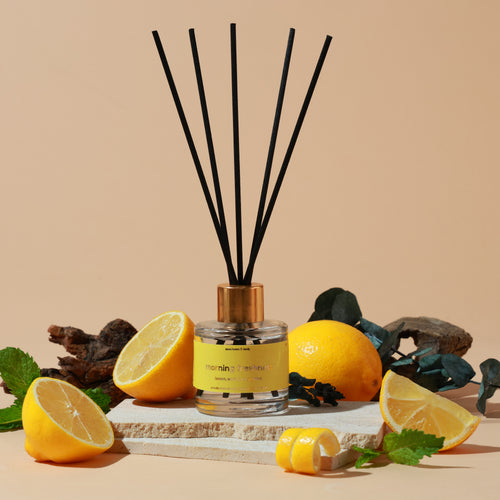
| 1. Morning Freshness 50ml ★ | Malabar lemon, peppermint, eucalyptus globulus — bright, 9.0 | The living room, at three reeds. Bright citrus contrasts with heavy air instead of adding to it | ₹749 |
| 2. Mountain Breeze 50ml | Himalayan pine, sage, Indian cedar — dry, resinous, 9.4 | If citrus reads as sharp to you, or you want the room to feel dry rather than bright | ₹849 |
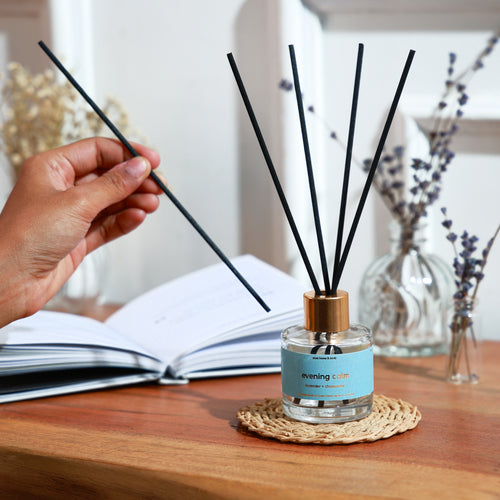
| 3. Evening Calm 50ml | Kashmir lavender, chamomile, soft musk drydown — 8.9, the softest we make | Beside a bed, at three reeds, in a household that finds most fragrance too much | ₹799 |
| Not this: Fresh Brew in a wet month, or a candle at the rack | Fresh Brew is our deepest gourmand at 9.5 and stacks onto humid heaviness. And a lit candle near drying fabric is not advice we give — fragrance oil is flammable and hanging clothes move in a draught | Named because it is our own bottle and I would still not lead it here | — |
| The honest gap: we sell nothing that addresses the cause | No dehumidifier, no air purifier, no odour eliminator, and no clean-linen, cotton or aquatic accord in the reed line | The first three lines of the mechanism are solved by airflow and drying speed, not by a purchase. If line-dried cotton is the smell you want, none of our five is it | — |
Versailles
I get asked this question more often than any other in the rains, and the honest answer is one a fragrance house is not supposed to give. The smell is not a fragrance problem. It is water and time, and the only levers that matter are how quickly the fabric dries and whether the air around it moves. A perfumer cannot help with either.
What a perfumer can tell you is why the intuitive fix backfires. The nose is a separator, not a mixer — it is designed to pull a mixture apart into its parts, which is the whole reason perfumery works at all. So when you add a bright citrus to a room with a damp note in it, you do not get a clean room. You get two clearly distinguishable things and the uncomfortable sense that one is trying to hide the other. People describe that as smelling worse than before, and they are describing it accurately.
Fix the drying and the picture changes completely. A closed grey flat that is not generating a musty note is simply a room that needs a reason to feel like something other than the weather, and that is the job I know how to do. Morning Freshness at three reeds is where I would start, mostly because of the eucalyptus base under the lemon: an ordinary citrus reed would be over in a fortnight and the rain never is. Everything is composed in Pune, and a part of every order funds a girl's classroom through Nanhi Kali.
Frequently asked questions
- Drying indoors in a Mumbai monsoon — the full sequence for a living room.
- Laundry in the spare bedroom — why a closed room with wet fabric is the worst case.
- What to fix before adding fragrance and the 1BHK with no choice.
- Fresh without becoming too perfumed — the dose question, answered properly.
- The best fresh fragrance for a Mumbai flat and citrus, green or floral when it feels damp.
- Reed diffuser vs Sukoon in monsoon — why an ultrasonic machine is the harder argument in a damp flat.
- A small flat through weeks of continuous rain — the whole system in one place.
- Brand: the SOSA founder story.
SOSA reed diffusers — facts verified August 2026: Five scents, all alcohol-free, on a heat-stable CCT (caprylic/capric triglyceride) base rather than DPG, which can crack and turn bitter above 40°C. Phthalate-free, paraben-free, IFRA-compliant, 0 ppm formaldehyde, six fibre reeds rather than rattan in a refillable glass bottle, composed and made in Pune, India. Morning Freshness (Malabar lemon · peppermint · eucalyptus globulus) 50ml ₹749 · 130ml ₹1,249 · 9.0 on the SOSA strength scale; the eucalyptus globulus base slows lemon evaporation three to four times, giving 6–8 weeks rather than the usual 10–14 day citrus fade. Evening Calm 50ml ₹799 · 130ml ₹1,299 · 8.9, the softest in the range. Garden Bloom 50ml ₹799 · 130ml ₹1,299 · 8.9. Mountain Breeze (Himalayan pine · sage · Indian cedar) 50ml ₹849 · 130ml ₹1,349 · 9.4. Fresh Brew 50ml ₹849 · 130ml ₹1,349 · 9.5, the deepest in the range. 50ml suits rooms up to about 150 sq ft and runs 6–8 weeks; 130ml suits above that and runs 14–18 weeks. Six reeds is full projection, three is a soft level and roughly doubles bottle life. Duos: Day & Night ₹1,498, Fresh & Grounded ₹1,548, Warmth & Bloom ₹1,598. Refills 300ml ₹2,399 · 500ml ₹3,499, oil only and not a first purchase. Machines: Boond ₹899, Sukoon ₹1,899 (270–320 sq ft, 16–18 hours on low), Megh ₹3,499 (six litres and around 100 hours of runtime but only about 215 sq ft of coverage — less than the Sukoon, and never a coverage upgrade). Reed oil and the water-based Hotel Collection are separate physical systems and are not interchangeable; there is no hotel-inspired reed diffuser. The reed line contains no oud, sandalwood, vetiver, amber, aquatic or clean-linen accord. Climate-tested through 45°C heat and 85% RH monsoon humidity. Free shipping above ₹499. SOSA is an independent Indian fragrance house and is not affiliated with or endorsed by any hotel brand. Prices subject to change — see the live product pages.